



Cape Town is the only metro in SA considered highly financially sustainable, with Nelson Mandela Bay in a “fair” but deteriorating condition, according to the latest Ratings Afrika Municipal Financial Sustainability Index (MFSI).
Other than Western Cape municipalities and Midvaal in Gauteng, most municipalities in the country are in severe financial distress.
Read/listen:
Treasury tightens public purse on red-flagged municipalities
Joburg to pay R2.4bn in debt to get R3.6bn funding reinstated
It’s a familiar cry, but the latest Ratings Afrika report goes a step further, warning that this cannot go on. It’s time for national government to step up.
“Residents and businesses are experiencing poor, and in some cases near-total, service delivery failure,” says the report.
“Municipalities are struggling to maintain existing infrastructure, let alone invest in future development, placing economic growth and investment at risk.”
The dire state of local government in SA has placed huge financial pressure on Eskom and the water utilities, given their dependence on municipal payments.
“Ultimately, well managed municipalities that deliver reliable services and support local economic activity are fundamental to South Africa’s growth and prosperity.
ADVERTISEMENT
CONTINUE READING BELOW
“This reality requires far greater attention from national government,” it says.
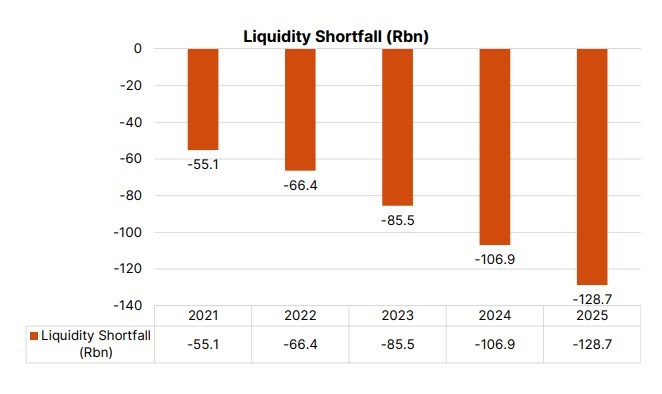
The chart below shows the liquidity shortfall for municipalities as a whole. That shortfall has more than doubled to R128.7 billion since 2021. This is nothing new. Ratings Afrika has consistently warned of the dire state of municipal governance since 2011.
Source: Ratings Afrika
The average score for local municipalities declined from 36 out of 100 in 2021 to just 33 in 2025, highlighting the continued deterioration in financial sustainability across the country. The average scores would be worse without being propped up by strong performances in the Western Cape.
With an average score of 57, Western Cape remains the highest-performing province by a considerable margin.
Read: Western Cape tops provincial growth, Free State at the bottom
If left unchecked, South Africa faces a growing risk of systemic municipal failure with profound social and economic consequences, according to the Ratings Afrika report.
“The practical implications are stark.”
Many municipalities no longer have sufficient cash to pay creditors such as Eskom, water utilities and other service providers within the 30-day period prescribed by the Municipal Finance Management Act (MFMA).
Without adequate working capital, municipalities cannot sustain acceptable service levels, increasing the likelihood of service disruptions, infrastructure failures and heightened social instability.”
Assessment
ADVERTISEMENT:
CONTINUE READING BELOW
The MFSI comprises six financial components:
- Operating performance
- Liquidity management
- Debt governance
- Budget practices
- Affordability, and
- Infrastructure development.
Municipalities are scored on a scale of one to 100.
Part of the problem is weak collections by municipalities, averaging 83.9% of what they bill monthly. The remaining roughly 16% remains uncollected and is effectively written off. No business could sustain losses of this magnitude. Unless municipalities get a grip on collections, they will continue their downward spiral and ultimately face collapse, says the report.
Poor collections are the result of the inability or unwillingness of administrators to collect what’s due.
Without decisive action, the spiral of accelerating operating losses and declining service delivery will continue. Some municipalities will collapse altogether, warns Ratings Afrika.
The evidence is plainly visible around the country in the form of erratic water supply, potholed roads, Eskom bills unpaid by municipalities and traffic lights not working.
That sums the state of municipal governance across most of the country, but there are notable exceptions – primarily in the Western Cape, where the best performing municipalities are all controlled by the Democratic Alliance (though this is not mentioned in the report).
There are lessons here that can be replicated elsewhere. For example, the average collection rate for Western Cape municipalities is 94.5%, which is a shade below the 95% benchmark, and well above the national average of 83.9%.
Metros, with an average collection rate of 85.3%, perform only slightly better than local municipalities.
ADVERTISEMENT:
CONTINUE READING BELOW
Cape Town stands head and shoulders above other metros with a collection rate of 98%.
Source: Ratings Afrika
“The experience of Western Cape municipalities shows that South Africa’s current municipal funding model is not fundamentally flawed or broken,” says the report.
“Rather, what is needed is greater accountability from elected councillors and municipal executive management to ensure effective financial governance and responsible stewardship of public resources.”
Read: When governance becomes optional, systemic failure becomes inevitable
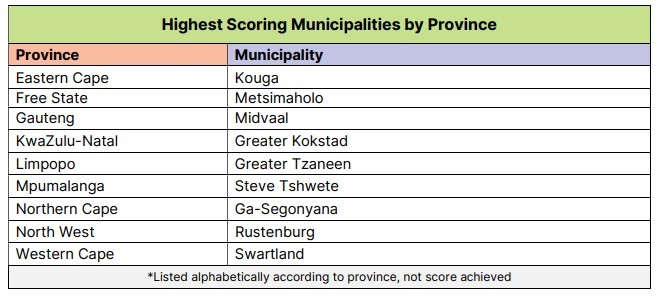
The five best performing municipalities are Drakenstein, Hessequa, Overstrand, Saldanha Bay and Swartland – all in the Western Cape, and all DA controlled.
Drakenstein scored the biggest improvement over the last six years by focusing on stronger governance and service delivery.
For the rest of the country, the picture is bleak. Ratings Afrika says without decisive intervention, the situation will deteriorate even further and the quality of life for millions of South Africans will worsen.