


Data + AI Summit 2026 brought together over 32k+ in-person attendees across hundreds of sessions, product announcements, ecosystem events, and hackathons. Among the many partner collaborations on display, the Databricks and OpenAI partnership had a notable presence throughout the event, including appearances in the keynote, Executive Forum, Hertz customer session, a hackathon, and the Grounded Reasoning Cup.
This blog recaps highlights from those moments and how the partnership is working together to deliver value for shared customers.
The key value proposition of the partnership is simple: OpenAI provides frontier model intelligence and agents. Databricks provides enterprise context & control. Together we help customers create AI experiences that are relevant, context-aware, and trusted.
Through this partnership, Databricks customers are building custom agents with OpenAI GPT models and Codex on Databricks’ unified, fully integrated end-to-end platform.
Natively available on the Databricks platform, Codex and GPT models can be fully governed, to include control over what agents can access, what they can do, and what it costs to run them. Several Databricks products enable this:
Without Databricks, customers must first integrate disparate tools, write custom code and manage their organization’s custom semantics and business definitions and then build their agents. Leveraging OpenAI on Databricks speeds time to value, lowers cost and improves agent quality.
Greg Brockman, OpenAI, on stage with Databricks co-founders Ali Ghodsi and Patrick Wendell
OpenAI co-founder and President Greg Brockman joined Databricks CEO Ali Ghodsi & Databricks co-founder Patrick Wendell for a fireside chat on how Databricks is used internally at OpenAI, what it takes to move AI from research to deployment, and Codex’s rapid rise and native availability with Databricks. With Unity AI Gateway, Databricks customers can now govern every Codex interaction, ensuring all coding activity is auditable, cost-controlled, and compliant before it touches production systems. Greg closed with a line that set the tone for the week: it has never been a better time to be a builder.
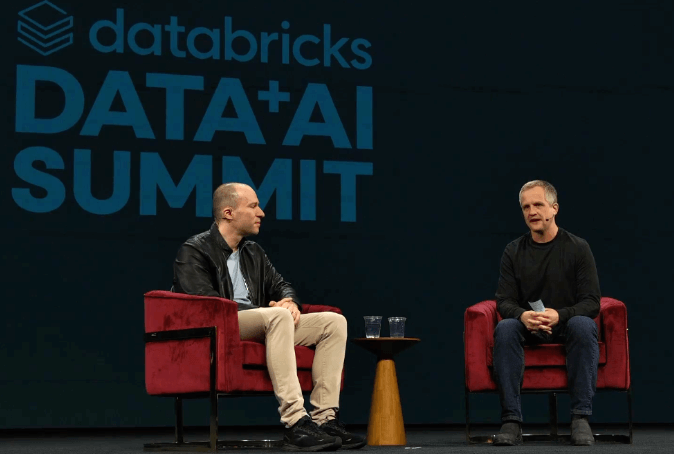
Executive Forum with Sarah Friar, OpenAI CFO, with Ron Gabrisko, Databricks CRO
Sarah Friar, OpenAI CFO joined Ron Gabrisko, Databricks CRO, on stage at Exec Forum for a candid conversation about what both organizations are hearing most from enterprises: deploying AI is the easy part; the real value comes from redesigning how work happens and embedding AI directly into core products to drive revenue. Success is no longer measured by usage or productivity alone, but by clear, top-line business impact.

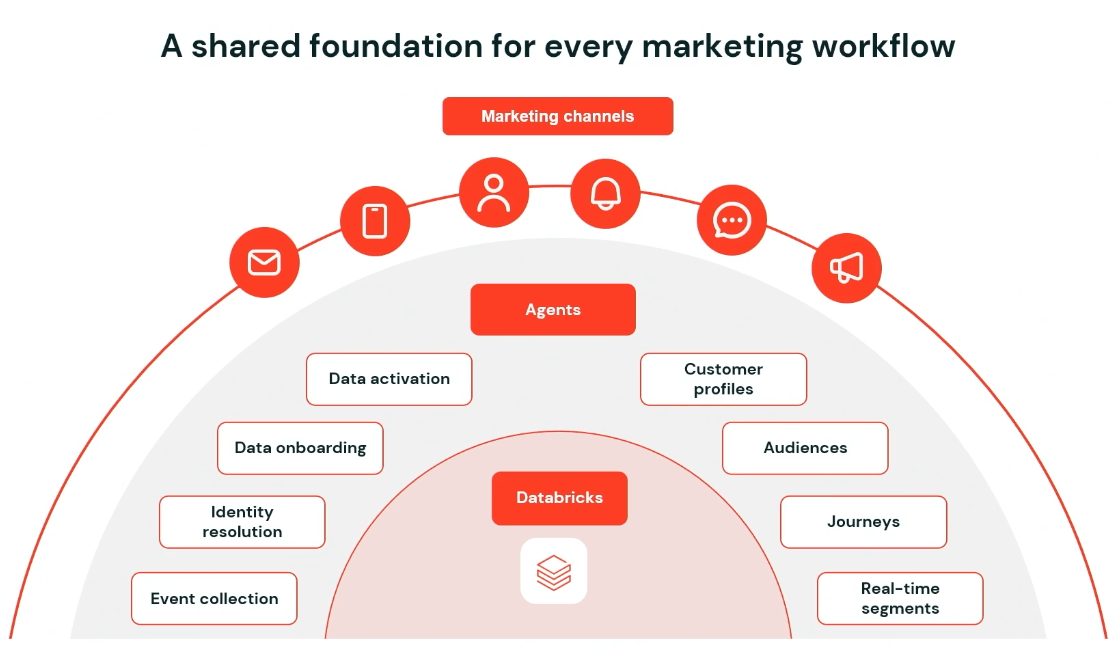
Databricks is OpenAI’s marketing data foundation
Jeff Canada manages marketing operations for one billion weekly active users with a team of two. He rebuilt OpenAI's entire marketing data foundation on Databricks using a Bronze-Silver-Gold medallion architecture — eliminating $400,000 per month in storage costs and enabling marketers to self-serve audiences without writing SQL. His lesson: fix the data foundation first. Agents aren’t useful if the data underneath them is wrong.
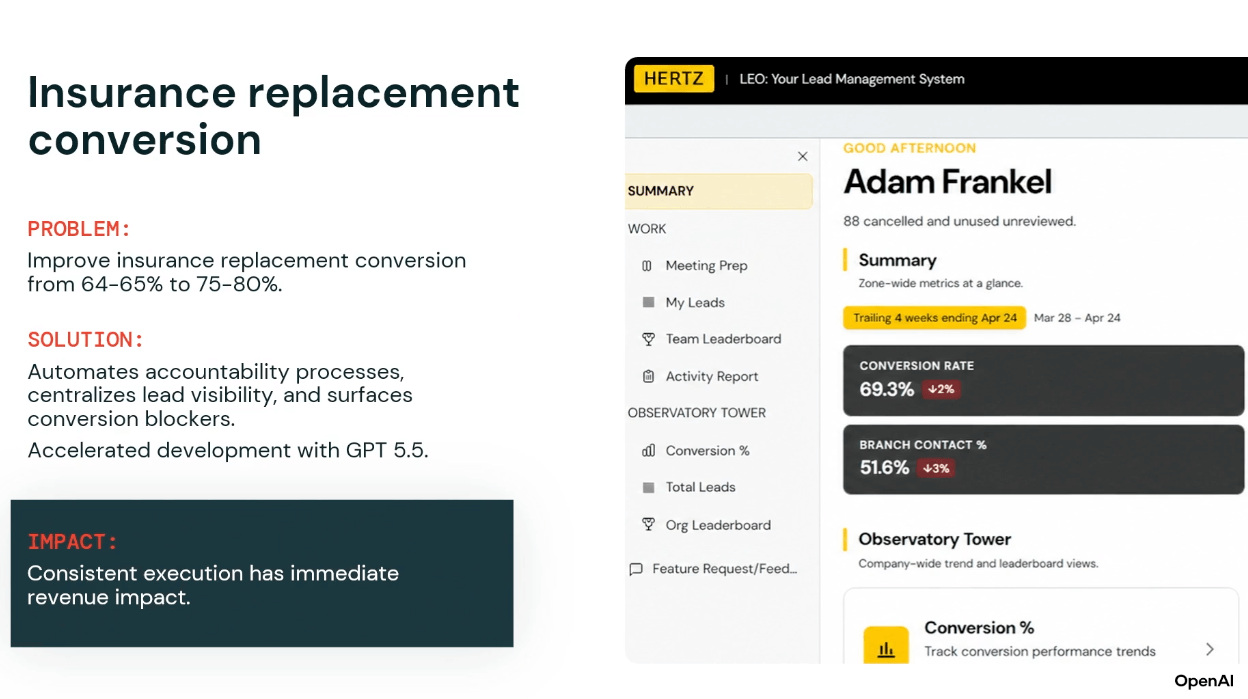
Hertz Global turned customer feedback into business impact
Hertz brought two production use cases to the DAIS stage that showed what the joint stack looks like when deployed across a company with thousands of locations and millions of customer interactions per year.
Hertz's insurance replacement business was converting only 60–65% of incoming leads due to an inefficient operating approach. The solution was to build a new accountability process into an application using GPT-5.5 and Databricks — pulling from Lakebase and Unity Catalog volumes, built in 11 business days by domain experts, not engineers. This solution had immediate impact: conversion rates improved to 75-80% and lifted the rest of the division toward that best-in-class standard.
The second use case: millions of customer feedback points captured in calls, NPS surveys, drop-off comments were previously only reviewable in aggregate. Now each comment is captured, categorized by GPT-5.5, turned into a specific assignable action, and routed to the right location leader in real time, decreasing time to insight and improving customer satisfaction.
Fireside chat with Rohan Varma and Ankit Mathur: Intelligence is no longer the bottleneck
OpenAI now ships new models every five to six weeks and new Codex features every Thursday. But developing enterprise agents at scale requires more than intelligent models and capable harnesses. Databricks put it plainly in the Agent Bricks announcement: the core agent loop is just 1% of the work. The other 99% is the hidden technical debt of agentic systems — deployment, security, evaluation, monitoring, context, and sharing and more. Rohan Varma, Codex Product Manager at OpenAI, reinforced this in his fireside chat with Databricks engineer Ankit Mathur: the bottleneck is no longer the model. It is everything around the model. Agent Bricks is built to solve exactly that 99%.
The conversations from DAIS don't stop here. On August 4 (AMER), August 5 (EMEA), and August 6 (APAC), Databricks and OpenAI are hosting a joint virtual event Agents at Work: Shipping Agentic Apps at Scale to help organizations scale fleets of agents in production.
Peter Steinberger, creator of OpenClaw at OpenAI, and Thibault Sottiaux, who leads product for Agents and Codex at OpenAI, will join Databricks co-founder and VP of Engineering Patrick Wendell for a conversation on what it actually takes to build agents developers trust and rely on. Hugo Sechier, Head of Agentic AI at Stellantis, will share how one of the world's largest automakers is scaling agentic AI across the enterprise.
If you are thinking about how to move your AI work from pilot to production, how to govern agents at scale, manage fleets, and build the kind of data foundation that makes all of it possible, this is the session to attend.
此内容由惯性聚合(RSS阅读器)自动聚合整理,仅供阅读参考。 原文来自 — 版权归原作者所有。