


Unlocking large-scale renewables, integrating customer resources, and maintaining system strength all depend on having a reliable and contemporary grid. While significant progress is being made in many parts of the energy sector, transmission and distribution (T&D) networks are facing significant challenges delivering the scale of new network capacity at the required pace without compromising affordability.
In this article, we explore five critical unlocks to this T&D bottleneck, and what Australia can learn from global leaders to capture opportunities head-on.
Transmission and distribution (T&D) networks are at the heart of a successful energy transition, and it is now the turn of Australia’s networks to play a key role in accelerating decarbonization of the grid. In the fourth quarter of 2025, renewables and storage supplied more than half of National Electricity Market energy for the first time.1 The Australian Energy Market Operator (AEMO) expects electricity consumption to nearly double by 2050, driven by electrification, data centers, and industrial migration from gas to electricity. To keep pace, Australia will need 6,000 km of new transmission by 2050,2 with more than 5,000 km required in the next decade. At the same time, significant upgrades to existing distribution networks are needed to enable consumer energy resources (CER) and maximize the hosting capacity of sub-transmission networks, while the real cost of overhead networks has risen materially against prior planning assumptions.3
That makes now a defining moment for the T&D sector. The pressure point that was once primarily on generation of new power is now shifting toward network execution: getting more generating capacity connected and safely operating with greater speed and discipline.
The opportunity is significant, but so is the level of change required. Five structural opportunities have been identified that could shape performance in the years ahead:
Australia's broader productivity underperformance forms a challenging backdrop for T&D players as they try to accelerate the energy transition. Aggregate productivity has been subdued, and the Australian Energy Regulator (AER)’s latest benchmarking shows that distribution productivity fell by 3.8 percent, and transmission productivity by 3.2 percent, in 2024.4 Our global benchmarks (Exhibit 1) suggest that Australian T&D operators are behind peers materially in both opex and capex efficiency, implying there is meaningful room for improvement.
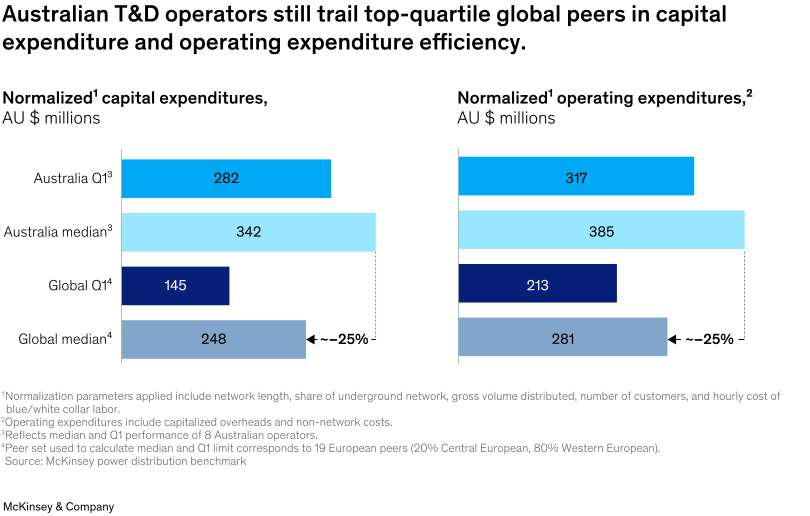
Some contributing factors are structural in nature. Australia’s T&D sector operates within established workforce and regulatory frameworks that shape operating models and delivery approaches across the industry. In some cases, these frameworks can add complexity when organizations seek to simplify processes, reprioritize resources, or adopt new ways of working at pace.
Even so, many of the largest productivity losses are operational, and within management control. In many cases, time and resources are not consistently directed toward the highest-value work, diluting overall system productivity. This is often compounded by execution inefficiencies. Across the sector, it is still common to see fragmented work management systems, inconsistent schedule adherence, manual dispatching, poor job readiness, ineffective KPIs, and very different performance expectations for internal crews and delivery partners. In that environment, rising work volumes often translate into overtime, rework, and additional contractor spend rather than sustainably higher throughput.
This is why the most effective productivity programs globally include work design. Leading operators are simplifying how jobs are planned, sequenced, staffed, and closed out. They are improving the quality of job packs, using better forecasts to manage break-ins and emergency work, tightening daily and weekly performance rhythms, and creating much stronger visibility on where time is lost between planning and execution. The goal is straightforward: more valuable work, more completed work, more network capacity, and better reliability from the same field hours and dollars.
One large US T&D operator embedded job-duration estimation, workload and break-in forecasting, scheduling process redesign, KPI tracking, and frequent performance dialogues into daily operations. Within six months, it delivered 16 to 20 percent field productivity improvement, 10 to 20 percent scheduler productivity improvement, more than 60 percent higher schedule adherence, and around 140 percent improvement in scouting, with gains scaled across additional operating centers.
For Australian operators, the next productivity frontier lies in redesigning frontline and support work so the system can absorb a much larger volume of capital and connections without a proportional increase in labor, rework, or delays, while ensuring capacity is directed to the highest-value work.
Urgency is high, but delivery remains challenged. Of the 17 “committed” or “actionable” priority transmission projects covered in AEMO’s Draft 2026 integrated system plan report, at least ten are one to four years behind schedule.5 Extended permitting and approval timelines, community opposition, and land access challenges are among the most visible causes (Exhibit 2). Rising input costs, supply chain disruptions, and market capacity constraints add further pressure.

In practice, major project underperformance is usually cumulative. Delays build when schedule risks are not identified or escalated early, design maturity is less progressed, interfaces between land, engineering, procurement, and construction are poorly managed, and cost and schedule information are too fragmented to support early intervention. In many cases, project controls exist, but they do not operate as a true management system. Teams may have data but lack a single, trusted view of what is moving, what is slipping, and where leadership attention is needed next.
Leading operators are responding by building a delivery engine rather than treating each project as a stand-alone effort. That means sharper stage gates; more disciplined readiness checks before committing the next tranche of spend; integrated cost and schedule management; explicit interface ownership; stronger delivery partner performance management; and much more active escalation of emerging issues. Just as importantly, it means bringing community engagement, landholder management, and approval pathways into the core delivery model rather than treating them as external dependencies that sit to the side of the program.
A European transmission system operator (TSO) faced growing delay risk, amounting to more than 1 million euros per day. To maintain control of the schedule, it built the first version of its real-time digital control tower in 24 weeks, upgrading and expanding it over the following months. More than 50 data sources were integrated into a single intelligence platform, including schedules, daily construction site reports of 100+ contractors, progress data, drone images, geographic information system (GIS) layers, and relevant contract clauses. The solution provided near-real-time condition monitoring, automatic detection of incidents on various sites (such as machine downtime), and quantification of time and cost impacts. A dedicated operations-control role was introduced to monitor the digital control tower daily, assess the events with local teams, and run a standing escalation cadence with management to agree on corrective actions. The result was a single, trusted view of performance and materially earlier intervention on emerging bottlenecks.
Australian networks could benefit from this kind of delivery discipline at scale. The challenge is broader than project management. It is about turning a portfolio of highly visible, community-sensitive, capital-intensive projects into a repeatable delivery system.
The arrival of AI at scale is simultaneously creating additional challenges for the grid and unlocking opportunities for more efficient operations. Our research suggests that data center electricity consumption in Australia could rise from around 4 TWh, or approximately 2 percent of National Electricity Market demand, in 2025 to 12 to 15 TWh, or around 6 percent of grid demand, by 2030, depending on utilization.6 The nature of this demand is also shifting, with AEMO projecting the share of data center load connected directly to the transmission network to rise from around 1.5 percent today to 32.0 percent by fiscal year 2030.7
The need to manage this significant increase in load is coming at the same time as network operations become more complex to manage. Australia installed more than 450,000 home batteries by the end of 2025 (cumulative),8 passed 4.3 million rooftop solar systems by the end of 2025,9 and saw electric vehicles (EVs) and plug-in hybrids exceed 19.0 percent of new light-vehicle sales in the first quarter of 2026,10 while fuel prices reduced petrol- and diesel-powered car sales by 30.1 percent and 21.7 percent, respectively, in April 2026 compared to the same month last year.11 AEMO also points to the potential for distribution networks to unlock additional latent CER capacity through measures such as improved voltage management. Each of these shifts increases the importance, and value, of better forecasting, better prioritization, and faster operational decisions.
AI has the potential to help unlock solutions to a number of these challenges. For example, many utilities are already exploring the potential for AI in enhanced forecasting to support operational decision-making. The question now is where and how to invest behind AI so it delivers maximum uplift in productivity. The strongest use cases are closely tied to core operational economics and clear pain points: connection studies, outage restoration, dynamic operating envelopes, asset inspection and defect triage, vegetation management, field scheduling, storm response, and portfolio-level asset replacement. In these domains, stronger data and faster decision support can materially improve service levels, capital efficiency, and risk outcomes.
Our research shows that AI adoption is now widespread, with over 80 percent of companies reporting active use of AI. But scaled value remains uneven. Many organizations are using AI in at least one business function, yet far fewer have translated that activity into enterprise-level performance impact.12 For Australian T&D operators, the implication is that translating AI investments into tangible performance improvements requires a focused approach, prioritizing domains of high-value applications that drive improvements on a system level, building supporting data products, and embedding tools into core operating rhythms.
A large US-based T&D operator has shown how reusable data products and a single source of truth can support asset inspection, maintenance and replacement optimization, risk-return investment planning, and storm-response readiness. Reported impact includes more than $200 million on customer affordability over ten years, 70,000 hours of manual work reinvested in the first year, and a 45-point increase in end-user usability score (from 37) in the first year.13
For Australian networks, the opportunity is substantial. The next few years will likely favor operators that move AI from interesting experiments and pilots into a focused operating capability that supports planning, dispatch, reliability, and network orchestration at scale.
A reenvisioned operating model is now emerging as a key factor for grid operators that are driving value from data- and AI-led transformations. Those that succeed holistically address how work gets done, who owns the process, and what happens when a new way of working creates friction in the field.
Most networks now have credible data platforms, mobile tools, workflow solutions, and analytics pilots. Yet many still struggle to convert those investments into sustained operational improvement. Digital and AI-enabled workflows are often layered onto analog processes, reducing the efficacy of technology investments. New tools require extra steps, approvals, or data entry; planners and crews experience delays or rework; contractors are trained lightly; and teams fall back to familiar habits whenever time pressure rises.
This pattern points to an operating-model issue. The utilities that capture value typically share a few features:
The same large US T&D operator saw the benefit of this approach firsthand. Despite significant digital and AI investments, progress stalled because each new idea remained siloed with complex integration. The operator responded by creating a digital operations factory: permanent cross-functional teams working directly with users to deliver tools in rapid cycles. The teams built workflow automation, mobile applications, and AI-driven analytics that streamlined intensive processes and improved operational decision-making. Combined with a simplified technology platform, this created a dependable engine for continuous productivity and reliability gains.14
Similarly, a European network operator identified opportunities to improve the consistency and efficiency of field operations, particularly for on-site studies related to low-voltage (LV) connections. While digital tools were already available, execution practices varied across regions, teams, and contractors, leading to differences in execution speed and quality. To address this, the operator defined a standardized end-to-end target operating model for the activity, with clear roles and responsibilities across field and central teams, as well as a structured split between technical and administrative tasks. Field designers were enabled to perform network studies directly on site, while support roles handled customer interaction, scheduling, and coordination. Digital tools, such as mobile GIS and workflow systems, were embedded to support real-time data capture, reduce duplicate entries, and streamline coordination between planning, studies, and construction teams. By aligning digital workflows with a standardized process and implementing regular training and clear execution guidelines, the operator created a more efficient and scalable way of working.
This effort matters because evolving the operating model can turn digital investments from discrete projects into a true, sustained capability. Australian utilities that make this shift can build an engine for repeated improvement. They will become better at scaling new tools, faster at capturing value, and more capable of sustaining change across both the regulated core and adjacent businesses.
Privatization of Australia's T&D players is raising expectations for operators to deliver growth both within and beyond their regulated businesses, including in contestable services. At the same time, ring-fencing requirements remain tight, and competition in unregulated markets is intensifying as global specialists and private-equity-backed innovators target many of the same adjacencies. For network businesses, growth now demands sharper choices.
The first question is where expanding the regulated core can create the most value. In many cases, that will come from enabling more load and generation to connect faster, making better use of existing network capacity, supporting flexibility, and improving service for large customers navigating electrification. Some of the most attractive opportunities sit close to the core mission: connection services, system orchestration, customer solutions, and reliability-related offerings that help defer or avoid more expensive buildings.
The second question is where the business may have differentiating capabilities to compete beyond the historic boundaries of the core. Networks can bring assets that many competitors often do not: deep technical knowledge of the grid, long-term customer relationships, physical assets and sites, operational credibility, and the ability to integrate complex infrastructure programs. Those qualities strengthen competitive advantages in selected adjacencies, but they do not guarantee success everywhere. In fast-moving contestable markets, specialist players often have advantages in speed, capital allocation, and focused execution. In this context, deliberate portfolio choices are key: where to build, where to partner, and where to stay out.
The competitive difference also rests on trust. Growth is easier to sustain when customers, communities, landholders, regulators, and governments can see a clear public-interest case for the role the network is playing. Social license is therefore not separate from growth. It shapes how quickly projects move, how confidently capital is deployed, and how much strategic room a network has to pursue new opportunities.
Global peers are moving with clarity and decisiveness. For example, one UK network operator has reframed regulated growth around flexibility and customer solutions as well as network build. Its distribution system operator (DSO) can now connect an average of 115 working days faster through active network management, with flexible connection quotes saving 50 to 75 percent of traditional connection costs and generating £72.5 million in customer savings.15 Meanwhile, it has built a distinct infrastructure-services business, including train line upgrades16 and an integrated solution for EV charging.17
For Australian T&D operators, growth can be treated as a strategic portfolio choice with clear guardrails: where to grow the regulated core, where to build ring-fenced propositions, where partnerships offer a better route, and how to maintain the license to operate while doing so.
The common thread across these five opportunities is execution. Australia’s networks still have a valuable window to turn today’s pressures into long-term advantage, but that window will not remain open indefinitely.
Over the next 12 to 36 months, leading utilities are likely to differentiate themselves through five things in particular:
Many of the toughest external conditions are outside management control. But productivity, delivery discipline, process redesign, capital allocation, and technology adoption are not. Organizations that move early can build momentum, credibility, and resilience. Those that move slowly will likely face rising costs, narrower delivery windows, and weaker confidence from customers, investors, regulators, and communities.
This is a moment for sharper choices and faster execution. For Australia's T&D sector, it’s time to flick the switch.
Gracie Brown is a partner in McKinsey’s Bay Area office; Tarandeep Singh Ahuja is a partner in the Melbourne office, where Victor Finkel is a partner and Vitaly Skirnevskiy is an associate partner; Alexander Dalton is an associate partner in the Sydney office, where Rinze Bloem is a consultant.
The authors wish to thank Natalie Kerry and Ryan Borges for their contributions to this article.
This article provides analysis based on publicly available information and industry experience. It is intended solely for informational purposes and does not constitute regulatory, policy, or investment advice.
此内容由惯性聚合(RSS阅读器)自动聚合整理,仅供阅读参考。 原文来自 — 版权归原作者所有。