


COSCO’s acquisition of a 51 percent majority stake in the Port of Piraeus in 2016 was a prelude to the country joining Xi Jinping’s signature Belt and Road Initiative in 2018. But the ties between China and Greece run deeper than ports and trade agreements. Closer media engagement with Greece, and across southern Europe, has been a key element of China’s strategy to shape narratives about the relationship and secure broader political goodwill.
This engagement has unfolded according to a familiar playbook: content-sharing agreements with news agencies and broadcasters, working actively toward diaspora media aligned with official narratives, and a growing presence on social media through polished influencer accounts that promote a flattering image of China to Greek audiences.
These efforts have been directed at a media landscape in Greece that was already fragmented. The financial crisis that began in late 2009 gutted advertising revenues, accelerated consolidation, and left outlets increasingly dependent on a small number of powerful owners, says Plamen Tonchev, Head of Asia Unit at the Athens-based Institute of International Economic Relations (IIER).

Lingua Sinica spoke with Tonchev about China’s media outreach in Greece — how it operates, who enables it, and what it means for one of the EU’s most economically and geopolitically vulnerable member states.
The following is an edited excerpt.
DP: How would you characterize China’s approach to media engagement in Greece? What does it look like on the ground — who are the key players, and how do they enter the space?
PT: In general, no Greek media outlet is directly controlled by Chinese interests.
However, what can be observed in the country is another policy by the Chinese authorities that encourages state-run media to establish cooperation agreements with overseas counterparts to promote China-friendly content. Using third-party outlets to mask Chinese propaganda has become such a common tactic that CCP officials have reportedly given it a name - “borrowing boats to go to sea”, meaning to use other actors’ resources to fulfill one’s goals. This explains Beijing’s strategy for projecting its narratives in Greece by targeting Greek media, both state-run and private, as useful allies and amplifiers, through a number of content-sharing agreements. Of course, there is a legal framework that sets necessary rules, but governments and competent public authorities cannot impose editorial or partnership policies on private media outlets or restrict freedom of speech. Greek state-run media, in turn, follow government policies that are largely meant not to antagonize Beijing.
DP: One thing that seems distinctive about Greece is that major media outlets are owned by shipping families — and those same families have significant commercial ties with China. How does this overlap between media ownership and economic dependence on China shape the way the relationship is covered?
PT: Indeed, a relatively small number of magnates, active in shipping one way or another, control influential TV networks and other media outlets. Their business interests expand into other areas as well, such as energy, real estate, construction, sports, etc.
This applies to the owners of private media groups, in particular: the Kathimerini — one of Greece’s oldest broadsheets — and the cluster of Skai audiovisual platforms; the Naftemporiki — a business and financial newspaper — and its TV network; the To Vima and Ta Nea dailies — two national newspapers — the MEGA TV channel and some popular portals; and the Star TV, Alpha TV, and Open TV channels — three of Greece’s commercial free-to-air broadcasters. As for the public broadcaster Hellenic Broadcasting Corporation (ERT), with its three channels and related platforms, it also has a relatively positive stance towards China, not least because of Chinese investments in the country.
It is worth noting the extent of the Greek shipping industry’s exposure to China. Greek shipping companies account for an estimated 20% of China’s seaborne trade, and a large number of Greek-owned ships are built in Chinese shipyards, representing a substantial capital relationship with the country.
DP: Are there any other forms of Chinese influence campaigns in Greece, particularly in the media sector?
PT: There is also the large-scale and richly endowed Greek program of China Radio International (CRI-Greece). But I would say that Chinese presence in the Greek media sector is much more substantive in the area of social media, because it is more innovative and sophisticated.
For instance, there are at least three female Chinese influencers who speak fluent Greek and have adopted Greek names: “Mariana”, “Elpida”, and “Iro”. They present themselves as travel vloggers, food bloggers, or individuals showcasing their lives in China and trips to Greece. The content of their pages is predominantly lifestyle-oriented, but with a consistent direction: to portray China in a positive light while avoiding or countering criticism of controversial issues. There have been videos painting a rosy picture of life in the Xinjiang Uyghur Autonomous Region, despite numerous reports of serious human rights violations there. In addition, these influencers frequently extol what they present as extremely promising prospects of Sino-Greek cooperation.
Read the Full Interview at Lingua Sinca
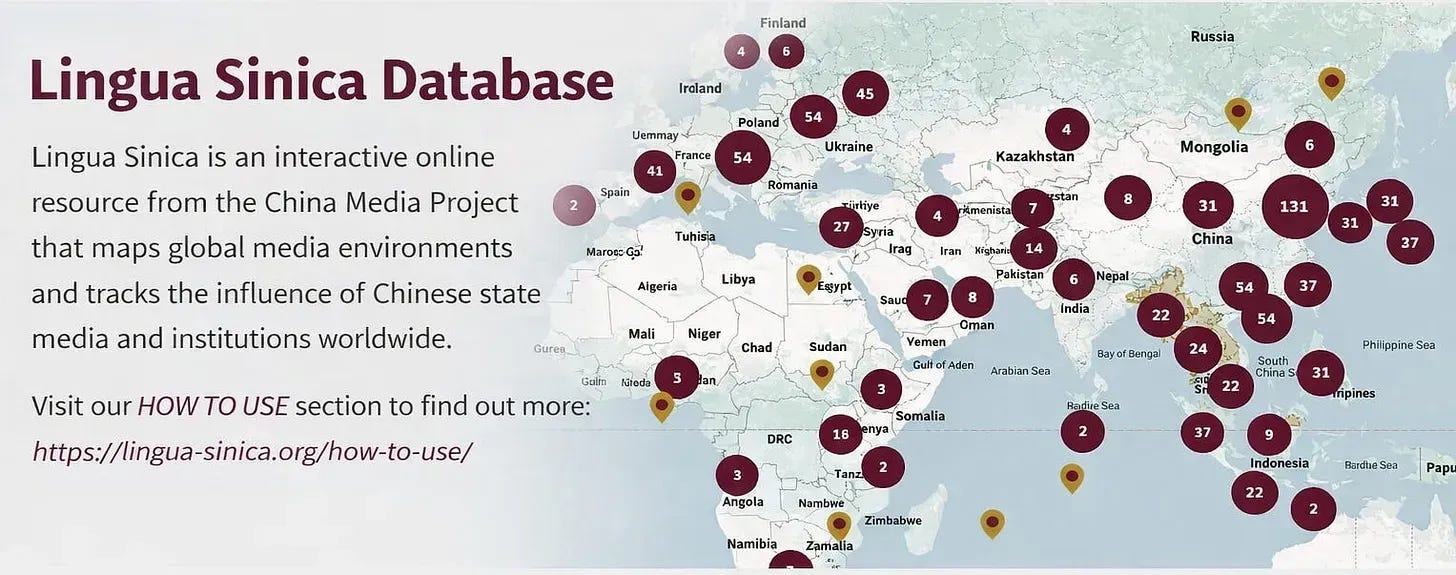
To learn more about China’s media engagements in Greece — selected below — check out the Lingua Sinica database. Note that the LS database now allows search by date, with a full calendar function. We encourage readers to explore the database of PRC engagements by selecting for countries, engagement types and dates under the map (don’t forget to click “Filter”). We have also implemented a full-site search function in the banner of the site. Enjoy!
October 30, 2023
Learn More About This Activity
November 10, 2019
Learn More About This Activity
July 4, 2016