


Welcome to Lingua Sinica.
This week our focus is a story first posted over at CMP about National Reading Week in China — and the nostalgic (quixotic?) push to get social-media-saturated humans to read the printed word for the sake of “national cultural power.”
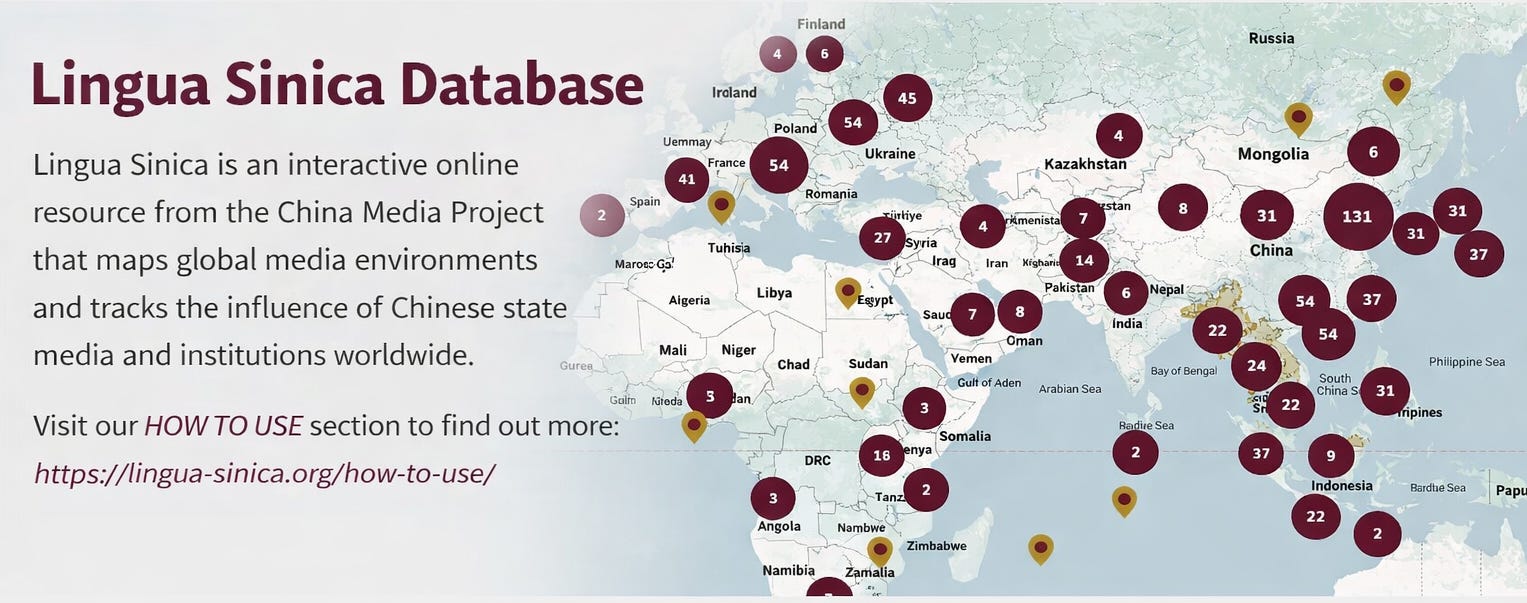
After that, we have a cluster of short stories selected this week by our team of humans at Lingua Sinica and Tian Jian (田間). Scroll down for a quick read, and click through to learn more at the Lingua Sinica website. Also down below, don’t miss our quick summary of a recent global media engagements logged in our Lingua Sinica database — just several of hundreds that are free to check out along with related entities and their affiliations.
While we’re on book publishing, Tian Jian has an absolute must-read out this week by Su Hsiao-fan (蘇曉凡) looking at the stories of three exile publishers from China.
If you haven’t yet, please consider subscribing. I’ve put a button right here. So simple.
David L. Bandurski
CMP Executive Director
✅ Human picks from the Sinosphere
Earlier this month, Beijing Normal University quietly deleted the social media account of Jingshi Scholars (京师学人), a student-run publication that had operated on campus for twenty years. No announcement was made to readers or former members as between 600 and 700 articles disappeared overnight. The account was listed as “voluntarily closed” (自主注销) — a bureaucratic formality that, according to former members, was not what had actually happened. Student outlets in China have long occupied a rare and contested space. Operating nominally under university party committees (党委), they have sometimes managed, within narrow limits, to report on subjects that official outlets dare not touch.
Last week, Malaysia’s Ministry of Home Affairs banned two books documenting the history of the Malayan Communist Party (马来亚共产党), a guerrilla movement that fought first against British colonial rule and then against the post-independence government in a decades-long insurgency that ended only with a peace agreement in 1989. The ministry invoked the Printing Presses and Publications Act of 1984 to prohibit the titles, saying their content poses a threat to public safety and national security. PEN Malaysia (多语作家协会), the local chapter of the international writers’ rights group, condemned the move as a severe setback for freedom of thought and democratic dialogue.

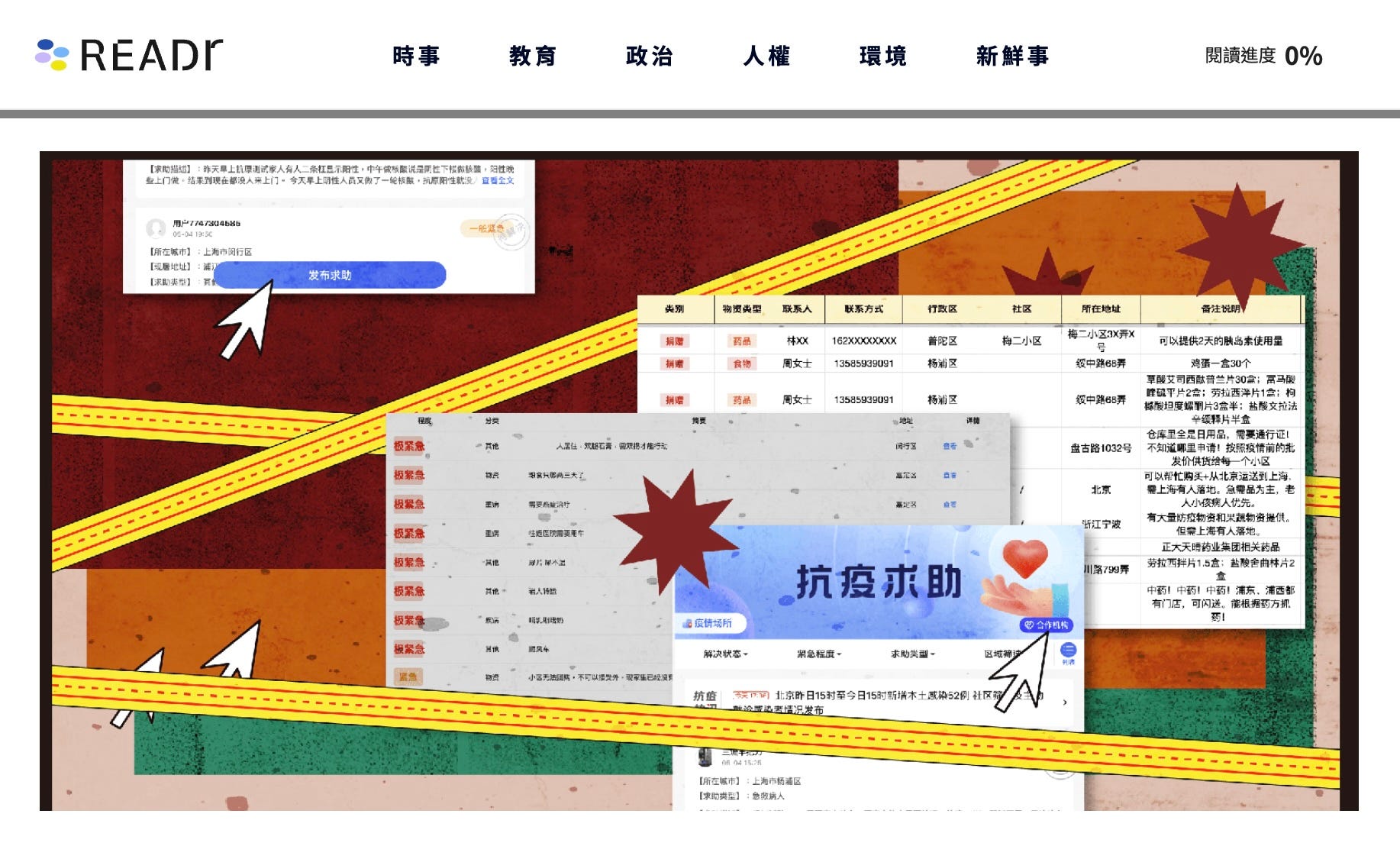
At a farewell gathering in Taipei earlier this month, the staff of READr said goodbye to readers — and to eight years of trying to answer a single question: can data drive journalism in Taiwan? READr (讀+) was founded in 2018 as a side project of the programming center at Mirror Media (鏡週刊), an outlet founded in 2016, built around the conviction that data could do more than illustrate a story — it could generate one. Over the years, the outlet produced notable work including an analysis of COVID-19 misinformation trends across more than 5,000 international fact-checking reports, and a data visualization of nearly 10,000 distress messages posted online during the 2022 Shanghai lockdown. Some fans could not understand why the team had chosen to disband. “The funders didn’t ask you to leave,” one wrote on Threads, “how could you dissolve yourselves!”
Elon Musk’s social media platform X was making no secret of its ambitions in China. Its new standalone messaging app, XChat, came equipped with Simplified Chinese language support and was listed simultaneously on the China App Store, suggesting X had its sights set on a vast base of Chinese users. But the app was buried in China before it could even get off the ground. X — or more precisely, “404” — marks the spot. According to a post by the influencer known as Teacher Li Is Not Your Teacher (李老师不是你老师), who goes by @whyyoutouzhele on X, outlets including Xinhua, People’s Daily Online, The Paper, and Jiemian News had each published reports on XChat’s impending launch — only to delete them. Teacher Li’s post drew nearly 970,000 views. Searches for “XChat” on Weibo, WeChat and Douyin returned no results.
Check out these and other global PRC media engagements at Lingua Sinica.
Over the weekend, the Paris Chinese Cultural Center hosted an event that brought together scholars, publishers, and industry representatives from both countries, focusing on technological innovation and cross-cultural communication in the age of artificial intelligence. The event, “Encounter China: Civilization Exchange Dialogue,” was organized by China International Communications Group (中國國際傳播集團), or CICG, a state-controlled media organization. The event points to the growing role of emerging technologies, including AI, in shaping China’s cultural exchanges.
In March 2026, the PRC invited a select group of Salvadoran journalists, primarily from state-aligned outlets, to cover the annual “Two Sessions” political event in Beijing. By providing exclusive access to high-level political meetings, the PRC ensures that the resulting coverage in El Salvador mirrors the official Chinese narrative on sensitive topics such as the status of Taiwan, over which China claims sovereignty under its “One China” principle.
On March 5, 2026, Radio Television Hong Kong (RTHK), the special administrative region’s public broadcaster, signed a memorandum of understanding with Malaysia’s Ministry of Communications in Kuala Lumpur. The agreement covers media cooperation, cultural exchange, and joint productions. RTHK, which in recent years has drawn more closely to PRC state media and state narratives, framed the agreement as about strengthening its “international communication capabilities” (國際傳播能力) under the Belt and Road Initiative — suggesting the primary concern is not to serve the audience but to advance Beijing’s external communication strategy.
As China launches its first National Reading Week, an official push for a “society of readers” — entranced by the nostalgic scent of the printed book — runs headlong into a nation glued to its screens.
Nearly two decades ago, Li Cuili, a shopkeeper from Lishi Village, a small community in rural Henan province surrounded by fields of vegetables, cleared the shelves of her general store of liquor and other top-selling goods and stocked them with books. Li made the decision, she later told People’s Daily, after a traveling performance troupe visited the village and inspired local children to repeat crude jokes. Books, she felt, were the old-fashioned remedy — a way to restore what she called “civilized rural ways” (文明乡风). In the space she then called “Glimmer Bookhouse” (微光书苑), the books were free to borrow — no questions asked. By 2024, the collection had grown to more than 5,000 volumes, according to Legal Daily.
For nearly twenty years, Li has been lionized in official state media for her simple act of community spirit, becoming an enduring symbol trotted out whenever reading and literacy are highlighted as a national priority. In 2023, her story became the subject of a short film celebrating community-minded small shop owners across China. This week, Li’s story appeared once again — this time at the very top of the front page of Monday’s People’s Daily — as China launched its first official National Reading Week and held its fifth annual National Reading Conference in Nanchang, Jiangxi province.
“General Secretary Xi Jinping has attached great importance to promoting nationwide reading and building a society of readers, and has on many occasions explained the importance of reading,” the People’s Daily said.
As the Chinese Communist Party makes its latest push to build momentum on literacy with the help of a new reading promotion law that took effect earlier this year, Li and her “Glimmer Bookhouse” are again presented as a glimmer of hope for the printed page in China. But as Chinese turn increasingly away from the printed page and toward video and the mobile screen, the gap between these ambitions and reality has never been wider.
The latest literacy push has real institutional force behind it. The Regulations on the Promotion of Nationwide Reading (全民阅读促进条例), signed by Premier Li Qiang late last year and effective from February, mandate the setup of reading facilities in new residential developments, require schools at every level to build reading into the curriculum, and establish accessible formats for disabled readers. Explaining the recent push in the state media — including yesterday’s leading piece in the People’s Daily — Article 13 of the law designates the fourth week of April as the annual National Reading Week. Underscoring its political force, the law is administered by China’s National Press and Publication Administration (NPPA), an office directly under the Chinese Communist Party’s Central Propaganda Department.

But the market, buffeted by forces the new law cannot easily legislate away, tells a more complicated story.
Writing recently on her Substack newsletter The Subtext Asia, Jo Lusby, former North Asia CEO of Penguin Random House, notes that China’s retail book market is now worth just 88 percent of its pre-pandemic 2019 peak, with sales falling 2.24 percent by value in 2025 alone. Short video and social commerce platforms — led by Douyin, the Chinese precursor to TikTok, and RedNote (小红书) — now command 40.53 percent of book sales by value, up more than 30 percent year on year, while physical bookstores hold a mere 13.65 percent of the market.
The broader picture is a downward trajectory for sales, with publishers doing their best to pivot. “The numbers overall paint a portrait of a sector struggling to find its way amid declining sales; yet there is an undeniable energy in certain sectors of the book market as publishers continue to go where the eyeballs are,” Lusby writes. She adds that while China’s publishing industry has “always occupied a special place in the Chinese official hierarchy,” reporting as it does directly to the Central Propaganda Department, official efforts are likely “too little too late.”
In the pages of the state-run media, however, there is hardly a glimmer of uncertainty. In its front-page tribute Monday to Li Cuili and the act of reading, the People’s Daily headlines the phrase “fragrance of books” (书香) — pointing to Xi’s vision of a “society of readers,” or literally, a “society fragrant with books” (书香社会). It is a quaint and evocative notion, invoking the scent of the printed page and shelves filled, like Li Cuili’s at “Glimmer Bookhouse,” with physical books to be borrowed and spirited away to some quiet corner.

The metaphor is wafting across the sector. Beijing Daily announced yesterday that the theme of the coming week would be “book-scented April days” (書香四月天), and that various organizers are giving away more than 10,000 books — everything from Chinese classics to children’s picture books. A special on China Central Television today profiles the historic Hoshwin Library (和顺图书馆) in Yunnan province, with its 130,000 volumes sealed away in display cases. The special was called: “Nothing carries one further than the scent of books” (最是书香能致远).
But the reality is that the glimmer for the book — and for reading — in China’s future will increasingly, irrevocably, be the glow of the screen.