


Nearly everyone who has seen partial fraction decomposition was introduced to it as a way to compute integrals. If P(x) and Q(x) are polynomials, then you can break their ratio P(x)/Q(x) into a sum of terms that can each be integrated in closed form. As with most topics in a calculus class, partial fractions go by in a blur.
This post will look at partial fractions more generally.
Every polynomial with real coefficients can be factored into a product of linear and irreducible quadratic terms. But actually calculating this factorization is difficult if the degree of the denominator is large.
The quadratic equation is easy to use. There are analogs for 3rd and 4th order polynomials, but they’re cumbersome. And there is no formula in general for finding roots of polynomials of degree 5 or higher.
You could find the roots numerically, but if you’re going to go that route, maybe you should evaluate your integral numerically.
Still, it is useful in proving theorems to know that a partial fraction decomposition exists, even if in practice you cannot calculate it.
Rational polynomials over the real numbers can be factored into powers of linear terms and irreducible quadratic terms. There are no irreducible quadratics over the complex numbers thanks to the Fundamental Theorem of Algebra, and every polynomial can be factored into a product of linear terms.
This means every rational in z can be broken into a sum of a polynomial in z and polynomials in 1/(z − zi) where the zi are the roots of the denominator. This fact is important, for example, in contour integration.
The concept of partial fraction decomposition can be generalized to the field of fractions over a ring R [1].
If the ring R is a principle ideal domain (PID) [2], then every element c of the field K of fractions over R can be written in the form

where the pi are nonassociate [3] irreducible elements of R, the ri are non-negative integers, and the elements ai and pi are relatively prime.
When R is the ring of of polynomials over a field, R is a PID, and the field of fractions is the set of rational functions over that field. When the field is the real or complex numbers, we get the results above. But the field could be something else, such as a finite field.
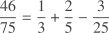
When R is the ring of integers, the irreducible elements are prime numbers. The nonassociate condition means you can’t count p and −p as distinct elements, so practically this means we only look at positive primes. The field of fractions is the rational numbers. So the theorem above says that every rational number can be written as a sum of fractions where the denominators of the fractions are prime powers and the numerators are relatively prime to the denominators.
The way you would decompose a rational number into fractions with prime power denominators is analogous to the way you’d do partial fraction decomposition in a calculus class. For example, suppose we want to decompose 46/75. The distinct prime factors of 75 are 3 and 5, and so we’d look for fractions with denominators 3, 5, and 25, and in fact
[1] The field of fractions over R is the set of formal terms a/b where a and b are in R and b ≠ 0. Operations are defined by analogy with rational numbers. If R is an integral domain, the field of fractions really is a field.
[2] A ring is a PID if every ideal can be generated by a single element.
[3] Two elements of an integral domain are said to be associate if they generate the same ideal.
此内容由惯性聚合(RSS阅读器)自动聚合整理,仅供阅读参考。 原文来自 — 版权归原作者所有。