
惯性聚合 高效追踪和阅读你感兴趣的博客、新闻、科技资讯
阅读原文 在惯性聚合中打开

推荐订阅源

F
Fortinet All Blogs
云风的 BLOG
云风的 BLOG
M
MIT News - Artificial intelligence
WordPress大学
WordPress大学
T
Tailwind CSS Blog
钛媒体:引领未来商业与生活新知
钛媒体:引领未来商业与生活新知
S
Secure Thoughts
博客园 - 【当耐特】
Know Your Adversary
Know Your Adversary
NISL@THU
NISL@THU
博客园 - 司徒正美
Last Week in AI
Last Week in AI
C
Cybersecurity and Infrastructure Security Agency CISA
P
Privacy & Cybersecurity Law Blog
C
CXSECURITY Database RSS Feed - CXSecurity.com
B
Blog
The GitHub Blog
The GitHub Blog
小众软件
小众软件
freeCodeCamp Programming Tutorials: Python, JavaScript, Git & More
Spread Privacy
Spread Privacy
Martin Fowler
Martin Fowler
博客园 - 叶小钗
Security Archives - TechRepublic
T
Tenable Blog
S
Securelist
博客园 - 三生石上(FineUI控件)
Threat Intelligence Blog | Flashpoint
Microsoft Security Blog
Apple Machine Learning Research
罗磊的独立博客
T
Threat Research - Cisco Blogs
Application and Cybersecurity Blog
F
Full Disclosure
Cloudbric
Cloudbric
The Cloudflare Blog
Y
Y Combinator Blog
Hugging Face - Blog
Hugging Face - Blog
Microsoft Azure Blog
H
Hacker News: Front Page
腾讯CDC
L
Lohrmann on Cybersecurity
C
CERT Recently Published Vulnerability Notes
V2EX - 技术
V2EX - 技术
GbyAI
GbyAI
TaoSecurity Blog
TaoSecurity Blog
I
Intezer
The Last Watchdog
The Last Watchdog
G
GRAHAM CLULEY
Google Online Security Blog
T
The Blog of Author Tim Ferriss

Modular Blog

Qualcomm to Acquire Modular Modular 26.4: SOTA MoE Serving, Model Bringup via Agent Skills, Mojo 1.0 Beta 2 and More ModCon 2026: Modular’s Developer Conference Day Zero: MiniMax M3 Open Weights on Modular Cloud Modverse #55: Mojo 1.0 Beta, Community Mojo Libraries, and Real-Time Patient Conversations Powered by MAX What about OpenCL and CUDA C++ alternatives? (Democratizing AI Compute, Part 5) Why LLM Inference Needs a New Kind of Router - Part 3 Three trends from MLSys 2026 Why LLM Inference Needs a New Kind of Router - Part 2 How I built a pure Mojo app (and 10 libraries) with AI agents Hippocratic AI partners with Modular to power flexible, high-quality inference for real-time patient conversations Translating to Mojo via AI Agents Inkwell: Why Your Inference Platform Matters As Much As Your Model Why LLM Inference Needs a New Kind of Router - Part 1 Modular 26.3: Mojo 1.0 Beta, MAX Video Gen, and more Modverse #54: AMD AI DevDay, New Modular Offices, and a Community That Keeps Shipping How Frontier Coding Agents Built a Video Diffusion Pipeline on MAX TileTensor Part 1 - Safer, More Efficient GPU Kernels Modular Opens Edinburgh & San Francisco Offices Structured Mojo Kernels Part 4 - Portability and the Road Ahead Day Zero Launch: Fastest Performance for Gemma 4 on NVIDIA and AMD Modverse #54: From GTC to Edinburgh, a Community Building Momentum Software Pipelining for GPU Kernels: Part 1 - The Pipeline Problem Structured Mojo Kernels Part 3 - Composition in Practice Modular 26.2: State-of-the-Art Image Generation and Upgraded AI Coding with Mojo Modular at NVIDIA GTC 2026: MAX on Blackwell, Mojo Kernel Porting, and DeepSeek V3 on B200 Structured Mojo Kernels Part 2 - The Three Pillars Modverse #53: Community Builds, Research Milestones, and a Growing Ecosystem Structured Mojo Kernels Part 1 - Peak Performance, Half the Code The Claude C Compiler: What It Reveals About the Future of Software BentoML Joins Modular The Five Eras of KVCache Modular 26.1: A Big Step Towards More Programmable and Portable AI Infrastructure How to Beat Unsloth's CUDA Kernel Using Mojo—With Zero GPU Experience 🔥 Modular 2025 Year in Review The path to Mojo 1.0 Modverse #52: Advancing AI Together — Community Projects & Platform Milestones Modular 25.7: Faster Inference, Safer GPU Programming, and a More Unified Developer Experience "TTS 1 Max" (powered by Modular Platform) Ranked #1 Speech Model on Artificial Analysis PyTorch and LLVM in 2025 — Keeping up With AI Innovation Achieving State-of-the-Art Performance on AMD MI355 — in Just 14 Days Modular Raises $250M to scale AI's Unified Compute Layer Modular 25.6: Unifying the latest GPUs from NVIDIA, AMD, and Apple Matrix Multiplication on Blackwell: Part 4 - Breaking SOTA Modverse #51: Modular x Inworld x Oracle, Modular Meetup Recap and Community Projects Matrix Multiplication on Blackwell: Part 3 - The Optimizations Behind 85% of SOTA Performance Matrix Multiplication on Blackwell: Part 2 - Using Hardware Features to Optimize Matmul Matrix Multiplication on Blackwell: Part 1 - Introduction Modverse #50: Modular Platform 25.5, Community Meetups, and Mojo's Debut in the Stack Overflow Developer Survey Modular Platform 25.5: Introducing Large Scale Batch Inference SF Compute and Modular Partner to Revolutionize AI Inference Economics AI Agents for AWS Marketplace Modverse #49: Modular Platform 25.4, Modular 🤝 AMD, and Modular Hack Weekend Inside Modular Hack Weekend: Top Projects and Community Highlights How is Modular Democratizing AI Compute? (Democratizing AI Compute, Part 11) Modular 25.4: One Container, AMD and NVIDIA GPUs, No Lock-In Introducing Mammoth: Enterprise-Scale GenAI Deployments Made Simple Modular + AMD: Unleashing AI performance on AMD GPUs Modverse #48: Modular Platform 25.3, MAX AI Kernels, and the Modular GPU Kernel Hackathon Exploring Metaprogramming in Mojo Modular GPU Kernel Hackathon Highlights: Innovation, Community, & Mojo🔥 Modular’s bet to break out of the Matrix (Democratizing AI Compute, Part 10) Modular Platform 25.3: 450K+ Lines of Open Source Code and pip Packaging A New, Simpler License for MAX and Mojo Why do HW companies struggle to build AI software? (Democratizing AI Compute, Part 9) Modverse #47: MAX 25.2 and an evening of GPU programming at Modular HQ What about the MLIR compiler infrastructure? (Democratizing AI Compute, Part 8) What about Triton and Python eDSLs? (Democratizing AI Compute, Part 7) MAX 25.2: Unleash the power of your H200's–without CUDA! What about TVM, XLA, and AI compilers? (Democratizing AI Compute, Part 6) Modverse #46: MAX 25.1, MAX Builds, and Democratizing AI Compute CUDA is the incumbent, but is it any good? (Democratizing AI Compute, Part 4) MAX 25.1 - Introducing MAX Builds Paged Attention & Prefix Caching Now Available in MAX Serve What exactly is “CUDA”? (Democratizing AI Compute, Part 2) Modular DeepSeek's Impact on AI (Democratizing AI Compute, Part 1) Modular Hands-on with Mojo 24.6 Evaluating Llama Guard with MAX 24.6 and Hugging Face Modular Introducing MAX 24.6: A GPU Native Generative AI Platform MAX GPU: State of the Art Throughput on a New GenAI platform Understanding SIMD: Infinite Complexity of Trivial Problems Community Spotlight: Writing Mojo with Cursor Hands-on with Mojo 24.5 MAX 24.5 - With SOTA CPU Performance for Llama 3.1 Announcing stack-pr: an open source tool for managing stacked PRs on GitHub Debugging in Mojo🔥 Write hardware-agnostic custom ops for PyTorch | Modular Take control of your AI Develop locally, deploy globally A brief guide to the Mojo n-body example What's new in MAX 24.4? MAX on macOS, fast local Llama3, native quantization and GGUF support What’s new in Mojo 24.4? Improved collections, new traits, os module features and core language enhancements MAX 24.4 - Introducing quantization APIs and MAX on macOS Deep dive into ownership in Mojo What ownership is really about: a mental model approach Fast⚡k-means clustering in Mojo🔥: a guide to porting Python to Mojo🔥 for accelerated k-means clustering
How did CUDA succeed? (Democratizing AI Compute, Part 3)
No items found. · 2025-02-12 · via Modular Blog

If we as an ecosystem hope to make progress, we need to understand how the CUDA software empire became so dominant. On paper, alternatives exist—AMD’s ROCm, Intel’s oneAPI, SYCL-based frameworks—but in practice, CUDA remains the undisputed king of GPU compute.

How did this happen?

The answer isn’t just about technical excellence—though that plays a role. CUDA is a developer platform built through brilliant execution, deep strategic investment, continuity, ecosystem lock-in, and, of course, a little bit of luck.

This post breaks down why CUDA has been so successful, exploring the layers of NVIDIA’s strategy—from its early bets on generalizing parallel compute to the tight coupling of AI frameworks like PyTorch and TensorFlow. Ultimately, CUDA’s dominance is not just a triumph of software but a masterclass in long-term platform thinking.

Let’s dive in. 🚀

The Early Growth of CUDA

A key challenge of building a compute platform is attracting developers to learn and invest in it, and it is hard to gain momentum if you can only target niche hardware. In a great “Acquired” podcast, Jensen Huang shares that a key early NVIDIA strategy was to keep their GPUs compatible across generations. This enabled NVIDIA to leverage its install base of already widespread gaming GPUs, which were sold for running DirectX-based PC games. Furthermore, it enabled developers to learn CUDA on low-priced desktop PCs and scale into more powerful hardware that commanded high prices.
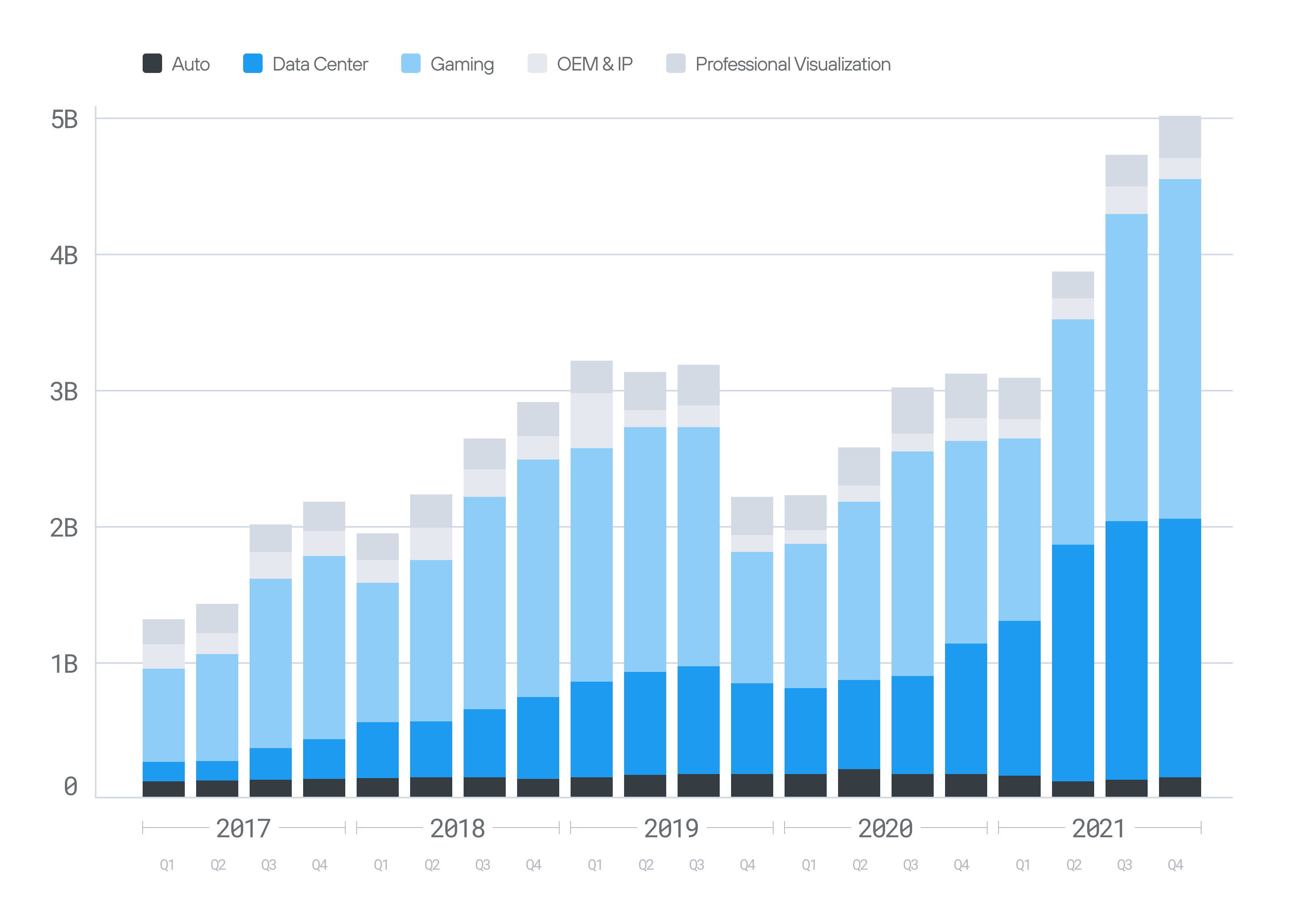
Chart depicting NVIDIA's earnings segmented by Auto, Data Center, Gaming, OEM & IP, and Professional Visualization

This might seem obvious now, but at the time it was a bold bet: instead of creating separate product lines optimized for different use-cases (laptops, desktops, IoT, datacenter, etc.), NVIDIA built a single contiguous GPU product line. This meant accepting trade-offs—such as power or cost inefficiencies—but in return, it created a unified ecosystem where every developer’s investment in CUDA could scale seamlessly from gaming GPUs to high-performance datacenter accelerators. This strategy is quite analogous to how Apple maintains and drives its iPhone product line forward.

The benefits of this approach were twofold:

  1. Lowering Barriers to Entry – Developers could learn CUDA using the GPUs they already had, making it easy to experiment and adopt.
  2. Creating a Network Effect – As more developers started using CUDA, more software and libraries were created, making the platform even more valuable.

This early install base allowed CUDA to grow beyond gaming into scientific computing, finance, AI, and high-performance computing (HPC). Once CUDA gained traction in these fields, its advantages over alternatives became clear: NVIDIA’s continued investment ensured that CUDA was always at the cutting edge of GPU performance, while competitors struggled to build a comparable ecosystem.

Catching and Riding the Wave of AI Software

CUDA’s dominance was cemented with the explosion of deep learning. In 2012, AlexNet, the neural network that kickstarted the modern AI revolution, was trained using two NVIDIA GeForce GTX 580 GPUs. This breakthrough not only demonstrated that GPUs were faster at deep learning—it proved they were essential for AI progress and led to CUDA’s rapid adoption as the default compute backend for deep learning.

As deep learning frameworks emerged—most notably TensorFlow (Google, 2015) and PyTorch (Meta, 2016)—NVIDIA seized the opportunity and invested heavily in optimizing its High-Level CUDA Libraries to ensure these frameworks ran as efficiently as possible on its hardware. Rather than leaving AI framework teams to handle low-level CUDA performance tuning themselves, NVIDIA took on the burden by aggressively refining cuDNN and TensorRT as we discussed in Part 2.

This move not only made PyTorch and TensorFlow significantly faster on NVIDIA GPUs—it also allowed NVIDIA to tightly integrate its hardware and software (a process known as “hardware/software co-design”) because it reduced coordination with Google and Meta. Each major new generation of hardware would come out with a new version of CUDA that exploited the new capabilities of the hardware. The AI community, eager for speed and efficiency, was more than willing to delegate this responsibility to NVIDIA—which directly led to these frameworks being tied to NVIDIA hardware.
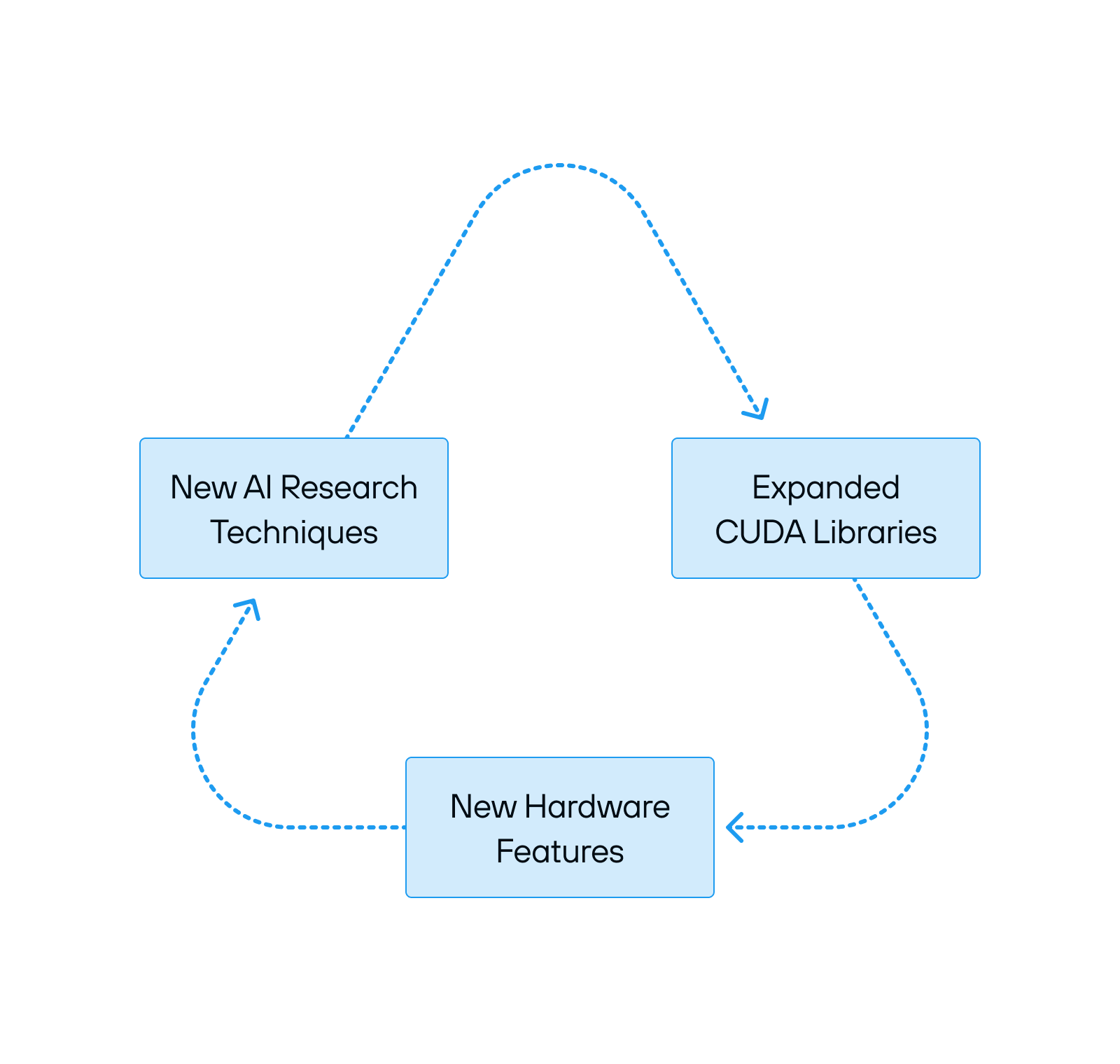
Circular diagram depicting the inter-relationship of New AI Research Techniques, Expanded CUDA Libraries, and New Hardware Feature

But why did Google and Meta let this happen? The reality is that Google and Meta weren’t singularly focused on building a broad AI hardware ecosystem—they were focused on using AI to drive revenue, improve their products, and unlock new research. Their top engineers prioritized high-impact internal projects to move internal company metrics. For example, these companies decided to build their own proprietary TPU chips—pouring their effort into optimizing for their own first-party hardware. It made sense to give the reins to NVIDIA for GPUs.

Makers of alternative hardware faced an uphill battle—trying to replicate the vast, ever-expanding NVIDIA CUDA library ecosystem without the same level of consolidated hardware focus. Rival hardware vendors weren’t just struggling—they were trapped in an endless cycle, always chasing the next AI advancement on NVIDIA hardware. This impacted Google and Meta’s in-house chip projects as well, which led to numerous projects, including XLA and PyTorch 2. We can dive into these deeper in subsequent articles, but despite some hopes, we can see today that nothing has enabled hardware innovators to match the capabilities of the CUDA platform.

With each generation of its hardware, NVIDIA widened the gap. Then suddenly, in late 2022, ChatGPT exploded onto the scene, and with it, GenAI and GPU compute went mainstream.

Capitalizing on the Generative AI Surge

Almost overnight, demand for AI compute skyrocketed—it became the foundation for billion-dollar industries, consumer applications, and competitive corporate strategy. Big tech and venture capital firms poured billions into AI research startups and CapEx buildouts—money that ultimately funneled straight to NVIDIA, the only player capable of meeting the exploding demand for compute.

As demand for AI compute surged, companies faced a stark reality: training and deploying GenAI models is incredibly expensive. Every efficiency gain—no matter how small—translated into massive savings at scale. With NVIDIA’s hardware already entrenched in data centers, AI companies faced a serious choice: optimize for CUDA or fall behind. Almost overnight, the industry pivoted to writing CUDA-specific code. The result? AI breakthroughs are no longer driven purely by models and algorithms—they now hinge on the ability to extract every last drop of efficiency from CUDA-optimized code.
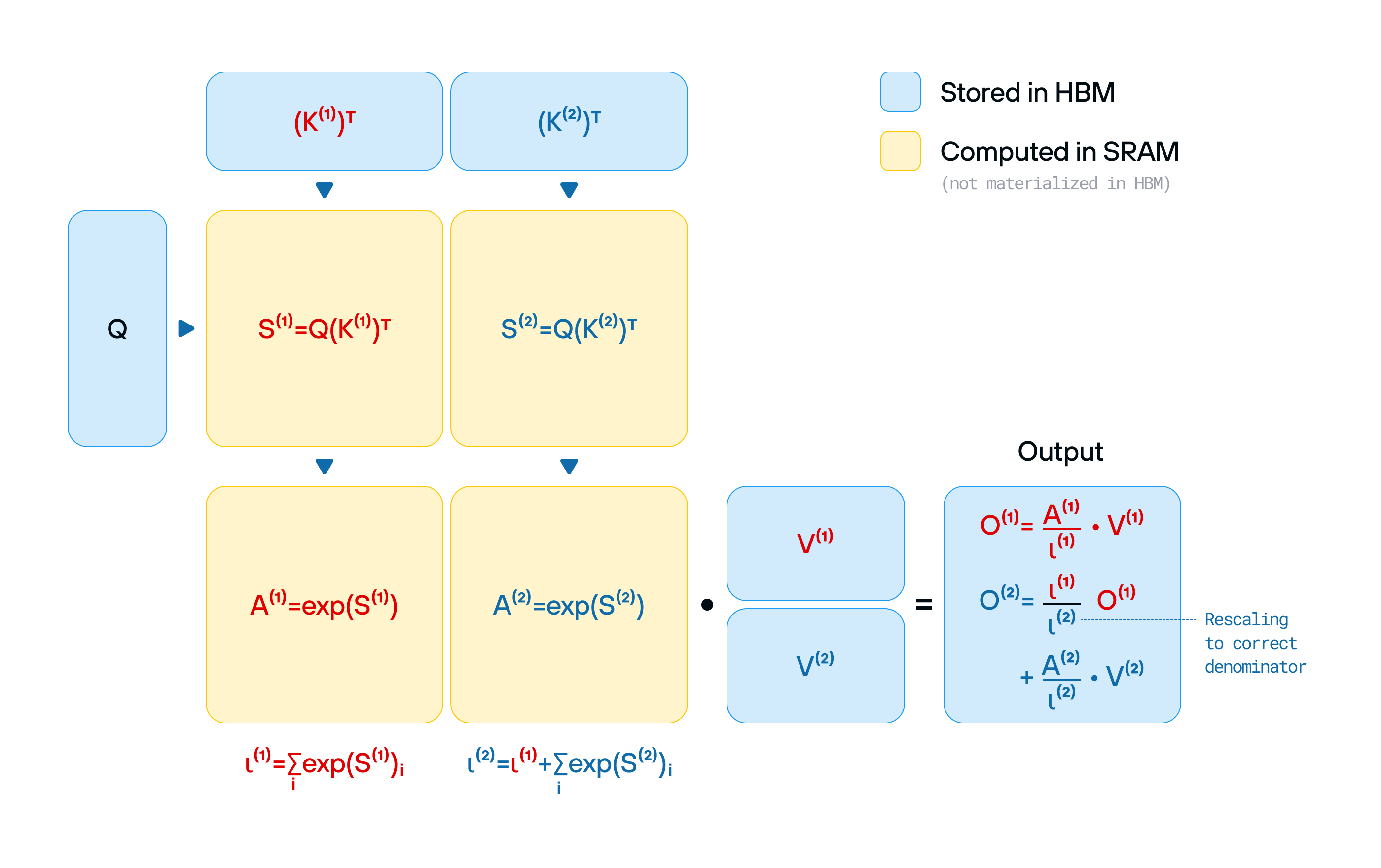
Diagram depicting the architecture of FlashAttention-3, delineated by Stored in HBM vs. Computed in SRAM

Take FlashAttention-3, for example: this cutting-edge optimization slashed the cost of running transformer models—but it was built exclusively for Hopper GPUs, reinforcing NVIDIA’s lock-in by ensuring the best performance was only available on its latest hardware. Continuous research innovations followed the same trajectory, for example when DeepSeek went directly to PTX assembly, gaining full control over the hardware at the lowest possible level. With the new NVIDIA Blackwell architecture on the horizon, we can look forward to the industry rewriting everything from scratch again.

The Reinforcing Cycles That Power CUDA’s Grip

This system is accelerating and self-reinforcing. Generative AI has become a runaway force, driving an insatiable demand for compute, and NVIDIA holds all the cards. The biggest install base ensures that most AI research happens in CUDA, which in turn drives investment into optimizing NVIDIA’s platform.
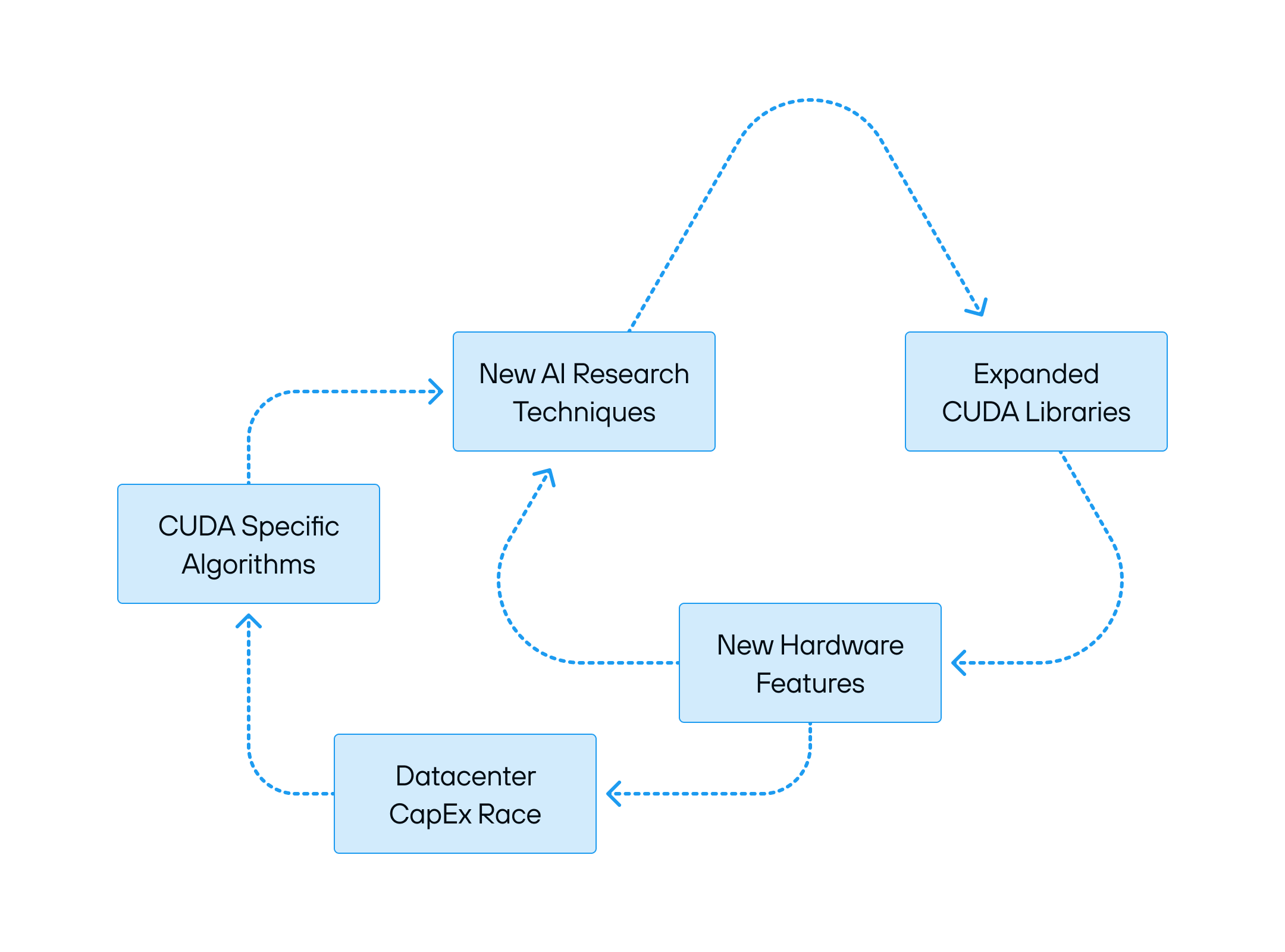
Expansion of the earlier circular diagram, this time overlaying the inter-relationship of New Hardware Features, Datacenter CapEx Race, CUDA Specific Algorithms, and New AI Research Techniques

Every new generation of NVIDIA hardware brings new features and new efficiencies, but it also demands new software rewrites, new optimizations, and deeper reliance on NVIDIA’s stack. The future seems inevitable: a world where CUDA’s grip on AI compute only tightens.

Except CUDA isn't perfect.

The same forces that entrench CUDA’s dominance are also becoming a bottleneck—technical challenges, inefficiencies, and barriers to broader innovation. Does this dominance actually serve the AI research community? Is CUDA good for developers, or just good for NVIDIA?

Let’s take a step back: We looked at what CUDA is and why it is so successful, but is it actually good? We’ll explore this in Part 4—stay tuned and let us know if you find this series useful, or have suggestions/requests! 🚀

-Chris