


We’re excited to announce MAX 25.2, a major update that unlocks industry-leading performance on the largest language models–built from the ground up without CUDA*.
This release builds on the momentum from MAX 25.1 released just a month ago, and delivers critical features to power faster, more responsive, and more customizable GenAI deployments at scale:
MAX 25.2 is a milestone in our mission to build a CUDA-free GenAI model inference platform that gives you uncompromising performance and control on a single heterogeneous stack.
👉 Dive into what’s new and get started today!
*MAX Requires the NVIDIA hardware driver for GPU access.
This release's headline feature is full multi-GPU support on NVIDIA H100 and H200s, allowing you to run even larger language models with incredible performance. You can now deploy Llama-3.3-70B-Instruct across multiple GPUs directly from MAX Builds.
After installing max-pipelines, try running a 70B parameter model in bfloat16 on 4 GPUs with a simple command:
Bash
max-pipelines generate \ --model-path=meta-llama/Llama-3.3-70B-Instruct \ --quantization-encoding bfloat16 \ --devices gpu:0,1,2,3 \ --prompt="Design a self-sustaining colony on Neptune's moon Triton..."
We rebuilt the entire AI stack from the bottom up–including all of the software that runs on the GPU–in order to bring a simple “it just works” experience to AI, without removing your power and control over AI. To do this, we implemented all of the GenAI GPU algorithms for the complex H100/H200 architecture, with performance that meets and beats the NVIDIA libraries. You don’t need to worry about this, but it does mean you can forget about CUDA version mismatches and its legacy weight!
But that's not all! We've also expanded our supported model architectures to include:
The MAX Builds repository now hosts over 500 preconfigured MAX models ready for immediate deployment. Whatever your AI use case, we've got you covered!
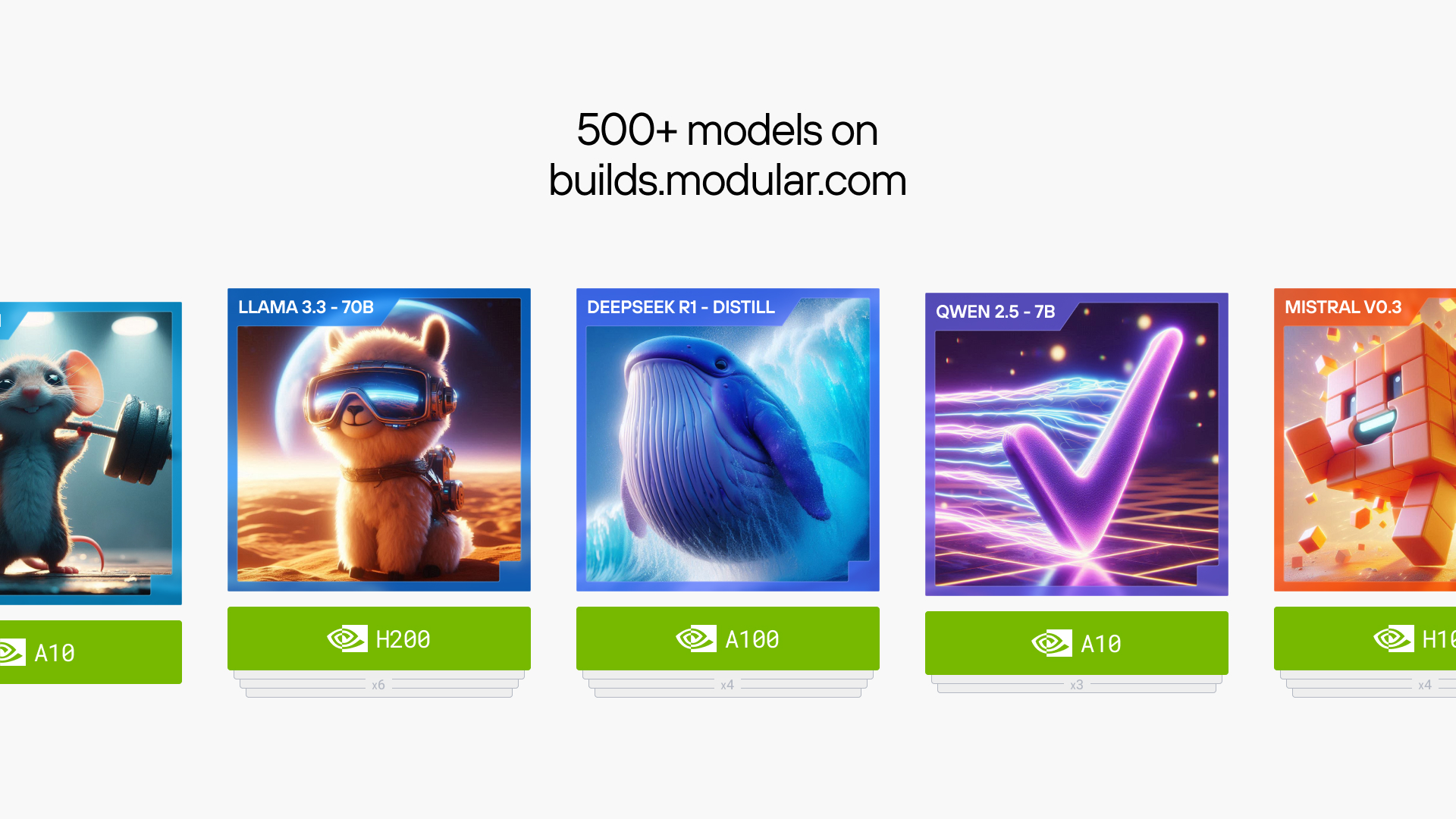
Beyond model generality, MAX transparently supports many advanced features. One example is GPTQ quantization for models–just specify the quantized weights, and MAX handles the rest. For Llama 3.1 70B, this reduces the total memory consumption of this model from about 140 GB to 35 GB, making MAX even more accessible on memory-limited devices. You can use max-pipelines to run Llama 3.1 70B using int4-quantized GPTQ weights:
Bash
max-pipelines generate \ --model-path hugging-quants/Meta-Llama-3.1-70B-Instruct-GPTQ-INT4 \ --prompt "Why is the sky blue?" \ --max-batch-size 1 --max-length 10000
Please see the detailed release notes for more details on this and other cool technology.
This release builds on our LLM serving capabilities to add:
These improvements give you better performance and capabilities that continue to "just work."
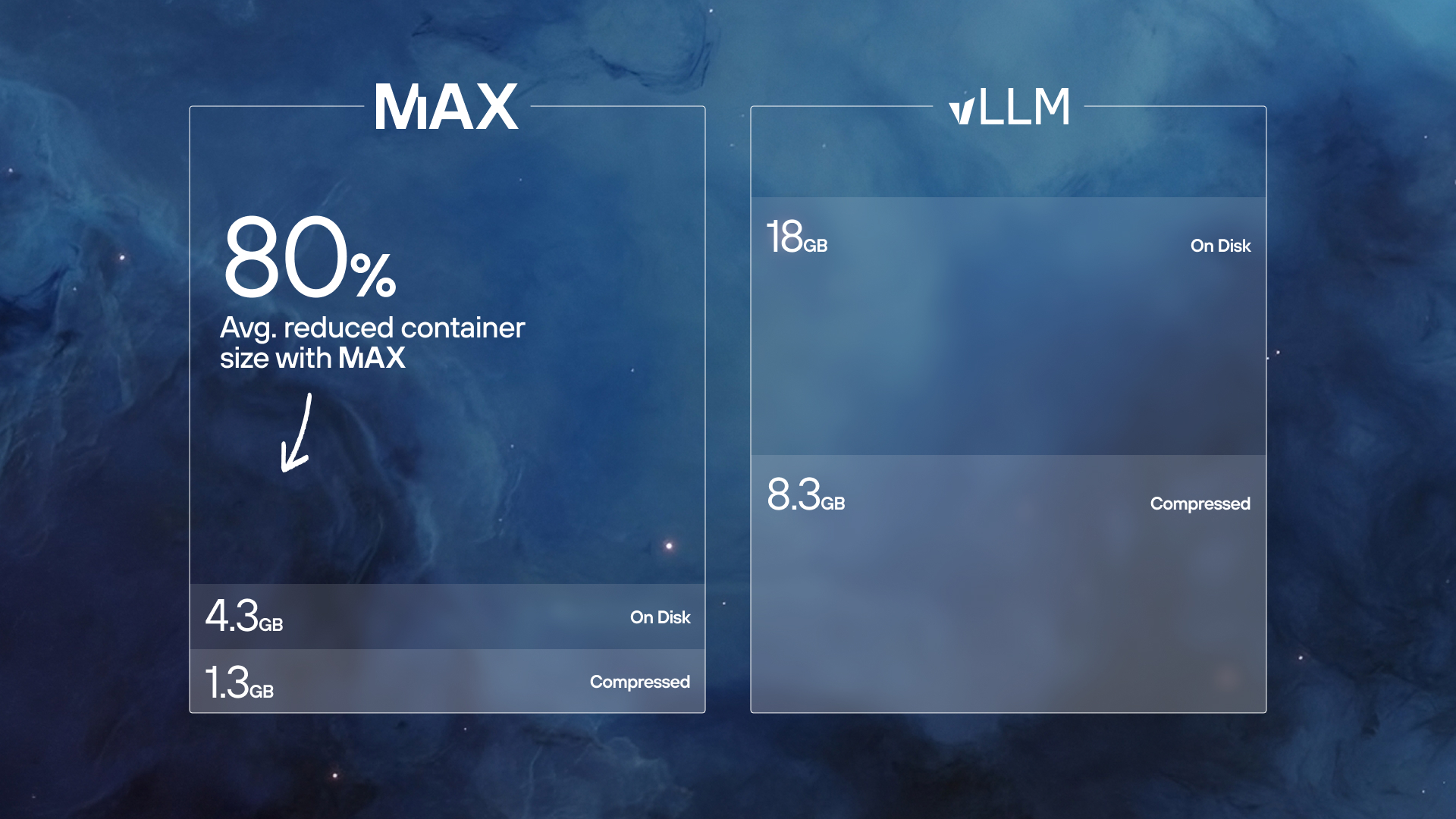
Speed matters not just in inference but also in deployment. Because MAX models are built without CUDA, we don't have to carry its weight. Our new slim Docker container slashes the footprint of the serving container to just 1.3 GB compressed, enabling lightning-fast deployments even for your largest models. Get your AI applications up and running in record time without compromising performance.
Beyond the the Open-AI compatible endpoint, MAX is also great for AI researchers and developers who want to unlock the full power of the GPU for novel applications. Our mission is to make "easy things work" without taking power or control away from you–we want to give you superpowers over AI.
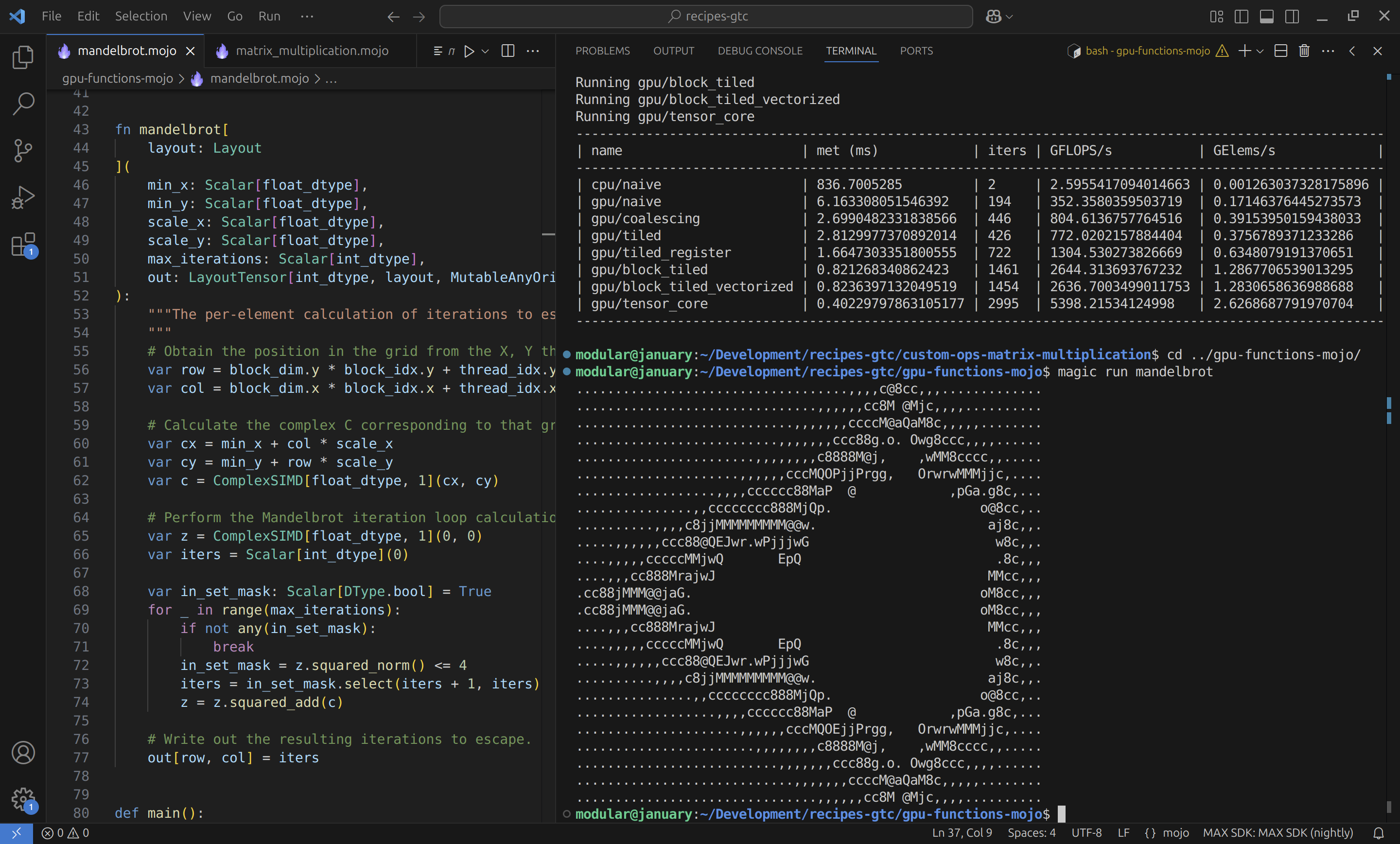
MAX and Mojo have fundamentally reimagined GPU programming. If you're familiar with CUDA C++, you'll feel right at home with a powerful GPU programming model that offers all the benefits of Mojo's modern language features.
Check out our examples on MAX Builds, which recreate the first few chapters from the popular textbook "Programming Massively Parallel Processors," but translated into Mojo. From the basic principles of vector addition to advanced patterns like high-performance matrix multiplication, we have examples to help you master device-independent GPU programming. Examples include:
You can download these recipes directly using Magic, making starting your GPU programming journey even easier. Also, don't miss the first chapter of our comprehensive guide to GPU programming in the MAX documentation!
MAX 25.2 represents a significant leap forward in our mission to make high-performance AI accessible to everyone. Whether running billion-parameter models or building custom GPU-accelerated applications, MAX provides the tools and performance you need.
Ready to get started? Download the latest release, check out our expanded documentation, or join our community to share your experiences and learn from other MAX users.
AI doesn't need to be held back by CUDA–check out MAX and Mojo🔥 today!
此内容由惯性聚合(RSS阅读器)自动聚合整理,仅供阅读参考。 原文来自 — 版权归原作者所有。