
惯性聚合 高效追踪和阅读你感兴趣的博客、新闻、科技资讯
阅读原文 在惯性聚合中打开

推荐订阅源

T
Threatpost
aimingoo的专栏
aimingoo的专栏
OSCHINA 社区最新新闻
OSCHINA 社区最新新闻
T
Tailwind CSS Blog
J
Java Code Geeks
博客园_首页
Google Online Security Blog
Hugging Face - Blog
Hugging Face - Blog
C
CXSECURITY Database RSS Feed - CXSecurity.com
I
Intezer
P
Palo Alto Networks Blog
V
Vulnerabilities – Threatpost
雷峰网
雷峰网
O
OpenAI News
SecWiki News
SecWiki News
小众软件
小众软件
酷 壳 – CoolShell
酷 壳 – CoolShell
美团技术团队
N
News | PayPal Newsroom
Project Zero
Project Zero
Forbes - Security
Forbes - Security
IT之家
IT之家
A
Arctic Wolf
WordPress大学
WordPress大学
Jina AI
Jina AI
T
Tor Project blog
博客园 - 三生石上(FineUI控件)
S
Secure Thoughts
Google DeepMind News
Attack and Defense Labs
博客园 - 聂微东
Exploit-DB.com RSS Feed
P
Privacy International News Feed
Cloudbric
Cloudbric
G
GRAHAM CLULEY
博客园 - 叶小钗
H
Hacker News: Front Page
腾讯CDC
量子位
Help Net Security
Help Net Security
人人都是产品经理
人人都是产品经理
C
Cyber Attacks, Cyber Crime and Cyber Security
月光博客
月光博客
奇客Solidot–传递最新科技情报
奇客Solidot–传递最新科技情报
宝玉的分享
宝玉的分享
爱范儿
爱范儿
L
Lohrmann on Cybersecurity
Hacker News - Newest:
Hacker News - Newest: "LLM"
Recorded Future
Recorded Future
C
CERT Recently Published Vulnerability Notes

Modular Blog

Qualcomm to Acquire Modular Modular 26.4: SOTA MoE Serving, Model Bringup via Agent Skills, Mojo 1.0 Beta 2 and More ModCon 2026: Modular’s Developer Conference Day Zero: MiniMax M3 Open Weights on Modular Cloud Modverse #55: Mojo 1.0 Beta, Community Mojo Libraries, and Real-Time Patient Conversations Powered by MAX What about OpenCL and CUDA C++ alternatives? (Democratizing AI Compute, Part 5) Why LLM Inference Needs a New Kind of Router - Part 3 Three trends from MLSys 2026 Why LLM Inference Needs a New Kind of Router - Part 2 How I built a pure Mojo app (and 10 libraries) with AI agents Hippocratic AI partners with Modular to power flexible, high-quality inference for real-time patient conversations Translating to Mojo via AI Agents Inkwell: Why Your Inference Platform Matters As Much As Your Model Why LLM Inference Needs a New Kind of Router - Part 1 Modular 26.3: Mojo 1.0 Beta, MAX Video Gen, and more Modverse #54: AMD AI DevDay, New Modular Offices, and a Community That Keeps Shipping How Frontier Coding Agents Built a Video Diffusion Pipeline on MAX TileTensor Part 1 - Safer, More Efficient GPU Kernels Modular Opens Edinburgh & San Francisco Offices Structured Mojo Kernels Part 4 - Portability and the Road Ahead Day Zero Launch: Fastest Performance for Gemma 4 on NVIDIA and AMD Modverse #54: From GTC to Edinburgh, a Community Building Momentum Software Pipelining for GPU Kernels: Part 1 - The Pipeline Problem Structured Mojo Kernels Part 3 - Composition in Practice Modular 26.2: State-of-the-Art Image Generation and Upgraded AI Coding with Mojo Modular at NVIDIA GTC 2026: MAX on Blackwell, Mojo Kernel Porting, and DeepSeek V3 on B200 Structured Mojo Kernels Part 2 - The Three Pillars Modverse #53: Community Builds, Research Milestones, and a Growing Ecosystem Structured Mojo Kernels Part 1 - Peak Performance, Half the Code The Claude C Compiler: What It Reveals About the Future of Software BentoML Joins Modular The Five Eras of KVCache Modular 26.1: A Big Step Towards More Programmable and Portable AI Infrastructure How to Beat Unsloth's CUDA Kernel Using Mojo—With Zero GPU Experience 🔥 Modular 2025 Year in Review The path to Mojo 1.0 Modverse #52: Advancing AI Together — Community Projects & Platform Milestones Modular 25.7: Faster Inference, Safer GPU Programming, and a More Unified Developer Experience "TTS 1 Max" (powered by Modular Platform) Ranked #1 Speech Model on Artificial Analysis PyTorch and LLVM in 2025 — Keeping up With AI Innovation Achieving State-of-the-Art Performance on AMD MI355 — in Just 14 Days Modular Raises $250M to scale AI's Unified Compute Layer Matrix Multiplication on Blackwell: Part 4 - Breaking SOTA Modverse #51: Modular x Inworld x Oracle, Modular Meetup Recap and Community Projects Matrix Multiplication on Blackwell: Part 3 - The Optimizations Behind 85% of SOTA Performance Matrix Multiplication on Blackwell: Part 2 - Using Hardware Features to Optimize Matmul Matrix Multiplication on Blackwell: Part 1 - Introduction Modverse #50: Modular Platform 25.5, Community Meetups, and Mojo's Debut in the Stack Overflow Developer Survey Modular Platform 25.5: Introducing Large Scale Batch Inference SF Compute and Modular Partner to Revolutionize AI Inference Economics AI Agents for AWS Marketplace Modverse #49: Modular Platform 25.4, Modular 🤝 AMD, and Modular Hack Weekend Inside Modular Hack Weekend: Top Projects and Community Highlights How is Modular Democratizing AI Compute? (Democratizing AI Compute, Part 11) Modular 25.4: One Container, AMD and NVIDIA GPUs, No Lock-In Introducing Mammoth: Enterprise-Scale GenAI Deployments Made Simple Modular + AMD: Unleashing AI performance on AMD GPUs Modverse #48: Modular Platform 25.3, MAX AI Kernels, and the Modular GPU Kernel Hackathon Exploring Metaprogramming in Mojo Modular GPU Kernel Hackathon Highlights: Innovation, Community, & Mojo🔥 Modular’s bet to break out of the Matrix (Democratizing AI Compute, Part 10) Modular Platform 25.3: 450K+ Lines of Open Source Code and pip Packaging A New, Simpler License for MAX and Mojo Why do HW companies struggle to build AI software? (Democratizing AI Compute, Part 9) Modverse #47: MAX 25.2 and an evening of GPU programming at Modular HQ What about the MLIR compiler infrastructure? (Democratizing AI Compute, Part 8) What about Triton and Python eDSLs? (Democratizing AI Compute, Part 7) MAX 25.2: Unleash the power of your H200's–without CUDA! What about TVM, XLA, and AI compilers? (Democratizing AI Compute, Part 6) Modverse #46: MAX 25.1, MAX Builds, and Democratizing AI Compute CUDA is the incumbent, but is it any good? (Democratizing AI Compute, Part 4) MAX 25.1 - Introducing MAX Builds How did CUDA succeed? (Democratizing AI Compute, Part 3) Paged Attention & Prefix Caching Now Available in MAX Serve What exactly is “CUDA”? (Democratizing AI Compute, Part 2) Modular DeepSeek's Impact on AI (Democratizing AI Compute, Part 1) Modular Hands-on with Mojo 24.6 Evaluating Llama Guard with MAX 24.6 and Hugging Face Modular Introducing MAX 24.6: A GPU Native Generative AI Platform MAX GPU: State of the Art Throughput on a New GenAI platform Understanding SIMD: Infinite Complexity of Trivial Problems Community Spotlight: Writing Mojo with Cursor Hands-on with Mojo 24.5 MAX 24.5 - With SOTA CPU Performance for Llama 3.1 Announcing stack-pr: an open source tool for managing stacked PRs on GitHub Debugging in Mojo🔥 Write hardware-agnostic custom ops for PyTorch | Modular Take control of your AI Develop locally, deploy globally A brief guide to the Mojo n-body example What's new in MAX 24.4? MAX on macOS, fast local Llama3, native quantization and GGUF support What’s new in Mojo 24.4? Improved collections, new traits, os module features and core language enhancements MAX 24.4 - Introducing quantization APIs and MAX on macOS Deep dive into ownership in Mojo What ownership is really about: a mental model approach Fast⚡k-means clustering in Mojo🔥: a guide to porting Python to Mojo🔥 for accelerated k-means clustering
Modular 25.6: Unifying the latest GPUs from NVIDIA, AMD, and Apple
No items found. · 2025-09-22 · via Modular Blog

Introducing 25.6

We’re excited to announce Modular Platform 25.6 – a major milestone in our mission to build AI’s unified compute layer. With 25.6, we’re delivering the clearest proof yet of our mission: a unified compute layer that spans from laptops to the world’s most powerful datacenter GPUs. The platform now delivers:

  • Peak performance on NVIDIA Blackwell (B200) GPUs: MAX achieves industry-leading throughput and latency wins, fully reproducible with our public benchmarking scripts.
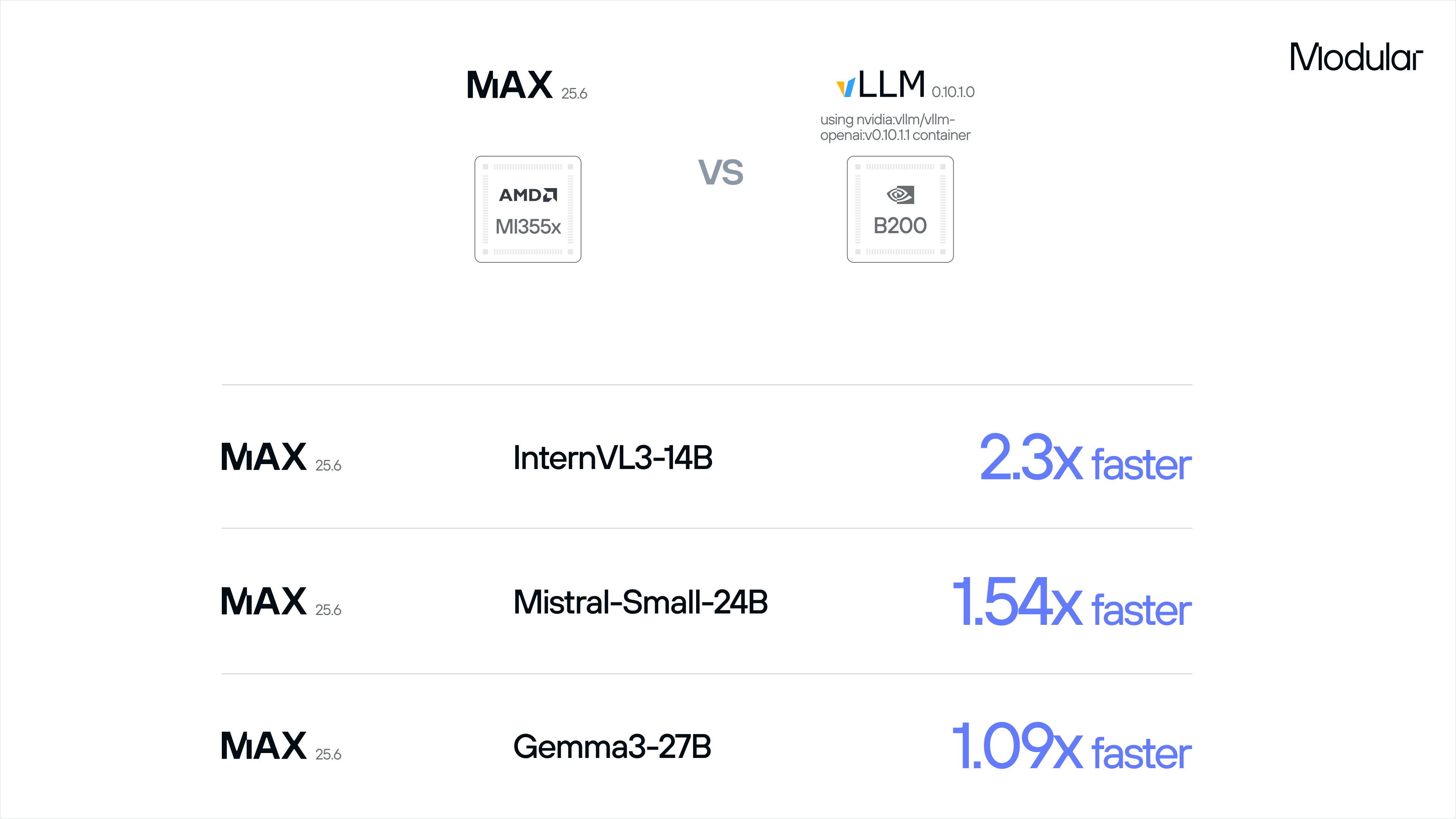
  • Peak performance on AMD MI355X GPUs: Modular’s performance uplift is even more pronounced on AMD’s latest MI355X GPUs - early benchmarks show MAX on MI355X can even outperform vLLM on Blackwell - and we’re not done yet!
  • Developer support for Apple, AMD, and NVIDIA consumer GPUs: Developers can now use Mojo to program many consumer GPUs from AMD, NVIDIA, and - highly requested - Apple Silicon GPUs. Mojo’s unified programming model enables accessibility for a wide range of developers learning GPU programming, not just enterprises with datacenter scale accelerators.

Beyond new hardware, this release builds in countless improvements from our 25.5 release just 7 weeks ago: Developers will enjoy new pip install mojo support, enhanced VS Code support, a wide range of improvements to Mojo and MAX APIs, increased model support, and many other features covered in our changelogs (MAX🧑‍🚀, Mojo🔥).

Why Unified Compute? Why Now?

AI is desperate for more compute! Models are bigger, prompts are longer, reasoning is more complex, and inference demand is exploding. Datacenter construction is surging, with new “neo-clouds” emerging and governments racing to build sovereign capacity. GPU vendors like NVIDIA and AMD are accelerating product cycles – shipping yearly upgrades with more memory, bandwidth, and new datatypes (FP4, FP6, and beyond). Hardware startups are raising billions aiming to break in, while hyperscalers are designing their own silicon to secure supply and reduce dependence on third-party GPU vendors.

But hardware alone isn’t enough. Without the right software, even the most powerful hardware can’t deliver on its promise. Developers have been stuck with fragmented, inefficient stacks that make portability and peak performance elusive. Anthropic recently pulled back the curtain on the pain of juggling NVIDIA GPUs, Google TPUs, and AWS Trainium: the bottleneck isn’t FLOPs – it’s the lack of full-stack software that provides abstractions, portability, and end-to-end performance. This is a deployment and maintenance nightmare!

The industry has long sought a simple, scalable foundation for AI: a unified compute layer delivering state-of-the-art performance and portability across the most advanced hardware. With the Modular 25.6 release, that vision is now reality – a unified software layer that unifies the latest GPUs from NVIDIA, AMD, and Apple.

Deep Dives: Performance Highlights

NVIDIA B200: Incredible Performance on NVIDIA’s Best

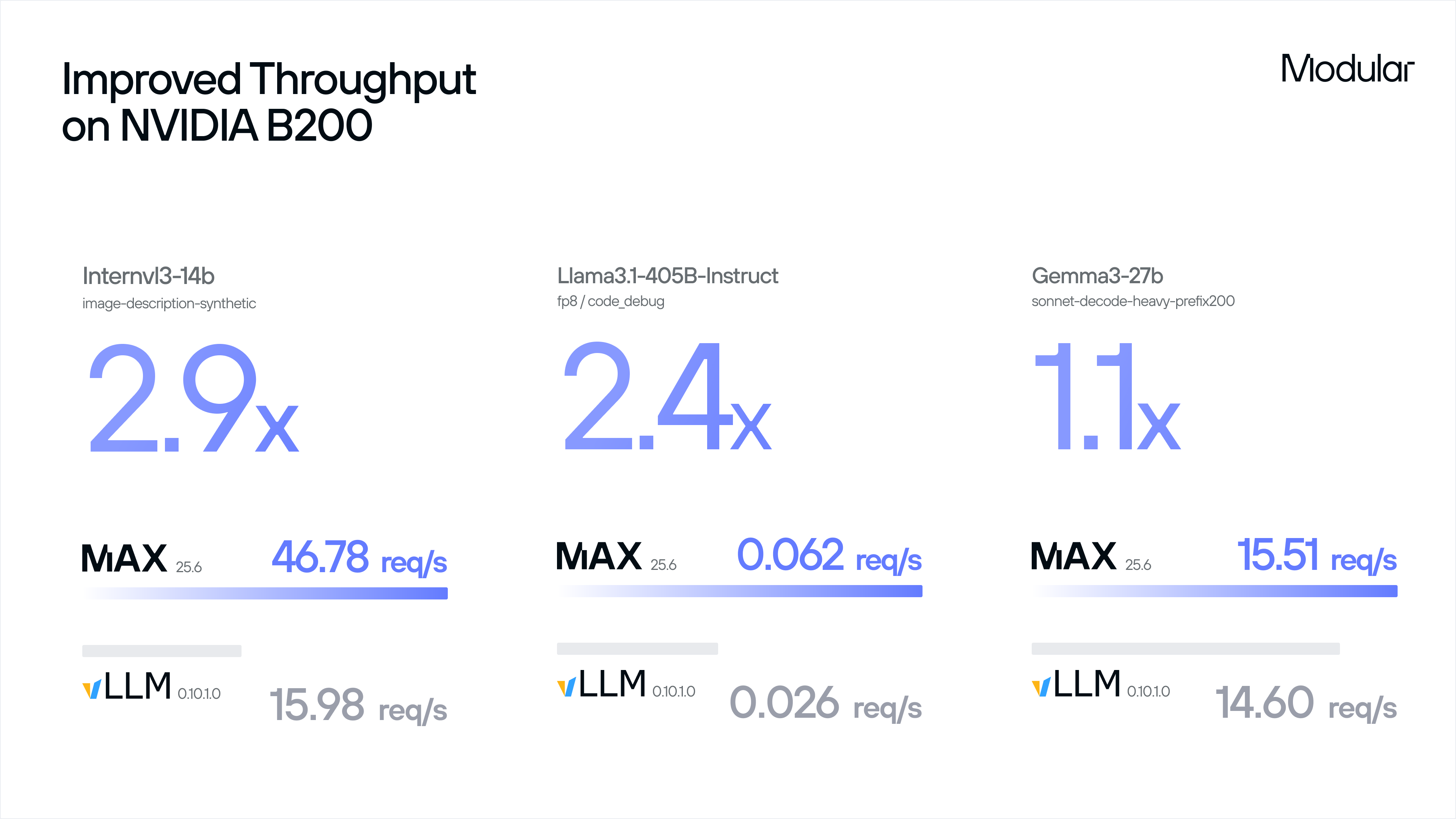
MAX delivers industry leading performance on NVIDIA Blackwell 200s, NVIDIA’s current flagship datacenter GPU. Following our partnership with Inworld, where we delivered 2.5x throughput wins and 3.3x latency wins (time to first audio) for their state-of-the-art text-to-speech model, we’ve now optimized MAX on B200 for additional use cases:
__wf_reserved_inherit

All results are fully reproducible: you can validate these numbers yourself by running our public benchmarking script on an endpoint deployed with the MAX container or pip package. To better understand how we’ve achieved these results, we’ve written a 4-part deep dive on how we were able optimize the matrix multiplication by fully utilizing Blackwell’s exotic architecture.

AMD MI355X: Head-to-Head with Blackwell

AMD has released the MI355X to go head-to-head with NVIDIA’s Blackwell – and it’s already being deployed by major cloud providers worldwide, including by our partner TensorWave. Thanks to TensorWave, we got first access to MI355X hardware on September 5th – barely two and a half weeks ago – and we’re excited to share that we’re already seeing strong results.

The obvious question is: can MI355X compete with Blackwell? Early signs point to yes. While performance always depends on the workload, MAX on MI355X delivers clear gains over vLLM on Blackwell, multiplying AMD’s existing price advantage into a significant TCO opportunity:
__wf_reserved_inherit

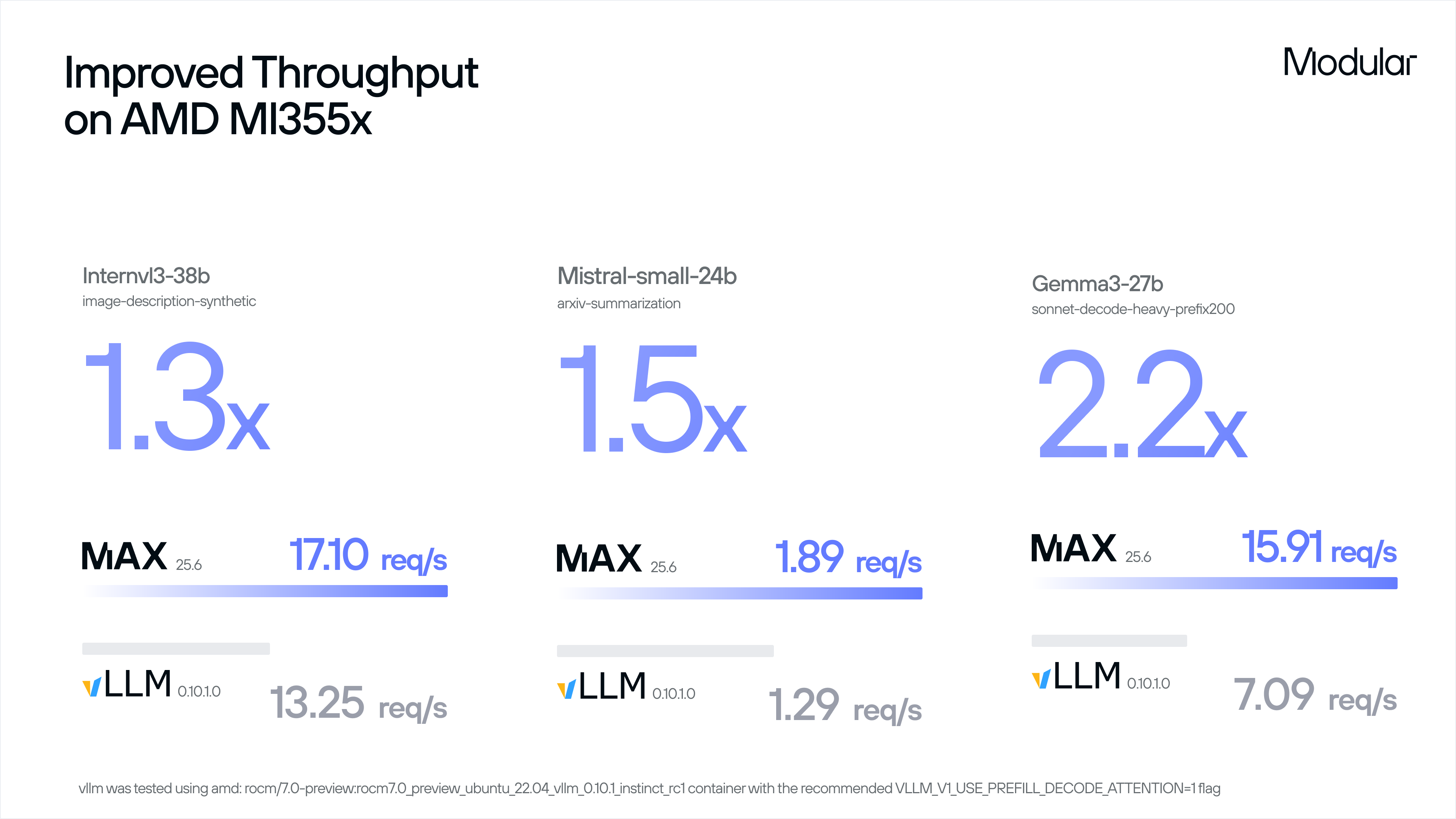
Modular achieves these performance results by bringing Modular’s advanced software to AMD’s impressive hardware.  You can see this contribution more directly by comparing MAX to vLLM directly on AMD MI355X, where MAX outperforms vLLM by wide margins:
__wf_reserved_inherit

Note that Modular has only had access to this architecture for a short time - these results reflect the benefits that our portable-by-design software brings to new hardware enablement, but we expect these numbers to improve even further as we have more time with the architecture. 

Getting started is simple: deploy our AMD container on an MI355X GPU. You can reproduce our results today by running our benchmarking script.

Mojo🔥 Support for Apple Silicon GPUs

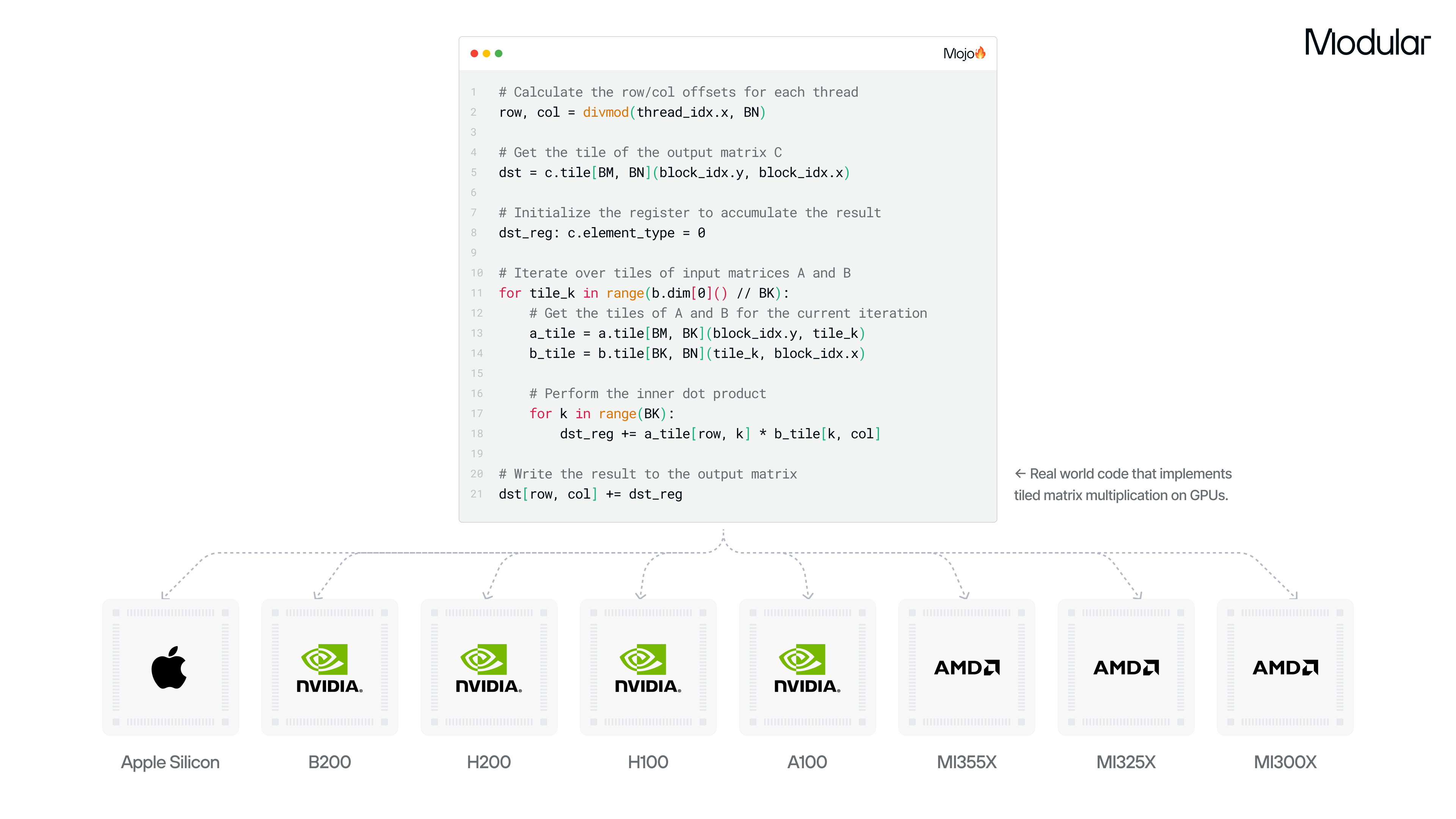
Modular’s mission is to democratize AI compute, and we know that datacenter accelerators are not within reach of many developers. With 25.6, we’ve begun to break down this barrier by enabling initial support for Apple Silicon GPUs - as well as many NVIDIA and AMD consumer GPUs.

For the first time, Mac users can directly tap into laptop or desktop GPUs with Mojo and try out the first seven Mojo GPU puzzles. This step enables these GPU algorithms to run unmodified across Apple Silicon GPUs, NVIDIA Blackwell, AMD MI325X, AMD MI355X, not to mention the Hopper, Ampere, MI300 and other GPUs Modular already supports. Write once, run anywhere.
__wf_reserved_inherit

Modular’s support for Apple Silicon GPUs is evolving rapidly: we encourage developers to utilize our nightly releases, which will enable end-to-end GenAI model execution soon.

pip install mojo and a New Mojo LSP

Mojo development is now one command away: pip install mojo

For the first time, the Mojo PyPI packages ship with the compiler, Language Server Protocol (LSP) server, and debugger all bundled together. That means developers using pip or uv get the full Mojo experience out of the box – and can even publish their own PyPI packages that depend directly on Mojo.

We’re also rolling out a significantly improved Mojo VS Code extension. It is rebuilt from the ground up to support both nightly and stable projects and deliver a more streamlined experience – it’s faster, more flexible, and completely open source! Over time, it will become even more customizable, improving life for Mojo developers whether you’re coding in VS Code, Cursor, or another IDE.

Mojo as a language has also received some exciting new capabilities, like stack traces on crashes, default methods on traits, significant extensions to the standard library, and far more.

Get started now and dig into the details!

Ready to dive into Modular 25.6? Jump right in by deploying and benchmarking a MAX endpoint using our quickstart guide. You can deploy a wide range of high-performance LLMs on NVIDIA or AMD GPUs using the MAX container. Or you can pip install Mojo and start writing code accelerated by NVIDIA, AMD, and Apple Silicon GPUs.

If you have access to NVIDIA B200 or AMD MI355X hardware, we encourage you to follow the quickstart which shows how to use our included benchmark script to validate the performance gains shown above on your own workloads. And if you're an advanced enterprise pushing the boundaries of Blackwell and MI355X, please reach out here.

For a deeper look at what’s new, a full list of changes are available in the MAX and Mojo changelogs. As always, your feedback and contributions help shape the future of the Modular platform. Join the discussion on our community forum – and come build with us in open source!