
惯性聚合 高效追踪和阅读你感兴趣的博客、新闻、科技资讯
阅读原文 在惯性聚合中打开

推荐订阅源

Threat Intelligence Blog | Flashpoint
WordPress大学
WordPress大学
N
Netflix TechBlog - Medium
宝玉的分享
宝玉的分享
V
Visual Studio Blog
S
Securelist
P
Palo Alto Networks Blog
A
Arctic Wolf
T
Tor Project blog
P
Proofpoint News Feed
I
InfoQ
博客园 - 三生石上(FineUI控件)
T
Threat Research - Cisco Blogs
G
GRAHAM CLULEY
M
MIT News - Artificial intelligence
Cyber Security Advisories - MS-ISAC
Microsoft Security Blog
MongoDB | Blog
MongoDB | Blog
C
CXSECURITY Database RSS Feed - CXSecurity.com
Apple Machine Learning Research
S
Secure Thoughts
Cyberwarzone
Cyberwarzone
Blog — PlanetScale
Blog — PlanetScale
Simon Willison's Weblog
博客园 - 【当耐特】
大猫的无限游戏
大猫的无限游戏
腾讯CDC
Latest news
Latest news
Project Zero
Project Zero
V
Vulnerabilities – Threatpost
Y
Y Combinator Blog
S
SegmentFault 最新的问题
Schneier on Security
C
CERT Recently Published Vulnerability Notes
W
WeLiveSecurity
罗磊的独立博客
Stack Overflow Blog
Stack Overflow Blog
酷 壳 – CoolShell
酷 壳 – CoolShell
L
LINUX DO - 热门话题
N
News and Events Feed by Topic
PCI Perspectives
PCI Perspectives
C
Cisco Blogs
Application and Cybersecurity Blog
爱范儿
爱范儿
T
The Exploit Database - CXSecurity.com
The Last Watchdog
The Last Watchdog
人人都是产品经理
人人都是产品经理
GbyAI
GbyAI
Know Your Adversary
Know Your Adversary
U
Unit 42

Modular Blog

Qualcomm to Acquire Modular Modular 26.4: SOTA MoE Serving, Model Bringup via Agent Skills, Mojo 1.0 Beta 2 and More ModCon 2026: Modular’s Developer Conference Day Zero: MiniMax M3 Open Weights on Modular Cloud Modverse #55: Mojo 1.0 Beta, Community Mojo Libraries, and Real-Time Patient Conversations Powered by MAX What about OpenCL and CUDA C++ alternatives? (Democratizing AI Compute, Part 5) Why LLM Inference Needs a New Kind of Router - Part 3 Three trends from MLSys 2026 Why LLM Inference Needs a New Kind of Router - Part 2 How I built a pure Mojo app (and 10 libraries) with AI agents Hippocratic AI partners with Modular to power flexible, high-quality inference for real-time patient conversations Translating to Mojo via AI Agents Inkwell: Why Your Inference Platform Matters As Much As Your Model Why LLM Inference Needs a New Kind of Router - Part 1 Modular 26.3: Mojo 1.0 Beta, MAX Video Gen, and more Modverse #54: AMD AI DevDay, New Modular Offices, and a Community That Keeps Shipping How Frontier Coding Agents Built a Video Diffusion Pipeline on MAX TileTensor Part 1 - Safer, More Efficient GPU Kernels Modular Opens Edinburgh & San Francisco Offices Structured Mojo Kernels Part 4 - Portability and the Road Ahead Day Zero Launch: Fastest Performance for Gemma 4 on NVIDIA and AMD Modverse #54: From GTC to Edinburgh, a Community Building Momentum Software Pipelining for GPU Kernels: Part 1 - The Pipeline Problem Structured Mojo Kernels Part 3 - Composition in Practice Modular 26.2: State-of-the-Art Image Generation and Upgraded AI Coding with Mojo Modular at NVIDIA GTC 2026: MAX on Blackwell, Mojo Kernel Porting, and DeepSeek V3 on B200 Structured Mojo Kernels Part 2 - The Three Pillars Modverse #53: Community Builds, Research Milestones, and a Growing Ecosystem Structured Mojo Kernels Part 1 - Peak Performance, Half the Code The Claude C Compiler: What It Reveals About the Future of Software BentoML Joins Modular The Five Eras of KVCache Modular 26.1: A Big Step Towards More Programmable and Portable AI Infrastructure How to Beat Unsloth's CUDA Kernel Using Mojo—With Zero GPU Experience 🔥 Modular 2025 Year in Review The path to Mojo 1.0 Modverse #52: Advancing AI Together — Community Projects & Platform Milestones Modular 25.7: Faster Inference, Safer GPU Programming, and a More Unified Developer Experience "TTS 1 Max" (powered by Modular Platform) Ranked #1 Speech Model on Artificial Analysis PyTorch and LLVM in 2025 — Keeping up With AI Innovation Achieving State-of-the-Art Performance on AMD MI355 — in Just 14 Days Modular Raises $250M to scale AI's Unified Compute Layer Modular 25.6: Unifying the latest GPUs from NVIDIA, AMD, and Apple Matrix Multiplication on Blackwell: Part 4 - Breaking SOTA Modverse #51: Modular x Inworld x Oracle, Modular Meetup Recap and Community Projects Matrix Multiplication on Blackwell: Part 3 - The Optimizations Behind 85% of SOTA Performance Matrix Multiplication on Blackwell: Part 2 - Using Hardware Features to Optimize Matmul Matrix Multiplication on Blackwell: Part 1 - Introduction Modverse #50: Modular Platform 25.5, Community Meetups, and Mojo's Debut in the Stack Overflow Developer Survey Modular Platform 25.5: Introducing Large Scale Batch Inference SF Compute and Modular Partner to Revolutionize AI Inference Economics AI Agents for AWS Marketplace Modverse #49: Modular Platform 25.4, Modular 🤝 AMD, and Modular Hack Weekend Inside Modular Hack Weekend: Top Projects and Community Highlights Modular 25.4: One Container, AMD and NVIDIA GPUs, No Lock-In Introducing Mammoth: Enterprise-Scale GenAI Deployments Made Simple Modular + AMD: Unleashing AI performance on AMD GPUs Modverse #48: Modular Platform 25.3, MAX AI Kernels, and the Modular GPU Kernel Hackathon Exploring Metaprogramming in Mojo Modular GPU Kernel Hackathon Highlights: Innovation, Community, & Mojo🔥 Modular’s bet to break out of the Matrix (Democratizing AI Compute, Part 10) Modular Platform 25.3: 450K+ Lines of Open Source Code and pip Packaging A New, Simpler License for MAX and Mojo Why do HW companies struggle to build AI software? (Democratizing AI Compute, Part 9) Modverse #47: MAX 25.2 and an evening of GPU programming at Modular HQ What about the MLIR compiler infrastructure? (Democratizing AI Compute, Part 8) What about Triton and Python eDSLs? (Democratizing AI Compute, Part 7) MAX 25.2: Unleash the power of your H200's–without CUDA! What about TVM, XLA, and AI compilers? (Democratizing AI Compute, Part 6) Modverse #46: MAX 25.1, MAX Builds, and Democratizing AI Compute CUDA is the incumbent, but is it any good? (Democratizing AI Compute, Part 4) MAX 25.1 - Introducing MAX Builds How did CUDA succeed? (Democratizing AI Compute, Part 3) Paged Attention & Prefix Caching Now Available in MAX Serve What exactly is “CUDA”? (Democratizing AI Compute, Part 2) Modular DeepSeek's Impact on AI (Democratizing AI Compute, Part 1) Modular Hands-on with Mojo 24.6 Evaluating Llama Guard with MAX 24.6 and Hugging Face Modular Introducing MAX 24.6: A GPU Native Generative AI Platform MAX GPU: State of the Art Throughput on a New GenAI platform Understanding SIMD: Infinite Complexity of Trivial Problems Community Spotlight: Writing Mojo with Cursor Hands-on with Mojo 24.5 MAX 24.5 - With SOTA CPU Performance for Llama 3.1 Announcing stack-pr: an open source tool for managing stacked PRs on GitHub Debugging in Mojo🔥 Write hardware-agnostic custom ops for PyTorch | Modular Take control of your AI Develop locally, deploy globally A brief guide to the Mojo n-body example What's new in MAX 24.4? MAX on macOS, fast local Llama3, native quantization and GGUF support What’s new in Mojo 24.4? Improved collections, new traits, os module features and core language enhancements MAX 24.4 - Introducing quantization APIs and MAX on macOS Deep dive into ownership in Mojo What ownership is really about: a mental model approach Fast⚡k-means clustering in Mojo🔥: a guide to porting Python to Mojo🔥 for accelerated k-means clustering
How is Modular Democratizing AI Compute? (Democratizing AI Compute, Part 11)
No items found. · 2025-06-20 · via Modular Blog

Given time, budget, and expertise from a team of veterans who’ve built this stack before, Modular set out to solve one of the defining challenges of our era: how to Democratize AI Compute. But what does that really mean—and how does it all add up?

This post is your end-to-end guide. We’ll walk through the technology, the architecture, and the underlying philosophy—before diving deeper into each layer in future posts.

At the heart of it is a singular idea: to democratize AI compute, we need to unify the scattered stars of AI:

  • Unify developers—across backgrounds and skill levels.
  • Unify low-level software—across frameworks and runtimes.
  • Unify hardware makers—across vendors, devices, and use cases.
  • Unify an industry of competing interests—who have grown a chaotic software stack that consolidated around one dominant vendor.

For too long, the AI software landscape has been a disconnected starfield—brilliant points of innovation, but hard to navigate, harder to connect, and spreading further apart every year. Modular is building the infrastructure to turn that starfield into a constellation: a coherent system that helps developers chart their path, unites the stars, and unlocks the full potential of AI.

Success in AI isn’t just about how powerful your hardware is, it’s about how many people can use it. That means lowering barriers, opening access, and building software tools that people love to use—not just to run benchmarks.

🌌 The World’s First Unified AI Constellation

Democratizing AI compute is about removing the invisible dark matter that divides the landscape. Today, the stars of AI are scattered across vendor boundaries, siloed software stacks, and outdated abstractions. We all want higher throughput and lower latency and TCO, but AI developers & deployers are forced to choose: a “safe bet for today” or owning your destiny with portability and generality in the future.

At Modular, we believe there’s a better way. One that doesn’t ask developers to compromise: we’re building toward a unified constellation.

Our goal is to expose the full power of modern hardware—NVIDIA’s Tensor Cores, AMD’s matrix units, Apple’s advanced unified memory architecture—not by hiding their complexity, but by building a system that understands it. One that lets developers scale effortlessly across clients, datacenters, and edge devices—without getting lost in a maze of incompatible compilers and fragmented runtimes.

It’s time to move beyond legacy architectures—like OpenCL and CUDA—designed in a pre-GenAI era. CUDA launched the AI revolution, and the industry owes it a great deal. But the future requires something more: a software stack built for GenAI from the ground up, designed for today’s workloads, today’s developers, and today’s hardware and scale.

This constellation can’t be unified by any single hardware vendor: vendors build great software for their chips—but the starry night sky is much broader. It spans NVIDIA, AMD, Intel, Apple, Qualcomm, and others in the hardware regatta ⛵, along with a wave of new stars rising across the AI hardware frontier. We think the industry must link arms and build together instead of fragmenting the galaxy further.

At Modular, we measure success with a simple but ambitious goal:

We want a unified, programmable system (one small binary!) that can scale across architectures from multiple vendors—while providing industry-leading performance on the most widely used GPUs (and CPUs).

That’s what a unified constellation means: Not uniformity—but a coherent, collaborative, and collective momentum. A system that celebrates hardware diversity while empowering developers with a common map—one they can use to build, explore, and reach further than ever before.

🪐 A Galactic Map for AI Compute

The AI universe is vast—and it’s rare to find two developers who work on exactly the same thing. Some operate near the core, close to the metal. Others orbit further out: building models, deploying inference pipelines, or managing massive GPU fleets. The landscape is fragmented—but it doesn’t have to be.

We designed the Modular Platform to unify this space with a novel, layered architecture: a system that’s powerful when used as a whole, but modular enough to plug into your existing tools like PyTorch, vLLM, and CUDA. Whether you're writing kernels, consolidating your inference platform, or scaling your infrastructure, Modular meets you where you are—and lights the path to where you're going.

Let’s dig into how the layers stack up 🪏
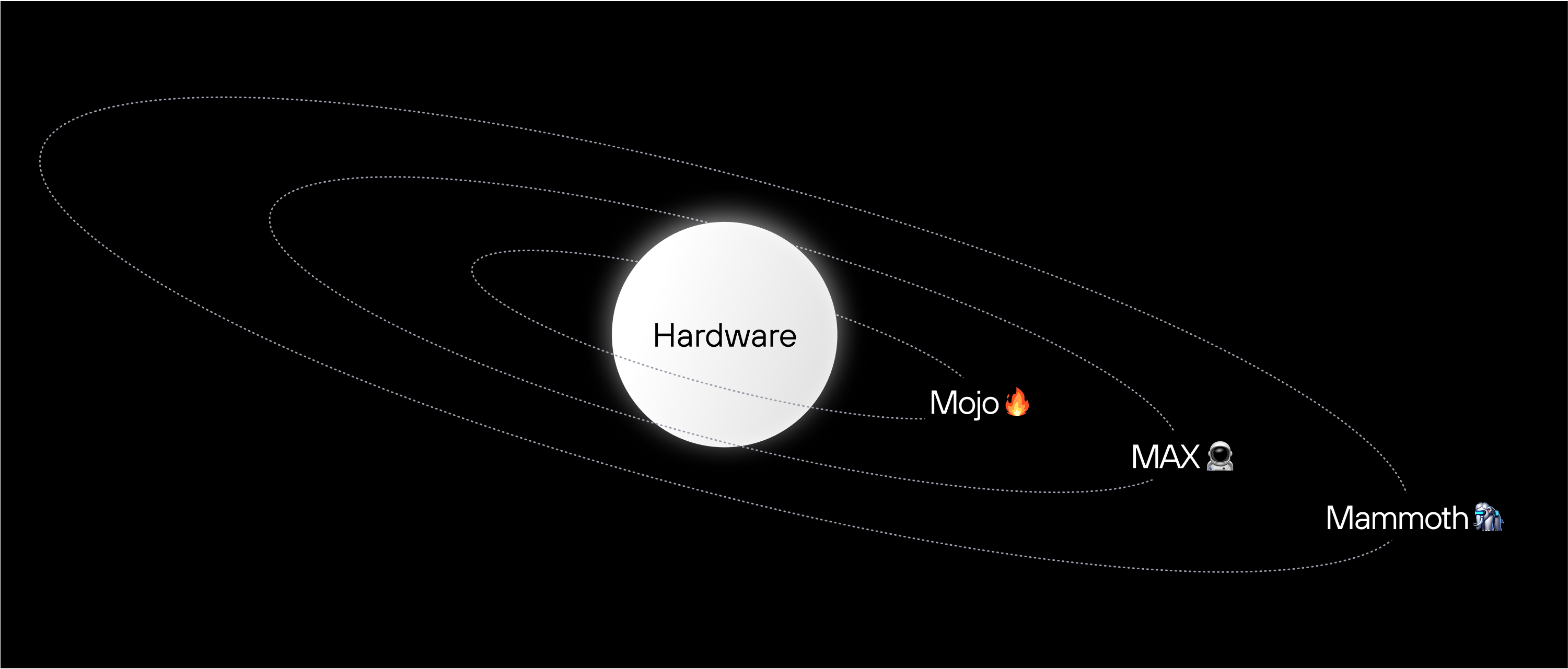
The central star of the solar system is the hardware, with Mojo closely orbiting it, while MAX  is a gas giant with a deep atmosphere. At the edges, we see the system is wrapped by a spiral arm of this Mammoth cluster.

Mojo🔥: A Programming Language for Heterogenous GenAI Compute

Mojo is a new language for a GenAI era, designed to solve the language fragmentation problem in AI. Developers love Mojo because it provides the speed and capability of C++, Rust, and CUDA but with familiar and easy-to-learn Python syntax that AI developers demand.

Mojo seamlessly integrates into existing workflows—Mojo files live side-by-side with Python modules with no bindings or extra build tools—while unlocking modern hardware: CPUs, GPUs, and custom accelerators. It offers developers great flexibility and usability, whether it’s crafting advanced GPU kernels like FlashAttention, leveraging Tensor Cores and TMAs, or implementing AI-specific optimizations with low-level control.

Mojo is like the inner planets of a solar system—close to the heat, close to the metal. This is where performance lives and FLOPS go brrrr.

Though Modular is focused on AI, we believe Mojo's ability to accelerate existing Python code opens up high-performance GPU programming to millions more developers, across domains. We aspire for Mojo to be the “best way to extend Python code” for developers in all domains.

MAX 👩‍🚀: The Modeling and Serving Layer

Orbiting Mojo is MAX—a unified, production-grade GenAI serving framework that answers the natural follow-up to Mojo’s portability: “Why not just build in PyTorch?” MAX goes where PyTorch stops, packaging state-of-the-art inference into a slim 1 GB container that cold-starts fast.

GenAI is about far more than a forward pass. Modern pipelines juggle KV-cache lifecycles, paged attention, speculative decoding, and hardware-aware scheduling. MAX folds all of that complexity into a familiar, PyTorch-like Python API, so you write dynamic graphs while it delivers predictable, fleet-wide performance.

Picture MAX as the massive gas giant in your GenAI solar system. Compute is the central star, and MAX’s deep “atmosphere” of KV-cache handling, paged attention, and speculative decoding provides the gravitational heft that keeps individual AI apps in orderly orbit while letting new models or hardware drift in without turbulence.

Built for use in heterogeneous clusters, a single MAX binary extracts peak throughput from today’s H200’s, B200’s and MI325’s, growing into tomorrow’s MI355’s and B300’s, and even mixed CPU/GPU footprints. Aggressive batching and memory optimizations drive the highest tokens-per-dollar, while the elimination of surprise recompiles and kernel swaps keeps latency steady under spiky loads—turning research notebooks into production-ready GenAI services without sacrificing speed, flexibility, or hardware choice.

Mammoth 🦣: GPU Cluster Management for the GenAI Age

Mammoth is a Kubernetes-native platform that turns fixed GPU footprints—on-prem or in the cloud—into an elastic, high-performance inference fabric.

GenAI has pushed optimizations higher up the stack: modern transformer models split their pre-fill and decode stages across many GPUs, shattering two old cloud assumptions. First, workloads are no longer stateless—chatbots and agents need to preserve conversational context. Second, GPUs can’t be spun up on demand; they’re capacity-constrained assets tied to multi-year commits, so every TFLOP has to count.

Because Kubernetes is already the control plane enterprises trust, Mammoth simply drops into existing clusters and layers on the capabilities teams are missing:

  • MAX-aware orchestration lets Mammoth coordinate with MAX for just-in-time autoscaling, intelligent placement of pre-fill and decode nodes, and fast checkpoint streaming.
  • Dynamic, multi-hardware scheduling treats a cluster of accelerators from multiple vendors as one resource pool, bin-packing workloads onto the best silicon in real time.
  • A unified declarative ops model exposes one API for on-prem and cloud clusters, so platform teams can ditch bespoke schedulers and hand-rolled scripts.

The result is a simple, scalable orchestration layer that lets CIOs embrace heterogeneous hardware without vendor lock-in—while developers stay entirely inside the Kubernetes workflows they already know.

Mammoth is like the spiral arm of the galaxy—an overarching gravitational framework that organizes many solar systems at once. Mammoth’s scheduling gravity aligns each solar system into smooth, predictable rotation, making room for new “stars” or “planets” (hardware and workloads) without ever destabilizing the galactic whole.

While each of these layers—Mojo, MAX, Mammoth—can stand on its own, together they form a coherent galactic map for GenAI compute: scalable, reliable, and portable across hardware and time.

💠 High Performance Models and Kernels

The Modular Platform is more than a CUDA-replacement—it’s a launchpad that meets two very different personas right where they work:

  • AI engineers & MLOps teams want production-ready assets. We ship complete, open-source model pipelines pre-tuned for speed and packaged in a ~1 GB container that run unchanged on CPUs and NVIDIA or AMD GPUs.
  • AI researchers & kernel hackers crave low-level control. Our GitHub repo at modular/modular exposes hand-optimized GPU kernels—FlashAttention, paged attention, KV-cache orchestration, speculative decoding—written in Mojo so you can tweak internals or invent entirely new operators without rewriting the stack.

Because every model and kernel sits on a common runtime, you can start fast with proven building blocks and dive deep only when you need to. The result is the largest coherent library of portable, open-source AI components anywhere—powerful enough for enterprise teams that just want to ship, yet modular enough for researchers pushing the frontier.

Picture these model pipelines as comets that soar around the solar system, the content that gives the infrastructure meaning.

Open source remains the bedrock of AI progress; a unified ecosystem ensures you can start with something powerful and go further than ever before—whether that means shipping a feature on Monday or publishing a paper on Friday.

🏛️ An Expanding Hardware Constellation

Truly democratizing AI compute requires the ability to scale into far more hardware than any team could individually support—it requires an industry coalition and experts in the hardware to drive best-possible support for their silicon.

Hardware diversity should be the foundation of the modern AI universe, not a problem. More choice and specialized solutions will drive more progress and products into the world.

The Modular stack was specifically designed to scale into a wide range of different accelerators, giving hardware innovators control over their performance and capabilities.  Now that Modular can prove portability across multiple industry standard GPUs from leaders like NVIDIA and AMD, we would like to open up our technology platform to far more hardware partners.

We don’t have all the details figured out yet though! If you are part of a hardware company and interested to learn more, please get in touch and we’ll reach out at the right time. If you are an AI developer and would like expanded support for new hardware, please ask that hardware team to reach out to us!

📋 The Mission Checklist

A new AI platform can’t just be clever or well-intentioned—it has to ship and work. Modular's work will never be done, but we can now show real progress on every dimension we believe is critical to Democratizing AI Compute.

Here’s how we judge the Modular Platform against the scorecard we’ve used in this series to evaluate other systems:

  • 🚤⛵🛳️🚢 Enable portability across hardware from multiple vendors: Compute is already diverse with many participants, and Modular has demonstrated the ability to scale from CPUs to NVIDIA and to AMD, all from a single unified binary—an industry first. ✅ Modular’s stack is designed to support ASIC’s and more exotic systems, but still needs to prove that. ⚠️
  • 🚀 Run with top performance on the industry leader’s hardware: NVIDIA makes great hardware, has the most widely deployed datacenter footprint, and is the most widely used by enterprises. Modular delivers peak performance on NVIDIA’s powerful Hopper and Blackwell architectures, not just alternative hardware. ✅
  • 🔧 Provide a full reference implementation: Modular ships a complete, production-grade stack that you can download today: a language, a framework, a runtime, and a Kubernetes-scale system. This isn’t a whitepaper or committee spec—it’s real software you can run in production. ✅
  • Evolve rapidly: AI moves fast—we move faster. Modular ships major updates every 6–8 weeks, and we’ve brought up complex platforms like H200 and AMD MI325X in record time. This velocity is only possible because of three years of deep tech investment. ✅
  • 💻 Cultivate developer love: We build for developers—clean APIs, deep control, and tools that scale from hobby projects to HPC. We’re opening more of the stack every month, and we’re engaging directly through forums, Discord, hackathons, and events. ✅
  • 🌐 Build an open community: Modular is vastly open source: hundreds of thousands of lines of high-performance models, kernels, and serving infrastructure. This is the largest portable and open AI GPU stack available today. ✅
  • 🧩 Avoid fragmentation across implementations: We embrace openness—but anchor it in a single, stable release process. This gives the ecosystem confidence, avoids version nightmares, and provides a reliable foundation that runs across CPUs and GPUs alike. ✅
  • 🛠️ Enable full programmability: No black boxes. Mojo gives you deep control, from low-level GPU kernels to high-level orchestration, all with Pythonic clarity. Modular layers work together—but remain programmable and composable on their own. ✅
  • 🦾 Provide leverage over AI complexity: Today’s challenge isn’t just FLOPS—it’s complexity at scale. Modular brings the “best of” in GenAI systems together into one place: compiler, language, and cluster orchestration. ✅
  • 🏗️ Enable large-scale applications: Modular isn’t just for benchmarks—it’s for production. Stateful workloads, intelligent scheduling, and resource orchestration are first-class citizens. ✅
  • 🧭 Have strong leadership and vision: We’ll let our track record speak for itself. Modular is setting an ambitious course and shipping major milestones. The path ahead is long, and we’re committed to charging into it. ✅

Each goal is ambitious on its own. Together, they define what a true successor to CUDA must deliver. Modular is well on its way—but we don’t support all the world’s hardware and we know that heterogeneous compute has a future far beyond AI.

Democratizing AI compute is a galactic-scale mission—far too ambitious for any one company alone. We as an industry need to continue to come together to solve this problem as a consortium.

Stay tuned for Mojo🔥: Tackling xPU Programmability

This post laid out the big picture—a galactic map 🗺️ of Modular’s architecture and mission. But to understand how it all works, we have to start at the core.

In the next post, we’ll descend from the star clusters back toward the inner planets with Mojo: the foundation of Modular’s stack, and our boldest bet. It’s a new kind of programming language—designed to give developers deep, precise control over modern hardware, without giving up the clarity and flexibility of Python. It’s where performance meets programmability, where the hardware burns hot, truly where the magic begins.

“The future is already here — it’s just not evenly distributed.” — William Gibson

Until then, may your GPU fleets chart safe paths through the star systems—without falling into the black hole of complexity.

-Chris