


Ownership is a well-known concept in modern programming languages such as Mojo that aims to provide a safe programming model for memory management while ensuring high performance. This allows programmers to build safe abstractions without the need to manually manage memory, making development more efficient and less error-prone.
In this blog post, we will build an intuitive understanding of how memory works and expand on that foundation to create a simple mental model for the concept of ownership. This post serves as accompanying material for the deep dive on ownership by our CEO, Chris Lattner. Be sure to watch the video as well, which covers how ownership is implemented in Mojo's compiler, providing further insights and technical details.
To build a simple mental model for ownership, we first need to build an intuitive understanding of how memory works in computing.
When a program runs, it needs a place to store data. This data is stored in two main areas of memory: the stack and the heap. Understanding the difference between these two is crucial for grasping the concept of ownership.
We can visualize the stack and the heap in a simple linear model of memory as follows:
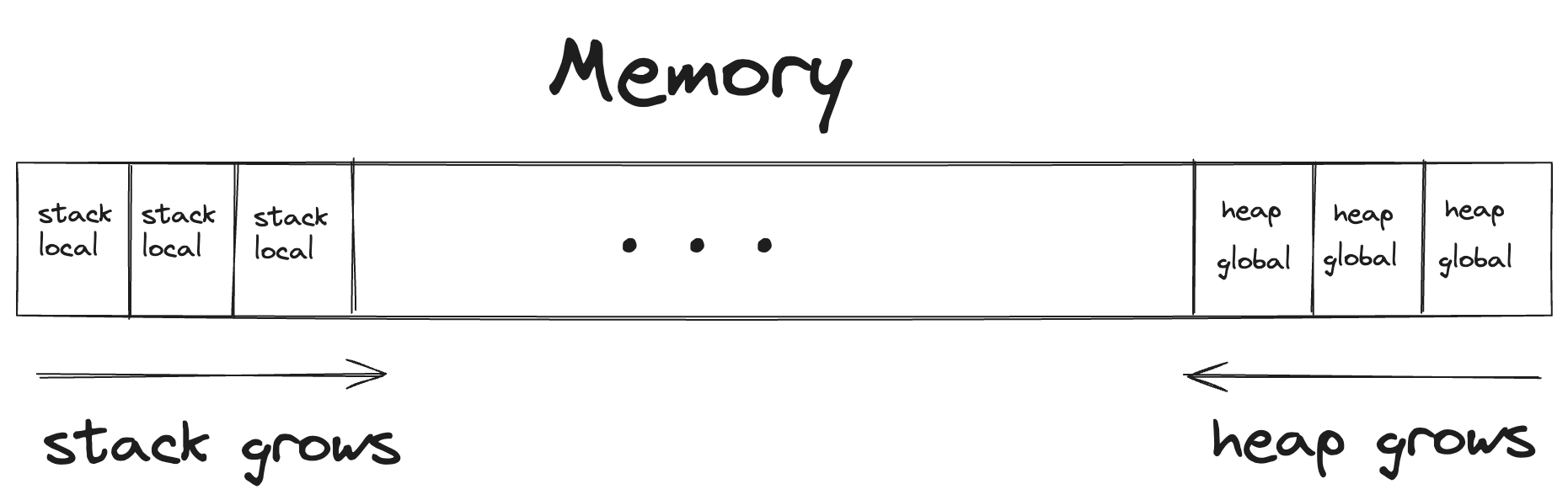
For example, the stack for the following Mojo program looks like:
Mojo
fn foo(): var y = 10 fn main(): var x = 42 foo()
We can zoom in each block of stack (i.e. stack frame) which includes a table of address, name and value. For simplicity, we do not take care of types and size of each stored value so the y‘s address is 1.
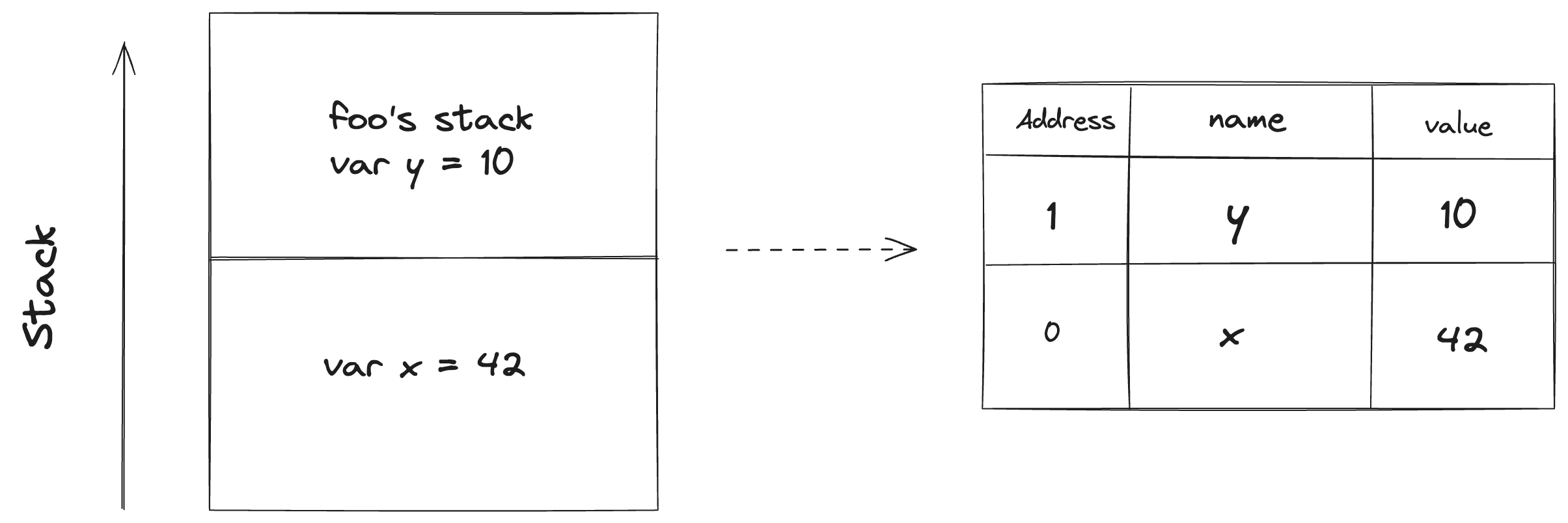
A crucial difference between the stack and the heap is that two functions cannot access each other's stack frames, making the stack local to each function. This local nature ensures that variables stored on the stack are isolated and protected from unintended interference by other functions. In contrast, the heap is globally accessible, allowing functions to share and modify the same dynamically allocated memory. This global accessibility makes the heap suitable for storing data that needs to persist and be shared across various parts of a program. Such global access forms the core of memory management. Two functions can step into each other’s heap memory, causing various issues that we will discuss later, and we will learn how ownership can prevent such memory management problems.
First, let’s see how we can access memory.
We showed a variable storing a value has an address in memory. In C such address can be found using the address operator &. In the following example, &x returns the address of x in memory which is a (raw) pointer ptr.
C
int main(): int x = 42; int *ptr = &x; // & i.e. address operator returns a raw pointer return 0;
To start building our mental model, we will use a Mojo-like pseudocode in this part to construct each piece that will eventually give rise to our mental model.
Pseudocode
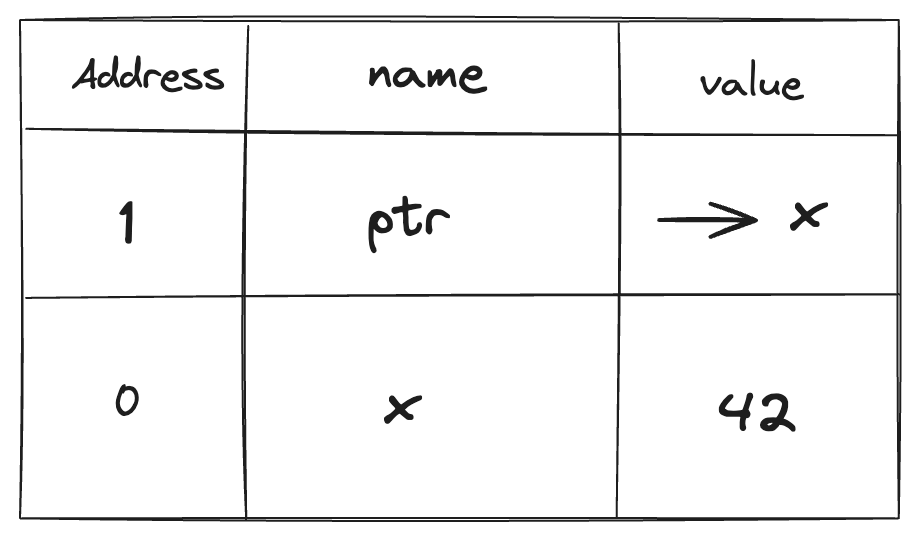
struct Address: var addr: Int ... # We don't use Mojo's keywords `inout`, `borrowed` and `owned` in this pseudocode struct RawPointer: fn alloc(self, size: Int): ... fn write(self, new_ptr: Self): ... fn read(self): ... fn free(self): ... fn main(): var x = 42 var ptr: RawPointer = Address(x)
In this example, Address represents a simple structure holding an address, and RawPointer provides methods to allocate, write, read, and free memory. The main function demonstrates creating a variable x and obtaining its address as a RawPointer. We can visualize the stack as follows where -> x refers to the value of ptr in memory.
So far, we have only worked with the stack. To work with the heap, let’s try to create a String object using our RawPointer. Note that the implementation details of String are not essential for our mental model, so we will skip them.
Pseudocode
struct String: var ptr: RawPointer ... fn main(): var x = String("hello, world!")
Looking closer, an instance of our String is created in these steps:
Pseudocode
fn main(): # step 0: Allocate enough heap memory `var x: String` var uninitialized_ptr = RawPointer().alloc(ENOUGH_SPACE) # step 1: Initialize var ptr = uninitialize_ptr.write("hello, world!") # step 2: Assign var x = ptr
In this example:
The final result can be visualized as follows where the value of x is ptr but the actual value of x is the ”hello, world!” stored in heap in binary format (below we also show the ASCII values for clarity):

Note that we also need to manually free the pointed memory after done with x. Next, let’s explore a few critical bugs that can occur with such manual memory access.
The following are the top two critical bugs that can happen in such manual memory management.
A use-after-free error occurs when a program continues to use a pointer after the memory it points to has been freed. This can lead to Undefined Behavior (UB), such as program crashes or data corruption.
Pseudocode
fn use_after_free(x: String): var tmp = String("Bye!") x.write(tmp.ptr) fn main(): var x = String("hello, world!") x.free() use_after_free(x)
A double-free error happens when a program attempts to free the same memory location more than once. This can lead to Undefined Behavior and potential security vulnerabilities.
Pseudocode
fn double_free(x: String): x.free() x.free() fn main(): var x = String("hello, world!") double_free(x)
We are now ready to build our intuitive mental model for the compiler to catch such mentioned bugs.
In order to help the compiler catch such errors, we start by including more metadata to our RawPointer representation.
As a statically compiled language, we first can enrich the RawPointer with the type information [T] as follows. Note that we are borrowing the compile-time parameter in square-brackets in Mojo
Pseudocode
struct TypedRawPointer[T]: fn alloc(self, size: Int): ... fn write(self, new_ptr: Self): ... fn read(self): ... fn free(self): ... struct String: ptr: TypedRawPointer[UInt8]
Adding type information [T] to RawPointer provides several benefits:
Next, we introduce a lifetime parameter to the TypedRawPointer[T] to track the validity period of pointer usage. This metadata tracks when a pointer is valid or has been freed.
Pseudocode
struct TypedRawPointerWithLifetime[T, Lifetime]: fn alloc(self, size: Int): ... fn write(self, new_ptr: Self): ... fn read(self): ... fn free(self): ...
With this, we have the following definitions
Definition 1: A reference is a typed raw pointer with lifetime. (Not be confused by the standard library Reference).
Pseudocode
alias Ref[T, Lifetime] = TypedRawPointerWithLifetime[T, Lifetime]
Definition 2: A reference is safe if its lifetime is in a valid state.
We should note that whenever we are done with checking lifetime, we can erase it (and its type too) to get to the underlying RawPointer.

With these added metadata, let’s go back and examine if they are enough to catch either use-after-free or double-free errors.
Here is an example of how lifetime analysis prevents double-free errors.
Pseudocode
fn double_free(x: String): x.free() x.free() fn main(): # var x = String("hello, world!") # is decomposed into # 1. allocate var uninitialized_ptr = TypedRawPointer[UInt8].alloc(ENOUGH_SPACE) # establish reference var ref = Ref[UInt8, IsALive](uninitialized_ptr) var ref_written: Ref[UInt8, IsALive] = ref.write("hello, world!") var x: Ref[UInt8, IsALive] = ref_written double_free(x) # compiler can now produce lifetime-error
First, memory heap is allocated. The allocation returns a raw pointer to an uninitialized memory. Next, a reference Ref is established and marks its lifetime as IsAlive. Finally, the data is written to the underlying memory with a variable x coming into existence.
The last line double_free(x) when expanded it becomes:
Pseudocode
x.free() # changes the liftime Ref[UInt8, IsDead] x.free() # Compiler time error because Lifetime == IsDead and `.free` can only be called when Lifetime != IsDead
Visually it looks like:
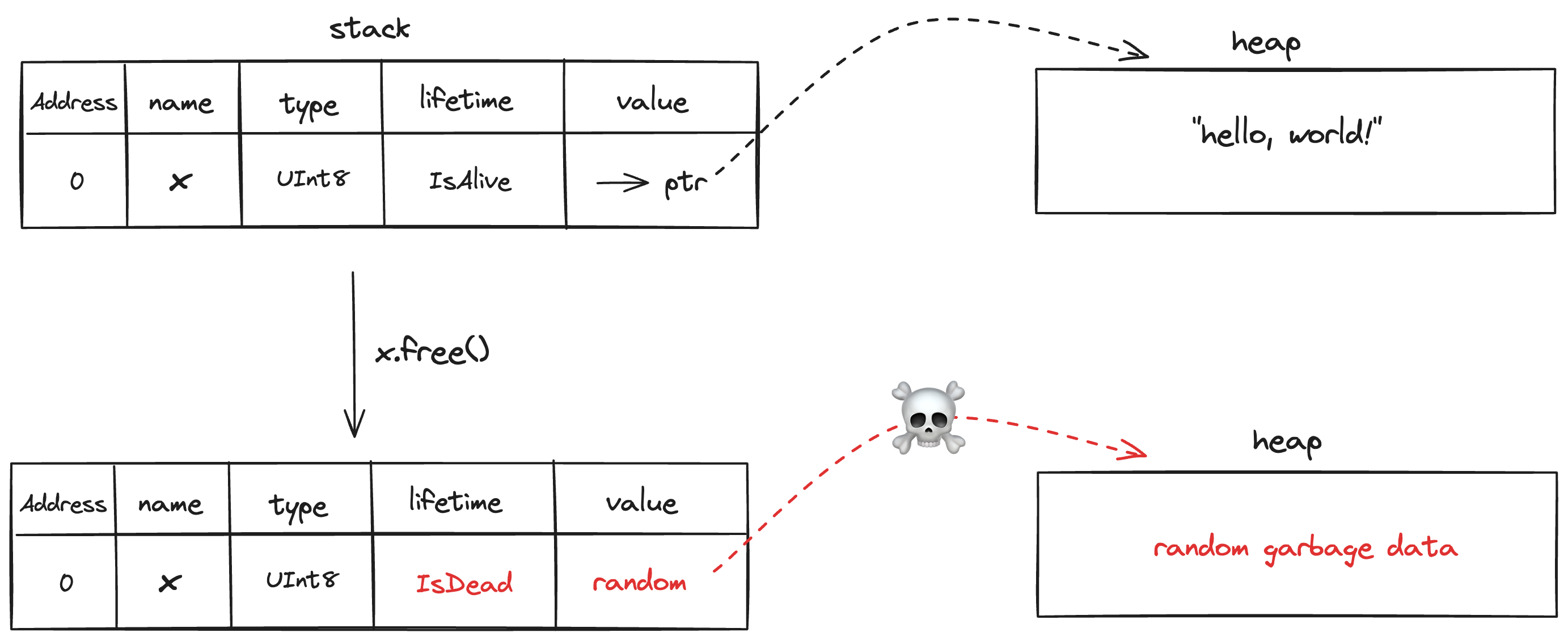
By using lifetime parameters, we can ensure that memory is only freed once, preventing double-free errors.
Let's see if lifetime analysis alone can prevent use-after-free errors.
Pseudocode
fn use_after_free(x: String): var tmp = String("Bye!") x.write(tmp.ptr) fn main(): var x = String("hello, world!") # decomposes into # 1. allocate var allocated_uninitialized_heap_memory = TypedRawPointer[UInt8].alloc(ENOUGH_SPACE) # 2. establish reference with IsBorn lifetime var ref = Ref[UInt8, IsALive](allocated_uninitialized_heap_memory) var ref_written: Ref[UInt8, IsALive] = ref.write("hello, world!") var x: Ref[UInt8, IsALive] = ref_written x.free() # changes the liftime Ref[UInt8, IsDead] use_after_free(x) # ??? this still allows use-after-free because lifetime by itself can not enforce ownership state
In the above example, the lifetime analysis ensures that the reference x is valid only within a specific time frame. After x.free(), the lifetime of the reference x is marked as IsDead, indicating that it should not be used. However, lifetime alone does not prevent other functions or parts of the code from using the reference x incorrectly (Lack of Exclusive Ownership). In the use_after_free function, x.write(tmp) is attempted even though x is already freed. Therefore, the lifetime system alone does not enforce exclusive access or prevent this usage. Lifetimes track validity but do not manage the state of the memory or enforce rules about how it can be accessed after certain operations. More metadata is needed to bake the ownership model which is necessary to ensure that once x.free() is called, no other references can access or modify x.
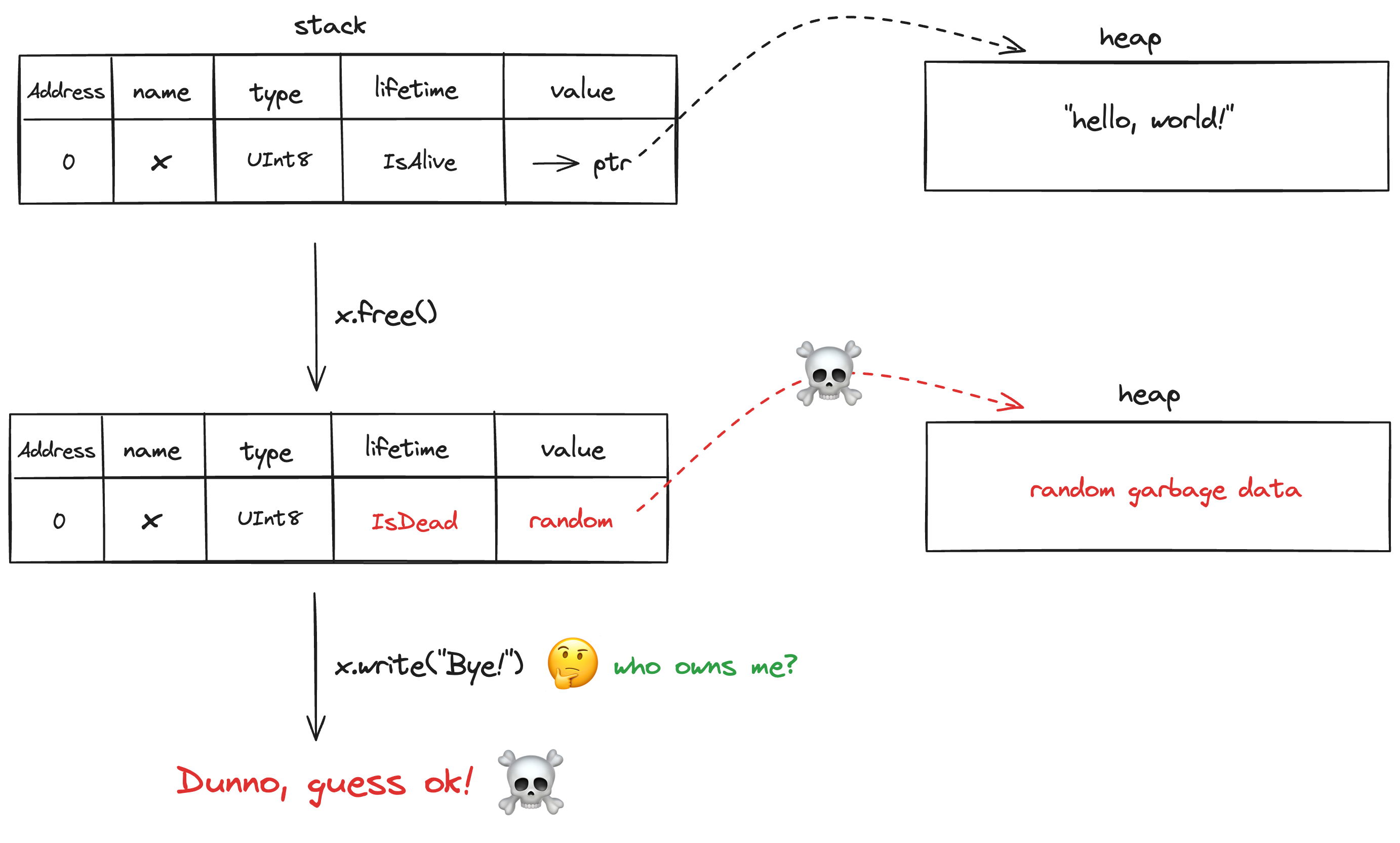
Looking at the above diagram, we might ask what if we disallow the use of x after its lifetime is marked IsDead? In that case, we will enter the dataflow analysis which keeps track of what value is in use, can or can not be used. This idea basically leads to the concept of ownership that we will talk about next.
To further enhance the safety of our memory management, we introduce ownership parameter. The goal of ownership is to enforce exclusive access and state management for memory references:
Pseudocode
struct TypedRawPointerWithLifetimeAndOwnership[T, Lifetime, Ownership]: fn alloc(self, size: Int): ... fn write(self, new_ptr: Self): ... fn read(self): ... fn free(self): ... # valid states of ownership i.e. ownership kind Ownership = Variant[Unique, Immutable, Mutable, Invalid] struct UniqueRef[T, Lifetime, Ownership = Unique]: ... struct ImmutableRef[T, Lifetime, Ownership = Immutable]: ... struct MutableRef[T, Lifetime, Ownership = Mutable]: ... struct InvalidRef[T, Lifetime, Ownership = Invalid]: ...
Such ownership parameter introduces a new layer of metadata that the compiler can use to enforce strict memory management rules:
Let’s have a look at the use-after-free case but now with ownership included
Pseudocode
struct String[Lifetime]: var ptr: UniqueRef[UInt8, Lifetime, Ownership = Unique] fn use_after_free(x: String[Lifetime]): var tmp = String("Bye!") x.write(tmp) fn main(): # var x = String("hello, world!") # is decomposed into # 1. allocate var allocated_uninitialized_heap_memory = TypedRawPointer[UInt8].alloc(ENOUGH_SPACE) # 2. establish reference var rvalue = UniqueRef[UInt8, IsALive](allocated_uninitialized_heap_memory) var rvalue_written: UniqueRef[UInt8, IsALive] = rvalue.write("hello, world!") var x: UniqueRef[UInt8, IsALive] = rvalue_written x.free() # InvalidRef[UInt8, IsDead] use_after_free(x) # compiler can now produce error # because x becomes String[IsDead]
The use-after-free error is prevented by the UniqueRef type through the following mechanisms:
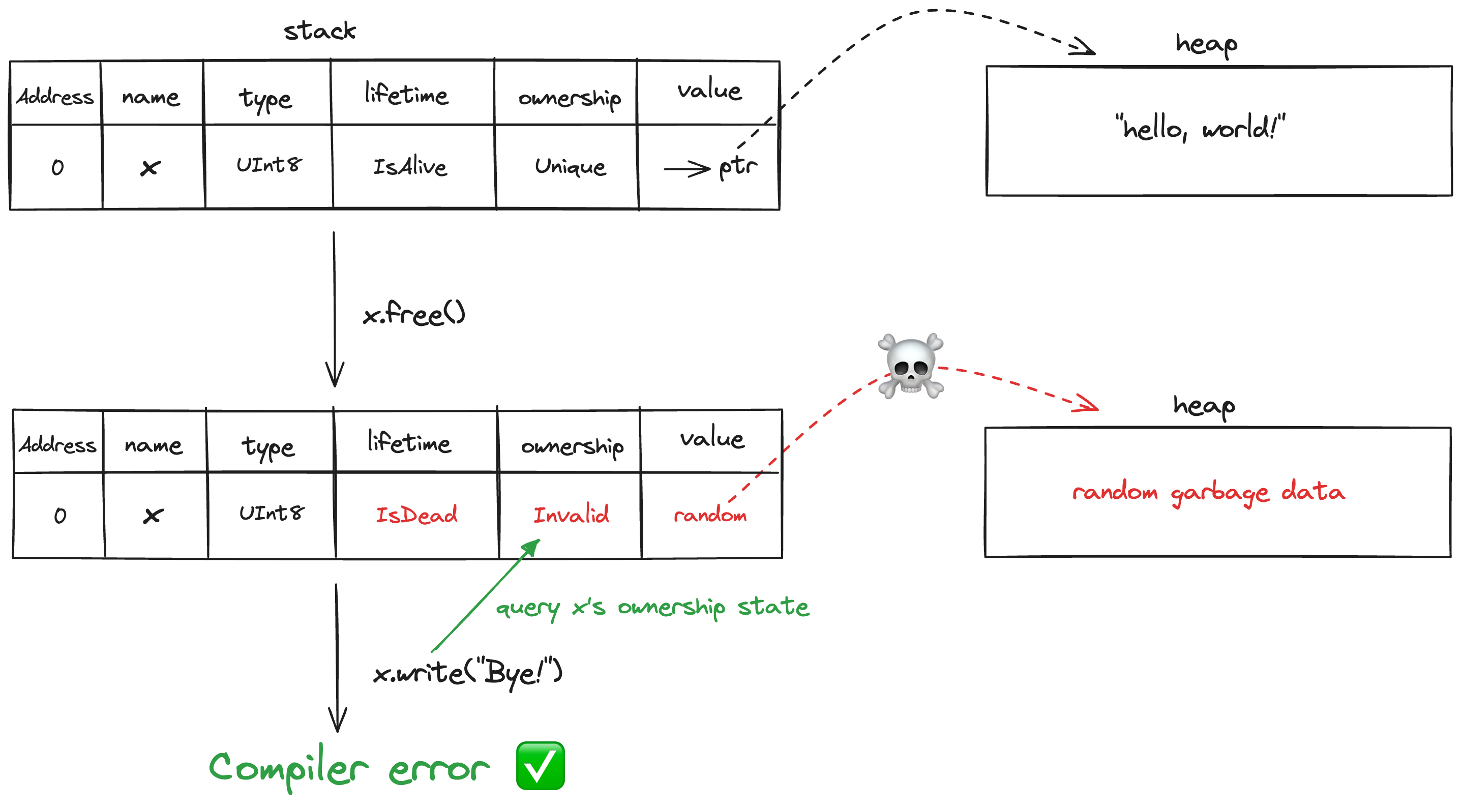
In this first part of the series on ownership, we have developed a mental model of how memory works. We talked about the stack being used for local variables and function calls, while the heap is used for dynamic memory allocation. The stack is fast and local, whereas the heap is flexible and globally accessible which can cause critical memory errors such as use-after-free and double-free that can lead to Undefined Behavior and security vulnerabilities.
Later, we tried to look through the lens of the compiler and develop an intuitive understanding of how adding type and lifetime parameters to RawPointer helps the compiler catch errors related to type safety and memory validity. Last but not least, we introduced the ownership parameter that enforces exclusive access and state management, preventing use-after-free and double-free errors. By incorporating these concepts into our mental model, we enable the compiler to catch memory management errors at compile time, ensuring safer and more efficient memory usage. In the next blog post, we will dive deep into ownership in Mojo. We end this part with the following quote from the talk.
“Ownership is a joint responsibility of type-checker and (dataflow) lifetime analysis.” - Chris Lattner
Additional resources:
Report feedback, including issues on our Mojo and MAX GitHub tracker.
Until next time! 🔥
此内容由惯性聚合(RSS阅读器)自动聚合整理,仅供阅读参考。 原文来自 — 版权归原作者所有。