
惯性聚合 高效追踪和阅读你感兴趣的博客、新闻、科技资讯
阅读原文 在惯性聚合中打开

推荐订阅源

G
Google Developers Blog
Jina AI
Jina AI
大猫的无限游戏
大猫的无限游戏
Martin Fowler
Martin Fowler
博客园 - 司徒正美
云风的 BLOG
云风的 BLOG
C
Cybersecurity and Infrastructure Security Agency CISA
CTFtime.org: upcoming CTF events
S
Securelist
S
Security Affairs
freeCodeCamp Programming Tutorials: Python, JavaScript, Git & More
L
LINUX DO - 热门话题
博客园 - 三生石上(FineUI控件)
T
Threatpost
T
The Blog of Author Tim Ferriss
C
CERT Recently Published Vulnerability Notes
IT之家
IT之家
P
Palo Alto Networks Blog
Microsoft Azure Blog
Spread Privacy
Spread Privacy
Cyberwarzone
Cyberwarzone
腾讯CDC
L
LangChain Blog
Know Your Adversary
Know Your Adversary
C
CXSECURITY Database RSS Feed - CXSecurity.com
GbyAI
GbyAI
Threat Intelligence Blog | Flashpoint
I
Intezer
T
Tor Project blog
AWS News Blog
AWS News Blog
T
Tenable Blog
NISL@THU
NISL@THU
Security Latest
Security Latest
cs.CL updates on arXiv.org
H
Hackread – Cybersecurity News, Data Breaches, AI and More
人人都是产品经理
人人都是产品经理
MongoDB | Blog
MongoDB | Blog
MyScale Blog
MyScale Blog
D
DataBreaches.Net
Microsoft Security Blog
钛媒体:引领未来商业与生活新知
钛媒体:引领未来商业与生活新知
量子位
美团技术团队
The Cloudflare Blog
酷 壳 – CoolShell
酷 壳 – CoolShell
罗磊的独立博客
The GitHub Blog
The GitHub Blog
阮一峰的网络日志
阮一峰的网络日志
OSCHINA 社区最新新闻
OSCHINA 社区最新新闻
Stack Overflow Blog
Stack Overflow Blog

Modular Blog

Qualcomm to Acquire Modular Modular 26.4: SOTA MoE Serving, Model Bringup via Agent Skills, Mojo 1.0 Beta 2 and More ModCon 2026: Modular’s Developer Conference Day Zero: MiniMax M3 Open Weights on Modular Cloud Modverse #55: Mojo 1.0 Beta, Community Mojo Libraries, and Real-Time Patient Conversations Powered by MAX What about OpenCL and CUDA C++ alternatives? (Democratizing AI Compute, Part 5) Why LLM Inference Needs a New Kind of Router - Part 3 Three trends from MLSys 2026 Why LLM Inference Needs a New Kind of Router - Part 2 How I built a pure Mojo app (and 10 libraries) with AI agents Hippocratic AI partners with Modular to power flexible, high-quality inference for real-time patient conversations Translating to Mojo via AI Agents Inkwell: Why Your Inference Platform Matters As Much As Your Model Why LLM Inference Needs a New Kind of Router - Part 1 Modular 26.3: Mojo 1.0 Beta, MAX Video Gen, and more Modverse #54: AMD AI DevDay, New Modular Offices, and a Community That Keeps Shipping How Frontier Coding Agents Built a Video Diffusion Pipeline on MAX TileTensor Part 1 - Safer, More Efficient GPU Kernels Modular Opens Edinburgh & San Francisco Offices Structured Mojo Kernels Part 4 - Portability and the Road Ahead Day Zero Launch: Fastest Performance for Gemma 4 on NVIDIA and AMD Modverse #54: From GTC to Edinburgh, a Community Building Momentum Software Pipelining for GPU Kernels: Part 1 - The Pipeline Problem Structured Mojo Kernels Part 3 - Composition in Practice Modular 26.2: State-of-the-Art Image Generation and Upgraded AI Coding with Mojo Modular at NVIDIA GTC 2026: MAX on Blackwell, Mojo Kernel Porting, and DeepSeek V3 on B200 Structured Mojo Kernels Part 2 - The Three Pillars Modverse #53: Community Builds, Research Milestones, and a Growing Ecosystem Structured Mojo Kernels Part 1 - Peak Performance, Half the Code The Claude C Compiler: What It Reveals About the Future of Software BentoML Joins Modular The Five Eras of KVCache Modular 26.1: A Big Step Towards More Programmable and Portable AI Infrastructure How to Beat Unsloth's CUDA Kernel Using Mojo—With Zero GPU Experience 🔥 Modular 2025 Year in Review The path to Mojo 1.0 Modverse #52: Advancing AI Together — Community Projects & Platform Milestones Modular 25.7: Faster Inference, Safer GPU Programming, and a More Unified Developer Experience "TTS 1 Max" (powered by Modular Platform) Ranked #1 Speech Model on Artificial Analysis PyTorch and LLVM in 2025 — Keeping up With AI Innovation Achieving State-of-the-Art Performance on AMD MI355 — in Just 14 Days Modular Raises $250M to scale AI's Unified Compute Layer Modular 25.6: Unifying the latest GPUs from NVIDIA, AMD, and Apple Matrix Multiplication on Blackwell: Part 4 - Breaking SOTA Modverse #51: Modular x Inworld x Oracle, Modular Meetup Recap and Community Projects Matrix Multiplication on Blackwell: Part 3 - The Optimizations Behind 85% of SOTA Performance Matrix Multiplication on Blackwell: Part 2 - Using Hardware Features to Optimize Matmul Matrix Multiplication on Blackwell: Part 1 - Introduction Modverse #50: Modular Platform 25.5, Community Meetups, and Mojo's Debut in the Stack Overflow Developer Survey Modular Platform 25.5: Introducing Large Scale Batch Inference SF Compute and Modular Partner to Revolutionize AI Inference Economics AI Agents for AWS Marketplace Modverse #49: Modular Platform 25.4, Modular 🤝 AMD, and Modular Hack Weekend Inside Modular Hack Weekend: Top Projects and Community Highlights How is Modular Democratizing AI Compute? (Democratizing AI Compute, Part 11) Modular 25.4: One Container, AMD and NVIDIA GPUs, No Lock-In Introducing Mammoth: Enterprise-Scale GenAI Deployments Made Simple Modular + AMD: Unleashing AI performance on AMD GPUs Modverse #48: Modular Platform 25.3, MAX AI Kernels, and the Modular GPU Kernel Hackathon Exploring Metaprogramming in Mojo Modular GPU Kernel Hackathon Highlights: Innovation, Community, & Mojo🔥 Modular’s bet to break out of the Matrix (Democratizing AI Compute, Part 10) Modular Platform 25.3: 450K+ Lines of Open Source Code and pip Packaging A New, Simpler License for MAX and Mojo Why do HW companies struggle to build AI software? (Democratizing AI Compute, Part 9) Modverse #47: MAX 25.2 and an evening of GPU programming at Modular HQ What about the MLIR compiler infrastructure? (Democratizing AI Compute, Part 8) What about Triton and Python eDSLs? (Democratizing AI Compute, Part 7) MAX 25.2: Unleash the power of your H200's–without CUDA! What about TVM, XLA, and AI compilers? (Democratizing AI Compute, Part 6) Modverse #46: MAX 25.1, MAX Builds, and Democratizing AI Compute CUDA is the incumbent, but is it any good? (Democratizing AI Compute, Part 4) MAX 25.1 - Introducing MAX Builds How did CUDA succeed? (Democratizing AI Compute, Part 3) Paged Attention & Prefix Caching Now Available in MAX Serve What exactly is “CUDA”? (Democratizing AI Compute, Part 2) Modular DeepSeek's Impact on AI (Democratizing AI Compute, Part 1) Modular Hands-on with Mojo 24.6 Evaluating Llama Guard with MAX 24.6 and Hugging Face Modular Introducing MAX 24.6: A GPU Native Generative AI Platform MAX GPU: State of the Art Throughput on a New GenAI platform Understanding SIMD: Infinite Complexity of Trivial Problems Community Spotlight: Writing Mojo with Cursor Hands-on with Mojo 24.5 MAX 24.5 - With SOTA CPU Performance for Llama 3.1 Announcing stack-pr: an open source tool for managing stacked PRs on GitHub Debugging in Mojo🔥 Write hardware-agnostic custom ops for PyTorch | Modular Take control of your AI Develop locally, deploy globally A brief guide to the Mojo n-body example What’s new in Mojo 24.4? Improved collections, new traits, os module features and core language enhancements MAX 24.4 - Introducing quantization APIs and MAX on macOS Deep dive into ownership in Mojo What ownership is really about: a mental model approach Fast⚡k-means clustering in Mojo🔥: a guide to porting Python to Mojo🔥 for accelerated k-means clustering
What's new in MAX 24.4? MAX on macOS, fast local Llama3, native quantization and GGUF support
No items found. · 2024-06-25 · via Modular Blog

In our recent MAX 24.4 release, we announced the availability of MAX on MacOS and MAX Pipelines with native support for local Generative AI models such as Llama3. Together, these innovations establish a new industry standard paradigm, enabling developers to leverage a single toolchain to build Generative AI pipelines locally and seamlessly deploy them to the cloud, all with industry-leading performance. 

In this blog post, we will explore various features of MAX Pipelines and their benefits for GenAI applications such as native GGUF, tokenizer and quantization support. To follow along, please ensure you have installed MAX 24.4. Note that MAX now ships with Mojo for all platforms. If you previously installed a standalone version of Mojo, you should uninstall it and install MAX instead. After installing MAX, you should get the following hash release when running max -v

Output

max 24.4.0 (59977802) Modular version 24.4.0-59977802-release

Get Started with MAX Pipelines

Let’s start with running quantized Llama3 pipeline in pure Mojo locally as follows

Bash

# get the latest MAX examples from GitHub git clone https://github.com/modularml/max.git # navigate to the llama3 pipeline cd max/examples/graph-api mojo run_pipeline.🔥 llama3 --prompt "I believe the meaning of life is"

On my M3 MacBook Pro, it outputs

Output

Loading tokenizer... Building model... Compiling... Executing... <|begin_of_text|>I believe the meaning of life is to find your purpose and passion, and to pursue it with intention and dedication. It's not about achieving some arbitrary goal or accumulating wealth, but about living a life that is authentic and meaningful to you. For me, that means using my skills and talents to make a positive impact on the world. I believe that everyone has a unique gift or talent that they can use to make a difference, and I encourage others to find their own purpose and passion. It's not always easy, and there will be challenges along the way. But I believe that the journey of finding your purpose and pursuing your passion is worth it, because it's a path that can bring joy, fulfillment, and a sense of purpose to your life. I hope that my story can inspire others to find their own purpose and passion, and to pursue it with intention and dedication. ... Prompt size: 8 Output size: 504 Startup time: 19395.084999999999 ms Time to first token: 158.25799999999998 ms Prompt eval throughput (context-encoding): 52.955934043384147 tokens per second Eval throughput (token-generation): 13.359391568776653 tokens per second

Fantastic 🎉 now we are ready to explore more features.

Native GGUF Support in Mojo

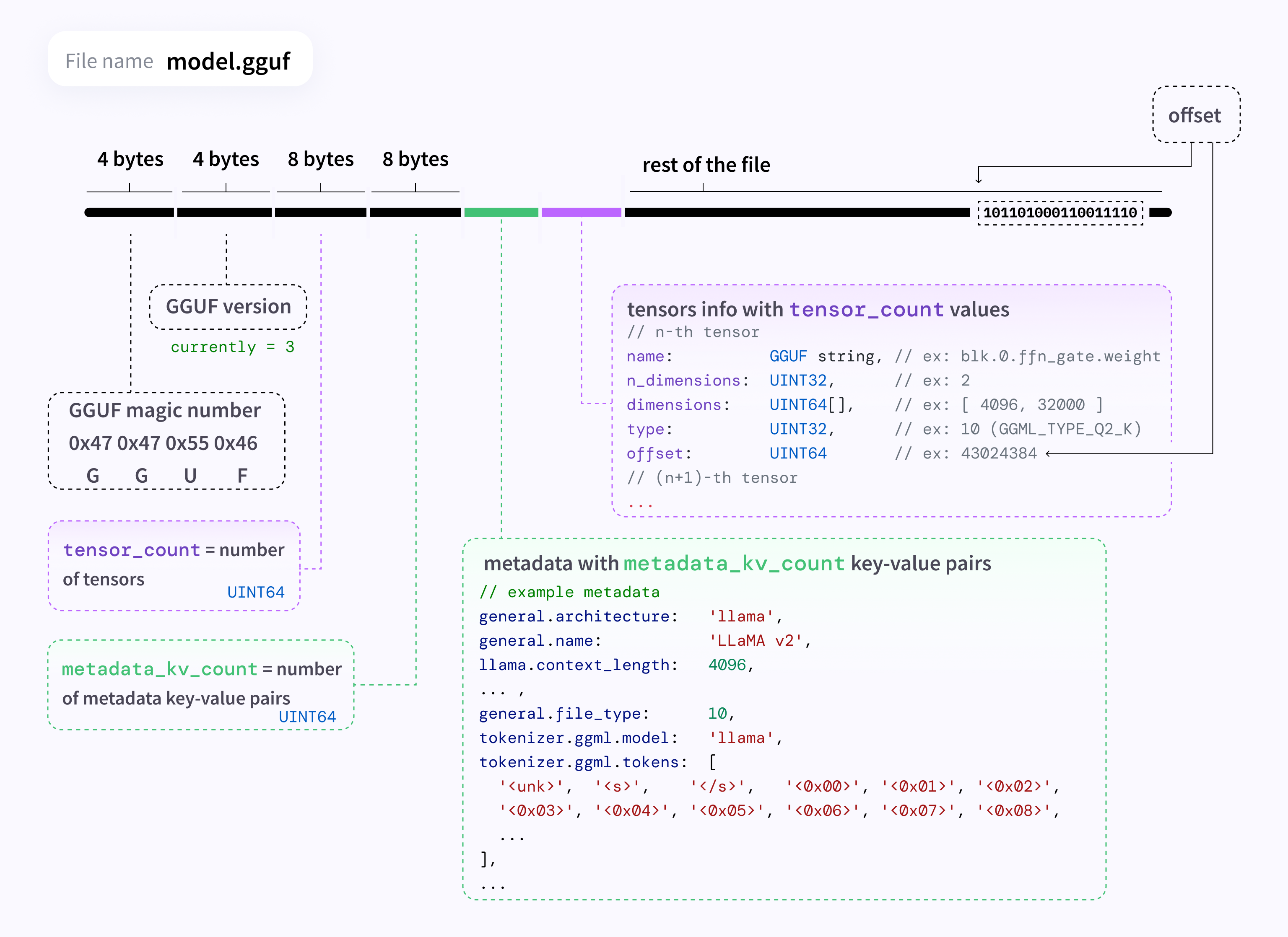
GGUF has become a standard file format for storing models for inference workload and specially is suitable for single-file deployment of LLMs. MAX Pipelines natively supports gguf in Mojo. GGUF specification is as follows
__wf_reserved_inherit

Our native implementation parses GGUF file format in preparation for inference ensuring optimal performance and integration within MAX Pipelines. This feature is fully integrated, allowing developers to efficiently load and utilize GGUF models without additional configuration.

Native Tokenizer Support in Mojo

MAX Pipelines provides native Mojo support for tokenizer, enabling efficient text preprocessing directly within your Mojo applications. This integration offers several benefits, ensuring that your Generative AI models can handle natural language input with high performance and accuracy.

Quantization Support

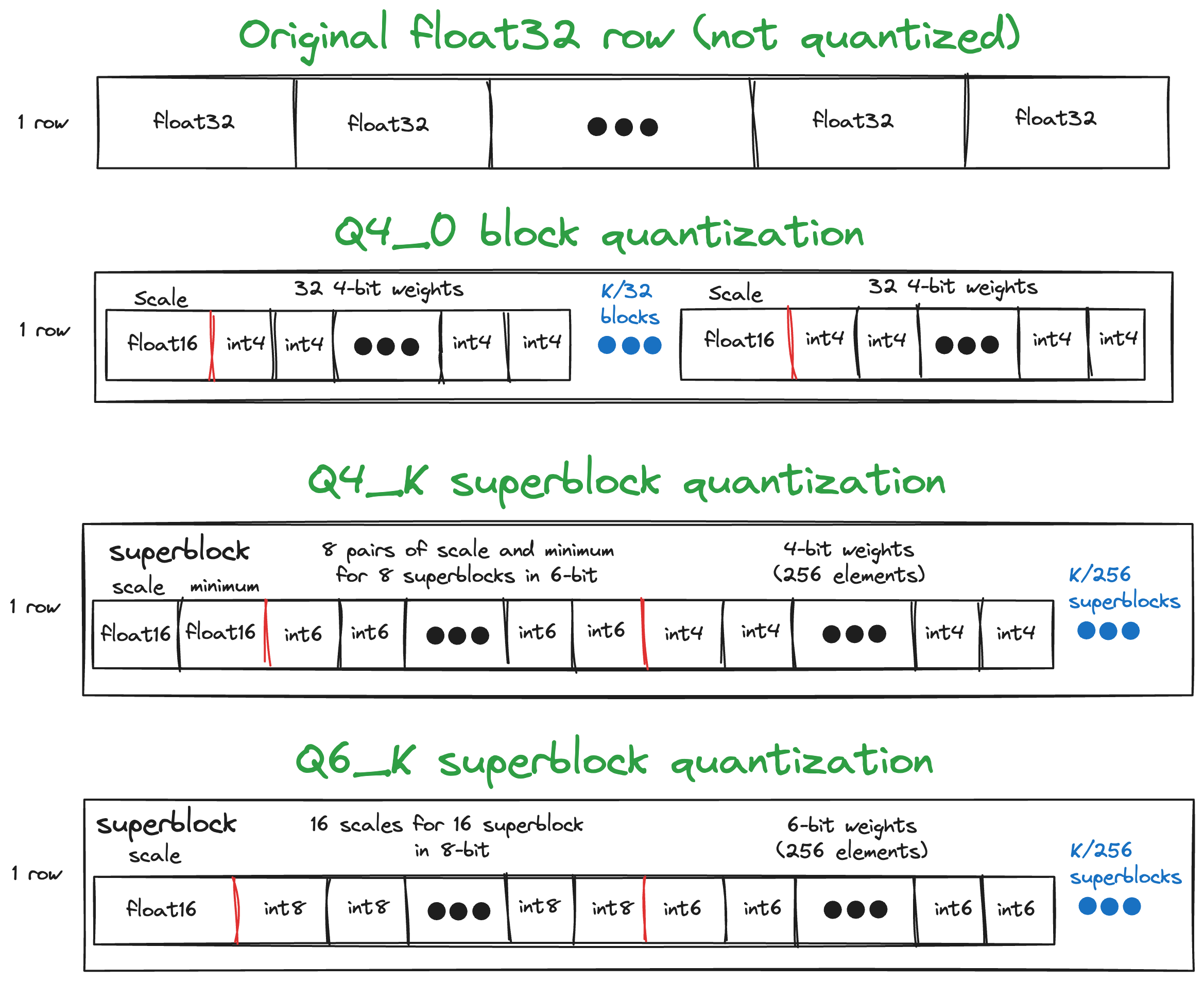
Quantization is a well-known technique to reduce memory and computational costs of running deep learning models. MAX Pipeline supports llama.cpp quantization encoding such as 

  • Q4_0: 4-bit block quantization where weights are divided in blocks of 32 weights. The scale of each block is stored as float16 format.
  • Q4_K4-bit quantization in super-blocks containing 8 blocks, each block having 32 weights. The scale and minimum of each super-block are stored as float16. The scales and minimums of each block in a super-block are quantized with 6-bits. On average, this ends up using 4.5 bits-per-weight.
  • Q6_K: 6-bit quantization in super-blocks containing 16 blocks, each block having 16 weights. The scale of each super-block is stored as float16. The scale of each block is quantized with 8 bits. On average, this ends up using 6.5625 bits-per-weight.

Here is a visual demonstration of these quantization schemes
__wf_reserved_inherit

We generally recommend using Q4_K for the best performance and memory use. The higher bit quantization encoding such as Q6_K is useful when we want to trade more memory for higher accuracy.

These advanced quantization approaches are typically only supported in specialized AI frameworks like llama.cpp, but MAX makes them accessible to a much wider range of models very easily. For more details, please refer to llama.cpp here.

The run_pipeline.🔥  comes with various CLI options such as changing the quantization encoding (default is Q4_K) as follows

Bash

mojo run_pipeline.🔥 llama3 \     --prompt "I believe the meaning of life is" \     --quantization-encoding q6_k     --temperature 0.5     --max-tokens 64

which outputs

Output

<|begin_of_text|>I believe the meaning of life is to find your purpose and pursue it with passion and dedication. For some, that purpose may be to make a difference in the world, while for others, it may be to find happiness and fulfillment in their personal lives. I believe that the key to finding one's purpose is to listen to one's heart and intuition.

MAX Pipeline Seamless Integration with PyTorch and HuggingFace

MAX Pipeline integrates seamlessly with the PyTorch and HuggingFace tokenizer as well. allowing developers to leverage the powerful tools and libraries from these ecosystems. This integration ensures that you can build and deploy advanced AI models using familiar frameworks while benefiting from the performance and efficiency enhancements provided by MAX. 

For example, in Llama2 pipeline, we proceed by installing the transformers package via

Bash

python3 -m pip install -r pipelines/llama2/requirements.txt

and we can use it with the llama2 option

Bash

mojo run_pipeline.🔥 llama2 \    --prompt "I believe the meaning of life is" \    --max-tokens 32

where it generates

Output

<s> I believe the meaning of life is to live a life that is worth living.

MAX Graph Custom Operator

MAX Graph API enables creating custom operators which is useful for writing highly customized graph level operators. Particularly for Llama2, MAX Pipelines has a custom Rotary Embedding (RoPE) operator here. We can invoke such custom operator via

Bash

source pipelines/llama2/setup-custom-rope.sh && \ mojo run_pipeline.🔥 llama2 \    --prompt "I believe the meaning of life is" \    --custom-ops-path "$CUSTOM_KERNELS/rope.mojopkg" \    --enable-custom-rope-kernel \    --quantization-encoding q6_k \    --max-tokens 32

which gives us

Output

<s> I believe the meaning of life is to live a life that is worth living. everybody has their own meaning of life. Prompt size: 8 Output size: 24 Startup time: 12718.287999999999 ms Time to first token: 134.37299999999999 ms Prompt eval throughput (context-encoding): 60.550097637032437 tokens per second Eval throughput (token-generation): 14.139838287382787 tokens per second

To learn more about MAX Graph Custom Operator, please visit our MAX Graph API Tutorial.

Example API

We are iterating rapidly on the MAX Pipelines to deliver best-in-class APIs for MAX developers. Our goal is to make MAX Pipelines more accessible, powerful, and easy to use. One such example can be obtained from here which showcases the capabilities and ease of use of MAX Pipelines, ensuring that developers can quickly integrate and benefit from our advancements. Below is an example to illustrate this

Mojo

from max.graph.quantization import Q4_KEncoding from llm import Llama def main():   llm = Llama[Q4_KEncoding].from_pretrained("https://huggingface.co/bartowski/Meta-Llama-3-8B-Instruct-GGUF/resolve/main/Meta-Llama-3-8B-Instruct-Q4_K_M.gguf")   prompt = "Tell me a dad joke"   print("Prompt:", prompt)   print("Response:", llm(prompt))

which generates this joke

Output

Prompt: Tell me a dad joke Response: !! I've got one! Why did the scarecrow win an award? Because he was outstanding in his field! (get it?)

We can also use the integrated tokenizer and tokenize our prompt with

Mojo

llm.tokenize(prompt)

outputs

Output

[128000, 41551, 757, 264, 18233, 22380]

By following these simple steps, developers can take full advantage of the advanced features provided by MAX Pipelines. This example API is designed to be intuitive and developer-friendly, allowing for quick integration and immediate productivity.

Next Steps

We are very excited to see what you can accomplish using MAX Pipelines. Please share your creations and innovations with the community. Here are a few options to get you started: 

  • Explore the various examples and templates provided in the MAX repository
  • Experiment with different quantization formats and tokenizers to optimize your models.
  • Utilize the GGUF file format for efficient model storage and deployment. 
  • Share your projects and experiences on forums, social media, and the Modular AI community. 
  • Use MAX Pipelines to build state-of-the-art AI models tailored to your specific needs. Deploy your models on various platforms, including macOS, Intel x86, and ARM Graviton cloud-serving infrastructure. Leverage the performance enhancements of the Quantization API to optimize your Generative AI pipelines.

Conclusion

The release of MAX 24.4 is a great progress on the unification of AI development tools. With the introduction of MAX on macOS and MAX Pipelines featuring native support for Generative AI models such as Llama3, developers now have unprecedented capabilities to build and deploy advanced AI models efficiently. This release brings together powerful features like the Quantization API, native GGUF, and tokenizer support, providing a comprehensive toolchain for creating high-performance AI solutions. 

Throughout this blog post, we have explored various features of MAX Pipelines and their benefits for Generative AI applications. From running quantized Llama3 models in pure Mojo to leveraging the integrated tokenizer and quantization support, MAX Pipelines offer a robust and flexible framework for AI development. 

Key Takeaways for Developers

  • Native GGUF Support: Simplifies model storage and deployment with efficient single-file format.
  • Integrated Tokenizers: Ensures efficient text preprocessing and seamless integration with Generative AI models. 
  • Quantization Support: Reduces memory and computational costs, enabling the deployment of large models on local machines. 
  • Seamless Integration: Works effortlessly with PyTorch and HuggingFace, allowing the use of powerful tools and libraries from these ecosystems. 
  • Custom Operators: Provides the ability to create highly customized graph-level operators, enhancing model performance and flexibility. 

By following the steps and examples provided, developers can take full advantage of the advanced features in MAX Pipelines, ensuring optimal performance and ease of use. Whether you're working on macOS, Intel x86, or ARM Graviton cloud-serving infrastructure, MAX 24.4 empowers you to build state-of-the-art AI models tailored to your specific needs.

We’re excited to see what you build with MAX 24.4 ⚡️ and Mojo 🔥!

Until next time! 🔥