


Pylon is a self-hosted daemon that triggers sandboxed Claude Code agents from webhooks (Sentry, cron, chat) and reports results with human approval — no data leaves your machine.
What Changed
Pylon is a new open-source (MIT) daemon that connects event triggers — like Sentry errors, cron schedules, or chat commands — to sandboxed AI coding agent runs. When a webhook fires, Pylon spins up a Docker container with your codebase, delegates the task to Claude Code, and reports the result back to a chat channel (Telegram, Slack, etc.) with optional human approval before any code is merged.
Key features:
- Triggers: Webhooks (Sentry, GitHub, custom), cron schedules, chat commands
- Agent runtime: Sandboxed Docker containers with your full codebase mounted
- Approval flow: Results reported to chat; human must approve before PR is created
- Self-hosted: Runs entirely on your machine — no SaaS, no data leaving your network
Setup is straightforward:
curl -fsSL https://pylon.to/install.sh | sh
pylon setup          # Configure channel + agent auth
pylon construct my-sentry --from sentry  # Create a pipeline from template
pylon start          # Start the daemon
pylon test my-sentry # Send a test webhook
What It Means For You
If you've ever wanted an automated pipeline that:
- Picks up a Sentry error → spins up a sandbox → uses Claude Code to investigate → proposes a fix → asks you to approve before creating a PR
…Pylon is the missing glue. It's not a replacement for Claude Code — it's a trigger-and-orchestration layer that gives Claude Code a job to do automatically, with guardrails.
This is especially powerful for teams that:
- Have a high volume of Sentry errors they want triaged automatically
- Want to run scheduled code maintenance (dependency bumps, lint fixes) via Claude Code
- Need human-in-the-loop approval before any automated code change hits production
Because Pylon is self-hosted, it also solves the data privacy concern that stops many teams from using AI agents on production code. No data leaves your network.
How To Apply It
- Install Pylon on a machine that has Docker and access to your codebase (CI runner, dev server, or dedicated box).
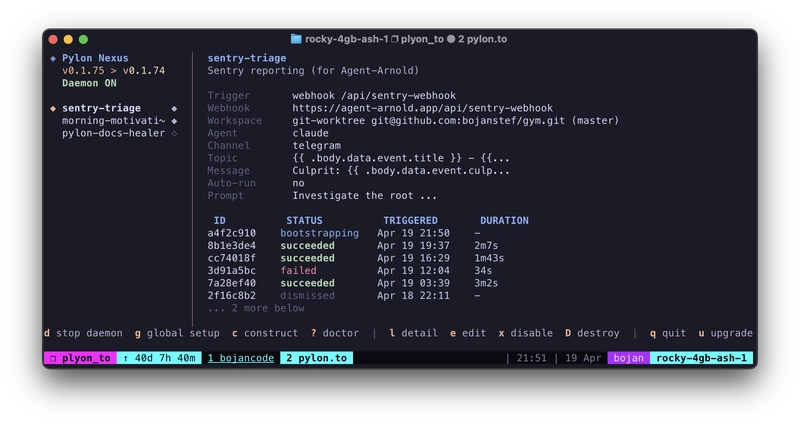
- Configure a Sentry pipeline:
pylon construct my-sentry --from sentry
This creates a pipeline that listens for Sentry webhooks. When a new error comes in, Pylon clones your repo into a Docker container, runs Claude Code with instructions to investigate and fix the error, and posts the proposed diff to your Telegram channel.
Add human approval: Set up Telegram (or another supported channel) so that the proposed PR is only created after you tap "Approve" in chat.
Test it:
pylon test my-sentry # sends a test webhook
-
Scale: Add more pipelines for cron jobs (weekly dependency audits), chat commands (
/fix-bug XYZ), or GitHub webhooks (auto-fix failing CI builds).
gentic.news Analysis
Pylon arrives at a moment when AI agents are crossing critical reliability thresholds — as we noted in our Agent Harnessing article last week, the infrastructure that makes agents work in production is becoming as important as the models themselves. Pylon is exactly that: an agent harness that manages triggers, sandboxing, and approval flows.
This follows the trend we've tracked in Version Sentinel (blocking hallucinated package versions) and our CLAUDE.md Playbook — developers are increasingly building guardrails around Claude Code to make it production-safe. Pylon adds a new layer: event-driven orchestration with human approval. It's not competing with Claude Code; it's extending it into automated workflows that previously required custom scripting.
The self-hosted nature is a differentiator. While Anthropic offers Claude Code as a CLI tool that runs locally, Pylon wraps it in a daemon that can run unattended — a pattern we're seeing more of as teams build custom agent infrastructure (see DigitalOcean's Signal Sampling for a related approach to agent reliability).
Originally published on gentic.news