


Most crypto workflows still feel broken.
You have one tab for charts, another for wallet actions, another for social scanning, another for research, and another for automation. Even when each tool is useful on its own, the overall workflow is fragmented, slow, and hard to trust.
That is the problem I wanted to solve with WhiteOwl.
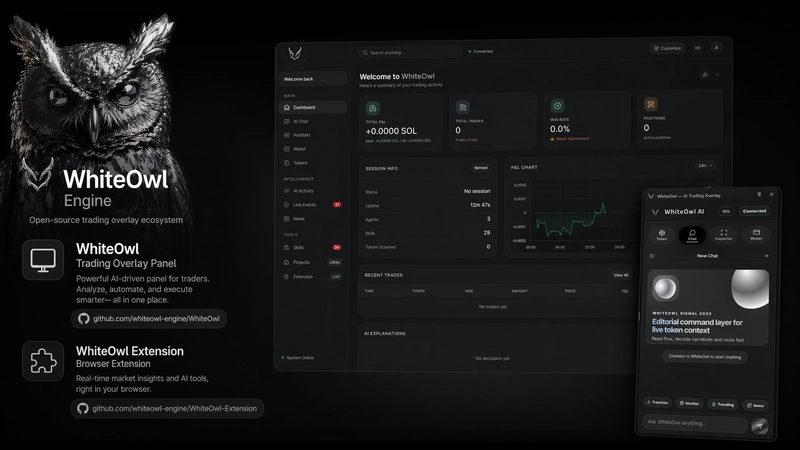
WhiteOwl is a local-first Solana operating stack that I built solo as two connected parts:
- WhiteOwl is the main panel, local runtime, AI layer, dashboard surface, and workflow control center.
- WhiteOwl Extension is the browser wallet, side panel, provider bridge, and page-aware execution layer.
The panel gives me a serious working surface.
The extension gives those workflows real browser context.
That split matters.
A lot of products try to force everything into either a hosted dashboard or a wallet popup. I wanted something that could do both: a real panel for thinking, monitoring, and automation, plus a browser-native wallet layer that stays close to what is actually happening on the page.
Why I built it
I kept running into the same issue over and over.
Research lived in one place. Wallet actions lived somewhere else. Social context was in another tab. Automation was usually bolted on afterward. Even when the individual tools were decent, the workflow itself felt messy.
None of it felt like one system.
So I started building the system I actually wanted to use.
A setup where:
- the core runtime lives locally
- wallet flows stay close to the browser
- page context is first-class
- AI is useful because it is connected to tools and workflow
- the whole product feels more like an operating surface than a pile of tabs
What the panel does
The WhiteOwl panel is the main control surface.
It is where I bring together:
- AI-assisted workflows
- Solana market and token analysis
- jobs and scheduled automation
- runtime configuration and local state
- execution flows that can evolve with the user instead of locking everything into a rigid hosted product
For me, the important part was not just adding AI.
It was making AI useful inside a real workflow.
That means agents should have context. They should work with tools. They should fit into a system where monitoring, decision-making, and execution are connected instead of isolated.
What the extension does
The extension is more than a wallet popup.
It acts as a browser-native layer for WhiteOwl, including:
- a browser wallet for connected-site flows
- a side panel that stays close to the page
- provider and site integration
- page-aware inspection
- workflows around live web surfaces like X/Twitter and other browser-first environments
That browser layer matters because so much crypto activity still happens in fast-moving page contexts. If your tooling ignores the browser, it misses a big part of the actual workflow.
Why local-first matters
I chose a local-first approach on purpose.
For something that touches wallet activity, research, automation, and execution, local-first has real advantages:
- more control
- better visibility into what the system is doing
- less dependence on a black-box hosted workflow
- a setup that feels faster and more personal
- a foundation that is easier to extend over time
I am not trying to build just another dashboard with an API wrapper on top.
I want WhiteOwl to feel closer to a real operating environment for Solana users.
Open source from day one
Both sides of the stack are open source:
- Main panel: WhiteOwl
- Browser wallet and extension: WhiteOwl Extension
I built the first versions solo, and that also shaped the product. I wanted it to stay inspectable, hackable, and close to the metal instead of becoming another polished black box.
If you are building around Solana, experimenting with local-first products, or thinking about how AI should fit into real execution workflows, I would genuinely love to hear what you think.
WhiteOwl is still evolving, but the direction is clear:
less tab chaos, more operating surface.