


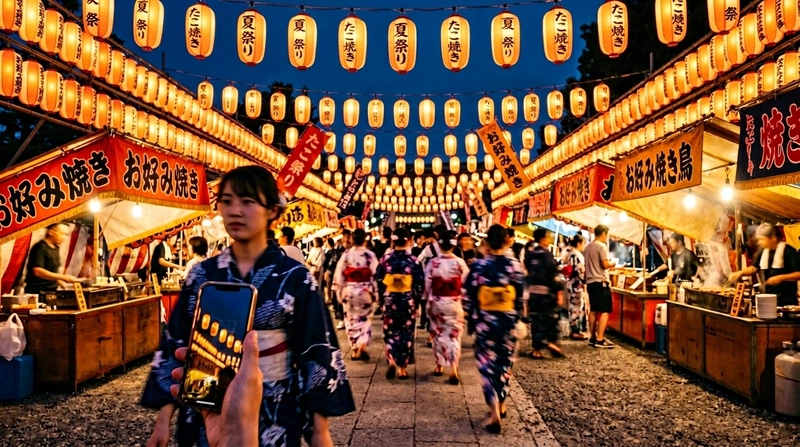
A line I added to a memo two years ago
I still remember the night I wrote the first commit, two years ago. In the corner of a memo titled "Digitizing Japanese festivals," I scribbled one extra line: "But never let it become just a booking site."
That line finally became code.
In the past few weeks, Matsuri has shipped Shop (a marketplace) and Crowdfunding, and Live (real-time streaming) launches in days. The moment those three features stood next to each other, I finally saw what we'd actually been building.
Matsuri is a festival economy — not a booking platform.
I built Shop because vendors couldn't sell online
A festival isn't just for tourists. The carver of mikoshi, the family hand-painting lanterns, the food vendor serving the same recipe for 30 years — a festival runs on thousands of tiny economies stitched together.
None of them can sell online. They don't have engineers. They can't configure Stripe. They can't manage SKUs.
So I built one checkout that unifies Stripe Connect, Solana settlement, and MTC (Matsuri Coin) balance. Any KYC-verified GCF member can list. Fee: 5% (1% to the inviter who introduced the buyer).
# accounts/services/shop_checkout.py
@transaction.atomic
def checkout_with_sku(cart, payment_method):
    inventory = (Inventory.objects
        .select_for_update()  # race-safe
        .get(sku_id=cart.sku_id))
    if inventory.available < cart.quantity:
        raise OutOfStockError
    # 5% fee split: 4% platform + 1% Lv1 referrer
    FeeLedger.record_split(order, fee_pct=Decimal('5'))
    return process_payment(payment_method, order.total)
SKU allocation is race-safe with select_for_update(), fee split is logged in 3 rows in the FeeLedger.
I built Crowdfunding to route capital to the festivals worth saving
Every year, festivals disappear because of depopulation. Lion-dance lineages break. Floats can't be repaired. Sacred objects rot.
Three principles locked the design:
- 6% fee (4% platform + 2% Lv1 referral commission)
- All-or-Nothing — if a campaign misses its goal, Celery beat auto-refunds every backer
- Lv2+ commission is zero — refused to build a multi-tier MLM
Rewards are NFTs, MTC, live-stream access, on-site experiences. "Backing" and "participating" become the same verb.
I built Live because synchronicity is the soul of a festival
The essence of a festival is synchronicity. The same instant, the same place, the same shared something. That's why these things have lasted 1,300 years.
So Live isn't a streaming feature. On a low-latency stack (LiveKit + Hetzner), one screen runs:
- Real-time tipping (Stripe Client Secret / MTC / Solana 7-step verification)
- Viewer count + 60s heartbeat (Celery 30s beat for expiration)
- 3-2-1 countdown (1 Hz APNs push)
- Live-only coupons (claim → apply → authoritative recompute → redeem)
- In-stream NFT drops (with recording markers)
- Paywalled archives (5-mode access)
- 5-language chat (BCP-47 → internal lang normalization)
// Canonical 1-type cue event for the WS protocol
socket.on('cue', (msg) => {
  switch (msg.data.phase) {
    case 'preroll':   showCountdown(msg.fire_at); break;
    case 'execute':   triggerCueAction(msg.kind);  break;
    case 'completed': markExecuted(msg.cue_id);    break;
    case 'failed':    markSkipped(msg.cue_id);     break;
  }
});
247 live tests pass. Django check: 0 issues. Frontend: TypeScript strict, zero warnings. Boring numbers, but that's the proof of intent.
Why all three only make sense together
Decomposed structurally, a festival is three things:
| Festival element | Matsuri feature |
|---|---|
| Exchange of goods (stalls, souvenirs, crafts) | Shop |
| Pooling of resources (festival dues, donations, repairs) | Crowdfunding |
| Sharing of time (mikoshi processions, lion dances, offerings) | Live |
Festivals 1,300 years ago and festivals today both run on these three.
If you only need one of them, use Shopify, Kickstarter, or Twitch. The reason Matsuri must exist on Web3 is the cultural context that ties the three together.
We finally made it here
Two years ago I started writing this alone. Today: backend 450 tests, frontend 0 errors, 9 migrations, 5 languages, three clients (iOS / Android / Web), 20+ internal docs.
The real festival hasn't started yet. The night Live launches, when someone in Kyoto runs a small local matsuri and people in Tokyo, New York, and Rio watch and tip the same instant — that's the night Matsuri actually boots up.
If you've been looking for a way to use Web3 not for speculation but for keeping culture alive, come take a look.
- Matsuri Platform: https://matsuri.group
- Matsuri DAO: https://www.matsuri-dao.com
Ko Takahashi (高橋高) — CEO of Jon & Coo Inc., Lead Architect of Matsuri Platform. Entrepreneur, Philosopher, Engineer. Based in Shinjuku, Tokyo. Building at the intersection of Japanese culture and Web3. https://www.ko-takahashi.jp