


I was working on CH32V00X integration for tinyboot on my newly fabricated CH32V006 OpenServoCore dev board, thanks to the generous sponsorship from PCBWay. The UART controller of this chip shares the same silicon and thus reuses the same tinyboot HAL driver as the CH32V003. However, the tinyboot CLI couldn't talk to the flashed bootloader via UART at all. This is strange... Same UART silicon, same HAL driver, but CH32V006 is clearly not responding via UART.
To eliminate the possibility of other driver or init issues, I wrote a separate UART test app to dig into it more thoroughly. I first wrote a bare minimal app that just initialized UART using the same HAL driver and sent out "Hello world" periodically via the TX line. For the PC, I used CuteCom, a graphical serial terminal. Immediately I got garbage, but after some RCC tweaks, I was able to get the right clocks setup to receive TX with no issues.
TX Works, RX Doesn't
The test app was happily transmitting bytes out over UART, but sending bytes back was a completely different story. The line was basically silent. It didn't matter how I tweaked the UART register settings or how many times I read and re-read the reference manual, I always got silence, nothing was reaching the chip. Given that the HAL code and the UART controller in the silicon are essentially the same as the V003, and that "Hello world" was coming out of the MCU's TX (proving clock init is sound), the only conclusion I could come up with was that the issue isn't in the firmware. It's in the hardware.
So I moved on to the schematic and the PCB layout, looking for anything wrong: a swapped pull-up, an inverted wire, anything. The UART TX/RX connector I used for testing is routed directly from the MCU. The same TX/RX routes also branch off to a half-duplex DXL TTL front-end. I had a brief suspicion that this might have something to do with RX not working, but couldn't come up with a plausible theory to back it up, so I moved on.
Listening to the Scope
When I ran out of ideas on why RX didn't work, I decided to look at the signal directly with a scope to isolate whether anything was actually reaching the MCU. I have a neat one liner for this:
yes U | tr -d '\n' > /dev/ttyACM0
This bash command sends alternating zeros and ones to the MCU's RX line, making scoping easy. It works like this:
-
yes Urepeatedly sends outU\nto STDOUT.Uis0x55in hex, and0b01010101in binary, which produces alternating HIGHs and LOWs on the scope once the start and stop bits are taken into account. -
tr -d '\n'strips\nfrom the stream, so we haveUUUUUUforever. -
> /dev/ttyACM0pipes the whole stream into the TTY, in this case my WCH-LinkE serial port.
So I hooked up the scope, blasted UUUUUUUUU into the RX line, and what I saw was a square wave, but a teeny tiny one...
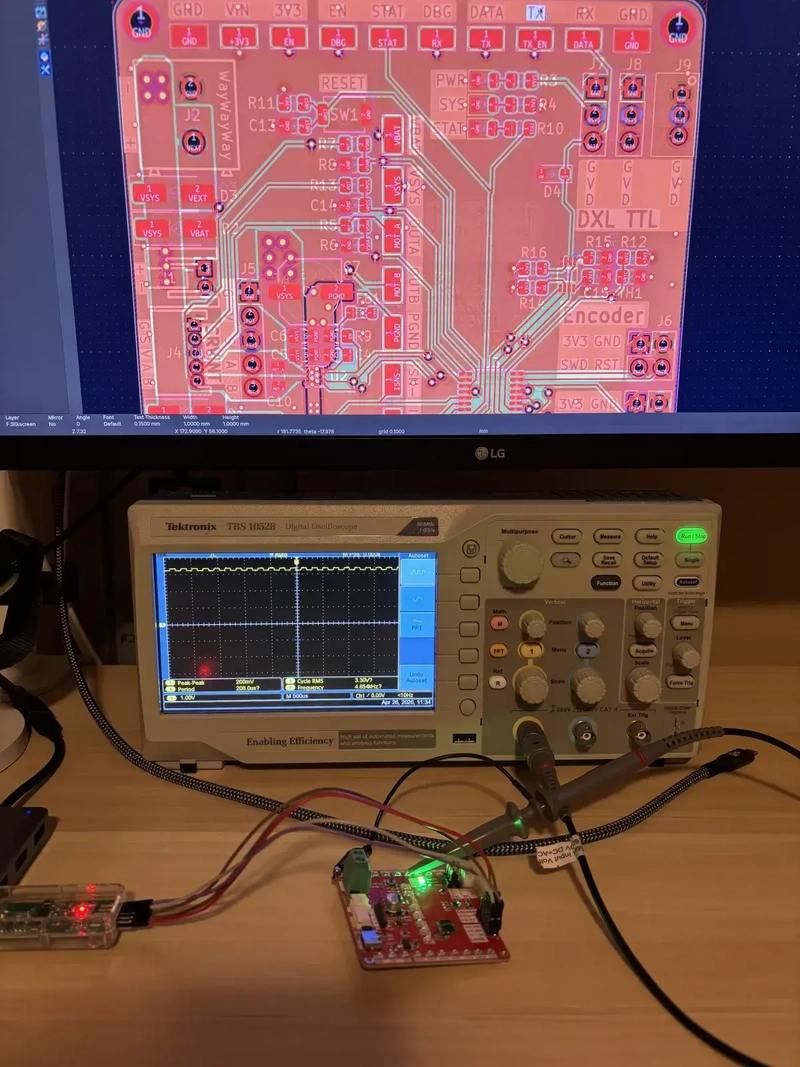
Zooming in on the scope:
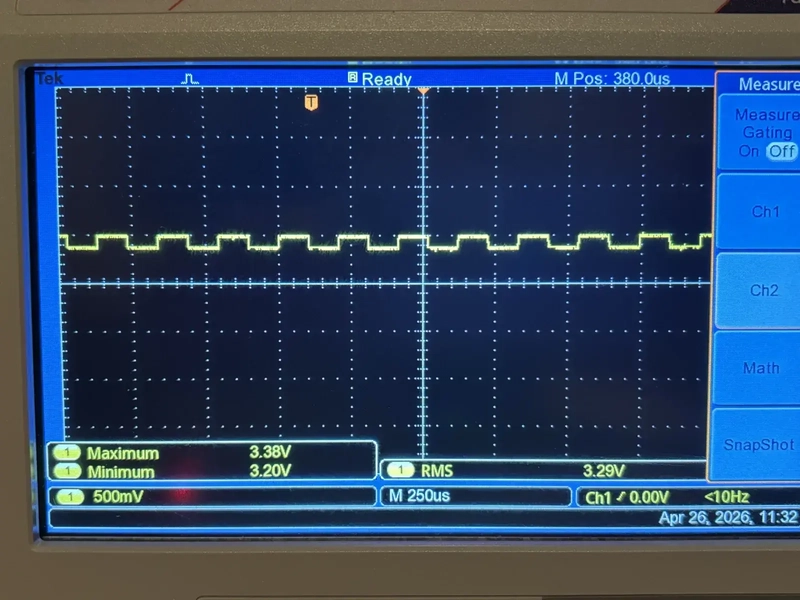
The waveform was there. The shape was right. But it was riding on top of 3.3 V with maybe 180 mV of amplitude. The maximum was 3.38 V, the minimum 3.20 V. Something was holding the line near the rail so hard that my USB UART adapter could only pull it down by a couple hundred millivolts. This is a big clue!
To rule out the wiring, I touched RX directly to ground. The line snapped to 0 V cleanly. So the connection was fine. The driver just couldn't win against whatever was holding RX high.
The Buffer I Suspected All Along
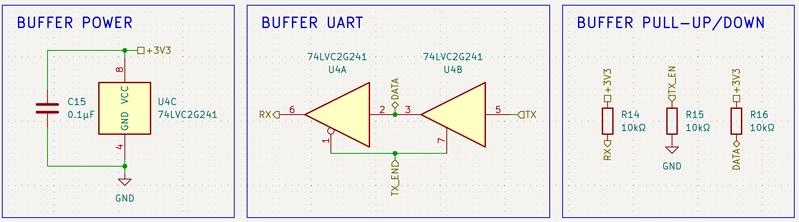
Looking at the TTL DXL front-end again, the RX line goes through a tri-state buffer (SN74LVC2G241) that implements half-duplex direction switching. TX_EN selects the direction:
-
TX_ENlow (default, held by a pulldown): the buffer routesDATAtoRX. The MCU listens to the bus. -
TX_ENhigh: the buffer routesTXtoDATA. The MCU talks to the bus.
This is when I had my facepalm moment. I had been picturing the buffer as some kind of passive switch that just connects two wires together. But after thinking about it for a few minutes, I realized that's not the case at all.
When TX_EN is low, the buffer's output stage is actively driving RX with whatever it sees on DATA. And DATA has its own 10K pullup, per the DXL TTL reference, so when nobody is talking on the bus, DATA sits at 3.3 V. The buffer reads that, and pushes 3.3 V back out through its high-side MOSFET onto RX. Simplified, RX is pretty much hooked directly to 3.3 V through maybe 20 Ω of MOSFET resistance, acting as a strong pull-up.
So when I was sending bytes from the USB UART adapter into RX, I was not fighting a passive 10K pullup. I was fighting a CMOS push-pull output stage. The 74LVC2G241 has very low high-side R_DS(on) and 24 mA of drive. A typical USB UART chip's TX output is much weaker. The two formed a voltage divider, and the buffer won. The line stayed parked near 3.3 V, with my adapter pulling it down by a couple hundred millivolts every time it tried to send a 0. That was my "ripple."
A hard short to ground bypasses that contention entirely, which is why poking RX with a ground clip snapped it cleanly to 0 V.
This One Weird Trick... (Sorry)
As absurd as it sounds, the workaround was to assert TX_EN, while reading from RX. Why would I assert the transmit enable when my problem was on the receive side? Because TX_EN isn't really a transmit enable. From firmware's perspective it's asserted when you talk and deasserted when you listen. But electrically, it's a mux select that picks which buffer drives the bus. Treating those as the same thing is what set me up for confusion in the first place.
With it held high, the DATA to RX buffer is disabled, RX falls back to its own pullup, and the USB UART adapter can drive it without a fight. Poking 3.3 V onto TX_EN confirmed it in real time:
Touching 3.3 V to TX_EN snaps the ripple into a clean rail-to-rail square wave. Release it and the line flat-lines back near 3.3 V. The buffer is the whole problem.
For those eagle-eyed viewers, yes. I'm touching the TP that says TX... But the electric trace is actually TX_EN.

This is another embarrassing yet hilarious mistake that got its own story, where I somehow "fixed" the issue by creating magic smoke on my board.
Why I'm Adding a Jumper
The workaround is assert TX_EN in firmware, however, this is not a real fix. Drive TX_EN high in the bootloader's startup code and only release it when the MCU genuinely wants to talk. It works, costs nothing, and ships today. But it means UART functionality on this board now depends on the firmware running correctly.
The right fix should be in hardware by adding a jumper on the RX line. Shorted means TTL mode, where RX is wired through the buffer as before. Open means plain UART mode, where RX bypasses the buffer entirely and goes straight to the MCU. More involved, requires a board respin, and adds a small amount of inconvenience for the user. But the UART works without any firmware running.
For Rev. B, I'm going with the jumper.
The reason is wchisp. That tool, and others like it, use the UART to read and write the CH32's Option Bytes. Those operations happen outside of any firmware I write. If my UART hardware depends on my firmware to function, then a misconfigured Option Byte, a half-flashed bootloader, or a chip fresh from the factory can lock me out of the recovery path. The whole appeal of UART-based programming is that it works on a bare chip with nothing running. That property has to live in hardware, not in firmware.
The rule I'm taking from this: recovery-path peripherals should not depend on firmware to function. For half-duplex TTL designs specifically, that means the RX line has to be usable as a standalone UART without anything running on the MCU. A jumper is a small price to ensure hardware recoverability.
And TX_EN is really a line selector, and buffers actively drives outputs. I'll remember that one for a while.