




🎮 Where my cloud journey started
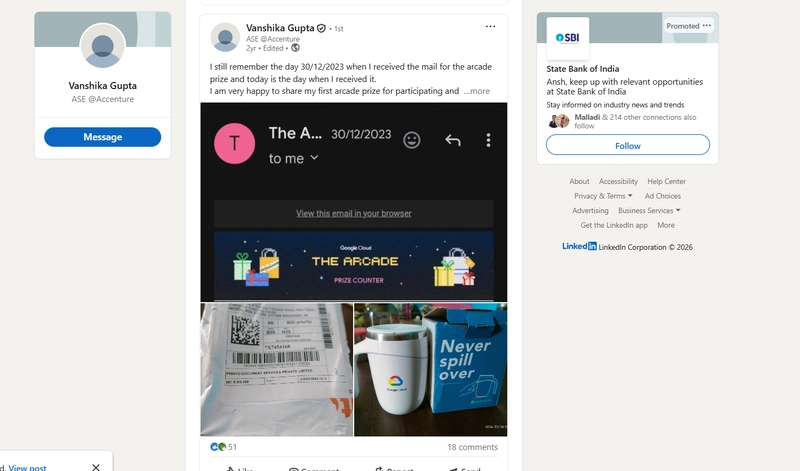
I'll be honest with you: I wasn't sure I had anything valuable to say about Google Cloud NEXT '26. I'm not a senior engineer. I've never deployed to production at scale. My cloud journey started a few months ago with Google Cloud Arcade — completing labs, earning badges, collecting points like a very nerdy treasure hunt.
But sometimes the most useful perspective in the room isn't the expert's. It's the person who just walked in and is paying attention to everything.
So here's my honest take on what stood out to me at NEXT '26, and what the Gemini Enterprise Agent Platform — the centerpiece announcement — actually means when you're someone still in the learning phase.
My entire Google Cloud experience before this was the Arcade — a gamified, hands-on learning program where you complete real labs inside actual GCP environments. No VMs to set up. No billing surprises. Just you, a browser, and a cloud environment that self-destructs when you're done.
- Arcade Base Camp — No prior experience required. Learned IAM, Cloud Storage, and BigQuery basics through guided labs.
- Skill Badges — Real credentials earned by solving challenge labs with no step-by-step guidance.
- Trivia & Sprints — Monthly quick challenges that test recall and application, not just reading.
- Watching NEXT '26 (now) — Going from lab consumer to trying to understand what the big picture actually is.
What the Arcade did that courses couldn't was make "cloud" feel concrete. You don't just read about a Cloud Function — you deploy one. You don't just hear about IAM roles — you misconfigure one and then debug it. That tactile experience made NEXT '26 feel less like a foreign language and more like vocabulary I was just starting to build on.
🚀 The announcement that changed how I think about building
Gemini Enterprise Agent Platform
If there was one thread woven through every keynote moment at NEXT '26, it was this: the era of pilots is over. The era of agents is here. Google Cloud CEO Thomas Kurian said exactly that on stage, and it wasn't just conference hyperbole — the product they showed backs it up.
What is it? Gemini Enterprise Agent Platform is the evolution of Vertex AI — a unified workspace to build, govern, deploy, and optimize AI agents. It brings together model selection, tuning, orchestration, security, and DevOps tooling under one roof, and extends that to non-technical employees through the Gemini Enterprise app.
Think about what "agent" actually means in this context. It's not a chatbot that answers a question and waits. It's software that can reason, plan, take action across multiple systems, and loop back — autonomously. Google calls this the shift from "thinking" AI to "doing" AI.
For someone like me who is used to following lab instructions step-by-step, this is a genuinely different mental model. It's asking: what if your code could write the next step of the lab for itself?
What's new in the platform:
- 🤖 Agent Designer — Build agents visually. Even non-technical employees can create workflows through conversational interfaces.
- 📥 Agent Inbox — A unified view to monitor, manage, and review what your agents are actually doing.
- 🧠 Permanent memory — Gemini Enterprise Projects give agents context that persists across sessions, not just in-conversation memory.
- 🔒 Governance built-in — Security, compliance, and oversight are foundational to the platform, not add-ons.
What struck me was the emphasis on governance. When you're learning cloud, governance feels like a future problem — something enterprises worry about. But Google baked it into the foundation here, not as an afterthought. For a beginner, that's actually reassuring: it signals that you're building in a framework that won't shatter the moment it scales.
⚡ The hardware story: TPU 8t and 8i
Honestly, I didn't expect to care about chips. Then Amin Vahdat, SVP of AI Infrastructure, called the new 8th-gen TPU "a thing of beauty" — and walked through why they built two separate chips instead of one.
The demands of training a model and serving that model to millions of users have "completely diverged." One chip can no longer do both well.
| TPU 8t | TPU 8i | |
|---|---|---|
| Optimized for | Training | Inference |
| Scale | Up to 9,600 TPUs in a single superpod | 1,152 TPUs via Boardfly topology |
| Memory | 2 petabytes shared HBM | 3× more on-chip SRAM vs previous gen |
| Performance | 3× processing power of Ironwood, 2× perf/watt | Collectives Acceleration Engine offloads heavy tasks |
For me, watching this was like learning that your cloud labs run on something — that "cloud" is a real, physical thing that engineers make choices about. That made it less abstract, not more intimidating.
📊 The numbers that tell a story
- 32,000+ attendees in Las Vegas
- 40% quarter-over-quarter growth in Gemini Enterprise paid monthly active users
- 260 total announcements made across the week
That 40% growth number isn't just a marketing metric. It tells you that companies aren't just experimenting anymore — they're paying for it and scaling it. The pilot era really is ending.
🔍 What this looks like for a developer just starting out
Here's where I want to be genuinely useful to other beginners reading this, rather than just summarising keynote slides.
"You don't wait until you're ready. You build — and you figure it out along the way."
That's the mindset shift that Arcade started for me, and that NEXT '26 reinforced hard. The Agent Designer is specifically built so that non-technical employees can build workflows with conversational interfaces. That's not an accident — Google is explicitly lowering the floor.
What that means practically:
- The entry point to building with AI is getting lower, not higher
- You don't need to understand the model to use the model in a real workflow
- Learning the fundamentals (which is what Arcade teaches) still matters — you need to understand what an agent is before you build one well
- The governance and security features mean you can experiment without feeling like you'll accidentally break everything
🤔 My honest critique
Not everything about NEXT '26 was beginner-friendly. The sheer volume — 260 announcements, 700+ sessions — is genuinely overwhelming. The "Agentic Data Cloud," the "Agentic Defense," the "Virgo Network," the cross-cloud Lakehouse — it's a lot of new vocabulary dropping at once. For someone still internalizing what a VPC is, hearing "petabyte-scale Boardfly topology" in the same breath is... a lot.
The flip side is that this breadth is actually honest. Google Cloud is not pretending that one product solves everything. The ecosystem is complex because real-world problems are complex. For a beginner, accepting that early is healthier than expecting a simple learning path.
I also wish there had been more beginner-oriented sessions streamed publicly. Most of the technical depth lives in breakout sessions, and not all of those are available on demand for free. That gap between "watched the keynote" and "can actually use any of this" remains real.
🌱 Where I go from here
After watching NEXT '26, I have a clearer learning path than I did before. The Arcade is still the right starting point for hands-on fundamentals. But now I know what I'm building toward — understanding the agent primitives (skills, projects, memory, orchestration) that are going to define how cloud applications get built.
"The Gemini Enterprise app is the primary environment where your business actually operates."
— Thomas Kurian, Google Cloud CEO, NEXT '26 Keynote
That sentence hit differently than I expected. If agents are going to be the primary way work gets done — and the momentum numbers suggest they might be — then understanding how to build, govern, and reason about agents isn't optional knowledge. It's foundational.
I'm not there yet. But I can see the path. And that's what NEXT '26 gave me — not mastery, but direction.
You don't need to be an expert to start. You just need to start — and keep paying attention.
From the Arcade to the agentic era, one lab at a time.
🔗 I documented part of this journey on LinkedIn too — check out my Google Cloud Arcade post here if you want to see the real swag I earned along the way 🎒
❤️