
惯性聚合 高效追踪和阅读你感兴趣的博客、新闻、科技资讯
阅读原文 在惯性聚合中打开

推荐订阅源

K
Kaspersky official blog
Engineering at Meta
Engineering at Meta
D
DataBreaches.Net
Stack Overflow Blog
Stack Overflow Blog
Microsoft Security Blog
Y
Y Combinator Blog
B
Blog RSS Feed
GbyAI
GbyAI
P
Proofpoint News Feed
aimingoo的专栏
aimingoo的专栏
MyScale Blog
MyScale Blog
D
Docker
阮一峰的网络日志
阮一峰的网络日志
Cyber Security Advisories - MS-ISAC
Recorded Future
Recorded Future
美团技术团队
The Register - Security
V
Visual Studio Blog
H
Hackread – Cybersecurity News, Data Breaches, AI and More
T
Tailwind CSS Blog
爱范儿
爱范儿
freeCodeCamp Programming Tutorials: Python, JavaScript, Git & More
T
The Blog of Author Tim Ferriss
博客园 - 司徒正美
量子位
B
Blog
F
Fortinet All Blogs
Martin Fowler
Martin Fowler
博客园 - 【当耐特】
MongoDB | Blog
MongoDB | Blog
A
About on SuperTechFans
I
InfoQ
钛媒体:引领未来商业与生活新知
钛媒体:引领未来商业与生活新知
有赞技术团队
有赞技术团队
雷峰网
雷峰网
大猫的无限游戏
大猫的无限游戏
J
Java Code Geeks
L
LangChain Blog
Latest news
Latest news
S
SegmentFault 最新的问题
Exploit-DB.com RSS Feed
Blog — PlanetScale
Blog — PlanetScale
Threat Intelligence Blog | Flashpoint
Cisco Talos Blog
Cisco Talos Blog
F
Full Disclosure
C
Cisco Blogs
D
Darknet – Hacking Tools, Hacker News & Cyber Security
W
WeLiveSecurity
T
Tenable Blog
T
Tor Project blog

Apple Machine Learning Research

Location-Invariant Properties of Functions Versus Properties of Distributions: United in Testing but Separated in Verification Interactive Proofs for General Distribution Properties Doubly Sub-linear Interactive Proofs of Proximity Personalizing Incremental Video Search with Hybrid Text and ID Embeddings Embarrassingly Simple Self-Distillation Improves Code Generation CLaRa: Bridging Retrieval and Generation with Continuous Latent Reasoning Uncertainty Quantification for LLM Function-Calling One Layer Is Enough: Adapting Pretrained Visual Encoders for Image Generation Proactive Agent Research Environment: Simulating Active Users to Evaluate Proactive Assistants Multilingual Semantic Retrieval for Apple Music Search Behavioral Privacy Leakage in Agentic Negotiation: Formalizing and Mitigating Inference Attacks via Randomized Policies Incentivizing Temporal-Awareness in Egocentric Video Understanding Models Recursive Language Models Meet Uncertainty: The Surprising Effectiveness of Self-Reflective Program Search for Long Context Unmasking On-Policy Distillation: Where It Helps, Where It Hurts, and Why Taming Text-to-Sounding Video Generation via Advanced Modality Condition and Interaction DynaMiCS: Fine-Tuning LLMs with Performance Constraints Using Dynamic Mixtures LensVLM: Selective Context Expansion for Compressed Visual Representation of Text MT-EditFlow: Reinforcement Learning for Multi-Turn Image Editing with Flow Matching Weblica: Scalable and Reproducible Training Environments for Visual Web Agents FlowEval: Reference-Based Evaluation of Generated User Interfaces A Single Neuron Is Sufficient to Bypass Safety Alignment in Large Language Models Path-Constrained Mixture-of-Experts Revisiting ASR Error Correction with Specialized Models TopoPrimer: The Missing Topological Context in Forecasting Models Multi-Agent Teams Hold Experts Back VideoFlexTok: Flexible-Length Coarse-to-Fine Video Tokenization Amortizing Maximum Inner Product Search with Learned Support Functions On Robustness and Chain-of-Thought Consistency of RL-Finetuned VLMs MemoryLLM: Plug-n-Play Interpretable Feed-Forward Memory for Transformers Learning Structured Reasoning via Tractable Trajectory Control Learning Unmasking Policies for Diffusion Language Models Residual Context Diffusion Language Models Conformal Thinking: Risk Control for Reasoning on a Compute Budget Anti-Causal Domain Generalization: Leveraging Unlabeled Data Metric-Dependent Annotation Saturation for Learning from Label Distributions Nine Judges, Two Effective Votes: Correlated Errors Undermine LLM Evaluation Panels Introducing the Third Generation of Apple’s Foundation Models IEEE/CVF Conference on Computer Vision and Pattern Recognition (CVPR) 2026 VSAS-Bench: Real-Time Evaluation of Visual Streaming Assistant Models EpiCache: Episodic KV Cache Management for Long-Term Conversation on Resource-Constrained Environments BalCapRL: A Balanced Framework for RL-Based MLLM Image Captioning Apple Workshop on Privacy-Preserving Machine Learning & AI 2026 Velox: Learning Representations of 4D Geometry and Appearance RVPO: Risk-Sensitive Alignment via Variance Regularization Large-Scale High-Quality 3D Gaussian Head Reconstruction from Multi-View Captures Text-Conditional JEPA for Learning Semantically Rich Visual Representations What Matters in Practical Learned Image Compression SpecMD: A Comprehensive Study on Speculative Expert Prefetching From Where Things Are to What They’re For: Benchmarking Spatial–Functional Intelligence for Multimodal LLMs STARFlow-V: End-to-End Video Generative Modeling with Normalizing Flows Bootstrapping Sign Language Annotations with Sign Language Models International Conference on Acoustics, Speech and Signal Processing (ICASSP) 2026 Adaptive Thinking: Large Language Models Know When to Think in Latent Space DSO: Direct Steering Optimization for Bias Mitigation StereoFoley: Object-Aware Stereo Audio Generation from Video LaDiR: Latent Diffusion Enhances LLMs for Text Reasoning Local Mechanisms of Compositional Generalization in Conditional Diffusion Learning Long-Term Motion Embeddings for Efficient Kinematics Generation ParaRNN: Large-Scale Nonlinear RNNs, Trainable in Parallel Apple Machine Learning Research at ICLR 2026 Can Large Language Models Understand Context? International Conference on Learning Representations (ICLR) 2026 Cram Less to Fit More: Training Data Pruning Improves Memorization of Facts Efficient Privacy Loss Accounting for Subsampling and Random Allocation ACM Human-Computer Interaction Conference (CHI) 2026 A Theoretical Framework for Acoustic Neighbor Embeddings Governance-Aware Agent Telemetry for Closed-Loop Enforcement in Multi-Agent AI Systems SQUIRE: Interactive UI Authoring via Slot QUery Intermediate REpresentations Personalized Group Relative Policy Optimization for Heterogenous Preference Alignment ProText: A Benchmark Dataset for Measuring (Mis)gendering in Long-Form Texts Beyond Real Data: Synthetic Data through the Lens of Regularization Entropy-Preserving Reinforcement Learning Less Gaussians, Texture More: 4K Feed-Forward Textured Splatting
Scaling Properties of Continuous Diffusion Spoken Language Models
2026-07-06 · via Apple Machine Learning Research

AuthorsJason Ramapuram†‡**, Eeshan Gunesh Dhekane‡, Amitis Shidani‡, Dan Busbridge, Bogdan Mazoure†**, Zijin Gu, Russ Webb, Tatiana Likhomanenko§, Navdeep Jaitly†§**

Speech-only spoken language models (SLMs) lag behind text and text-speech models in performance, with recent discrete autoregressive (AR) SLMs indicating significant computational and data demands to match text models. Since discretizing continuous speech for AR creates bottlenecks, we explore whether continuous diffusion (CD) SLM is more viable. To quantify the SLMs linguistic quality, we introduce the phoneme Jensen-Shannon divergence (pJSD) metric. Our analysis reveals CD SLMs, mirroring AR behavior, exhibit scaling laws for validation loss and pJSD, and show optimal token-to-parameter ratios decreasing as compute scales. However, for the latter, loss becomes insensitive to choice of data and model sizes, showing potential for fast inference. Scaling CD SLMs to 16B parameters with tens of millions of hours of conversational data enables generation of emotive, prosodic, multi-speaker, multilingual speech, though achieving long-form coherence remains a significant challenge.
  • † Google
  • ‡ Core contributor
  • § Core advising
  • ** Work done while at Apple

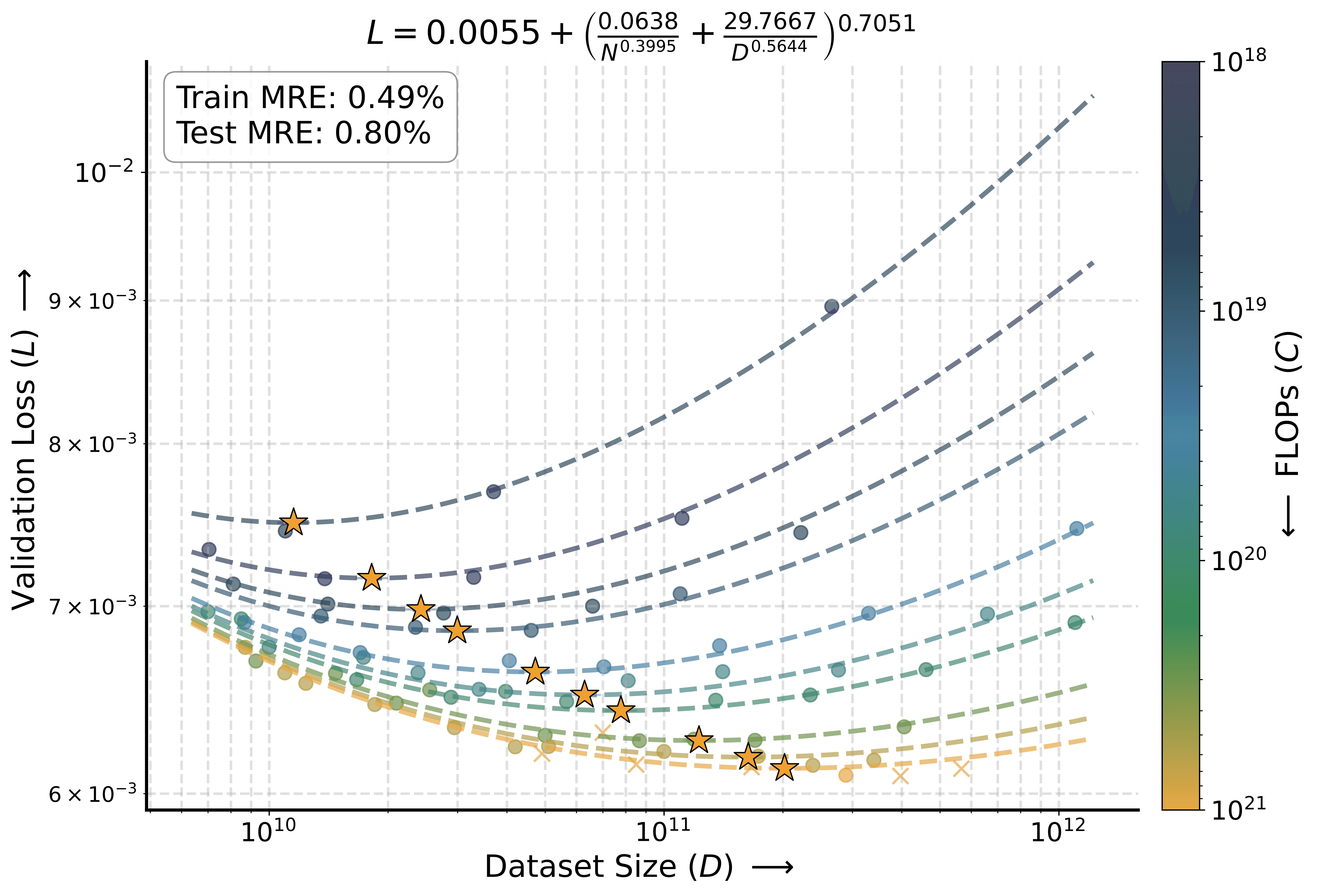
Scaling law fit for validation loss showing training points, testing points, and compute-optimal points across different model and data scales.

Figure 1: Scaling law fit for validation loss. Training (•) and testing (×) points are shown alongside compute-optimal points (★).
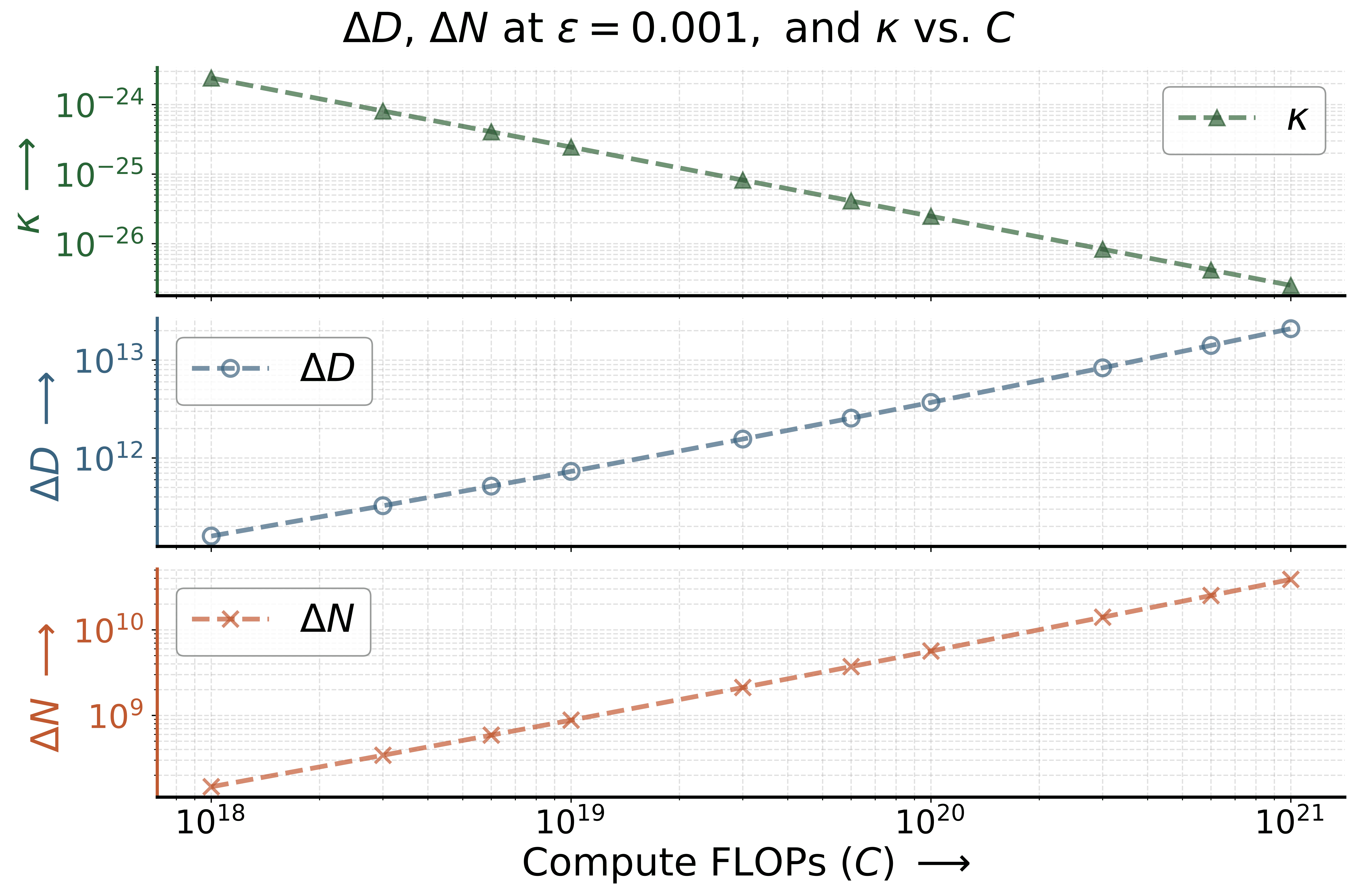
Chart showing how the curvature of isoFLOP optima changes with compute, illustrating the range of model and dataset sizes that achieve near-optimal loss as compute increases.

Figure 2: The curvature κ of isoFLOPs at their optima decreases as compute increases: flattening corresponds to approximately two orders of magnitude expansion in the range of model (ΔN) and dataset (ΔD) sizes yielding a loss within ε of the optimum L*. Thus, higher compute allows near-optimal performance across a much wider variety of parameter-to-data allocations, opening up an efficient inference frontier.

Related readings and updates.

This paper was accepted at the Workshop on Memory for LLM-Based Agentic Systems at ICLR.

Language models have consistently grown to compress more world knowledge into their parameters, but the knowledge that can be pretrained into them is upper-bounded by their parameter size. Especially the capacity of Small Language Models (SLMs) is limited, leading to factually incorrect generations. This problem is often mitigated by giving the SLM access…

Read more

This paper was accepted at the Efficient Natural Language and Speech Processing (ENLSP) Workshop at NeurIPS 2024.

While large language models (LLMs) dominate the AI landscape, Small-scale large Language Models (SLMs) are gaining attention due to cost and efficiency demands from consumers. However, there is limited research on the training behavior and computational requirements of SLMs. In this study, we explore the computational bottlenecks of…

Read more