

惯性聚合 高效追踪和阅读你感兴趣的博客、新闻、科技资讯
阅读原文 在惯性聚合中打开

推荐订阅源

SecWiki News
SecWiki News
H
Help Net Security
罗磊的独立博客
Stack Overflow Blog
Stack Overflow Blog
M
MIT News - Artificial intelligence
Jina AI
Jina AI
L
LangChain Blog
K
Kaspersky official blog
I
Intezer
Martin Fowler
Martin Fowler
爱范儿
爱范儿
AWS News Blog
AWS News Blog
The Hacker News
The Hacker News
Recorded Future
Recorded Future
人人都是产品经理
人人都是产品经理
H
Hackread – Cybersecurity News, Data Breaches, AI and More
C
CXSECURITY Database RSS Feed - CXSecurity.com
Spread Privacy
Spread Privacy
Simon Willison's Weblog
U
Unit 42
N
News and Events Feed by Topic
A
Arctic Wolf
G
GRAHAM CLULEY
Microsoft Azure Blog
博客园 - 聂微东
F
Fortinet All Blogs
C
Cisco Blogs
美团技术团队
Vercel News
Vercel News
K
KPMG report finds enterprise disconnect between AI and its ROI | CIO
H
Hacker News: Front Page
T
Tailwind CSS Blog
I
InfoQ
宝玉的分享
宝玉的分享
Google DeepMind News
博客园 - 司徒正美
P
Palo Alto Networks Blog
A
About on SuperTechFans
Threat Intelligence Blog | Flashpoint
云风的 BLOG
云风的 BLOG
TaoSecurity Blog
TaoSecurity Blog
Google Online Security Blog
Exploit-DB.com RSS Feed
P
Privacy & Cybersecurity Law Blog
H
Heimdal Security Blog
cs.CV updates on arXiv.org
Hacker News: Ask HN
Hacker News: Ask HN
O
OpenAI News
博客园 - Franky
Scott Helme
Scott Helme

PostHog's RSS Feed

Training our own AI models - PostHog From 270GB RAM to 5GB: Moving local flag evaluation from Django to Rust The best analytics stack for vibe-coded apps The do's and don'ts of minimum viable product marketing - PostHog The best MCP servers for startups, by workflow 4,063 errors closed without a human opening PostHog – here's what we learned - PostHog PostHog Code and the self-driving product - PostHog Why attacking your competitors online is dumb - PostHog The best real-time analytics platforms for developers, compared DuckDB vs ClickHouse: Why we use both at PostHog - PostHog PostHog's next chapter - PostHog Making Claude Cowork actually useful - PostHog PostHog vs Matomo in-depth tool comparison You're doing lifecycle emails wrong Untangling Tokio and Rayon in production: From 2s latency spikes to 94ms flat The best HIPAA-compliant A/B testing tools - PostHog A beginner's guide to testing AI agents - PostHog I hate the standup bot (so I built an agent to do it for me) - PostHog The best CDPs for developers, compared The best error tracking tools for developers, compared The best feature flag software for developers, compared 7 best session replay tools for mobile apps 7 best free open source business intelligence tools right now 7 best free and open source LLM observability tools PostHog vs LogRocket in-depth tool comparison The most popular PostHog alternatives, compared Open source (and self-hosted) session replay tools - PostHog The 9 best GA4 alternatives for apps and websites - PostHog PostHog vs Google Analytics 4 in-depth tool comparison How we built automatic clustering for LLM traces - PostHog The 7 best HIPAA-compliant analytics tools 8 best open source analytics tools you can self-host - PostHog The best product analytics tools for startups, compared PostHog vs FullStory in-depth tool comparison The best in-app survey tools for product teams, compared The 7 best mobile app analytics tools PostHog vs Hotjar in-depth tool comparison The 8 best free and open-source feature flag services - PostHog The 5 best free and open-source A/B testing tools - PostHog The best mobile app A/B testing tools, compared What is a feature flag? Feature Flags vs Remote Config vs A/B Testing PostHog is now available in Vercel’s v0 The best Heap alternatives & competitors, compared PostHog vs Heap in-depth tool comparison PostHog vs Pendo in-depth tool comparison PostHog × Vercel: feature flags, minus the plumbing Your logs' final destination is in GA. You always end up here anyway Behind the scenes of a PostHog hackathon - PostHog The most popular Mixpanel alternatives & competitors, compared PostHog vs Mixpanel in-depth tool comparison The 9 best GDPR-compliant analytics tools How we use Logs at PostHog The best web analytics tools for developers, compared Stop AI slop: Run evals with LLM-as-a-Judge - PostHog App onboarding: How to fix drop-off points Meet Logs (beta) – logs with all the tools you’re already using Why small teams crush tiger teams How we built user behavior analysis with multi-modal LLMs (in 5 not-so-easy steps) - PostHog The best Contentsquare alternatives & competitors, compared 8 learnings from 1 year of agents – PostHog AI - PostHog Why we killed our AI product assistant Workflows graduate to beta! Product data, meet automation The best Rollbar alternatives & competitors, compared Workflows are now in Alpha and I already broke mine - PostHog I've consistently underestimated how important communication is as a CEO - PostHog How we made feature flags even faster and more reliable The best session replay tools for developers, compared What I learned attending my first ever hackathon - PostHog Did you know AI is answering our community questions? - PostHog How not to be boring - PostHog We built an internal tool to generate changelog images for social media - PostHog What we built at our windswept Mykonos hackathon - PostHog How we built our onboarding email flow (with actual performance data) - PostHog We're building a better PostHog community by closing our public Slack - PostHog Introducing Notebooks for PostHog - PostHog Why we've launched PostHog user surveys - PostHog How we made feature flags faster and more reliable - PostHog In-depth: ClickHouse vs Redshift - PostHog Introducing HouseWatch: An open-source toolkit for ClickHouse - PostHog Introducing HogQL: Direct SQL access for PostHog - PostHog What we built at our sun-kissed Aruba hackathon - PostHog In-depth: ClickHouse vs BigQuery - PostHog In-depth: ClickHouse vs Elasticsearch - PostHog HogMail #22: Why do companies over-hire?" - PostHog Our simpler goal: Help engineers to be better at product - PostHog In-depth: ClickHouse vs Snowflake - PostHog HogMail #21: Avoiding the "Product Death Cycle" - PostHog Sunsetting Kubernetes support for PostHog - PostHog Why 'Product Engineer' is the most fun role I've had in tech - PostHog HogMail #20: Why do startups fail? - PostHog The best Google Optimize alternatives for apps and websites - PostHog Array 1.43.0: Massive performance improvements! - PostHog In-depth: ClickHouse vs Druid - PostHog HogMail #19: Which meetings should you kill? - PostHog CEO diary: The things I learned in 2022 - PostHog The essential tools used by product engineers - PostHog HogMail #18: What can SaaS learn from the New York Times? - PostHog What is a product engineer? - Product Engineer Handbook - PostHog Array 1.42.0: Get beta features via our roadmap! - PostHog HogMail #17: The personal traits that can't be taught - PostHog
You product data just got a job: Workflows is now out
Sara Miteva · 2025-12-30 · via PostHog's RSS Feed

If your product data was a person, they'd basically be unemployed. They could get picked up in the occasional "freelance" query, but would ideally be looking for more steady work.

We’ve always been good at collecting product data. In PostHog, you could see when a user hits an important milestone in your product, but couldn’t act on it. If PostHog already knows what happened, why does the next step have to happen in another system? That question is what led to Workflows.

Workflows is basically PostHog's version of an employment agency, giving your data a steady job it can do all the time.

We introduced Workflows in alpha asking: could we let teams define what happens next directly on top of the same events and user data they already trust for analytics? During the beta, we saw it used to automate onboarding, coordinate feature rollouts, and trigger messages based on real product behavior.

After seeing this usage and getting positive feedback, Workflows is now generally available.

Workflows lets you automate product-led actions directly from your PostHog data. When something happens in your product, you can respond immediately by sending an email, updating a user property, or triggering a Slack alert. This is done without syncing tools, duct-taped integrations, or API key scavenger hunts.

If you’ve used tools like Zapier, Make, Brevo, or ActiveCampaign, building workflows will feel familiar. The difference is that everything runs inside PostHog, without sending data to third-party tools or platforms.

Everything runs on the same event data you already track. Whether you’re sending a welcome email after onboarding or personalizing notifications based on an upgrade path, it all happens inside PostHog, without shipping data off to third-party platforms.
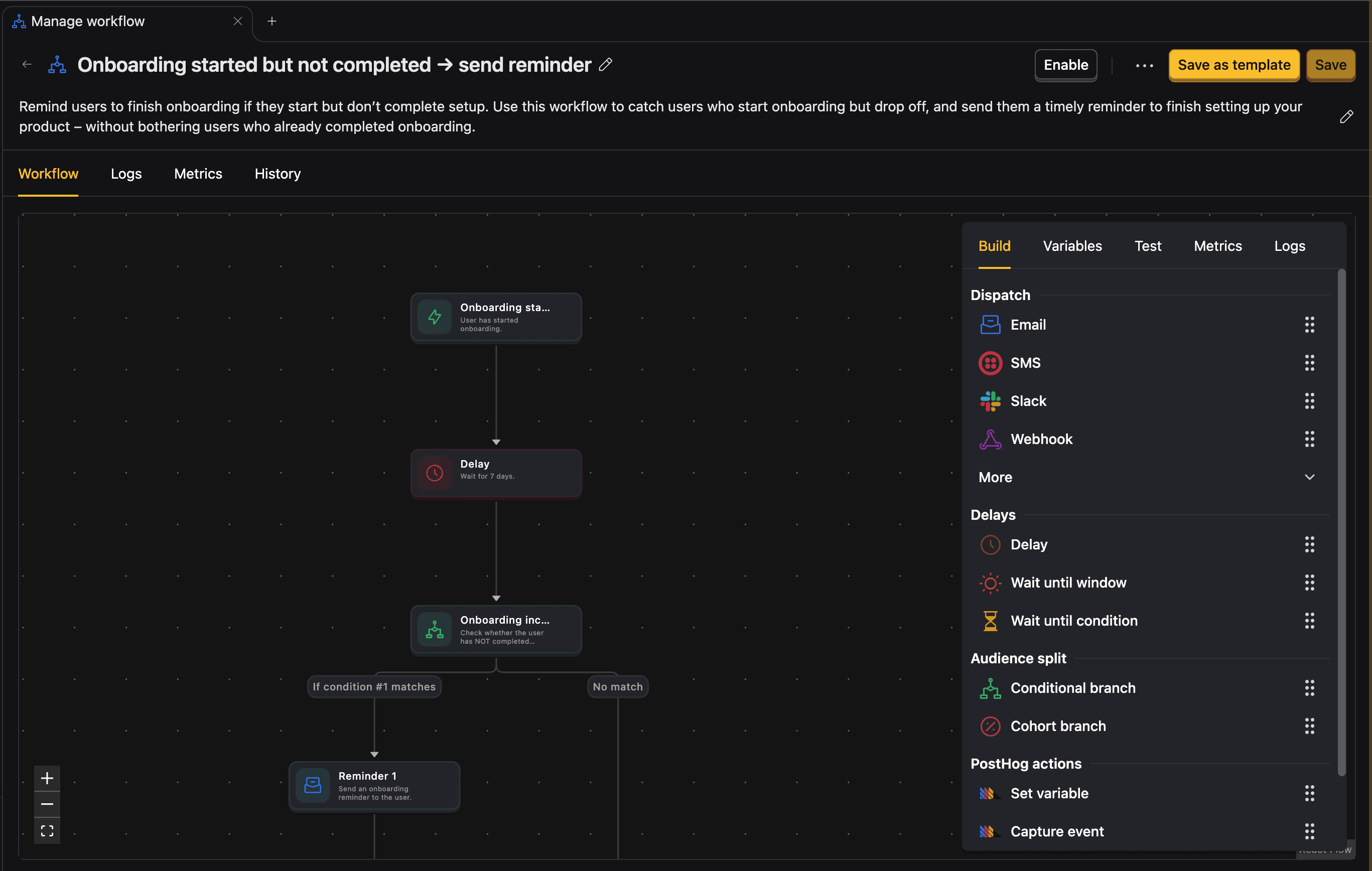
workflows-onboarding-example

Because your product data already lives in PostHog, Workflows can react to it in real time. You can trigger automation from:

  • Product events and user actions
  • Person property and cohort membership updates
  • Feature flag exposure and experiment variants

There’s nothing to sync and nothing to reconcile later. When something meaningful happens in your product, Workflows can respond immediately by updating user state, branching logic, or triggering the next step in the flow.

This also means your automation logic no longer lives in five different tools. Conditions, delays, exits, and actions sit next to the data they depend on, which makes workflows easier to build, easier to debug, and easier to evolve over time. Instead of coordinating systems that only partially agree on who a user is or what they’ve done, everything runs in one place, where your product truth already exists.

Workflows doesn’t stop at sending emails. Because it sits on top of PostHog’s feature flags and messaging system, a single workflow can coordinate both product changes and communication.
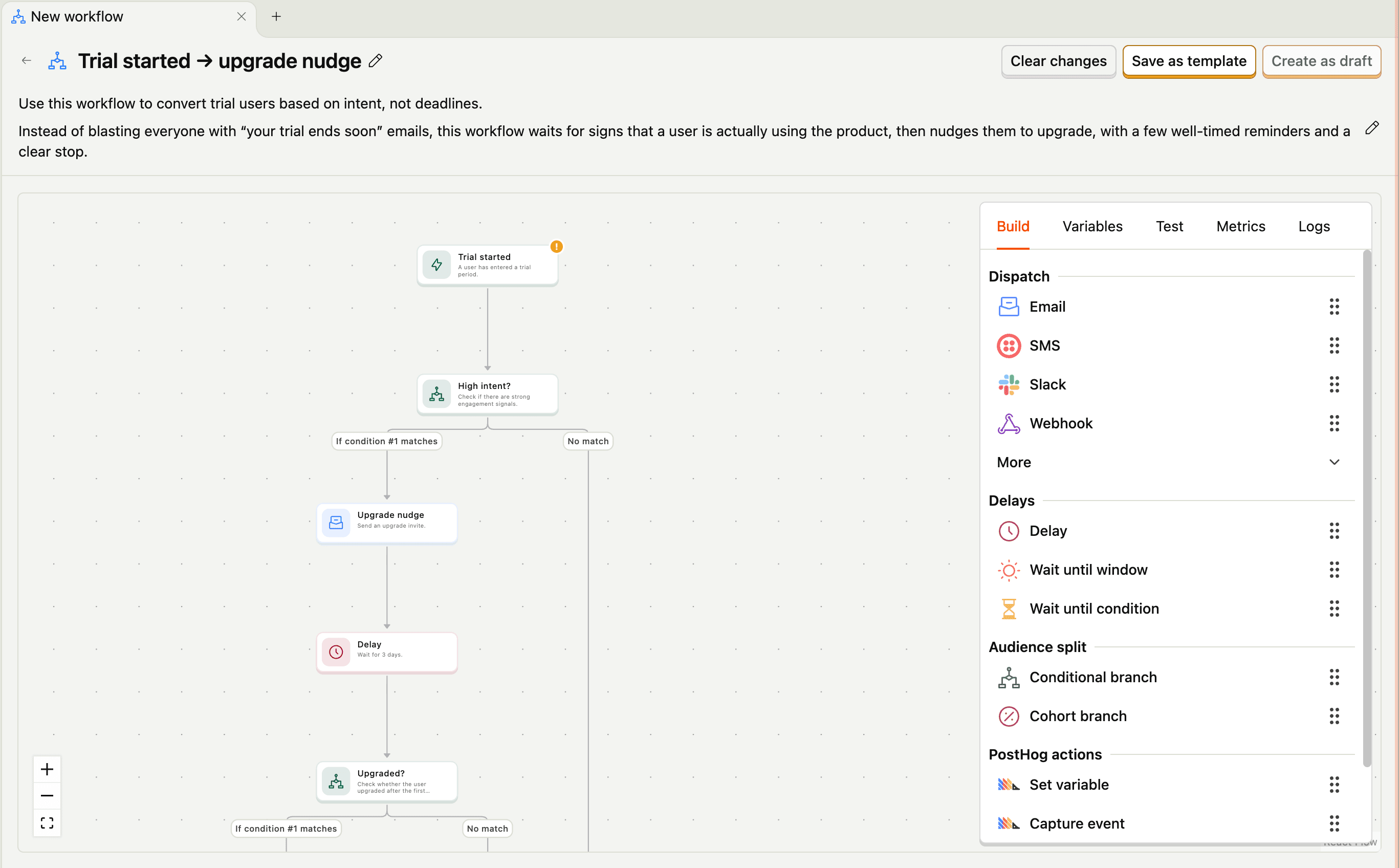
trial-upgrade-nudge-example

In one flow, you can:

  • Enable or disable a feature flag
  • Assign users to a specific variant
  • Update person properties for future targeting

This keeps what users see in the product and what they’re told about it in sync, without relying on separate systems to catch up later.

At Croissant, Workflows is used to act on intent signals without moving data between tools. Their growth team triggers follow-ups directly from PostHog events, keeping experimentation and iteration fast.

“The main benefit is that everything’s already in PostHog. Syncing data across tools is always hit-or-miss, and expensive. Now it’s all in one place, and we can iterate way faster.”

At Grantable, Workflows builds on an analytics foundation where every feature is instrumented and measured. Product usage data now feeds automation directly, instead of stopping at dashboards.

“We track usage, pipe that into dashboards for activation and retention, and now we’re starting to act on it automatically with Workflows.”

Different products, same pattern: using trusted product events as the source of truth and acting on them without adding another automation layer to maintain.

PostHog's free tier allows you to send 10,000 messages monthly with all channels (push, email, SMS, and CDP events) included. After that, prices start at $0,005 per send, depending on the channel. Pricing decreases with volume and every channel has a generous volume discount.

Compared to most automation and messaging tools on the market, this makes Workflows one of the most accessible and cost-effective options available. Traditional automation platforms charge per task, quickly becoming expensive as workflows grow more complex, while customer messaging tools often bundle pricing around user profiles or locked plans. PostHog takes a different approach – you only pay for what you actually send, with no feature gating, no per-user pricing, and no extra tooling required to connect your product data.

If your product already knows when someone signed up, finished onboarding, or hit a meaningful usage milestone, that information shouldn’t stop at a dashboard.

With Workflows, those signals can trigger messages, updates, or follow-up actions immediately, without routing data through another tool first. The result is fewer moving parts, less glue code, and your data & actions living in the same tool you already love.

Learn more in the docs or jump straight into launching your first workflow.