


惯性聚合 高效追踪和阅读你感兴趣的博客、新闻、科技资讯
阅读原文 在惯性聚合中打开

推荐订阅源

Stack Overflow Blog
Stack Overflow Blog
WordPress大学
WordPress大学
罗磊的独立博客
S
Secure Thoughts
Schneier on Security
博客园 - Franky
www.infosecurity-magazine.com
Exploit-DB.com RSS Feed
爱范儿
爱范儿
cs.CV updates on arXiv.org
Hacker News: Ask HN
Hacker News: Ask HN
PCI Perspectives
PCI Perspectives
Google DeepMind News
S
Security Affairs
SecWiki News
SecWiki News
博客园 - 聂微东
Security Archives - TechRepublic
Google Online Security Blog
H
Heimdal Security Blog
S
Security @ Cisco Blogs
Engineering at Meta
Engineering at Meta
C
CXSECURITY Database RSS Feed - CXSecurity.com
Cloudbric
Cloudbric
Threat Intelligence Blog | Flashpoint
V
Visual Studio Blog
P
Proofpoint News Feed
Project Zero
Project Zero
T
Threat Research - Cisco Blogs
Webroot Blog
Webroot Blog
Blog — PlanetScale
Blog — PlanetScale
K
KPMG report finds enterprise disconnect between AI and its ROI | CIO
W
WeLiveSecurity
Last Week in AI
Last Week in AI
月光博客
月光博客
Microsoft Azure Blog
M
MIT News - Artificial intelligence
有赞技术团队
有赞技术团队
S
Securelist
GbyAI
GbyAI
Application and Cybersecurity Blog
C
CERT Recently Published Vulnerability Notes
Recent Commits to openclaw:main
Cyberwarzone
Cyberwarzone
B
Blog RSS Feed
P
Palo Alto Networks Blog
H
Hacker News: Front Page
D
Docker
雷峰网
雷峰网
Latest news
Latest news
Microsoft Security Blog

PostHog's RSS Feed

Training our own AI models - PostHog From 270GB RAM to 5GB: Moving local flag evaluation from Django to Rust The best analytics stack for vibe-coded apps The do's and don'ts of minimum viable product marketing - PostHog The best MCP servers for startups, by workflow 4,063 errors closed without a human opening PostHog – here's what we learned - PostHog PostHog Code and the self-driving product - PostHog Why attacking your competitors online is dumb - PostHog The best real-time analytics platforms for developers, compared DuckDB vs ClickHouse: Why we use both at PostHog - PostHog PostHog's next chapter - PostHog Making Claude Cowork actually useful - PostHog PostHog vs Matomo in-depth tool comparison You're doing lifecycle emails wrong Untangling Tokio and Rayon in production: From 2s latency spikes to 94ms flat The best HIPAA-compliant A/B testing tools - PostHog A beginner's guide to testing AI agents - PostHog I hate the standup bot (so I built an agent to do it for me) - PostHog The best CDPs for developers, compared The best error tracking tools for developers, compared The best feature flag software for developers, compared 7 best session replay tools for mobile apps 7 best free open source business intelligence tools right now 7 best free and open source LLM observability tools PostHog vs LogRocket in-depth tool comparison The most popular PostHog alternatives, compared Open source (and self-hosted) session replay tools - PostHog The 9 best GA4 alternatives for apps and websites - PostHog PostHog vs Google Analytics 4 in-depth tool comparison How we built automatic clustering for LLM traces - PostHog The 7 best HIPAA-compliant analytics tools 8 best open source analytics tools you can self-host - PostHog The best product analytics tools for startups, compared PostHog vs FullStory in-depth tool comparison The best in-app survey tools for product teams, compared The 7 best mobile app analytics tools PostHog vs Hotjar in-depth tool comparison The 8 best free and open-source feature flag services - PostHog The 5 best free and open-source A/B testing tools - PostHog The best mobile app A/B testing tools, compared What is a feature flag? Feature Flags vs Remote Config vs A/B Testing PostHog is now available in Vercel’s v0 The best Heap alternatives & competitors, compared PostHog vs Heap in-depth tool comparison PostHog vs Pendo in-depth tool comparison PostHog × Vercel: feature flags, minus the plumbing Your logs' final destination is in GA. You always end up here anyway Behind the scenes of a PostHog hackathon - PostHog The most popular Mixpanel alternatives & competitors, compared PostHog vs Mixpanel in-depth tool comparison The 9 best GDPR-compliant analytics tools How we use Logs at PostHog The best web analytics tools for developers, compared Stop AI slop: Run evals with LLM-as-a-Judge - PostHog You product data just got a job: Workflows is now out App onboarding: How to fix drop-off points Meet Logs (beta) – logs with all the tools you’re already using Why small teams crush tiger teams How we built user behavior analysis with multi-modal LLMs (in 5 not-so-easy steps) - PostHog The best Contentsquare alternatives & competitors, compared 8 learnings from 1 year of agents – PostHog AI - PostHog Why we killed our AI product assistant Workflows graduate to beta! Product data, meet automation The best Rollbar alternatives & competitors, compared Workflows are now in Alpha and I already broke mine - PostHog I've consistently underestimated how important communication is as a CEO - PostHog How we made feature flags even faster and more reliable The best session replay tools for developers, compared What I learned attending my first ever hackathon - PostHog How not to be boring - PostHog We built an internal tool to generate changelog images for social media - PostHog What we built at our windswept Mykonos hackathon - PostHog How we built our onboarding email flow (with actual performance data) - PostHog We're building a better PostHog community by closing our public Slack - PostHog Introducing Notebooks for PostHog - PostHog Why we've launched PostHog user surveys - PostHog How we made feature flags faster and more reliable - PostHog In-depth: ClickHouse vs Redshift - PostHog Introducing HouseWatch: An open-source toolkit for ClickHouse - PostHog Introducing HogQL: Direct SQL access for PostHog - PostHog What we built at our sun-kissed Aruba hackathon - PostHog In-depth: ClickHouse vs BigQuery - PostHog In-depth: ClickHouse vs Elasticsearch - PostHog HogMail #22: Why do companies over-hire?" - PostHog Our simpler goal: Help engineers to be better at product - PostHog In-depth: ClickHouse vs Snowflake - PostHog HogMail #21: Avoiding the "Product Death Cycle" - PostHog Sunsetting Kubernetes support for PostHog - PostHog Why 'Product Engineer' is the most fun role I've had in tech - PostHog HogMail #20: Why do startups fail? - PostHog The best Google Optimize alternatives for apps and websites - PostHog Array 1.43.0: Massive performance improvements! - PostHog In-depth: ClickHouse vs Druid - PostHog HogMail #19: Which meetings should you kill? - PostHog CEO diary: The things I learned in 2022 - PostHog The essential tools used by product engineers - PostHog HogMail #18: What can SaaS learn from the New York Times? - PostHog What is a product engineer? - Product Engineer Handbook - PostHog Array 1.42.0: Get beta features via our roadmap! - PostHog HogMail #17: The personal traits that can't be taught - PostHog
Did you know AI is answering our community questions? - PostHog
Cory Watilo · 2024-10-03 · via PostHog's RSS Feed

AI. You may have heard of it.

Sure, ChatGPT is pretty cool, but when it comes to AI chatbots that try to replace a human in a product support context, I've generally been underwhelmed. The experience generally isn't great, and I'm often left with more frustration than before I skeptically asked the question in the first place.

But it's not all the fault of LLMs. It also has to do with the available information about a product that an LLM consumes. And for a technical product like PostHog, the documentation has to be extensive enough to answer very nuanced questions. (This is tricky as information is constantly changing and there's always room for improvement!)

As the product owner totally official "webmaster" of PostHog.com, I've contemplated how we can make use of AI to help answer questions... and until now, I've lacked a good solution.

There are a lot of "wrong" ways to do AI chatbots – and there are many examples of this even before we collectively started using true AI.

How many times have you tried to create a support ticket but then:

  • been first prompted to review a list of "related questions" that may solve your issue
  • been blocked from submitting until you explicitly confirm that none of the suggested answers are helpful

And now in a world of actual AI, we see a new set of issues – largely centered around LLMs not understanding the question, the context, or straight up hallucinating.

In no world would we want to subject our very technical audience to these types of dreaded experiences.

This isn't to say all AI chatbots are bad. A couple of exceptions come top of mind mainly Intercom and Shopify. But the status quo that the industry has to overcome is the negative connotation of historically bad chatbot interactions.

The reason we've been so cautious to introduce AI is that we're very intentional about earning (and not losing) the trust of our audience. We do this in a handful of ways:

  1. We don't use fancy words that don't add actual value
  2. We try to be relatable and show a personality
  3. We traded in the value-based sales model for a no-BS approach (self-service, fair, usage-based pricing)
  4. We avoid gimmicky marketing tactics (like popups and jamming CTAs into every available whitespace)

So for an AI solution to mesh well with our brand's vibe (yes, we're about the vibes), it needs to be accurate and succinct in its replies, and never make up a false answer.

After all, if you interact with an AI chatbot and don't get the answer you're looking for, you're likely to write it off entirely. And that's exactly what I want to avoid.

The most natural place to include an AI chatbot would be in our docs. But I was hesitant to start here, as the conversational nature of AI meant we'd lack control over the quality and accuracy of the responses. So I decided to try something different.

Our community questions section is where users can ask questions directly in the docs. And we currently have... a lot of open (unanswered) questions. But because they're posted in a forum-style format, there's no expectation of a live chat experience. And this presented an opportunity...

Today customers may wait hours (or even longer) for a response from a human. So what if AI could answer only the questions it was highly confident it could answer, then leave the rest for a human?

Using this approach, AI can add value by instantly responding if it has a high degree of confidence, but it won't detract from the experience if it doesn't have the solution, simply leaving those questions open as they normally would.

This whole idea came about from an Inkeep ad on LinkedIn – which is incredible to say because I'm generally allergic to ads. But Inkeep's ad spoke to me.
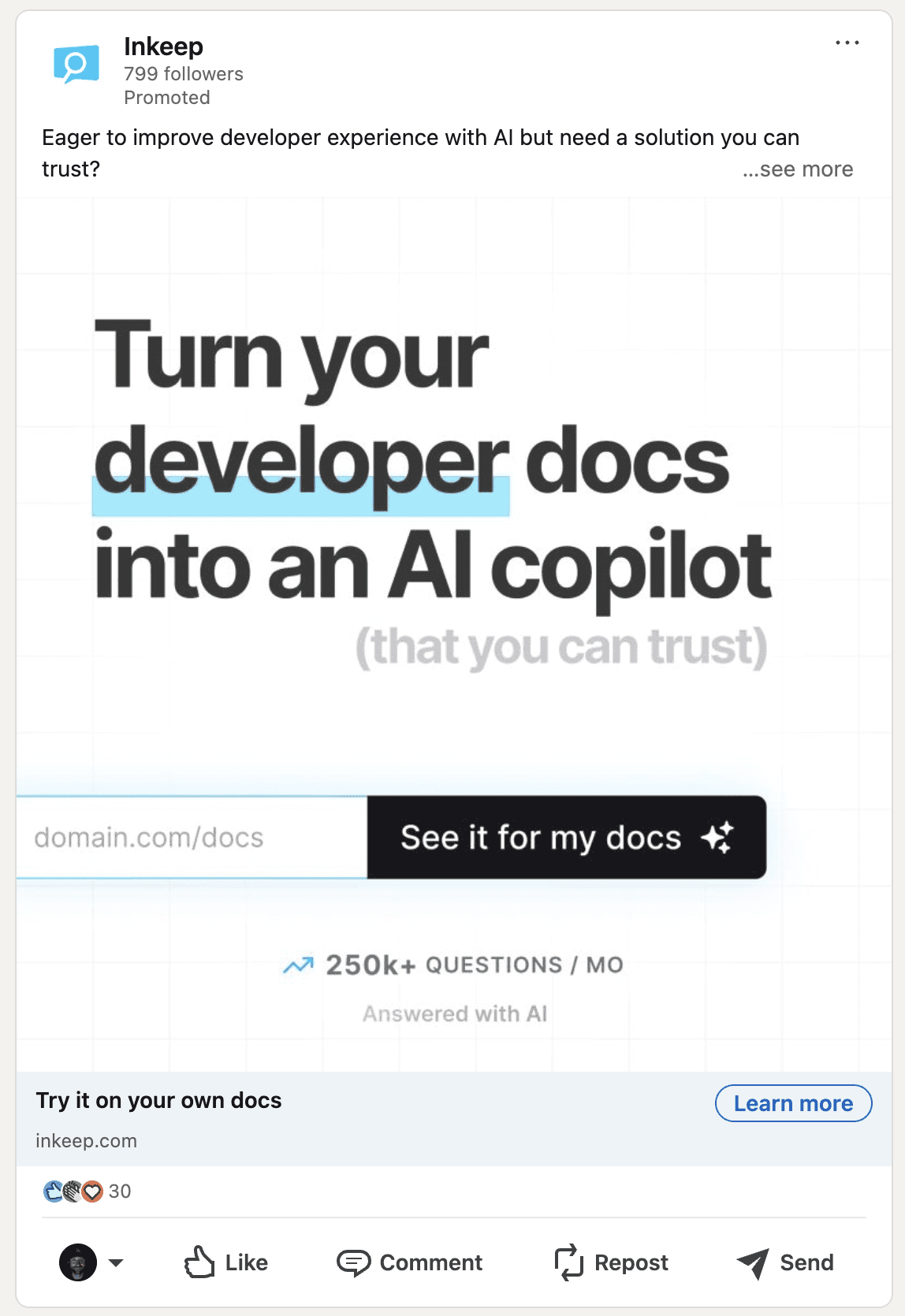
Inkeep's LinkedIn ad

I took the bait, and they quickly set me up with a custom sandbox to try them out. They're indexing our docs, tutorials, blog posts, handbook, existing community answers, and even GitHub repos. (This also means it's aware of bug reports, feature requests, and open pull requests - huge!)
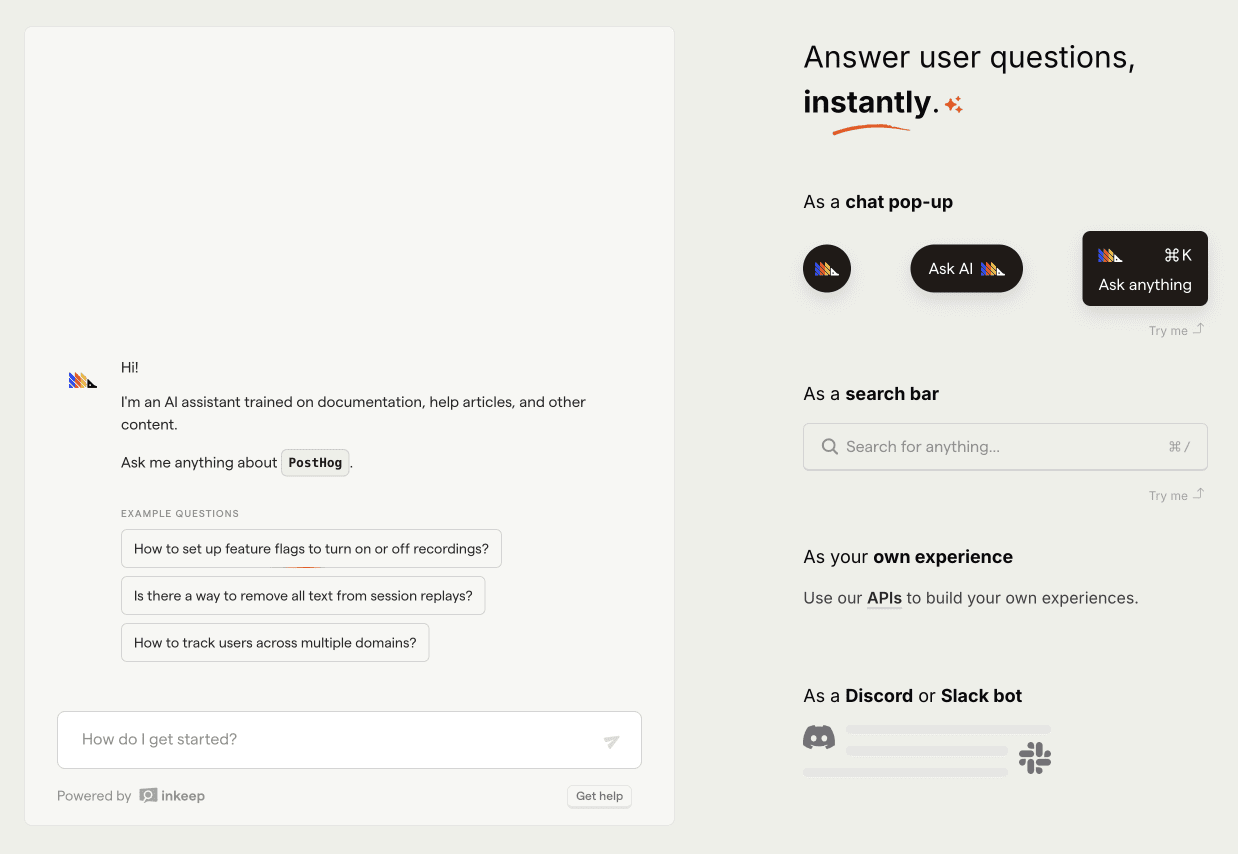
Inkeep sandbox

They even themed the sandbox to match our brand. <3
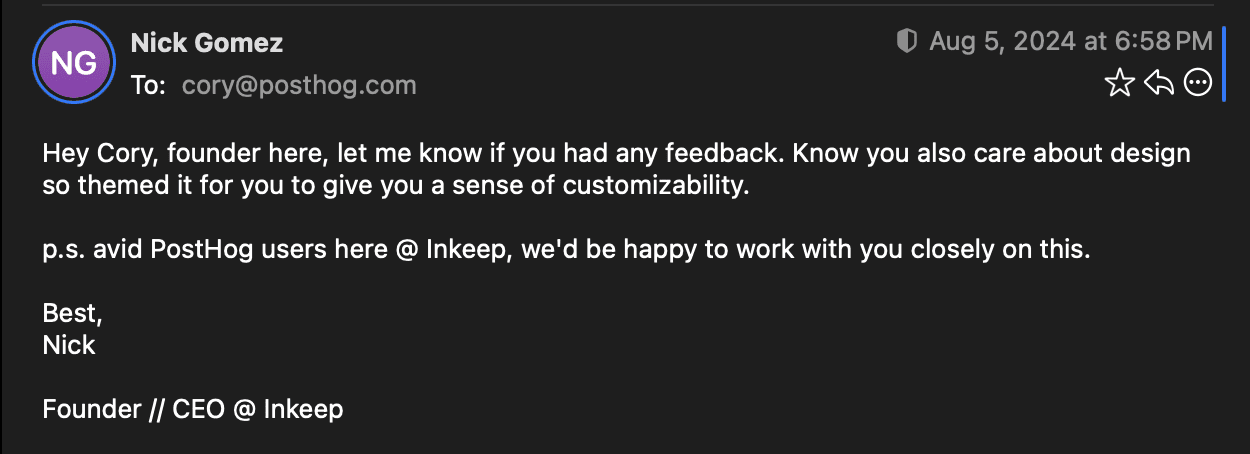
Inkeep email

To vet the quality of the answers, I started copy/pasting unanswered community questions into the sandbox and seeing what Inkeep could produce. And to say I wasn't let down should tell you something. It was good enough to where I was willing to try it out on our real questions.

Inkeep's pre-built library of UI components works great for most companies. But out of the kindness of their hearts, they went the extra mile for us.

Here's how our setup works:

  1. When a new question is posted, we send it to Inkeep's LLM.

  2. Typically within ~20 seconds, we get a response. During this time, we show that we're searching for an answer.
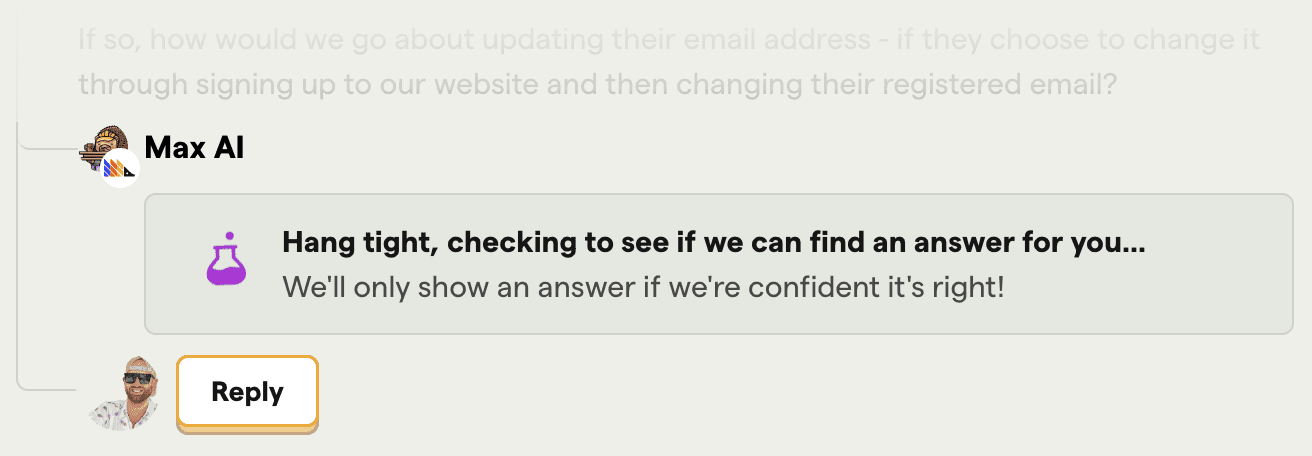
    AI answer in progress

  3. In the response, we get a confidence score.

    If the confidence score is high enough, we show the answer to the user.

    If Inkeep isn't confident in the answer, we show a message that says we couldn't find an answer, and that a human will appear as soon as possible.

When an AI answer is presented, we show feedback buttons so the original poster can tell us if the answer was helpful. We use this information to improve the quality of the answers.
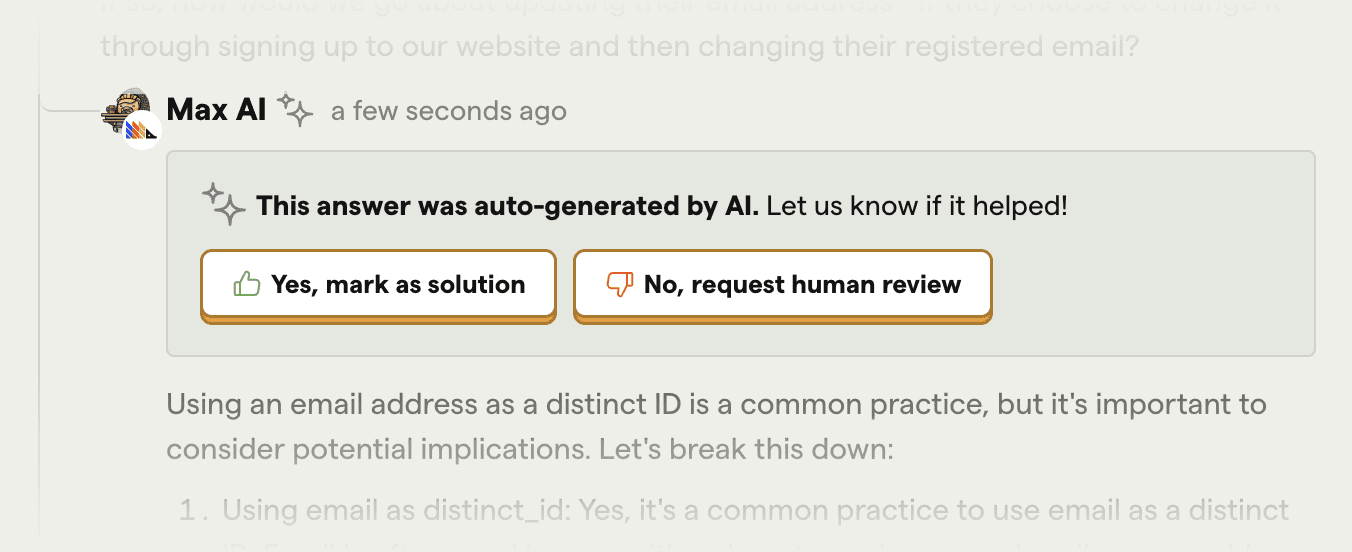
How's the AI answer?

Here's what it looks like to submit a question and receive an AI answer from Inkeep.

As you can imagine, every time a customer rates a response, we're sending the information into PostHog as a custom event. Along with the event, it sends properties like the sentiment ("helpful" or "not helpful") and the category of the question. (This will help us identify if certain areas of our documentation needs to improve.)
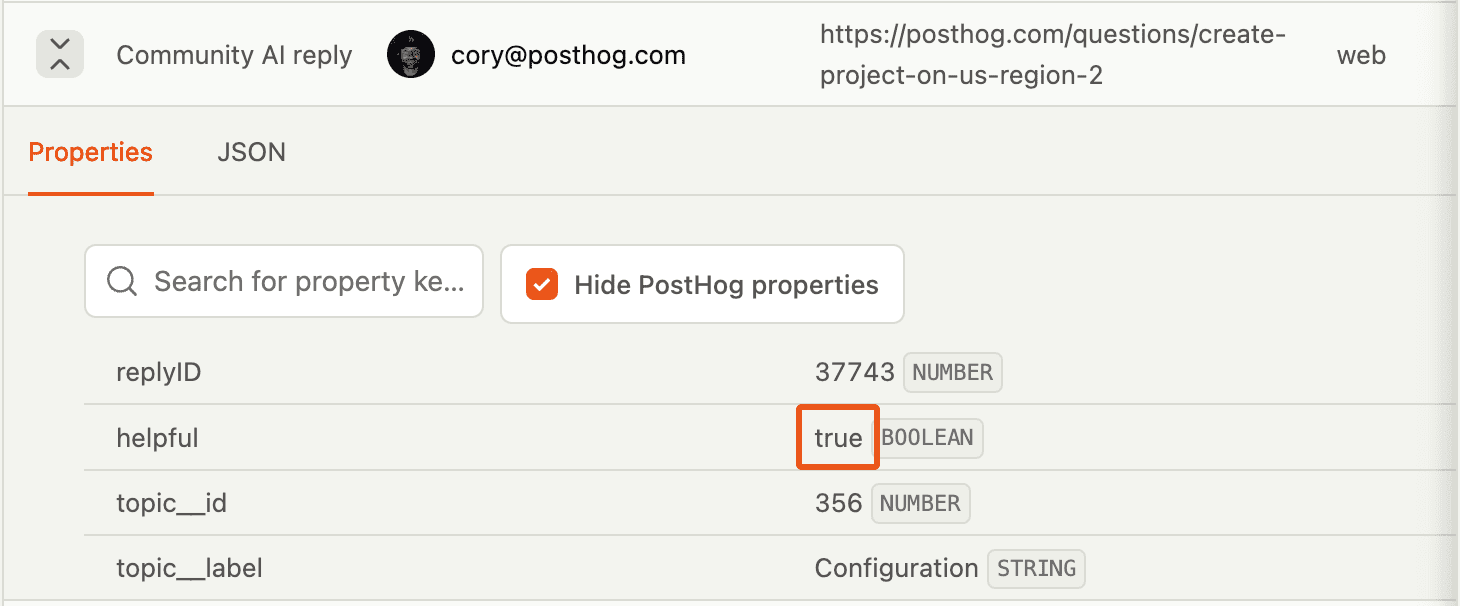
Feedback event

Now that this is live, we're monitoring feedback in Slack. PostHog's recently introduced support for realtime destinations in data pipelines.
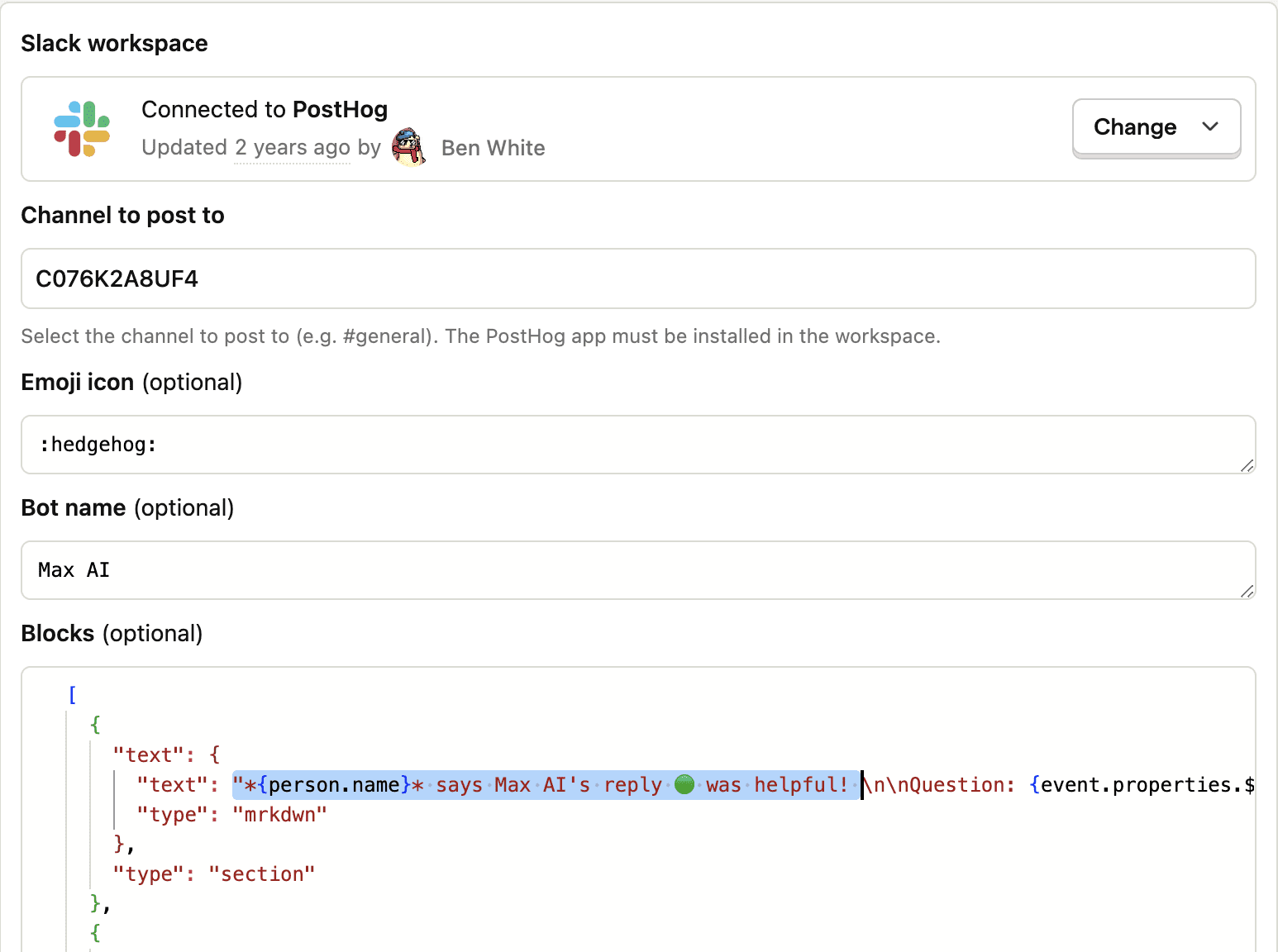
Realtime Slack notification config

This allowed me to configure notifications when we get feedback about an AI answer.

Slack notification

Overall, it's working pretty well! In fact, it worked so well in one case that the original poster replied to share his delight.
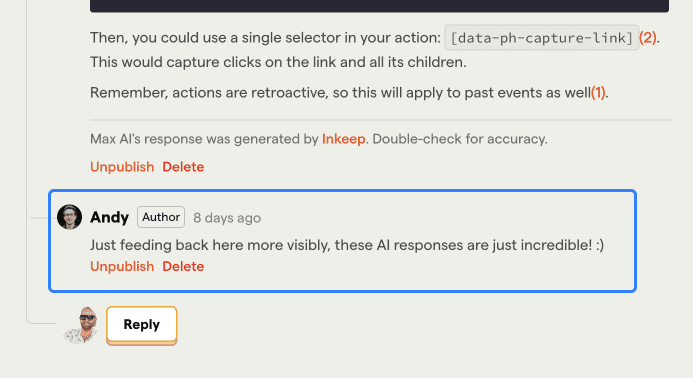
Customer approved

In other examples, we were receiving feedback that the answer wasn't helpful. But after reviewing the response, the best way to accurately summarize the bulk of feedback is: "The answer is correct, but I didn't like the answer." (This is usually the case when a feature isn't yet supported and it's not the answer the customer was hoping for.)

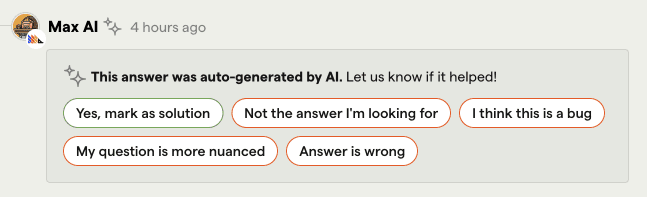
This resulted in a lower overall success rate. So we modified the response options to better understand the different reasons why a response might not meet the mark.
Response options

With these additional feedback options, we're able to use it to inform areas for improvement. For example, if someone says, "I think this is a bug", we'll take a closer look. Or if they choose the "Answer is wrong" option, we'll take a look into what might be missing from the documentation.

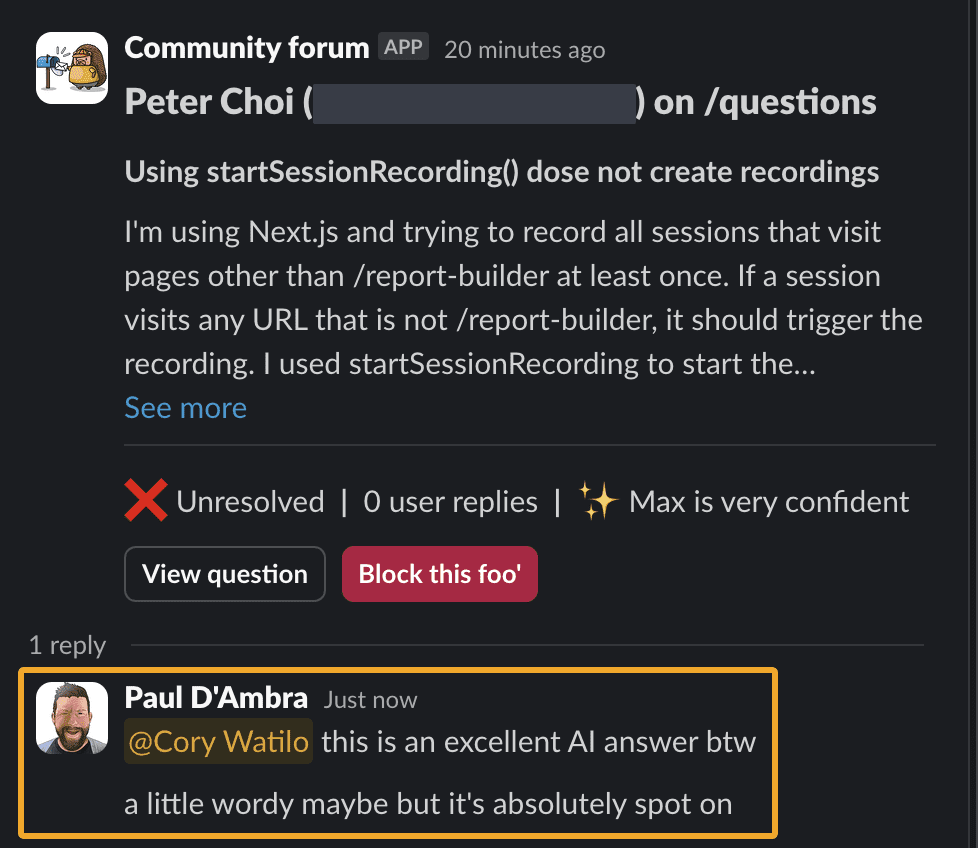
It's also won over some internal support from developers on the PostHog team:
Developer approved


We're still early in our days of exploring AI – and don't worry, AI is coming to the PostHog app when we feel it's ready.

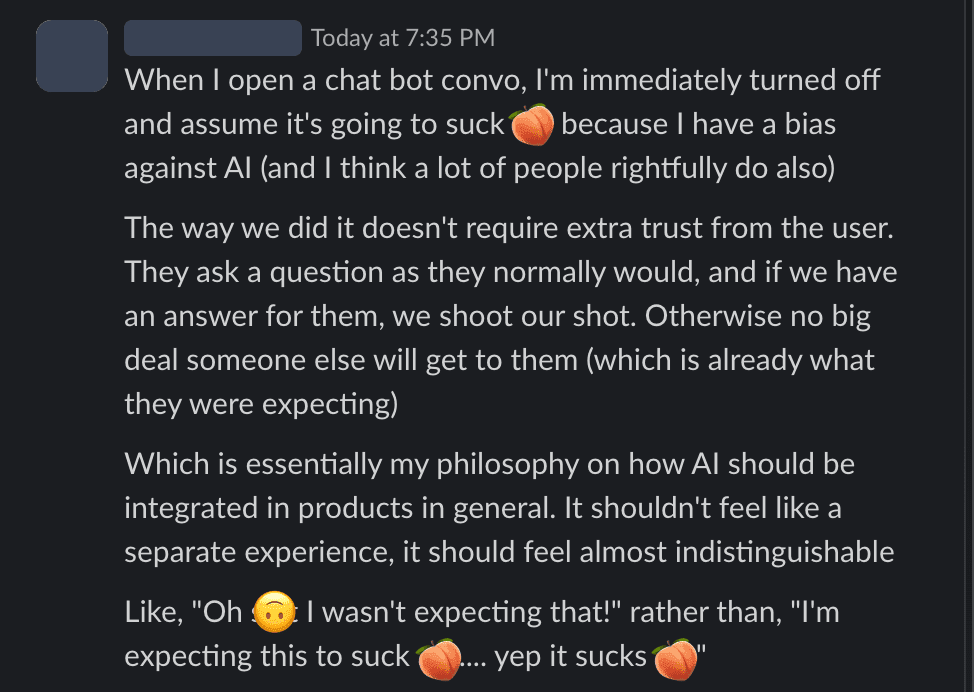
But I couldn't give you a better rationale for a slow rollout than how a colleague explained it to me:
Anonymous quote

Hopefully the next time you ask a question in our community, you'll get the answer you're looking for. And even better – if you get it even faster than a human could answer.