


惯性聚合 高效追踪和阅读你感兴趣的博客、新闻、科技资讯
阅读原文 在惯性聚合中打开

推荐订阅源

Microsoft Azure Blog
S
Securelist
V
Vulnerabilities – Threatpost
C
Cyber Attacks, Cyber Crime and Cyber Security
Schneier on Security
Cyberwarzone
Cyberwarzone
Simon Willison's Weblog
Hacker News - Newest:
Hacker News - Newest: "LLM"
P
Palo Alto Networks Blog
T
Troy Hunt's Blog
SecWiki News
SecWiki News
Security Archives - TechRepublic
T
The Blog of Author Tim Ferriss
Project Zero
Project Zero
Microsoft Security Blog
The Register - Security
OSCHINA 社区最新新闻
OSCHINA 社区最新新闻
J
Java Code Geeks
F
Full Disclosure
阮一峰的网络日志
阮一峰的网络日志
www.infosecurity-magazine.com
Attack and Defense Labs
Know Your Adversary
Know Your Adversary
WordPress大学
WordPress大学
PCI Perspectives
PCI Perspectives
N
News | PayPal Newsroom
The Last Watchdog
The Last Watchdog
酷 壳 – CoolShell
酷 壳 – CoolShell
P
Privacy & Cybersecurity Law Blog
P
Proofpoint News Feed
V
Visual Studio Blog
C
CERT Recently Published Vulnerability Notes
H
Help Net Security
K
KPMG report finds enterprise disconnect between AI and its ROI | CIO
云风的 BLOG
云风的 BLOG
月光博客
月光博客
T
The Exploit Database - CXSecurity.com
I
InfoQ
大猫的无限游戏
大猫的无限游戏
钛媒体:引领未来商业与生活新知
钛媒体:引领未来商业与生活新知
U
Unit 42
腾讯CDC
小众软件
小众软件
V2EX - 技术
V2EX - 技术
罗磊的独立博客
Cloudbric
Cloudbric
Recorded Future
Recorded Future
IT之家
IT之家
Google DeepMind News
C
CXSECURITY Database RSS Feed - CXSecurity.com

Let's Encrypt

The difficulty of making sure your website is broken Simplifying Certificate Renewals for Millions of Domains with ACME Renewal Information (ARI) Six-Day and IP Address Certificates Available in Certbot Shorter Certificate Lifetimes and Rate Limits DNS-PERSIST-01: A New Model for DNS-based Challenge Validation On the Importance of "Hello" and "Thanks" 6-day and IP Address Certificates are Generally Available 10 Years of Let's Encrypt Certificates Decreasing Certificate Lifetimes to 45 Days New "Generation Y" Hierarchy of Root and Intermediate Certificates Ten Years of Community Support ACME Renewal Information (ARI) Published as RFC 9773 Native ACME Support Comes to NGINX End of Life Plan for RFC 6962 Certificate Transparency Logs OCSP Service Has Reached End of Life We've Issued Our First IP Address Certificate Expiration Notification Service Has Ended Reflections on a Year of Sunlight How We Reduced the Impact of Zombie Clients Sustaining a More Secure Internet: The Power of Recurring Donations Ending TLS Client Authentication Certificate Support in 2026 How Pebble Supports ACME Client Developers Ten Years of Let's Encrypt: Announcing support from Jeff Atwood We Issued Our First Six Day Cert Encryption for Everybody Scaling Our Rate Limits to Prepare for a Billion Active Certificates Ending Support for Expiration Notification Emails Announcing Six Day and IP Address Certificate Options in 2025 Announcing Certificate Profile Selection Ending OCSP Support in 2025 Intent to End OCSP Service More Memory Safety for Let’s Encrypt: Deploying ntpd-rs Let’s Encrypt Continues Partnership with Princeton to Bolster Internet Security Takeaways from Tailscale’s Adoption of ARI An Engineer’s Guide to Integrating ARI into Existing ACME Clients Deploying Let's Encrypt's New Issuance Chains New Intermediate Certificates Introducing Sunlight, a CT implementation built for scalability, ease of operation, and reduced cost A Year-End Letter from our Vice President Our role in supporting the nonprofit ecosystem Increase your security governance with CAA Shortening the Let's Encrypt Chain of Trust ISRG’s 10th Anniversary Improving Resiliency and Reliability for Let’s Encrypt with ARI Thank you to our 2023 renewing sponsors A Look into the Engineering Culture at ISRG Let’s Encrypt improves how we manage OCSP responses A New Life for Certificate Revocation Lists Nurturing Continued Growth of Our Oak CT Log TLS Beyond the Web: How MongoDB Uses Let’s Encrypt for Database-to-Application Security Let’s Encrypt Receives the Levchin Prize for Real-World Cryptography New Major Funding from the Ford Foundation Making the Web safer and more secure for everyone Resources for Certificate Chaining Help Speed at scale: Let’s Encrypt serving Shopify’s 4.5 million domains Preparing to Issue 200 Million Certificates in 24 Hours The Next Gen Database Servers Powering Let's Encrypt A Year-End Letter from the Executive Director of Let's Encrypt and ISRG Extending Android Device Compatibility for Let's Encrypt Certificates Standing on Our Own Two Feet [Updated] Let's Encrypt's New Root and Intermediate Certificates Let's Encrypt Has Issued a Billion Certificates Multi-Perspective Validation Improves Domain Validation Security How Let's Encrypt Runs CT Logs Onboarding Your Customers with Let's Encrypt and ACME Introducing Oak, a Free and Open Certificate Transparency Log Transitioning to ISRG's Root The ACME Protocol is an IETF Standard Facebook Expands Support for Let’s Encrypt Looking Forward to 2019 Let's Encrypt Root Trusted By All Major Root Programs Engineering deep dive: Encoding of SCTs in certificates Looking Forward to 2018 ACME Support in Apache HTTP Server Project Wildcard Certificates Coming January 2018 Milestone: 100 Million Certificates Issued ACME v2 API Endpoint Coming January 2018 OVH Renews Platinum Sponsorship of Let's Encrypt Let’s Encrypt 2016 In Review Launching Our Crowdfunding Campaign Our First Grant: The Ford Foundation Squarespace OCSP Stapling Implementation Introducing Internationalized Domain Name (IDN) Support ISRG Legal Transparency Report, January 2016 - June 2016 What It Costs to Run Let's Encrypt Let's Encrypt Root to be Trusted by Mozilla Full Support for IPv6 Defending Our Brand [Updated] Progress Towards 100% HTTPS, June 2016 Leaving Beta, New Sponsors ISRG Legal Transparency Report, July 2015 - December 2015 New Name, New Home for the Let's Encrypt Client Software Our Millionth Certificate OVH Sponsors Let's Encrypt Entering Public Beta Facebook Sponsors Let's Encrypt Public Beta: December 3, 2015 Why ninety-day lifetimes for certificates? The CA's Role in Fighting Phishing and Malware Let's Encrypt is Trusted
TLS Simply and Automatically for Europe’s Largest Cloud Customers
2021-10-28 · via Let's Encrypt

By Sarah Gran ·

OVHcloud, the largest hosting provider in Europe, has used Let’s Encrypt for TLS certificates since 2016. Since then, they’ve provisioned tens of millions of certificates for their shared hosting customers. We often get asked about how large integrations work and their best practices so this will be the first in a series of blog posts we’ll publish on the topic.

OVHcloud first started looking into using Let’s Encrypt certificates because the team saw a need for the protection provided by TLS for every customer (remember, way back five years ago, when that wasn’t just a thing everybody did?). “Our goal was to deliver TLS simply. We didn’t want to have to write a tutorial for our customers to upload a cert, but instead just click and it works,” said Guillaume Marchand, OVHcloud’s Technical Team Lead.

They considered building their own CA but determined the cost and complexity of doing so would be impractical. Instead, they built an ACME client to prepare for using Let’s Encrypt. It took about six months, “we simply followed the RFC and did a bit of reverse engineering of Certbot,” said Guillaume. In addition to a custom client, OVHcloud automated their Certificate Signing Request (CSR) process and certificate installation process.
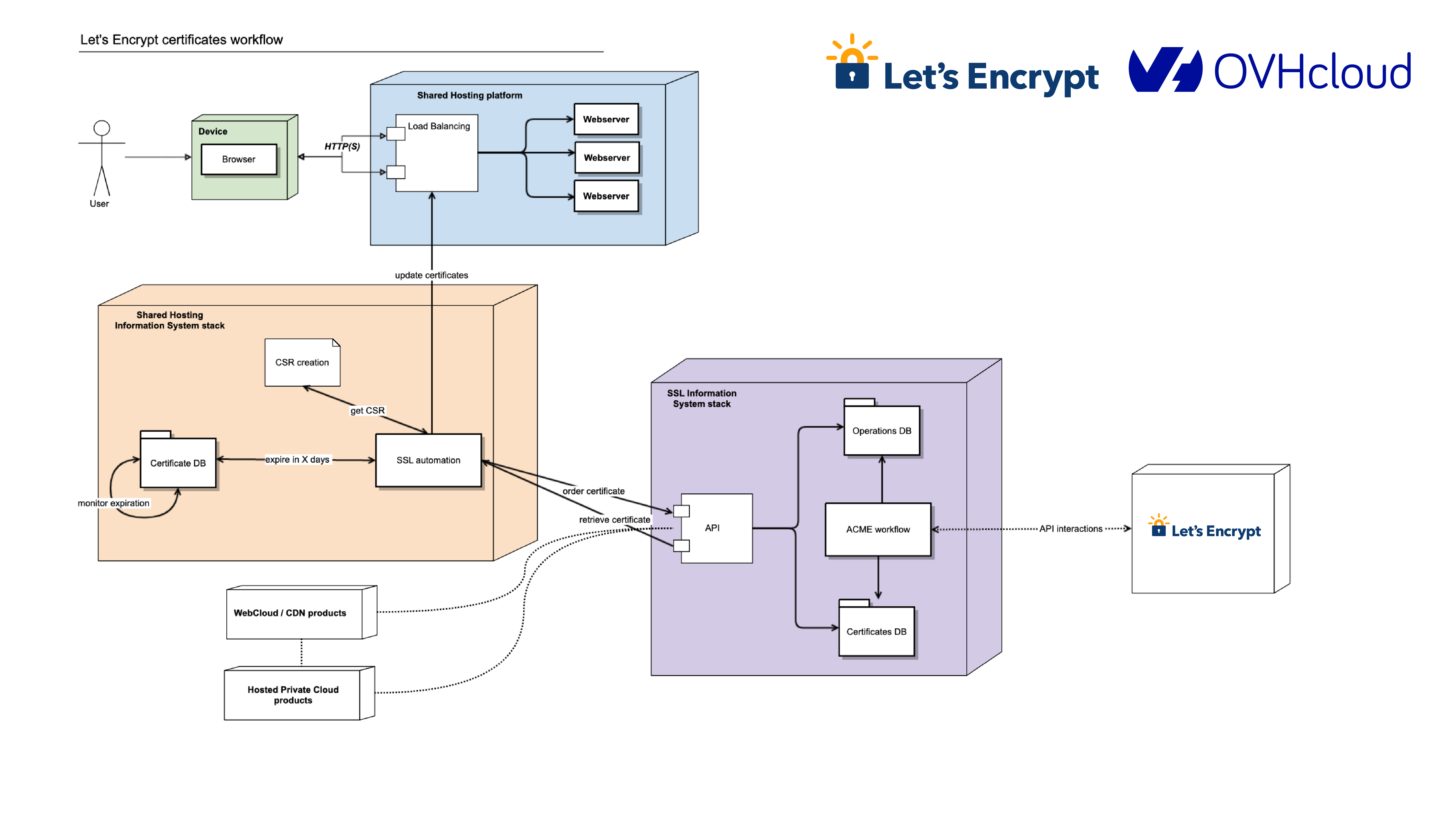
Schematic of how OVHcloud automatically and simply gets Let's Encrypt certificates

Getting a TLS certificate is on the critical path to onboarding a shared hosting client, so monitoring is a big part of OVHcloud’s success with Let’s Encrypt. They set up monitoring at every step in the delivery process: requesting the certificate, asking for challenges, waiting for validation, and requesting certificate creation. They also keep an eye on how long it takes to get a certificate (“it’s really fast”). OVHcloud also monitors our status page to stay apprised of our operational status.

Over 10,000 certificates are issued from Let’s Encrypt to OVHcloud every day. As the company continues to expand into North America, they predict that number will grow. The initial and ongoing work done by the OVHcloud team ensures that TLS will be a simple and reliable aspect of their service.

OVHcloud is a longtime sponsor of ISRG so we’d like to close by thanking them for not just being great technical collaborators, but also financial supporters.

Check out our blog post about how Shopify uses Let’s Encrypt certificates for another example of how our certificates are used in the enterprise.

Supporting Let’s Encrypt

As a nonprofit project, 100% of our funding comes from contributions from our community of users and supporters. We depend on their support in order to provide our services for the public benefit. If your company or organization would like to sponsor Let’s Encrypt please email us at sponsor@letsencrypt.org. If you can support us with a donation, we ask that you make an individual contribution.