



惯性聚合 高效追踪和阅读你感兴趣的博客、新闻、科技资讯
阅读原文 在惯性聚合中打开

推荐订阅源

P
Privacy International News Feed
CTFtime.org: upcoming CTF events
Jina AI
Jina AI
T
Tailwind CSS Blog
WordPress大学
WordPress大学
Scott Helme
Scott Helme
C
Cybersecurity and Infrastructure Security Agency CISA
博客园 - Franky
C
CERT Recently Published Vulnerability Notes
cs.AI updates on arXiv.org
雷峰网
雷峰网
Schneier on Security
博客园 - 聂微东
T
Tor Project blog
Hugging Face - Blog
Hugging Face - Blog
博客园 - 司徒正美
AI
AI
T
Troy Hunt's Blog
Security Latest
Security Latest
T
The Blog of Author Tim Ferriss
cs.CV updates on arXiv.org
C
Check Point Blog
T
Threat Research - Cisco Blogs
W
WeLiveSecurity
V
Vulnerabilities – Threatpost
Recorded Future
Recorded Future
Recent Commits to openclaw:main
Cisco Talos Blog
Cisco Talos Blog
C
CXSECURITY Database RSS Feed - CXSecurity.com
Cloudbric
Cloudbric
J
Java Code Geeks
罗磊的独立博客
C
Cyber Attacks, Cyber Crime and Cyber Security
aimingoo的专栏
aimingoo的专栏
L
LangChain Blog
freeCodeCamp Programming Tutorials: Python, JavaScript, Git & More
P
Privacy & Cybersecurity Law Blog
Google DeepMind News
Threat Intelligence Blog | Flashpoint
让小产品的独立变现更简单 - ezindie.com
L
Lohrmann on Cybersecurity
I
InfoQ
MongoDB | Blog
MongoDB | Blog
OSCHINA 社区最新新闻
OSCHINA 社区最新新闻
The GitHub Blog
The GitHub Blog
The Hacker News
The Hacker News
H
Help Net Security
钛媒体:引领未来商业与生活新知
钛媒体:引领未来商业与生活新知
P
Proofpoint News Feed
N
News and Events Feed by Topic

Maggie Appleton

The Dark Forest and Generative AI One Developer, Two Dozen Agents, Zero Alignment Gas Town’s Agent Patterns, Design Bottlenecks, and Vibecoding at Scale January 2026 | Maggie Appleton A Treatise on AI Chatbots Undermining the Enlightenment A Brief History & Ethos of the Digital Garden Vibe Code is Legacy Code May 2025 | Maggie Appleton Home-Cooked Software and Barefoot Developers Statistically, When Will My Baby Be Born? Speculative Calendar Events ChatGPT Would be a Decent Policy Advisor March 2025 | Maggie Appleton The Expanding Dark Forest and Generative AI Humanity's Last Exam Squish Meets Structure Common Misconceptions in AI Undetected AI Exam Answers Unbaited Smidgeons Growing a Human: The First 30 Weeks How to Import Academic Papers from Zotero into Tana December 2024 | Maggie Appleton Aesthetic Command Lines with Hyper, Spaceship, and Oh My Zsh Leaving Elicit July 2024 | Maggie Appleton A Short History of Bi-Directional Links The Pattern Language of Project Xanadu Assumed Audiences Ambient Co-presence On Opening Essays, Conference Talks, and Jam Jars Spinning Worlds, Seasickness, and Dealing with Vestibular Neuritis A Collection of Design Engineers Gathering Structures Daily Notes Pages Historical Trails December 2023 | Maggie Appleton September 2023 | Maggie Appleton Digital Gardening for Non-Technical Folks Language Model Sketchbook, or Why I Hate Chatbots June 2023 | Maggie Appleton Computational Notebooks Folk Interfaces Reverse Outlining with Language Models Command K Bars Spatial Web Browsing A Picture Worth a Thousand Programmes Programmable Notes Programming Portals Teenage Skeuomorphic Desktop Designs Tending Evergreen Notes in Roam Research Growing the Evergreens Why You Own an iPad and Still Can't Draw Transclusion and Transcopyright Dreams The Block-Paved Path to Structured Data Empty Pointers and Constellations of AI Metaphors We Web By The Gift Economy Epistemic Disclosure November 2022 | Maggie Appleton Joining Ought July 2022 | Maggie Appleton The Linear Oppression of Note-taking Apps Paleolithic Nostalgia Interoperable Personal Libraries and Ad Hoc Reading Groups The Finest Narrative Non-Fiction Essays Algorithmic Transparency October 2021 | Maggie Appleton Plebeian Programming with Keyboard Maestro The Cultural Anthropology of React August 2021 | Maggie Appleton Natureculture, Moral Purity, and Cultural Boundaries The Echo & Narcissus Writing Club Pink, Soft, Glittering Developers Fetishism & Mechanical Keyboards Making Programming Visual, Spatial, and Learnable Organic, Local, Artisan Data Storage Positioning Elements & Scrollytelling in CSS Painting Roam Research with Custom CSS A Digital Anthropology Reading List The Eponymous Laws of Programming A History of Cyborgs Neologisms GreenSock Animations with React Hooks The Bare Essentials of Greensock September 2020 | Maggie Appleton Illustrating Gatsby's Key Concepts Problematic Proteins New Harvest & Illustrating the Cultivated Meat Podcast Synecdoche: Drawing the Part for the Whole A Meta-Tour of This Site Douglas, Dirt, and Matter Out of Place The Knowledge Hydrant A Naïve Exploration of Computer-Supported Collaborative Learning Silent Synchronous Reading Sessions What the Fork is React Suspense? Visually Workshopping the AWS Cloud Are Data Unions the Future of Data? Pattern Languages in Programming and Interface Design A Metaphorical Reading Collection
A Brief Introduction to Digital Anthropology
Francie Kaye · 2023-01-18 · via Maggie Appleton

Eight years ago, one of my undergraduate professors handed me the book Addiction by Design by Natasha Dow Schull . It’s a gorgeous ethnographic tale of gambling machines and the people addicted to them.

Addiction By Design

It’s more than a voyeuristic insight into people who sit at slot machines for 48 hours straight though. The garish floors of Las Vegas casinos become a venue to explore our embodied relationships with machines, the nature of technological dependence, and the potential hazards of mixing algorithmic systems with Capitalist incentives.

The book was my gateway drug into the field of digital anthropology (also known as cyborg anthropology back then), as well as its sister discipline Science and Technology Studies (STS).

I fell for it hard. The way everyone falls for big, intoxicating ideas at twenty-one. Like Marxism or Foucauldian Power or Quantum String Theory. But unlike my other intellectual flings, this one stuck with me.

It led to a thesis on the Quantified Self

Tracking Humanity

The introduction to my thesis on the Quantified Self movement and the culture of self-tracking movement, technological embodiment, and western cosmology. I’m still exploring all the same research questions now, just through different means and ends.

After a few professional detours through illustration, web design, programming, and art direction, I’m circling back to my digital anthropology roots.

This means I’m being asked the question “so… what is digital anthropology?” far more frequently.

What is ‘Digital Anthropology’?

Forgive the obviousness of this, but as it says on the tin, it’s the intersection of cultural anthropology and digital things.

Let’s break these two down because they’re both open to generous interpretation.

A venn diagram showing the intersection of anthropology and digital systems

Cultural anthropology is the study of human culture – our narratives, symbols, rituals, habits, beliefs and norms.

Or as Clifford Geertz put it, it’s all the webs of meaning and significance we spin for ourselves If you’d like more insightful writings on the nature of culture, Geertz’s The Interpreation of Cultures is an essential read .

That might sound pointlessly generic. Plenty of disciplines study culture – sociologists, historians, and economists among them.

What defines Anthropologists is that we study culture through participant observation Anthropologists use all manner of other methods too – surveys, data collection, interviews, mapping, and historical research. But active participant observation is at the heart of the discipline – the act of completely immersing yourself in another culture for a long period of time as both an active participant in it, and an observer of it. You join in the dance and then analyse what the dance means.

Essentially, we study culture at an “on the ground” level – looking for the individual stories, rich details, particular nuances, and thick description you can only find by spending extended time with people in their daily lives.
As opposed to pointing a telescope at them from afar, bringing them into labs to run hypothetical experiments, or amassing troves of personal data and analysing it for the ‘big trends’.

If you want to know more about Anthropology, I can enthusiastically recommend Tim Ingold’s short but beautiful introduction Anthropology: Why It Matters .
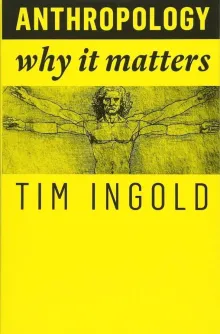
Anthropology: Why It Matters

What counts as “Digital”?

By digital things I mean objects and systems based on binary logic – the 1’s and 0’s that run all of modern computing.

Given that digital systems are now pervasive across human societies and take on a million manifestations, it feels a bit trite to try and define them. But this description fits quite well.

It comes from Miller & Horst’s essential introduction The Digital and the Human : A Prospectus for Digital Anthropology

Binary code enables us to simplify information down into single bytes that can be easily stored, copied, manipulated and sent through fibre optic cables at warp speed. It’s what makes all modern communication technologies possible. It’s also a sufficient catch-all category for the kinds of things Digital Anthropologists study.

We’re into algorithms, data, anything to do with the internet, robotics, programming, virtual currencies, the gig economy, wearable devices, ubiquitous computing, and yes, weird subcultures in the dark corners of 4chan.

Or more specifically, we’re interested in understanding the cultural symbolism, narratives, beliefs, rituals, taboos, economics, power dynamics, and daily practices around those things. I’ve put together A Digital Anthropology Reading List

A Digital Anthropology Reading List

A few favourite books from the field of digital anthropology that includes a few relevant ethnographies. It includes work on open-source software, virtual worlds, digital gambling machines, and ubiquitous computing.