

惯性聚合 高效追踪和阅读你感兴趣的博客、新闻、科技资讯
阅读原文 在惯性聚合中打开

推荐订阅源

H
Hackread – Cybersecurity News, Data Breaches, AI and More
让小产品的独立变现更简单 - ezindie.com
V
V2EX
T
The Blog of Author Tim Ferriss
腾讯CDC
Hugging Face - Blog
Hugging Face - Blog
雷峰网
雷峰网
爱范儿
爱范儿
GbyAI
GbyAI
H
Help Net Security
I
InfoQ
罗磊的独立博客
酷 壳 – CoolShell
酷 壳 – CoolShell
钛媒体:引领未来商业与生活新知
钛媒体:引领未来商业与生活新知
cs.AI updates on arXiv.org
人人都是产品经理
人人都是产品经理
J
Java Code Geeks
Microsoft Security Blog
Threat Intelligence Blog | Flashpoint
N
Netflix TechBlog - Medium
Last Week in AI
Last Week in AI
宝玉的分享
宝玉的分享
云风的 BLOG
云风的 BLOG
Project Zero
Project Zero
P
Privacy & Cybersecurity Law Blog
A
Arctic Wolf
Know Your Adversary
Know Your Adversary
G
Google Developers Blog
freeCodeCamp Programming Tutorials: Python, JavaScript, Git & More
T
Tor Project blog
V
Vulnerabilities – Threatpost
Y
Y Combinator Blog
WordPress大学
WordPress大学
V
Visual Studio Blog
博客园_首页
G
GRAHAM CLULEY
K
Kaspersky official blog
T
Tailwind CSS Blog
T
Threat Research - Cisco Blogs
博客园 - Franky
D
Docker
Security Latest
Security Latest
I
Intezer
有赞技术团队
有赞技术团队
Application and Cybersecurity Blog
博客园 - 【当耐特】
B
Blog RSS Feed
T
The Exploit Database - CXSecurity.com
cs.CV updates on arXiv.org
OSCHINA 社区最新新闻
OSCHINA 社区最新新闻

School of Computer Science News

Designing the Future of Tech Governance AI, Single-Cell Technology Reveal How 3D Genome Differs in People With Alzheimer's Disease Tepper School of Business and School of Computer Science Partner to Launch AI for Business Executive Education Program Carnegie Mellon Researchers Lead Three DOE Genesis Mission Awards to Advance the Future of AI-Enabled Scientific Discovery Snake Robots Support Earthquake Search and Rescue in Venezuela Lindlbauer Receives NSF CAREER Award for Adaptive Extended Reality Interfaces Fredrikson Earns Test of Time Award for AI Security CMU Advances Defense Manufacturing and Military Education at Pennsylvania Defense and Innovation Summit Looking Ahead: AI Needs UI Liu Receives NSF CAREER Award Carnegie Foundry, Carnegie Mellon and American Drone Manufacturers Launch Initiative to Supercharge America Stepping Toward Better Mobility Natalie Hatcher Turns Closed Doors Into Open Futures for High School Students - The Piper - Carnegie Mellon University When One Drone Isn’t Enough: CMU Builds Swarms for High-Stakes Response Efforts Carnegie Mellon’s Richard King Mellon Hall of Sciences Enters New Phase of Construction Researchers Channel AI To Solve Open Mathematical Problems Fujitsu Joins CMU Robotics Innovation Center Carnegie Mellon University Selects OptiTrack as Motion Capture Technology Partner for New Robotics Innovation Center | Optitrack.com | Optitrack.com CMU Team Rises to Amazon Nova AI Challenge - Language Technologies Institute - School of Computer Science - Carnegie Mellon University NoRILLA Wins Global Competition Don’t Let FOMO Be Your Organization’s AI Strategy CMU Researchers Train Robots With Internet Videos - Robotics Institute Carnegie Mellon University Carnegie Mellon and Meta Partner To Develop AI Tools for Emergency Response Singing a New Tune: Computational Music — The Link - The Magazine of CMU's School of Computer Science Pathak Receives 2026 PAMI Young Researcher Award Carnegie Mellon Team Helps Farmers Fight Crop Disease With Robots EcoAssist Shows Devs Greener Ways to Code Bacteria Can Learn and Form Memories Without a Brain Sandholm Receives SIGecom Test of Time Award SURF Grant Powers Research Into the Genetics of Bipolar Disorder Chen Receives NSF CAREER Award for Research in Machine Learning Systems Vatican Calls on Waibel to Help Shape AI Ethics — The Link - The Magazine of CMU's School of Computer Science Frank Pfenning Receives Herbrand Award How Do Boomers Really Feel About AI? Decoding Muscle Fatigue With Radar - Electrical and Computer Engineering - College of Engineering - Carnegie Mellon University Listening to Your Fingertips Test of Time Award - Electrical and Computer Engineering - College of Engineering - Carnegie Mellon University Let Me Entertain You: How SCS Trains the Minds Who Shape How We Play — The Link - The Magazine of CMU's School of Computer Science Delphi Group Uses Data To Forecast the Flu and Other Epidemics Carnegie Mellon extends historic run with its fifth straight MITRE eCTF title NVIDIA Founder, CEO Jensen Huang to Carnegie Mellon University Graduates: ‘Shape What Comes Next’ CMU Researchers Develop AI System to Help Prevent Airport Collisions Kaplow Named 2026 Searle Scholar New CMU Tool Reduces Manual Work To Accelerate Medical Analysis Rosenfeld Named University Professor Work Hard and Dream Harder Xing Named 2026 ISCB Fellow CMU Tool Prevents Anxiety Spirals When Searching for Medical Advice Online Design Tweaks That Keep Students Learning Job Interviews, But Make It a Game Night CyLab study finds “privacy-preserving” tracking alternatives may still expose users Bringing Computational Sciences to Health and Human Services — The Link - The Magazine of CMU's School of Computer Science How Transformational Play Is Shaping CMU’s Next Research Frontier - Center for Transformational Play - Carnegie Mellon University Playing on Common Ground: CMU Monster Game Helps Groups Work Across Differences Fujitsu, CMU Launch Joint Center for Physical AI Pennsylvania Universities and Commonwealth Leaders Launch Keystone AI + Quantum Factory CMU Teams Recognized in Moonshots AI Competition After you’re gone, who gets your passwords? Compeau Inducted Into 2026 AIMBE College of Fellows Chan Wins AHA Career Development Award CMU Tops U.S. News Graduate CS Rankings The AI Is in the Room Bridging the Communication Gap With AI Earbuds that Listen to the Heart - Electrical and Computer Engineering - College of Engineering - Carnegie Mellon University CMU Launches Keystone Astronomy & AI Visiting Fellows Program Obituary: David J. Farber Earned Nickname 'Grandfather of the Internet' CMU Research Challenges Long-Held Ecological Belief of How Rare Species Survive Teaching AI-Generated Scenes To Obey Physics Saxena, Saint Phalle Receive Stehlik Scholarship Application Opens for 2026 LearnLab Summer School AI4BIO Selects Inaugural Projects for Biomedical Discovery - Center for AI-Driven Biomedical Research - School of Computer Science - Carnegie Mellon University When an AI Bot Becomes Your Boss MSCF Program Adds Accelerated Option for CMU Undergraduates Akshat Prakash Serano Tannason
The Missing Infrastructure for AI-Powered Robots - Robotics Institute Carnegie Mellon University
Mallory Lindahl · 2026-07-08 · via School of Computer Science News
Warning: You are viewing this site with an outdated/unsupported browser. Please update your browser or consider using a different one in order to view this site without issue.
For a list of browsers that this site supports, see our Supported Browsers page.
Skip to content

The Missing Infrastructure for AI-Powered Robots

CMU Researchers Develop Software To Move AI Between Robots

07/07/2026    Mallory Lindahl

The Breakdown: 

  • RIO lets researchers use the same software across different robots, reducing the need to rebuild code for each new platform.
  • This functionality speeds up robot setup and lets researchers spend more time developing and testing robot behaviors.
  • The system helps accelerate robotics research and real-world deployment.

* * *
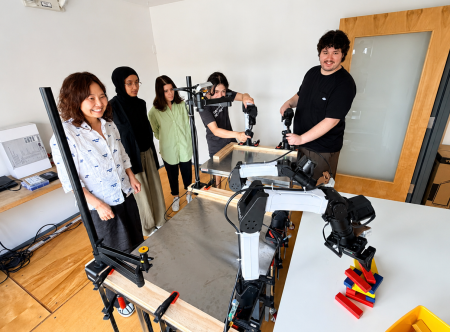
A group of people stand around a table. There are robotic arms on the table moving around colorful wooden blocks.

Researchers set up and operate robotic arms using RIO’s unified interface for robot control and teleoperation. 

Robotics researchers often spend weeks, or even months, simply getting a new robot up and running before they can begin testing new behaviors. Researchers in the Carnegie Mellon University School of Computer Science have developed an open-source software framework designed to eliminate much of that setup work, making it easier to deploy AI systems across different robots without rebuilding software from scratch.

The framework, called RIO, provides a unified interface for robot control, data collection, teleoperation and AI deployment. By allowing researchers to move more easily between robotic arms, humanoids and other platforms, RIO addresses one of the most persistent challenges in robotics: the extensive engineering work required before research can begin.

“The biggest bottleneck in robot learning research isn’t ideas, it is infrastructure,” said Jean Oh, an associate research professor in the Robotics Institute (RI). “Students can spend an entire semester or even their entire first year simply setting up a robot before they can begin their research. RIO gives researchers and engineers a lightweight, modular foundation for deploying robots quickly on any platform.”

The framework’s emphasis on accessibility became apparent during testing. Reya Shukla, an undergraduate intern with machine learning experience but no robotics background, was asked to unpack a robotic arm and configure it for teleoperation using RIO. Following the framework’s documentation, she went from opening the box to controlling the robot in about two hours.

That ease of setup reflects the problem RIO was designed to solve. While advances in robot intelligence have accelerated in recent years, the infrastructure needed to support those systems has lagged. Research groups often build custom software for individual robots, making it difficult to share tools, data and AI models across platforms. Much of the code developed for one robot must be rewritten when moving to another system, making it difficult to reproduce results or share advances across labs.

RIO is built around modular software components that can be reused across different robots and research projects. Instead of rebuilding the same infrastructure each time they switch hardware, researchers can combine existing components and customize the system to fit their needs. The approach is intended to make robotics development more accessible while improving consistency and reproducibility across experiments.

According to RI Ph.D. student Pablo Ortega-Kral, RIO arrives at a pivotal moment as new AI approaches are changing how robots are controlled. Existing robotics software was largely designed before these more general-purpose intelligence systems became common, creating a need for infrastructure that can support them.

“Today, everyone talks about needing more data,” said Eliot Xing, another RI Ph.D. student on the RIO team. “But robot data doesn’t come from thin air. You need robots to collect it, and that takes robot infrastructure. We’ve been missing some shared building blocks that other AI fields have, the ones that let researchers build on each other’s work instead of starting from scratch every time.”

Vernon Luk, an incoming RI master’s student (MSR), and Megan Lee, a recent graduate of the Master of Science in Robotics Systems Development (MRSD) program, found that RIO also simplified working with multiple robots while developing policies for humanoid and bimanual platforms.

“Since the building blocks are designed to be swappable, you can use the same pipeline for all the robots you work with,” Luk said. “You don’t have to write special code to collect data or train policies for different platforms, even when they have additional cameras or robot arms.”

By providing a shared foundation for robot control, data collection and AI deployment, the framework could help accelerate research across the field while making robotics more approachable for newcomers.

“In industrial robotics settings, this kind of infrastructure really matters because real deployments rarely involve just one robot, one sensor setup or one fixed environment,” said Jonathan Francis, lead research scientist at the Bosch Center for Artificial Intelligence and courtesy faculty in the RI. “RIO helps make robot learning systems more reusable across platforms, which can shorten the path from a research prototype to something that can be tested and adapted in the real world.”

While RIO is still an active research project, some team members are continuing to build on the technology through Lavoro AI, a startup co-founded by Oh that focuses on simplifying robot deployment and accelerating robot learning. Future work will focus on expanding hardware support and further lowering the barrier to bringing new robots online, with a longer-term vision of building robotics foundation models that enable robots to rapidly and autonomously adapt to new tasks and environments across platforms.

In addition to Oh, Ortega-Kral, Xing, Luk, Lee, and Francis, the RIO team includes RI Assistant Professor Guanya Shi; RI Ph.D. student Arthur Fender Coelho Bucker; incoming MSR student Vernon Luk; RI visiting scholar and Delft University master’s student Junseo Kim; biomedical engineering master’s alumnus Owen Kwon; MSR student Angchen Xie; MRSD students and alumni Yifu Yuan, Deepam Ameria and Bhaswanth Ayapilla; electrical and computer engineering graduate student Nikhil Sobanbabu; and Jaycie Bussell, an engineer at Bosch Manufacturing. 

To learn more about RIO, visit the project website.

For More Information: Aaron Aupperlee | 412-268-9068 | aaupperlee@cmu.edu

2026-07-06T14:19:07-04:00

Share This Story!