
惯性聚合 高效追踪和阅读你感兴趣的博客、新闻、科技资讯
阅读原文 在惯性聚合中打开

推荐订阅源

The Last Watchdog
The Last Watchdog
freeCodeCamp Programming Tutorials: Python, JavaScript, Git & More
GbyAI
GbyAI
Y
Y Combinator Blog
CTFtime.org: upcoming CTF events
The GitHub Blog
The GitHub Blog
博客园_首页
小众软件
小众软件
I
InfoQ
J
Java Code Geeks
月光博客
月光博客
S
Secure Thoughts
Microsoft Security Blog
V
Visual Studio Blog
Hacker News - Newest:
Hacker News - Newest: "LLM"
钛媒体:引领未来商业与生活新知
钛媒体:引领未来商业与生活新知
Stack Overflow Blog
Stack Overflow Blog
cs.CV updates on arXiv.org
N
News and Events Feed by Topic
Exploit-DB.com RSS Feed
Threat Intelligence Blog | Flashpoint
The Cloudflare Blog
T
Threat Research - Cisco Blogs
A
About on SuperTechFans
H
Help Net Security
MongoDB | Blog
MongoDB | Blog
博客园 - 聂微东
人人都是产品经理
人人都是产品经理
H
Hackread – Cybersecurity News, Data Breaches, AI and More
Recent Commits to openclaw:main
Latest news
Latest news
G
GRAHAM CLULEY
IT之家
IT之家
C
Cisco Blogs
Last Week in AI
Last Week in AI
Engineering at Meta
Engineering at Meta
L
LangChain Blog
The Register - Security
SecWiki News
SecWiki News
M
MIT News - Artificial intelligence
NISL@THU
NISL@THU
T
Tenable Blog
博客园 - Franky
美团技术团队
I
Intezer
U
Unit 42
雷峰网
雷峰网
cs.AI updates on arXiv.org
S
SegmentFault 最新的问题
C
Cyber Attacks, Cyber Crime and Cyber Security

School of Computer Science News

Designing the Future of Tech Governance AI, Single-Cell Technology Reveal How 3D Genome Differs in People With Alzheimer's Disease Tepper School of Business and School of Computer Science Partner to Launch AI for Business Executive Education Program Carnegie Mellon Researchers Lead Three DOE Genesis Mission Awards to Advance the Future of AI-Enabled Scientific Discovery Snake Robots Support Earthquake Search and Rescue in Venezuela Lindlbauer Receives NSF CAREER Award for Adaptive Extended Reality Interfaces Fredrikson Earns Test of Time Award for AI Security CMU Advances Defense Manufacturing and Military Education at Pennsylvania Defense and Innovation Summit Looking Ahead: AI Needs UI Liu Receives NSF CAREER Award Carnegie Foundry, Carnegie Mellon and American Drone Manufacturers Launch Initiative to Supercharge America Stepping Toward Better Mobility Natalie Hatcher Turns Closed Doors Into Open Futures for High School Students - The Piper - Carnegie Mellon University When One Drone Isn’t Enough: CMU Builds Swarms for High-Stakes Response Efforts Carnegie Mellon’s Richard King Mellon Hall of Sciences Enters New Phase of Construction Fujitsu Joins CMU Robotics Innovation Center The Missing Infrastructure for AI-Powered Robots - Robotics Institute Carnegie Mellon University Carnegie Mellon University Selects OptiTrack as Motion Capture Technology Partner for New Robotics Innovation Center | Optitrack.com | Optitrack.com CMU Team Rises to Amazon Nova AI Challenge - Language Technologies Institute - School of Computer Science - Carnegie Mellon University NoRILLA Wins Global Competition Don’t Let FOMO Be Your Organization’s AI Strategy CMU Researchers Train Robots With Internet Videos - Robotics Institute Carnegie Mellon University Carnegie Mellon and Meta Partner To Develop AI Tools for Emergency Response Singing a New Tune: Computational Music — The Link - The Magazine of CMU's School of Computer Science Pathak Receives 2026 PAMI Young Researcher Award Carnegie Mellon Team Helps Farmers Fight Crop Disease With Robots EcoAssist Shows Devs Greener Ways to Code Bacteria Can Learn and Form Memories Without a Brain Sandholm Receives SIGecom Test of Time Award SURF Grant Powers Research Into the Genetics of Bipolar Disorder Chen Receives NSF CAREER Award for Research in Machine Learning Systems Vatican Calls on Waibel to Help Shape AI Ethics — The Link - The Magazine of CMU's School of Computer Science Frank Pfenning Receives Herbrand Award How Do Boomers Really Feel About AI? Decoding Muscle Fatigue With Radar - Electrical and Computer Engineering - College of Engineering - Carnegie Mellon University Listening to Your Fingertips Test of Time Award - Electrical and Computer Engineering - College of Engineering - Carnegie Mellon University Let Me Entertain You: How SCS Trains the Minds Who Shape How We Play — The Link - The Magazine of CMU's School of Computer Science Delphi Group Uses Data To Forecast the Flu and Other Epidemics Carnegie Mellon extends historic run with its fifth straight MITRE eCTF title NVIDIA Founder, CEO Jensen Huang to Carnegie Mellon University Graduates: ‘Shape What Comes Next’ CMU Researchers Develop AI System to Help Prevent Airport Collisions Kaplow Named 2026 Searle Scholar New CMU Tool Reduces Manual Work To Accelerate Medical Analysis Rosenfeld Named University Professor Work Hard and Dream Harder Xing Named 2026 ISCB Fellow CMU Tool Prevents Anxiety Spirals When Searching for Medical Advice Online Design Tweaks That Keep Students Learning Job Interviews, But Make It a Game Night CyLab study finds “privacy-preserving” tracking alternatives may still expose users Bringing Computational Sciences to Health and Human Services — The Link - The Magazine of CMU's School of Computer Science How Transformational Play Is Shaping CMU’s Next Research Frontier - Center for Transformational Play - Carnegie Mellon University Playing on Common Ground: CMU Monster Game Helps Groups Work Across Differences Fujitsu, CMU Launch Joint Center for Physical AI Pennsylvania Universities and Commonwealth Leaders Launch Keystone AI + Quantum Factory CMU Teams Recognized in Moonshots AI Competition After you’re gone, who gets your passwords? Compeau Inducted Into 2026 AIMBE College of Fellows Chan Wins AHA Career Development Award CMU Tops U.S. News Graduate CS Rankings The AI Is in the Room Bridging the Communication Gap With AI Earbuds that Listen to the Heart - Electrical and Computer Engineering - College of Engineering - Carnegie Mellon University CMU Launches Keystone Astronomy & AI Visiting Fellows Program Obituary: David J. Farber Earned Nickname 'Grandfather of the Internet' CMU Research Challenges Long-Held Ecological Belief of How Rare Species Survive Teaching AI-Generated Scenes To Obey Physics Saxena, Saint Phalle Receive Stehlik Scholarship Application Opens for 2026 LearnLab Summer School AI4BIO Selects Inaugural Projects for Biomedical Discovery - Center for AI-Driven Biomedical Research - School of Computer Science - Carnegie Mellon University When an AI Bot Becomes Your Boss MSCF Program Adds Accelerated Option for CMU Undergraduates Akshat Prakash Serano Tannason
Researchers Channel AI To Solve Open Mathematical Problems
Marylee Will · 2026-07-09 · via School of Computer Science News

Artificial intelligence can accelerate scientific discovery, but it isn't as simple as submitting a single query to an AI model. Research led by a collaboration between Carnegie Mellon University's School of Computer Science and Google is developing new methods to solve some of the hardest open mathematical problems with these models.

"My research describes different methods to interact with AI to accelerate research," said David Woodruff, a professor in the Computer Science Department. "We're witnessing a fundamental shift in scientific workflow. These AI tools are a force multiplier for human intellect, and many researchers, myself included, are asking, 'What's the best way of interacting with them to accelerate research?'"
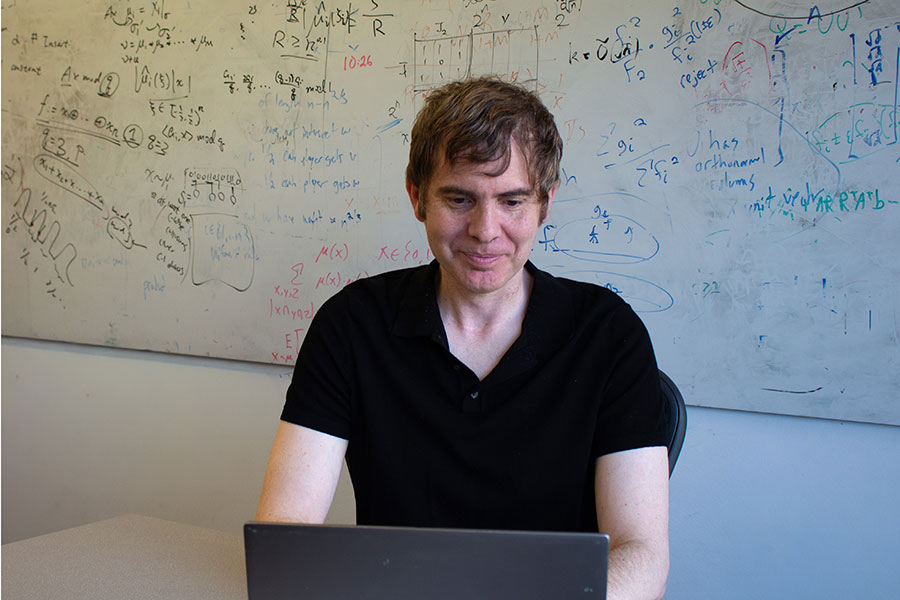
A man sits at a laptop in front of a dry erase board covered in complicated equations.
CSD's David Woodruff and collaborators at Google are developing new methods to solve some of the hardest open mathematical problems using AI models.

Woodruff recently collaborated with Michael Brenner, from Harvard University and Google Research, and Vincent Cohen-Addad, also from Google Research, on an open problem involving gravitational waves from cosmic strings. Previously, researchers would hit a mathematical brick wall, leaving the problem unsolved.

To break through this barrier, researchers looked to a Google Gemini Deep Think model not simply as a calculator, but as a genuine collaborator. The team developed what they call a "neuro-symbolic system," which uses an AI model's ability to generate ideas and predict patterns to theorize, develop and test possible solutions. The Gemini-based model developed the hypotheses and did the conceptual work. From there, it mapped out many possibilities and explored different avenues to a solution, potentially combining ideas or pulling from areas a human might not have considered. Finally, after the computer automatically verified the math, the results were sent to a human researcher to do a final check and iterate.

"In these AI models, there can be a lot of randomness in their exploration," Woodruff said. "So if you call one of these models once, but then you call it again with exactly the same prompt, it often gives you a very different answer. What that means is if I call it many times, then maybe one of those times it'll get it right.

"Then you can take all these answers and feed them back into a Gemini model to try to determine which ones are right, or combine some of this model's thoughts with another model's thoughts to maybe get the best of both of them, and eventually converge on a good solution," Woodruff continued. "This is known as recursive self-aggregation."

This approach is part of a larger study featuring Woodruff and 35 co-authors showing how they collaborated with Google's Gemini-based models to solve a diverse collection of open mathematical problems to advance scientific investigation and discovery.

Rather than simply identifying the best method or application of these AI tools, Woodruff and his peers point to the numerous ways the tools can help tackle complex problems as collaborators. The human researchers serve as the architects of these projects, working to structure the system so the models can explore the many possibilities that could lead to solutions.

"Just as the advent of calculators and computational algebra systems revolutionized applied mathematics in previous decades, the ability to rapidly iterate on abstract reasoning with a tireless, knowledgeable AI collaborator promises to dramatically reduce the friction of theoretical execution," the researchers wrote in their study.