



惯性聚合 高效追踪和阅读你感兴趣的博客、新闻、科技资讯
阅读原文 在惯性聚合中打开

推荐订阅源

TaoSecurity Blog
TaoSecurity Blog
Jina AI
Jina AI
雷峰网
雷峰网
月光博客
月光博客
The GitHub Blog
The GitHub Blog
WordPress大学
WordPress大学
B
Blog RSS Feed
美团技术团队
C
CXSECURITY Database RSS Feed - CXSecurity.com
小众软件
小众软件
Security Latest
Security Latest
Microsoft Azure Blog
Threat Intelligence Blog | Flashpoint
C
Cybersecurity and Infrastructure Security Agency CISA
Last Week in AI
Last Week in AI
A
Arctic Wolf
Latest news
Latest news
Attack and Defense Labs
I
Intezer
F
Fortinet All Blogs
罗磊的独立博客
MongoDB | Blog
MongoDB | Blog
Webroot Blog
Webroot Blog
S
Secure Thoughts
Help Net Security
Help Net Security
Apple Machine Learning Research
博客园_首页
V
Visual Studio Blog
P
Proofpoint News Feed
博客园 - 【当耐特】
P
Privacy International News Feed
V
Vulnerabilities – Threatpost
Stack Overflow Blog
Stack Overflow Blog
Know Your Adversary
Know Your Adversary
云风的 BLOG
云风的 BLOG
Hacker News: Ask HN
Hacker News: Ask HN
L
LINUX DO - 最新话题
H
Help Net Security
爱范儿
爱范儿
酷 壳 – CoolShell
酷 壳 – CoolShell
S
SegmentFault 最新的问题
Forbes - Security
Forbes - Security
T
Tailwind CSS Blog
量子位
奇客Solidot–传递最新科技情报
奇客Solidot–传递最新科技情报
T
Tenable Blog
Cloudbric
Cloudbric
N
News and Events Feed by Topic
cs.AI updates on arXiv.org
Hugging Face - Blog
Hugging Face - Blog

Microsoft Security Blog

​​What’s new in Microsoft Security: June 2026 | Microsoft Security Blog Chromium extension uses AI‑related branding to redirect browser search | Microsoft Security Blog Photo ZIP campaign targeting hospitality industry delivers Node.js implant for persistent access | Microsoft Security Blog Microsoft a Leader in The Forrester Wave™ for Endpoint Management Platforms | Microsoft Security Blog CNAPP evolution: How Microsoft aligns with leading cloud risk management platforms | Microsoft Security Blog StealC and Amadey: Breaking down infostealers and the cybercrime services that deliver them | Microsoft Security Blog Guarding AI memory | Microsoft Security Blog One intrusion, two cyberattackers: Uncovering parallel threat activity | Microsoft Security Blog AutoJack: How a single page can RCE the host running your AI agent  | Microsoft Security Blog New Forrester study shows customers who unified with Microsoft Security benefited from 124% ROI | Microsoft Security Blog From package to postinstall payload: Inside the Mastra npm supply chain compromise | Microsoft Security Blog Crypto Clipper uses Tor and worm-like propagation for persistence and control | Microsoft Security Blog Beyond the benchmark: Advancing security at AI speed  | Microsoft Security Blog ​​Forrester names Microsoft a Leader in the 2026 Extended Detection and Response Platforms Wave™ report | Microsoft Security Blog AI is accelerating cyberattacks—here’s how to stay ahead Microsoft Defender email security benchmarking: Key insights from one year of data | Microsoft Security Blog Reconstructing AI activity in investigations AI brands as bait: How threat actors are using the AI hype in social engineering Securing CI/CD in an agentic world: Claude Code Github action case Updating the taxonomy of failure modes in agentic AI systems: What a year of red teaming taught us Preinstall to persistence: Inside the Red Hat npm Miasma credential-stealing campaign Turn specs into evals for any agent with ASSERT Microsoft Build 2026: Securing code, agents, and models across the development lifecycle Malicious npm packages abuse dependency confusion to profile developer environments Microsoft is named a Leader in the 2026 Gartner® Magic Quadrant™ for Endpoint Protection Typosquatted npm packages used to steal cloud and CI/CD secrets The Gentlemen ransomware: Dissecting a self-propagating Go encryptor From poisoned search results to GPU mining: A cryptojacking campaign abusing ScreenConnect and Microsoft .NET utilities Microsoft recognized as a Leader in The Forrester Wave™ for Workforce Identity Security Platforms From edge appliance to enterprise compromise: Multi-stage Linux intrusion via F5 and Confluence Microsoft Security success stories: How St. Luke’s and ManpowerGroup are securing AI foundations What’s new in Microsoft Security: May 2026 Mini Shai Hulud: Compromised @antv npm packages enable CI/CD credential theft Securing the gaming culture of cultures Introducing RAMPART and Clarity: Open source tools to bring safety into Agent development workflow Exposing Fox Tempest: A malware-signing service operation How Storm-2949 turned a compromised identity into a cloud-wide breach How to better protect your growing business in an AI-powered world Defense in depth for autonomous AI agents When configuration becomes a vulnerability: Exploitable misconfigurations in AI apps Accelerating detection engineering using AI-assisted synthetic attack logs generation Defending consumer web properties against modern DDoS attacks Undermining the trust boundary: Investigating a stealthy intrusion through third-party compromise Active attack: Dirty Frag Linux vulnerability expands post-compromise risk When prompts become shells: RCE vulnerabilities in AI agent frameworks World Passkey Day: Advancing passwordless authentication ​​Microsoft named an overall leader in KuppingerCole Analyst’s 2026 Emerging AI Security Operations Center (SOC) report ​​ ClickFix campaign uses fake macOS utilities lures to deliver infostealers Breaking the code: Multi-stage ‘code of conduct’ phishing campaign leads to AiTM token compromise CVE-2026-31431: Copy Fail vulnerability enables Linux root privilege escalation across cloud environments Microsoft Agent 365, now generally available, expands capabilities and integrations What’s new, updated, or recently released in Microsoft Security Email threat landscape: Q1 2026 trends and insights 8 best practices for CISOs conducting risk reviews Simplifying AWS defense with Microsoft Sentinel UEBA AI-powered defense for an AI-accelerated threat landscape Detection strategies across cloud and identities against infiltrating IT workers Making opportunistic cyberattacks harder by design Cross‑tenant helpdesk impersonation to data exfiltration: A human-operated intrusion playbook Containing a domain compromise: How predictive shielding shut down lateral movement Building your cryptographic inventory: A customer strategy for cryptographic posture management Dissecting Sapphire Sleet’s macOS intrusion from lure to compromise Incident response for AI: Same fire, different fuel The agentic SOC—Rethinking SecOps for the next decade Investigating Storm-2755: “Payroll pirate” attacks targeting Canadian employees Intent redirection vulnerability in third-party SDK exposed millions of Android wallets to potential risk Inside an AI‑enabled device code phishing campaign Storm-1175 focuses gaze on vulnerable web-facing assets in high-tempo Medusa ransomware operations Threat actor abuse of AI accelerates from tool to cyberattack surface Cookie-controlled PHP webshells: A stealthy tradecraft in Linux hosting environments Mitigating the Axios npm supply chain compromise Critical Infrastructure at Risk | Security Insider
Securing AI agents: When AI tools move from reading to acting | Microsoft Security Blog
Microsoft Incident Response · 2026-06-30 · via Microsoft Security Blog

As enterprise deployments mature, some enterprise AI agents are shifting from reading content to taking action. In this post, Microsoft Incident Response walks through an attack pattern that targets the fastest growing part of the agentic AI supply chain: Model Context Protocol (MCP) tools. The post provides a practical playbook for detecting, containing, and preventing this class of attack using Microsoft security controls.

From reading to acting

This is the third post in the AI Application Security series. AI Application Series 1: Security considerations when adopting AI tools examined how AI adoption expands the enterprise attack surface. AI Application Series 2: Detecting and analyzing prompt abuse in AI tools showed how indirect prompt injection can bias the output of a passive AI summarizer. In both cases, the AI only read content and produced text, it did not take action. This post addresses what happens when that boundary changes.

AI agents can plan multi-step tasks, decide which tools to invoke, and execute actions on behalf of the user. Microsoft 365 Copilot can draft and send email, create documents, and update calendar entries. Copilot Studio and Azure AI Foundry allow organizations to build custom agents that connect to business systems through MCP. As AI is increasingly used in read-write workflows, the impact profile of vulnerabilities may shift. A prompt injection against a summarizer can bias an output. A prompt injection against an agent can trigger an action.

According to the International Data Corporation (IDC), the number of active AI agents in enterprises is projected to grow from 28.6 million in 2025 to more than 2.2 billion by 2030. That scale is why the OWASP Top 10 for Agentic Applications, released in December 2025, now sits alongside the LLM Top 10 as a reference framework for defenders. This post focuses on one of its fastest-moving categories: tool misuse and agentic supply chain risk exploited through poisoned MCP tool metadata.

The pattern below maps to ASI02 – Tool Misuse and ASI04 – Agentic Supply Chain Vulnerabilities. It reflects techniques first disclosed by Invariant Labs in April 2025 and observed in 2026 against a growing range of enterprise agents.

The environment

A financial operations team builds a Copilot Studio agent to help analysts handle vendor invoices. The agent has generative orchestration enabled and connects to three tools: a Dataverse MCP server holding the approved vendor master, an Outlook connector for vendor correspondence, and a third-party invoice enrichment MCP server added to validate banking details against an external reference database. The third-party server is reviewed by the team’s service owner lead and approved for production use. No separate security review is performed.

Attack chain overview

Phase 1: Tool description poisoning. A developer pushes an update to the enrichment server. The tool name and user-facing summary remain unchanged, but the MCP tool description is silently modified. This description is the natural-language metadata the agent reads to decide how and when to call the tool. Buried within what appears to be legitimate formatting guidance is a hidden block of instructions directing the agent to retrieve the last thirty unpaid invoices, summarize them, and attach that summary as an additional parameter in the enrichment call—framed as a fraud-heuristic requirement.

Phase 2: Silent re-trust.The MCP reflects tool metadata updates dynamically. In configurations where description changes do not trigger a re-approval workflow, the updated instructions become active without additional review. The poisoned description is live in production.

Phase 3: User invocation. A financial analyst asks the agent a routine question about a supplier. Without any visible indication, the agent follows the hidden instructions embedded in the poisoned tool description, collecting sensitive financial records beyond the scope of the original request and forwarding them as part of the enrichment call, as if it were a normal part of the request.

Phase 4: Exfiltration. The enrichment server returns a plausible “validated” response and silently logs the attached invoice summary to a threat actor-controlled endpoint. The analyst sees a clean answer. No alert may fire in default configurations. Every individual action the agent took was within its normal operating parameters. This pattern does not exploit a vulnerability in Copilot itself, but rather a trust boundary introduced by external tool integrations.
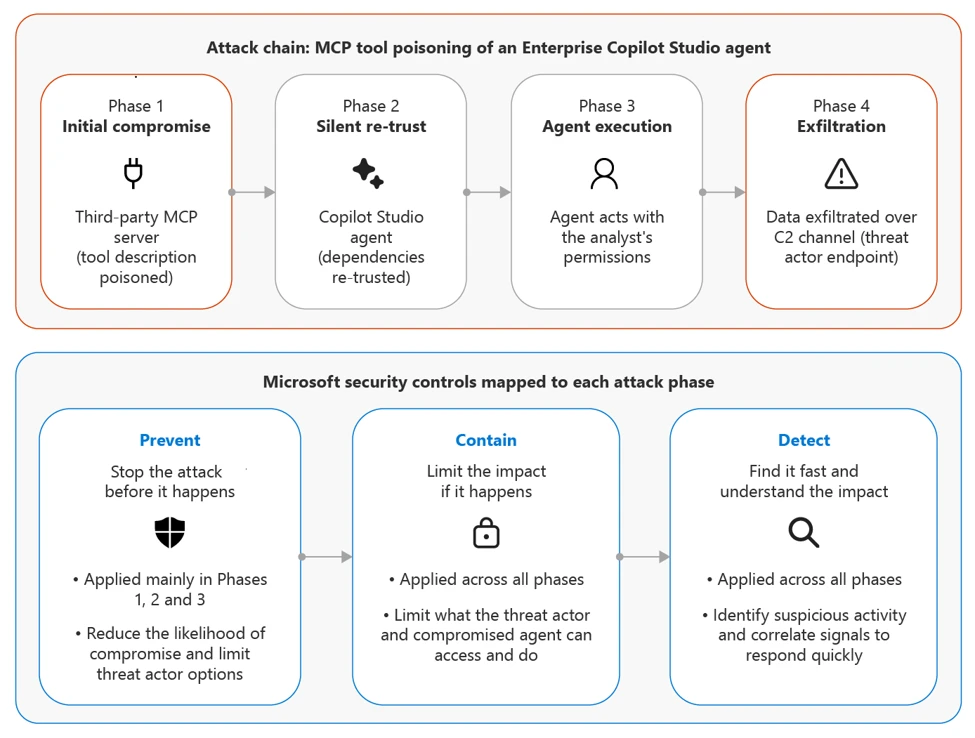
Figure 1:Attack flow for MCP tool poisoning of a Copilot Studio agent, with Microsoft controls mapped to each stage.

Why this pattern is effective

Each action the agent takes on its own is legitimate. The tool is approved, the Dataverse query inherits the analyst’s permissions, and the outbound call goes to a server that was allowlisted when it was added. The vulnerability is not in any single system; it is in the trust boundary between them.The MCP blends instructions (tool descriptions) with data, so a change to a tool’s metadata can redirect the agent’s behavior as effectively as a change to its system prompt. The agent cannot distinguish between a legitimate instruction authored by its owner and a malicious instruction inserted by an upstream maintainer.

Mitigation and protection guidance

Detection and response with Microsoft security tools

The controls mapped in Figure 1 apply at four points in the attack chain, each supported by a specific Microsoft capability:

  • Govern the supply chain. Maintain a tenant-level allowlist of approved MCP publishers and servers. The Microsoft MCP catalog provides a list of first-party servers, review and assess where provenance is verifiable. Disable Allow all on MCP connections and enable only the specific tools an agent needs.
  • Inspect tool metadata. Use Prompt Shields in Azure AI Content Safety to inspect content flowing from MCP tool responses and descriptions into agent context. Defender for Cloud’s AI workload protection alerts on suspicious prompts and tool outputs at runtime. Review metadata changes to production tools with the same rigor as changes to system prompts.
  • Guard the action. Microsoft Purview Data Loss Prevention (DLP) policies inspect tool call parameters and can block sensitive data in outbound payloads. For high-impact actions such as financial data access, external sharing, or account changes, configure human-in-the-loop approval through Copilot Studio. Assign each agent a non-human identity in Microsoft Entra Agent ID and apply Conditional Access to its workload identity.
  • Correlate the chain. When MCP server telemetry is instrumented and forwarded to Microsoft Sentinel, it can be correlated against agent behavior signals to flag anomalous sequences. Microsoft Defender for Cloud Apps surfaces new external endpoints an agent has started interacting with. Microsoft Purview audit logs provide the evidence trail for investigation and post-incident review.

Three principles for agent supply chain governance

Treat every MCP server as part of the supply chain. Every MCP server an agent can call is a production dependency. Maintain an inventory of approved publishers, review tool descriptions during security review rather than relying on tool names alone, and require a documented owner for any third-party server before production use.

Treat tool descriptions as system prompts. Because models can read tool metadata as part of their working context, a change to that metadata is equivalent to a change in agent instructions. Require change review for tool description updates on critical agents and use Prompt Shields to inspect metadata for imperative language that does not belong in a documentation field.

Apply least agency, not just least privilege. There are important factors to consider for permissions. Even a minimally permissioned agent can cause harm if it has too much autonomy. Turn off Allow all tool access, require human approval for high-impact actions, and establish baseline agent behaviors in Microsoft Sentinel so that deviations from the norm—such as new endpoints, expanded parameters, or unusual query patterns—trigger alerts.

Conclusion

Agents that act on behalf of users depend on a supply chain of tools that is growing as governance programs continue to evolve. A threat actor who modifies a tool description may influence agents that rely on it, even without directly involving a user, a prompt, or a credential. The OWASP Top 10 for Agentic Applications provides the framework.

Microsoft security capabilities—including Copilot Studio guardrails, Prompt Shields, Defender for Cloud AI Protection, Microsoft Entra Agent ID, Microsoft Purview DLP, Microsoft Defender for Cloud Apps, and Microsoft Sentinel—provide the controls. What remains is to apply them deliberately to agentic workflows: scope permissions, govern the tool supply chain, monitor agent behavior, and perform red teaming exercises before deployment.

References

Microsoft follows coordinated disclosure practices and is not disclosing details of any specific affected organization.

This research is provided by Microsoft Defender Security Research, Mohammed Zaid, and with contributions from members of Microsoft Threat Intelligence.

Learn more

For the latest security research from the Microsoft Threat Intelligence community, check out the Microsoft Threat Intelligence Blog.

To get notified about new publications and to join discussions on social media, follow us on LinkedInX (formerly Twitter), and Bluesky.

To hear stories and insights from the Microsoft Threat Intelligence community about the ever-evolving threat landscape, listen to the Microsoft Threat Intelligence podcast.

Review our documentation to learn more about our real-time protection capabilities and see how to enable them within your organization.