惯性聚合 高效追踪和阅读你感兴趣的博客、新闻、科技资讯
阅读原文 在惯性聚合中打开

推荐订阅源

S
Schneier on Security
P
Proofpoint News Feed
Apple Machine Learning Research
WordPress大学
WordPress大学
博客园 - Franky
V
V2EX
爱范儿
爱范儿
J
Java Code Geeks
小众软件
小众软件
Last Week in AI
Last Week in AI
The Cloudflare Blog
让小产品的独立变现更简单 - ezindie.com
Hugging Face - Blog
Hugging Face - Blog
T
The Blog of Author Tim Ferriss
酷 壳 – CoolShell
酷 壳 – CoolShell
The Register - Security
GbyAI
GbyAI
Vercel News
Vercel News
Y
Y Combinator Blog
腾讯CDC
F
Fortinet All Blogs
I
InfoQ
N
Netflix TechBlog - Medium
B
Blog RSS Feed
D
Docker
OSCHINA 社区最新新闻
OSCHINA 社区最新新闻
量子位
博客园 - 司徒正美
阮一峰的网络日志
阮一峰的网络日志
The GitHub Blog
The GitHub Blog
Microsoft Security Blog
V
Visual Studio Blog
博客园 - 三生石上(FineUI控件)
宝玉的分享
宝玉的分享
Blog — PlanetScale
Blog — PlanetScale
H
Help Net Security
云风的 BLOG
云风的 BLOG
A
About on SuperTechFans
Scott Helme
Scott Helme
T
Tor Project blog
U
Unit 42
Google Online Security Blog
PCI Perspectives
PCI Perspectives
钛媒体:引领未来商业与生活新知
钛媒体:引领未来商业与生活新知
NISL@THU
NISL@THU
D
Darknet – Hacking Tools, Hacker News & Cyber Security
aimingoo的专栏
aimingoo的专栏
cs.CV updates on arXiv.org
Stack Overflow Blog
Stack Overflow Blog
Security Archives - TechRepublic

Microsoft Security Blog

Microsoft at Black Hat USA 2026: Defending trust in the age of AI and supply chain attacks | Microsoft Security Blog ACR Stealer: Two observed intrusion chains amid increased threat activity | Microsoft Security Blog Least privilege for AI agents: Identity, access, and tool binding | Microsoft Security Blog Unpacking the AsyncAPI npm supply chain compromise and import-time payload delivery | Microsoft Security Blog Turning threat intelligence into decisive action with Defender Experts | Microsoft Security Blog Defending SaaS-based applications against ShinyHunters OAuth abuse | Microsoft Security Blog Microsoft Entra ID security updates: Passkeys are the default authentication method in Entra ID | Microsoft Security Blog Securing our future: July 2026 progress report on Microsoft's Secure Future Initiative | Microsoft Security Blog GigaWiper: Anatomy of a destructive backdoor assembled from multiple malware | Microsoft Security Blog Protecting Microsoft at AI speed: How SFI proactively hardens our cloud   | Microsoft Security Blog 5 insights from Frost & Sullivan’s 2025 Frost Radar™ for Cloud Security Posture Management | Microsoft Security Blog Improving security posture across the Microsoft partner ecosystem | Microsoft Security Blog Microsoft named a leader in the Frost Radar for cloud and application runtime security | Microsoft Security Blog Accelerating the quantum-safe timeline | Microsoft Security Blog ​​What’s new in Microsoft Security: June 2026 | Microsoft Security Blog Securing AI agents: When AI tools move from reading to acting | Microsoft Security Blog Chromium extension uses AI‑related branding to redirect browser search | Microsoft Security Blog Photo ZIP campaign targeting hospitality industry delivers Node.js implant for persistent access | Microsoft Security Blog Microsoft a Leader in The Forrester Wave™ for Endpoint Management Platforms | Microsoft Security Blog CNAPP evolution: How Microsoft aligns with leading cloud risk management platforms | Microsoft Security Blog StealC and Amadey: Breaking down infostealers and the cybercrime services that deliver them | Microsoft Security Blog Guarding AI memory | Microsoft Security Blog One intrusion, two cyberattackers: Uncovering parallel threat activity | Microsoft Security Blog AutoJack: How a single page can RCE the host running your AI agent  | Microsoft Security Blog New Forrester study shows customers who unified with Microsoft Security benefited from 124% ROI | Microsoft Security Blog From package to postinstall payload: Inside the Mastra npm supply chain compromise | Microsoft Security Blog Crypto Clipper uses Tor and worm-like propagation for persistence and control | Microsoft Security Blog Beyond the benchmark: Advancing security at AI speed  | Microsoft Security Blog ​​Forrester names Microsoft a Leader in the 2026 Extended Detection and Response Platforms Wave™ report | Microsoft Security Blog AI is accelerating cyberattacks—here’s how to stay ahead Microsoft Defender email security benchmarking: Key insights from one year of data | Microsoft Security Blog Reconstructing AI activity in investigations AI brands as bait: How threat actors are using the AI hype in social engineering Securing CI/CD in an agentic world: Claude Code Github action case Updating the taxonomy of failure modes in agentic AI systems: What a year of red teaming taught us Preinstall to persistence: Inside the Red Hat npm Miasma credential-stealing campaign Turn specs into evals for any agent with ASSERT Microsoft Build 2026: Securing code, agents, and models across the development lifecycle Malicious npm packages abuse dependency confusion to profile developer environments Microsoft is named a Leader in the 2026 Gartner® Magic Quadrant™ for Endpoint Protection Typosquatted npm packages used to steal cloud and CI/CD secrets The Gentlemen ransomware: Dissecting a self-propagating Go encryptor From poisoned search results to GPU mining: A cryptojacking campaign abusing ScreenConnect and Microsoft .NET utilities Microsoft recognized as a Leader in The Forrester Wave™ for Workforce Identity Security Platforms From edge appliance to enterprise compromise: Multi-stage Linux intrusion via F5 and Confluence Microsoft Security success stories: How St. Luke’s and ManpowerGroup are securing AI foundations What’s new in Microsoft Security: May 2026 Mini Shai Hulud: Compromised @antv npm packages enable CI/CD credential theft Securing the gaming culture of cultures Introducing RAMPART and Clarity: Open source tools to bring safety into Agent development workflow How Storm-2949 turned a compromised identity into a cloud-wide breach How to better protect your growing business in an AI-powered world Defense in depth for autonomous AI agents When configuration becomes a vulnerability: Exploitable misconfigurations in AI apps Accelerating detection engineering using AI-assisted synthetic attack logs generation Defending consumer web properties against modern DDoS attacks Undermining the trust boundary: Investigating a stealthy intrusion through third-party compromise Active attack: Dirty Frag Linux vulnerability expands post-compromise risk When prompts become shells: RCE vulnerabilities in AI agent frameworks World Passkey Day: Advancing passwordless authentication ​​Microsoft named an overall leader in KuppingerCole Analyst’s 2026 Emerging AI Security Operations Center (SOC) report ​​ ClickFix campaign uses fake macOS utilities lures to deliver infostealers Breaking the code: Multi-stage ‘code of conduct’ phishing campaign leads to AiTM token compromise CVE-2026-31431: Copy Fail vulnerability enables Linux root privilege escalation across cloud environments Microsoft Agent 365, now generally available, expands capabilities and integrations What’s new, updated, or recently released in Microsoft Security Email threat landscape: Q1 2026 trends and insights 8 best practices for CISOs conducting risk reviews Simplifying AWS defense with Microsoft Sentinel UEBA AI-powered defense for an AI-accelerated threat landscape Detection strategies across cloud and identities against infiltrating IT workers Making opportunistic cyberattacks harder by design Cross‑tenant helpdesk impersonation to data exfiltration: A human-operated intrusion playbook Containing a domain compromise: How predictive shielding shut down lateral movement Building your cryptographic inventory: A customer strategy for cryptographic posture management Dissecting Sapphire Sleet’s macOS intrusion from lure to compromise Incident response for AI: Same fire, different fuel The agentic SOC—Rethinking SecOps for the next decade Investigating Storm-2755: “Payroll pirate” attacks targeting Canadian employees Intent redirection vulnerability in third-party SDK exposed millions of Android wallets to potential risk Inside an AI‑enabled device code phishing campaign Storm-1175 focuses gaze on vulnerable web-facing assets in high-tempo Medusa ransomware operations Threat actor abuse of AI accelerates from tool to cyberattack surface Cookie-controlled PHP webshells: A stealthy tradecraft in Linux hosting environments Mitigating the Axios npm supply chain compromise Critical Infrastructure at Risk | Security Insider
Exposing Fox Tempest: A malware-signing service operation
Microsoft Threat Intelligence · 2026-05-19 · via Microsoft Security Blog

Fox Tempest is a financially motivated threat actor that operates a malware-signing-as-a-service (MSaaS)  used by other cybercriminals to more effectively distribute malicious code, including ransomware. The threat actor abuses Microsoft Artifact Signing to generate short-lived, fraudulent code-signing certificates to appear legitimately signed, allowing malware to evade security controls.

Fox Tempest has created over a thousand certificates and established hundreds of Azure tenants and subscriptions to support its operations. Microsoft has revoked over one thousand code signing certificates attributed to Fox Tempest. In May 2026, Microsoft’s Digital Crimes Unit (DCU), with support from industry partner Resecurity, disrupted Fox Tempest’s MSaaS offering, targeting the infrastructure and access model that enables its broader criminal use.

Microsoft Threat Intelligence observed Fox Tempest’s operations enabling the deployment of Rhysida ransomware by threat actors such as Vanilla Tempest, as well as the distribution of other malware families including Oyster, Lumma Stealer, and Vidar. The consistency, scale, and downstream impact of the resulting attack activity demonstrate that Fox Tempest is a vital operator within the broader cybercrime ecosystem.

In this blog, we examine how Fox Tempest’s MSaaS operation functioned and how it enabled the delivery of trusted, signed malware across the cybercrime ecosystem. We also provide Microsoft Defender detections, indicators of compromise (IOCs), and mitigation recommendations to help organizations identify and disrupt similar activity.

Fox Tempest’s role and impact

Fox Tempest doesn’t directly target victims but instead provides supporting services that enable ransomware operations by other threat actors. Microsoft Threat Intelligence has tracked Fox Tempest since September 2025. Microsoft Threat Intelligence has linked the actor to various ransomware groups including Vanilla Tempest, Storm-0501, Storm-2561, and Storm-0249, who have all leveraged Fox Tempest-signed malware in active intrusions. Malware delivery in these attacks have included use of legitimate purchased advertisements, malvertising, and SEO poisoning.

Cryptocurrency analysis associated with Fox Tempest has identified clear links tying the actor to ransomware affiliates responsible for delivering several prominent ransomware families, including INC, Qilin, Akira, and others, with observed proceeds in the millions. Based on the scale of the MSaaS offering, Microsoft Threat Intelligence assesses that Fox Tempest is a well-resourced group handling infrastructure creation, customer relations, and financial transactions.

The downstream impact of these operations has resulted in attacks against a broad range of industry sectors, including healthcare, education, government, and financial services, impacting organizations globally including, but not limited to the United States, France, India, and China.

Fox Tempest’s malware signing as a service infrastructure

Fox Tempest’s MSaaS capability was available through the website signspace[.]cloud, a now defunct service that was disrupted by DCU, which enabled other threat actors to fraudulently obtain short-lived Microsoft-issued certificates that were valid for only 72 hours, obtained through Artifact Signing (previously named Azure Trusted Signing). This use of short-life certificates from a trusted source allowed malware and ransomware to masquerade as legitimate software (like AnyDesk, Teams, Putty, and Webex) to bypass security controls, significantly increasing the likelihood of execution and successful delivery. Fox Tempest offered this MSaaS capability to the ransomware ecosystem since at least May 2025.

To obtain legitimate signed certificates through Artifact Signing, the requestor must pass detailed identify validation processes in keeping with industry standard verifiable credentials (VC), which suggests the threat actor very likely used stolen identities based in the United States and Canada to masquerade as a legitimate entity and obtain the necessary digital credentials for signing. The SignSpace website was built on Artifact Signing and enabled secure file signing through an admin panel and user page, leveraging Azure subscriptions, certificates, and a structured database for managing users and files. A GitHub repository, called code‑signing‑service, included configuration files and technical details that directly linked it to the infrastructure behind signspace[.]cloud.

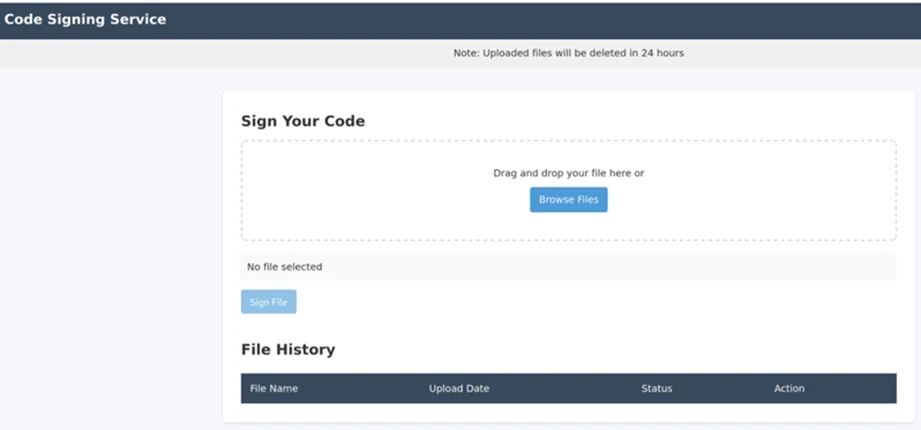
The signspace[.]cloud service has two unique modeling groupings: the admin and the customers. The admin is responsible for maintaining the tooling, account creation, and infrastructure, while the customers provide files to be fraudulently code signed. Customers who accessed the service could upload malicious files to be signed using Fox Tempest-controlled certificates.

Below are examples of the signspace[.]cloud portal as seen by Fox Tempest’s customers:

SignSpace sign-in portal with fields to input a username and password to login
Figure 1. Fox Tempest’s SignSpace sign-in portal
Code signing service upload page depicting a blue button to upload files, another blue button to sign the file, and an empty file history table
Figure 2. Fox Tempest’s SignSpace code signing service upload page

In February 2026, Microsoft Threat Intelligence observed a notable shift in Fox Tempest’s operational infrastructure. Fox Tempest transitioned to providing customers with pre-configured virtual machines (VMs) hosted on US-based virtual private server provider Cloudzy’s infrastructure, allowing threat actors to upload their malicious files directly to Fox Tempest‑controlled environments and receive signed binaries in return. This infrastructure evolution reduced friction for customers, improved operational security for Fox Tempest, and further streamlined the delivery of malicious but trusted, signed malware at scale. Microsoft’s Digital Crimes Unit (DCU) disrupted this infrastructure and continues to partner with Cloudzy to identify and disrupt related infrastructure.

Below is an example of the Fox Tempest-provided VM environment as seen by customers:
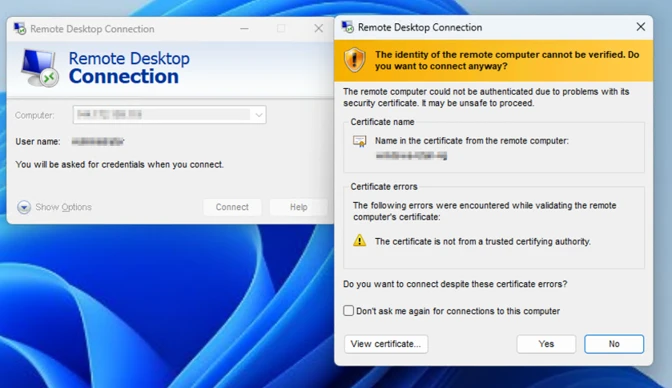
Screenshot of Remote Desktop Connection interface showing login prompt and security warning. Warning highlights unverified remote computer identity and certificate errors, with options to view certificate, connect anyway, or cancel connection.
Figure 3. Accessing VM provided by Fox Tempest

Inside the VM, Fox Tempest provided files that are used to sign code:
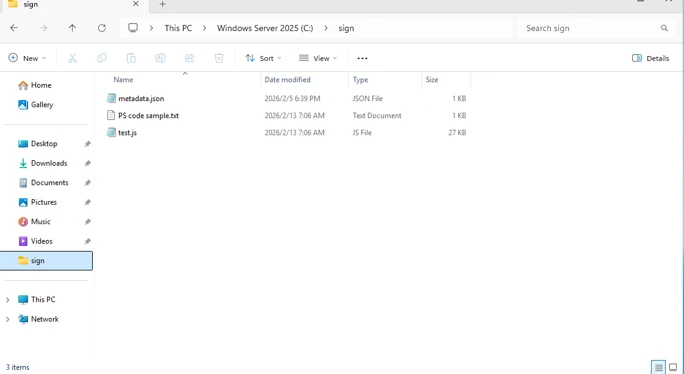
  • The first file, metadata.json, was a configuration file that pointed to an Azure‑hosted endpoint which also included the signing account and certificate profile.
  • The second file, test.js, is an example of a file provided by Fox Tempest that had been digitally signed to demonstrate their signing capabilities to customers.
  • The third file, PS code sample.txt, contains the PowerShell script they used to sign customer‑submitted files using certificates under Fox Tempest control.
Figure 4. Fox Tempest provided files
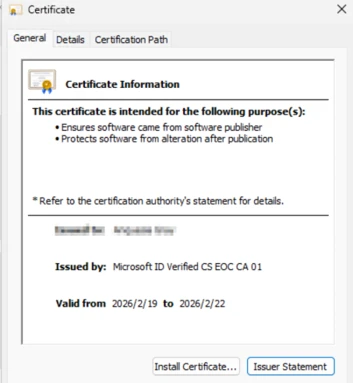
Screenshot of a digital certificate details window showing certificate purpose, issuer, and validity period. The certificate ensures software authenticity and protection against alteration, issued by Microsoft ID Verified CS EOC CA 01, valid from February 19 to February 22, 2026.
Figure 5. Fox Tempest provided certificate

Threat actors using Fox Tempest’s MSaaS offering paid thousands of dollars to get their malicious code signed, as shown below with the Google Form detailing the service’s pricing model. Actors filled out the form before being added to a queue to submit payment and gain access to a VM. The form (written in both English and Russian) asks the user to choose a selected plan from a price list of $5000 USD, $7500 USD, or $9000 USD, with a mention that higher paying plans receive priority in the queue sequence.
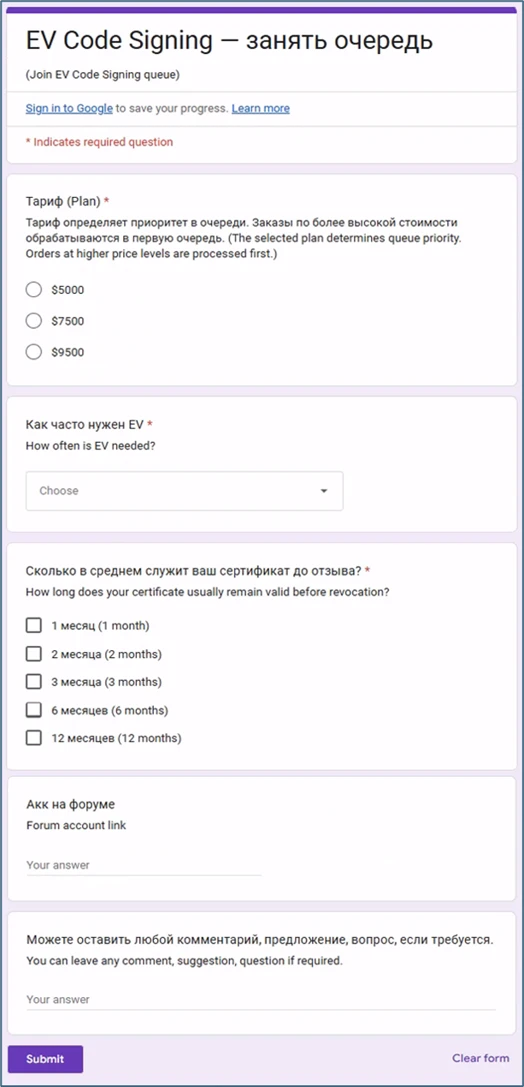

Screenshot of an online form for joining an EV Code Signing queue, featuring sections for selecting a pricing plan with three options ($8500, $7500, $9500), frequency of EV need, certificate validity duration, and forum account link. Form includes bilingual instructions in Russian and English, required fields marked with a red asterisk, and buttons for submitting or clearing the form.
Figure 6. Google form used by Fox Tempest
Screenshot of a subscription channel page promoting EV certificates for sale by SamCodeSign with 290 subscribers. Features a blue icon of a certificate with a key, a call-to-action button labeled "JOIN CHANNEL," and a message about certificate sale information and support contact.
Figure 7. Telegram used by Fox Tempest

Fox Tempest engaged directly with customers using a Telegram channel, EV Certs for Sale by SamCodeSign under the user account arbadakarba2000. All signing activity occurred using a Fox Tempest-provided email address associated with a very small number of IP addresses.

Case study: Fox Tempest enables Vanilla Tempest attacks

Vanilla Tempest began using Fox Tempest’s MSaaS service as early as June 2025. Through this service, Vanilla Tempest uploaded malicious payloads such as trojanized Microsoft Teams installers, which Fox Tempest would fraudulently signed to appear legitimate. Vanilla Tempest would then distribute these signed binaries through legitimately purchased advertisements that redirected users searching for Microsoft Teams to attacker‑controlled advertisements and fraudulent download pages.

Diagram illustrating a phishing attack flow involving fake Microsoft Teams installer downloads from fraudulent websites. Key components include labeled nodes for Fox Tempest and Vanila Tempest tools, user interaction steps, scheduled tasks, and deployment of a hybrid backdoor malware, with color-coded boxes highlighting different stages of the attack.
Figure 8. Vanilla Tempest and Fox Tempest attack chain

Victims were presented with a malicious MSTeamsSetup.exe in place of the legitimate client, reflecting a broader pattern of Vanilla Tempest frequently abusing trusted software brands to lure victims and establish initial access. Execution of the counterfeit installer resulted in the deployment of the Oyster backdoor (also known as Broomstick), a modular, multistage implant that establishes persistent remote access, initiates command‑and‑control (C2) communications, collects host‑level information, and enables the delivery of additional payloads. By masquerading as a widely deployed enterprise collaboration tool hiding behind a fraudulently signed binary, Vanilla Tempest’s Oyster payload was likely able to evade casual detection and blend into normal enterprise activity. In some observed cases, Vanilla Tempest also deployed Rhysida ransomware within victim environments using the same process.

Defending against Fox Tempest-enabled attacks

To defend against Fox Tempest tactics, techniques, and procedures (TTPs) and similar activity, Microsoft recommends the following mitigation measures:

Microsoft Defender detections

Microsoft Defender customers can refer to the list of applicable detections below. Microsoft Defender coordinates detection, prevention, investigation, and response across endpoints, identities, email, apps to provide integrated protection against attacks like the threat discussed in this blog.

Tactic Observed activity Microsoft Defender coverage 
PersistenceThreat actors distributed malware families including using Fox Tempest‑signed binariesMicrosoft Defender for Antivirus  
– Trojan:Win64/OysterLoader  
– Trojan:Win64/Oyster  
– Trojan:Win32/Malcert  
– Trojan:Win32/LummaStealer  
– Trojan:Win32/Vidar  
– Backdoor:Win32/Spyder  
– Trojan:Win32/Malgent  
– Trojan:Win64/Tedy  
– Trojan:Python/MuddyWater  
– Trojan:Win64/Fragtor  

Microsoft Defender for Endpoint
– Vanilla Tempest activity group
– User account created under suspicious circumstances
– New group added suspiciously
– New local admin added using Net commands – ‘LummaStealer’ malware was prevented
– ‘Malcert’ malware was prevented
– ‘Vidar’ malware was prevented  

ImpactAnalysis of Fox Tempest MSaaS identified links to the enablement of several ransomware familiesMicrosoft Defender for Antivirus
– Ransom:Win64/Rhysida
– Ransom:Win64/Inc
– Ransom:Win32/Qilin
– Ransom:Win32/BlackByte

Microsoft Defender for Endpoint
– Ransomware-linked threat actor detected
– ‘BlackByte’ ransomware was prevented
– ‘INC’ ransomware was prevented
– ‘Qilin’ ransomware was prevented
– ‘Rhysida’ ransomware was prevented
– A file or network connection related to a ransomware-linked emerging threat activity group detected  

Microsoft Security Copilot

Microsoft Security Copilot is embedded in Microsoft Defender and provides security teams with AI-powered capabilities to summarize incidents, analyze files and scripts, summarize identities, use guided responses, and generate device summaries, hunting queries, and incident reports.

Customers can also deploy AI agents, including the following Microsoft Security Copilot agents, to perform security tasks efficiently:

Security Copilot is also available as a standalone experience where customers can perform specific security-related tasks, such as incident investigation, user analysis, and vulnerability impact assessment. In addition, Security Copilot offers developer scenarios that allow customers to build, test, publish, and integrate AI agents and plugins to meet unique security needs.

Threat intelligence reports

Microsoft Defender XDR customers can use the following threat analytics reports in the Defender portal (requires license for at least one Defender XDR product) to get the most up-to-date information about the threat actor, malicious activity, and techniques discussed in this blog. These reports provide the intelligence, protection information, and recommended actions to prevent, mitigate, or respond to associated threats found in customer environments.

Microsoft Defender XDR threat analytics

Microsoft Security Copilot customers can also use the Microsoft Security Copilot integration in Microsoft Defender Threat Intelligence, either in the Security Copilot standalone portal or in the embedded experience in the Microsoft Defender portal to get more information about this threat actor.

Indicators of compromise

IndicatorTypeDescriptionFirst seenLast seen
signspace[.]cloudDomainAttacker-controlled domain hosting MSaaS2025-05-292026-05-05
dc0acb01e3086ea8a9cb144a5f97810d291020ceSignerSha-1Certificate2026-03-182026-05-11
7e6d9dac619c04ae1b3c8c0906123e752ed66d63SignerSha-1Certificate2026-03-212026-05-11
f0668ce925f36ff7f3359b0ea47e3fa243af13cd6ad9661dfccc9ff79fb4f1ccSHA-256File hash2026-03-192026-05-04
11af4566539ad3224e968194c7a9ad7b596460d8f6e423fc62d1ea5fc0724326SHA-256File hash2026-03-212026-05-07
f0a6b89ec7eee83274cd484cea526b970a3ef28038799b0a5774bb33c5793b55SHA-256File hash2026-03-122026-04-19

Learn more

For the latest security research from the Microsoft Threat Intelligence community, check out the Microsoft Threat Intelligence Blog.

To get notified about new publications and to join discussions on social media, follow us on LinkedIn, X (formerly Twitter), and Bluesky. To hear stories and insights from the Microsoft Threat Intelligence community about the ever-evolving threat landscape, listen to the Microsoft Threat Intelligence podcast.