


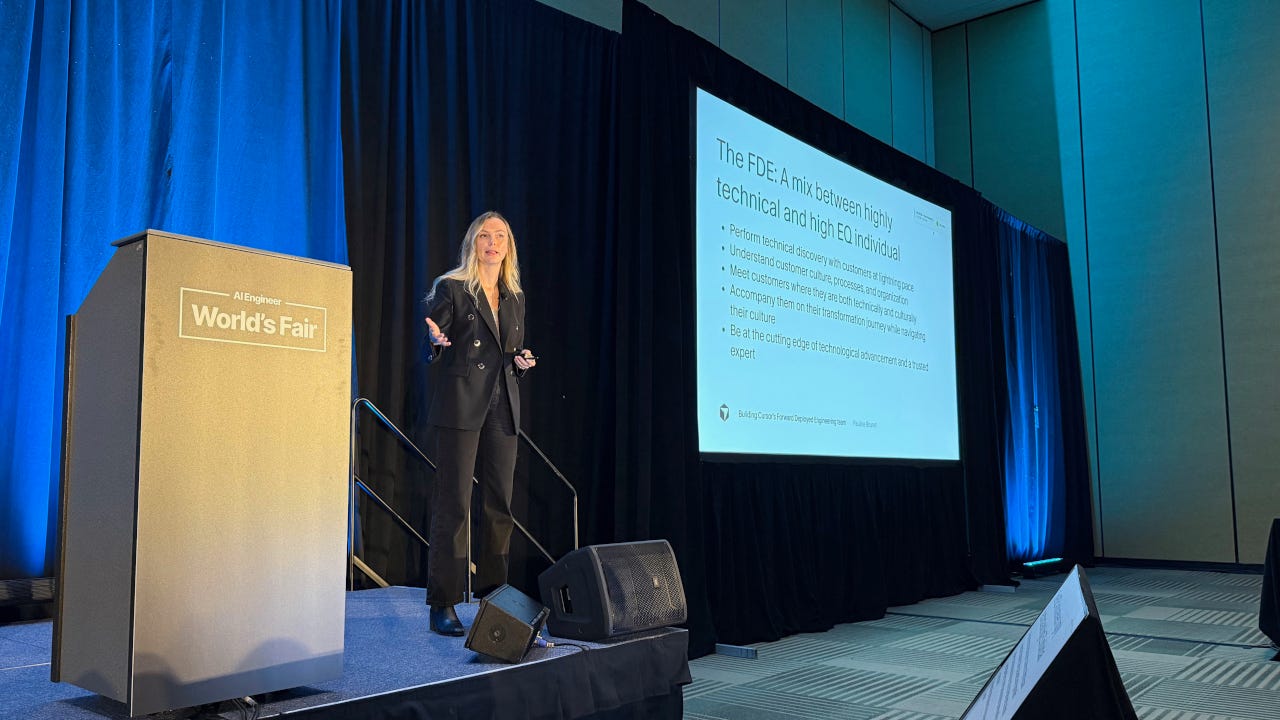
Forward deployed engineering has quickly become one of the most prominent roles in enterprise AI. Sitting somewhere between software engineering, product development and customer implementation, forward deployed engineers [FDEs] work directly with organizations to implement AI capabilities.
At Cursor, the role is especially ambitious. Pauline Brunet, the company’s VP of Forward Deployed Engineering, is building a team that works with organizations to implement agents across the entire software development lifecycle.
In an interview with Latent Space at the AI Engineer World’s Fair, Brunet discussed Cursor’s vision of an “AI software factory,” the challenge of expanding agent adoption beyond individual enthusiasts, and what engineers need to demonstrate if they want to move into forward-deployed work.
Latent Space: To begin with, how do you define forward deployed engineering?
Pauline Brunet: Forward deployed engineering depends on the business, the product, and the customer. You have to consider how configurable the application is. Is it something customers can use out of the box, or are you deploying something complex and highly configurable?
You also have to consider where customers are in their journey.
I don’t think of forward deployed engineering as a team that supports a traditional, out-of-the-box deployment. I think of it as a team that goes on-site, works inside a customer’s systems and tools, and deploys applications or platforms that help solve challenges at scale.
Those deployments are highly configurable and customized around the customer’s workflows, processes, systems, and tools.
Latent Space: Cursor’s customers are predominantly engineers. How does the FDE role apply to the way they use the product?
Brunet: Cursor is an AI coding platform and coding assistant. We work with people on AI-assisted coding, synchronous and asynchronous agents, and ultimately the idea of an AI software factory.
Today, we work with customers across many industries, including financial services, telecommunications, software development, technology, and semiconductors.
We help transformation leaders, IT leaders, and CTO organizations create an AI software factory across their operations. That includes how they plan and design software, how they write code, how they test and review it, and how they deploy and maintain applications at scale. So, very focused on the software development lifecycle from start to finish.
Latent Space: How large is Cursor’s FDE team?
Brunet: We’re growing rapidly. Our goal is to grow the team tenfold by the end of December.
Latent Space: Are your current FDE employees primarily engineers, or does the team also include product specialists?
Brunet: They are all engineers. We hire software engineers with at least five years of experience and extensive customer-facing experience.
These are people who have developed and shipped code in production. They have built and designed systems, and they can make trade-off decisions and evaluate which systems or technologies should be used.
They also need customer-facing experience. We have people who previously worked at companies including Spotify, Rippling, and Palantir, and who have deployed production systems for customers.
Latent Space: You mentioned the term “software factory,” which has begun appearing more frequently in the industry. What does that term mean to Cursor?
Brunet: For Cursor, it is about the software development lifecycle from start to finish: how you plan, design, write, review, test, and deploy code.
Today, those stages are often handled by different teams. You might have a design team, a development team, and a product manager working alongside them. Each group may be optimizing its own work with AI-assisted coding, but the process remains siloed.
We want to help customers across the entire lifecycle. You should be able to say, “Here is the feature I want to develop,” and then have long-running agents work with you across every step. That could include creating the plan and product requirements document, producing a demonstration of what the feature might look like, writing and testing the code, putting it into production, and maintaining it.
Issues and product feedback should also feed back into that same lifecycle. For us, a software factory means long-running agents helping people throughout that entire process.
Latent Space: So it is broader than agent orchestration alone?
Brunet: Correct. Exactly.
Latent Space: What problems are enterprises encountering as they try to implement agent technology?
Brunet: One challenge is that adoption is still concentrated among early adopters.
Within an organization, you might have 10% or 20% of people who are enthusiastic early adopters. They have done great work using local agents and cloud agents for their own tasks, and they have become highly productive.
What is missing in the next phase is the ability to use long-running agents across teams, processes, and workflows.
That requires more support from the top of the organization. Leadership has to say, “This is a priority, and this is how we want to automate or change this process.”
For the FDE team, it is therefore important to find the right champions inside an organization: people who want to meaningfully change the business and who will work with us and their internal teams to transform how work gets done.
Latent Space: Local AI appears to be gaining momentum, partly because of the increasing availability of open-source models. Are you doing more local AI implementation work with customers?
Brunet: We have local agents that people run through the desktop application or the CLI, and that experience is largely self-service. People have adopted the technology at a phenomenal rate, particularly across Cursor’s user base.
We are also seeing people adopt cloud agents because they are excited about being able to run tasks without keeping their laptops half open. Agents can now work in the cloud on tasks that previously ran locally.
What becomes interesting is when this moves beyond an agent helping with one person’s job. The next question is how agents can work across a function, team, or organization so that processes are automated consistently. For example, you could have a QA agent applying the same process across several development teams.
We are receiving a lot of questions from customers about those kinds of use cases.
Latent Space: Do the lessons from these deployments feed back into the core Cursor product?
Brunet: Yes. The forward deployed engineering team works very closely with customers on their use cases, so we are naturally a good way for the product and engineering teams to understand what customers want to build next.
We work closely with those teams and play a significant role in helping shape Cursor’s product roadmap.
Latent Space: As agents become more autonomous, how do you expect the FDE role to evolve?
Brunet: I think the role is going to change drastically. I always say that if we are doing the same job we were doing six months ago, we have done something wrong.
Right now, people are still looking for inspiration about the use cases they can solve, so we want to propose new possibilities.
In software development, for example, we can show how designers and product managers might work seamlessly in Cursor alongside developers and testing teams.
We might also ask whether a company has considered using long-running agents to handle call-center or ticketing processes from start to finish.
As we work across industries such as healthcare, life sciences, the public sector, retail, and consumer packaged goods, we will continue identifying use cases across marketing, sales, and supply-chain operations. The FDE role will evolve alongside those possibilities.
Latent Space: There are around 7,000 AI engineers at this conference. What advice would you give developers who want to move into forward deployed engineering?
Brunet: I’ve had this conversation five or six times already today. We are looking for builders with software engineering experience: people who have identified a problem and built a production-grade application or system from start to finish.
You should have designed it, developed it, tested it, and put it into production with real users.
My recommendation is to find those kinds of projects inside your organization and take ownership of them from beginning to end. Make sure you understand why you made each design decision.
How did you select the database? How did you choose the different services? Why did you design the system in that particular way? What were the trade-offs?
You should also understand the measurable return on investment, both in traditional business terms and through evaluations that demonstrate the value you are creating for internal customers.
If you want to get into forward deployed engineering, become familiar with these kinds of projects, gain experience delivering them, and learn how to explain the decisions you made.
此内容由惯性聚合(RSS阅读器)自动聚合整理,仅供阅读参考。 原文来自 — 版权归原作者所有。