
惯性聚合 高效追踪和阅读你感兴趣的博客、新闻、科技资讯
阅读原文 在惯性聚合中打开

推荐订阅源

Hacker News: Ask HN
Hacker News: Ask HN
Recent Commits to openclaw:main
cs.CV updates on arXiv.org
C
Check Point Blog
S
Security Affairs
Hacker News - Newest:
Hacker News - Newest: "LLM"
S
Secure Thoughts
Recorded Future
Recorded Future
cs.AI updates on arXiv.org
T
The Blog of Author Tim Ferriss
B
Blog
C
Cybersecurity and Infrastructure Security Agency CISA
Google DeepMind News
CTFtime.org: upcoming CTF events
A
Arctic Wolf
T
The Exploit Database - CXSecurity.com
Stack Overflow Blog
Stack Overflow Blog
T
Threat Research - Cisco Blogs
GbyAI
GbyAI
AWS News Blog
AWS News Blog
MongoDB | Blog
MongoDB | Blog
Y
Y Combinator Blog
Google Online Security Blog
T
Troy Hunt's Blog
I
InfoQ
L
LINUX DO - 热门话题
WordPress大学
WordPress大学
C
Cisco Blogs
G
GRAHAM CLULEY
The Register - Security
A
About on SuperTechFans
让小产品的独立变现更简单 - ezindie.com
Schneier on Security
Project Zero
Project Zero
H
Hackread – Cybersecurity News, Data Breaches, AI and More
P
Privacy & Cybersecurity Law Blog
Cloudbric
Cloudbric
H
Hacker News: Front Page
小众软件
小众软件
雷峰网
雷峰网
The Hacker News
The Hacker News
www.infosecurity-magazine.com
T
Tor Project blog
博客园 - 聂微东
N
Netflix TechBlog - Medium
V
Vulnerabilities – Threatpost
The GitHub Blog
The GitHub Blog
腾讯CDC
P
Palo Alto Networks Blog
Scott Helme
Scott Helme

Latent.Space

[AINews] Claude Opus 5: Fable-level performance at Opus price (half Fable) [AINews] Black Forest Labs FLUX 3 - Multimodal Flow Models that beat Seedance 2.0, Gemini Omni and Grok Imagine, and FLUX-mimic video-action robotics model [AINews] "Laguna S 2.1 Released: Cheaper than Deepseek v4 Flash, Better than V4 Pro" Inside the Model Factory — Eiso Kant, Poolside AI [AINews] AI Cybersecurity becomes top of mind 🔬Causal Models Need Causal Data - Xaira’s X-Cell model for Drug Discovery (Bo Wang & Ci Chu, Chief Discovery Officer & Chief AI Scientist) [AINews] not much happened today [AINews] not much happened today [AINews] Kimi K3 2.8T-A50B: the largest open model ever released; Opus 4.8-class at Sonnet 5 pricing 🔬 The Lab of the Future Should Feel Like a Data Center — Andy Beam & Rafa Gómez-Bombarelli, Lila Sciences [AINews] Thinky's Inkling: 975B-A41B multimodal, new best American Apache 2.0 open model (with Inkling-Small, 276B-A12B) [AINews] not much happened today 5 Trends That Defined AI Engineering at World’s Fair 2026 [AINews] Codex usage up >10x in 6 months to 7M users, +1M in the past ~day; did Codex overtake Claude Code?? [AINews] not much happened today [AINews] OpenAI launches GPT 5.6 Sol/Terra/Luna, Codex becomes ChatGPT superapp [AINews] SpaceXAI launches Grok 4.5, first Opus-class model post Cursor acquisition Why AI Infrastructure must evolve for Agent Experience — Akshat Bubna, Modal CTO [AINews] Lilian Weng summarizes 35 papers on Harness Engineering for RSI [AINews] The Field Guide to Fable AIEWF Daily Dispatch: The great loops debate and the state of AI engineering Vercel's Andrew Qu on why agents are a new kind of software The website of the future may assemble itself for every visitor [AINews] not much happened today AIEWF Daily Dispatch: Autoresearch and the tension between AI and human agency Autoresearch: The feedback loop behind self-improving agents How Cursor deploys AI inside the enterprise 🔬 The Coolest Diffusion Research Isn't in LLMs — Evan Feinberg & Sergey Edunov, Genesis Molecular AI Warp CEO Zach Lloyd on why software factories are the next phase of coding AIEWF Daily Dispatch: Loops, Software Factories & Forward Deployed Engineers [AINews] Sonnet 5 today, and Fable 5 tomorrow Forward Deployed Engineers and the future of software engineering Ahmad Osman on why local AI is catching up [AINews] not much happened today [AINews] OpenAI GPT-5.6 Sol / Terra / Luna — restricted to trusted partners [AINews] OpenAI reports median internal Codex output tokens grew 56x in Research, 32x in Customer Support, 27x in Engineering, and 13x in Legal since November 2025. [AINews] It's Meta-Harness Summer Why the Frontier Ecosystem must be Open — Matei Zaharia and Reynold Xin, Databricks [AINews] Claude Tag: Multiplayer, Proactive, Persistent Agents in Slack [AINews] SpaceX is already a $28B/yr Neocloud Red-Teaming after Mythos — Zico Kolter & Matt Fredrikson, Gray Swan How to AIE Good [AINews] not much happened today [AINews] GLM-5.2 is the real deal; Z.ai forecasts Open Fable by EOY The Professor of Outputmaxxing — Anjney Midha, AMP [AINews] Midjourney Medical: scan your organs like you step on a scale 🔬 The Self-Driving Lab — Joseph Krause, Radical AI [AINews] GLM-5.2: the top Frontend Coding model in the world, IndexShare for Speculative Decoding [AINews] Satya on Loopcraft: Building Frontier Ecosystems [AINews] Fable and Mythos officially too dangerous to release [AINews] Loopcraft: The Art of Stacking Loops [AINews] Loopcraft: The Art of Stacking Loops [AINews] Open Models, Model Labs vs Agent Labs, and What's Untrainable — Sarah Guo [AINews] Anthropic Claude Fable 5 — Mythos but Safe, with Controversial Terms [AINews] FrontierCode: Benchmarking for Code Quality over Slop [AINews] not much happened today How to Stop Shipping Low-Quality RL Environments (with Examples) [AINews] not much happened today Reality: The Final Eval — Lukas Petersson and Axel Backlund of Andon Labs [AINews] Reve 2 and Ideogram 4: Layouts in Imagegen 🔬Scaling Past Informal AI - Carina Hong, Axiom Math ⚡️Satya Nadella: No Priors x Latent Space Crossover Special at Microsoft Build [AINews] Microsoft Build: MAI-Thinking-1 and MAI Family models GitHub's plan for Agents — Kyle Daigle, GitHub [AINews] NVIDIA Cosmos 3, Nemotron 3 Ultra, and RTX Spark Why Video Agent models are next — Ethan He, xAI Grok Imagine [AINews] Founders and Forward Deployed Engineers [AINews] Anthropic raises $965B Series H, releases Opus 4.8 and Dynamic Workflows/ultracode The Age of Async Agents — Cognition's Walden Yan & OpenInspect's Cole Murray [AINews] Cognition raises $1B in $26B Series D 🔬 ESMFold2: The Bitter Lesson is Coming for Proteins - Alex Rives, BioHub [AINews] New AI Infra decacorns: Fireworks, Baseten (with OpenRouter on the way) [AINews] All Model Labs are now Agent Labs [AINews] New AI Infra unicorns: Exa, Modal, TurboPuffer Giving Agents Computers — Ivan Burazin, Daytona [AINews] OpenAI GPT-next disproves 80 year old Erdős planar unit distance problem for under $1000 Railway: The Agent-Native Cloud — Jake Cooper [AINews] Google I/O 2026: Gemini 3.5 Flash, Omni (NanoBanana for Video), Spark (background agents), and Antigravity 2.0 [AINews] How to land a job at a frontier lab (on Pretraining) The Autonomous Drone Tech Stack & Economics of Drones — Yaroslav Azhnyuk, The Fourth Law & Guest Host Noah Smith, Noahpinion [AINews] Cerebras' $60B IPO: Slowly, then All at Once [AINews] Everything is Conductor AI-Native Healthcare: 100M Doctor Visits, 10–20 Hours Saved, Prior Auth in Minutes — Janie Lee & Chai Asawa, Abridge [AINews] Codex Rises, Claude Meters Programmatic Usage [AINews] The End of Finetuning [AINews] Thinking Machines' Native Interaction Models - TML-Interaction-Small 276B-A12B - advances SOTA Realtime Voice and kills standard VAD
Skill engineering and the case against one-shot AI design
Richard MacManus · 2026-07-02 · via Latent.Space
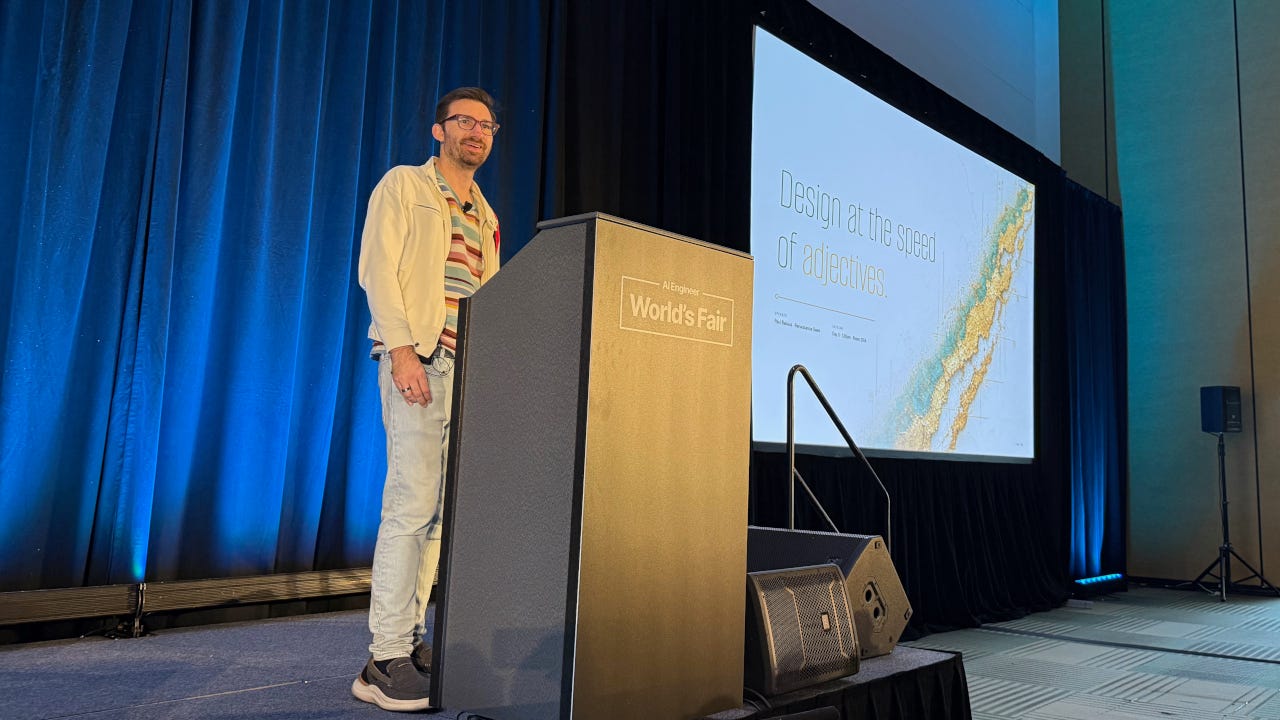
Impeccable’s Paul Bakaus at the AI Engineer World’s Fair.

Paul Bakaus thinks the emerging discipline of “skill engineering” can make AI agents more capable — but he absolutely does not want to remove people from the creative process. He chats to Latent Space about his approach to design in the AI age.

Bakaus is the creator of Impeccable, an open-source design skills system that gives coding agents a vocabulary for improving interfaces. Instead of asking an agent to redesign an entire website in one shot, users can tell it to make a section “bolder,” “quieter,” “denser,” or more polished.

Behind those apparently simple commands is a larger argument about how AI products should be built. Agents need more than instructions, Bakaus said: they need domain knowledge, context and carefully defined ways for humans to steer the result.

“The point is to give you a way to steer what you want to end up with,” he said during a session at the AI Engineer World’s Fair. “It’s never going to be a tool for one-shot design. That’s not the intent.”

Impeccable began as a relatively simple extension of Anthropic’s frontend design skill. As its audience grew, Bakaus expanded it into a more complex system with multiple components and workflows.

That process led him to start thinking of skill engineering as a discipline in its own right. His workshop at the conference explored what he called the “dark arts” of building skills.

“One of the interesting topics was that most skills — [and] most models — are not very creative,” Bakaus told me. “They converge in one direction, and if everybody uses the same skill to do frontend design work or something like that, everything ends up looking the same.”

Skill engineers must also account for differences between agent harnesses and models. Codex and Claude, for example, do not necessarily handle subagents or permissions in the same way. A skill intended to run across Claude Code, Cursor, GitHub Copilot and Codex cannot assume they all provide identical capabilities.

Bakaus has also experimented with routing inside a skill, allowing it to combine several capabilities and direct a task toward the relevant instructions. He compared this to a mixture-of-experts model, with routing used both to conserve tokens and improve effectiveness.

Impeccable’s core innovation is to take terms familiar to designers and give them a more precise operational meaning for an agent.

An unassisted model asked to make a page “bolder” may add gradients, neon effects or glass-like surfaces. Impeccable instead defines boldness through concepts such as hierarchy, scale and decisive typography — changes that attract attention without necessarily breaking the existing design system.

“An adjective with nothing behind it is just a nice apostrophe,” Bakaus said. “You really have to tell the agent what you mean.”

He described these terms as words that have been “imbued with meaning.” The model already has some conception of what words such as “bold” or “quiet” mean, but the skill translates them into a specific professional domain.

This is the key, because experts often possess a vocabulary that non-experts do not. Bakaus said he had observed large differences between the work produced by a designer and an engineer using the same model, simply because the designer knew how to articulate the desired result.

“I’ve been trying to put that language — basically compress it into a skill and into a system — to be able to express yourselves better,” he said.

However, he does not believe every part of design can be controlled from this level of abstraction. Directly manipulating spacing may still be the fastest option for a small adjustment, while open-ended prompting can be useful during initial exploration.

The objective is not to replace every tool with an agent, he insisted. It is to determine “the exact level of control” and insert the person at the point where their judgment is most valuable.

Bakaus sees the boundaries between design, engineering and product management becoming less distinct.

“Designers are moving into code, engineers are moving into design, and vice versa,” he said. “These worlds are all colliding.”

That shift will be uncomfortable for people whose work primarily consists of translating an existing artifact into another form. Engineers who mainly turn Figma designs into code face growing automation, while designers whose contribution is limited to making an existing interface look competent face similar pressure.

“Designers all have to move one layer up the stack to think more about the what,” he said. “I think the role of the product manager and designer is actually converging.”

At the same time, designers are moving closer to implementation — into code. Bakaus initially expected Impeccable to appeal mostly to engineers and assumed professional designers might resent that. Instead, he estimates that designers now make up at least half of its audience.

“So rather than moving directly into code and, you know, having no help,” Bakaus said about designers, “they use Impeccable as a bridge, because it communicates the way they communicate. And that was not obvious to me when I first built it.”

Impeccable also has a live mode that combines visual selection with an underlying coding agent. A user can select a section inside a development environment and request several alternative layouts or (for example) ask for a bolder or quieter treatment. The system operates within the project’s existing code and design system rather than exporting an isolated mockup from a third-party design tool.

Bakaus described this as a potential “design harness” at the intersection of chat and direct visual manipulation.

The AI industry often treats complete automation as the natural endpoint of product development. Bakaus rejects that premise.

He sees two dominant camps: people trying to preserve the traditional Figma-centered workflow, and on the other side advocates of “loopmaxxing” who want agents to work with as little human intervention as possible.

“The truth is somewhere in the middle,” he said.

His preferred model is for AI to produce the first 80% quickly: the competent layout and basic implementation that would otherwise consume a lot of time. The person then owns the final 20%, where taste, context and a distinctive point of view enter the product. This is a key part of Bakaus’s design philosophy in the agentic era.

“People need purpose, and they want to play a role in whatever they create,” Bakaus said. “When you work with the agent, then you feel more ownership of the product.”

Users regularly ask him to add an automatic mode to Impeccable so that the system chooses the commands itself. He has no intention of doing so.

“There is no auto,” he said, “and there will be no auto.”

Asked about the language of software factories and other visions that appear to remove people from engineering altogether, his response was unambiguous.

“I’m squarely against that.”