
惯性聚合 高效追踪和阅读你感兴趣的博客、新闻、科技资讯
阅读原文 在惯性聚合中打开

推荐订阅源

T
Tenable Blog
K
KPMG report finds enterprise disconnect between AI and its ROI | CIO
V
Vulnerabilities – Threatpost
G
GRAHAM CLULEY
Simon Willison's Weblog
C
CXSECURITY Database RSS Feed - CXSecurity.com
P
Privacy International News Feed
H
Heimdal Security Blog
Exploit-DB.com RSS Feed
S
Secure Thoughts
MyScale Blog
MyScale Blog
C
Cyber Attacks, Cyber Crime and Cyber Security
V
Visual Studio Blog
OSCHINA 社区最新新闻
OSCHINA 社区最新新闻
L
LINUX DO - 最新话题
D
Darknet – Hacking Tools, Hacker News & Cyber Security
The Cloudflare Blog
美团技术团队
Recorded Future
Recorded Future
T
Tailwind CSS Blog
Latest news
Latest news
Security Archives - TechRepublic
Security Latest
Security Latest
Know Your Adversary
Know Your Adversary
Cloudbric
Cloudbric
Schneier on Security
I
Intezer
L
LINUX DO - 热门话题
P
Palo Alto Networks Blog
云风的 BLOG
云风的 BLOG
cs.CL updates on arXiv.org
Vercel News
Vercel News
Attack and Defense Labs
人人都是产品经理
人人都是产品经理
L
LangChain Blog
爱范儿
爱范儿
博客园 - 三生石上(FineUI控件)
博客园 - 叶小钗
L
Lohrmann on Cybersecurity
S
SegmentFault 最新的问题
W
WeLiveSecurity
C
Cybersecurity and Infrastructure Security Agency CISA
S
Securelist
SecWiki News
SecWiki News
V2EX - 技术
V2EX - 技术
IT之家
IT之家
Cyberwarzone
Cyberwarzone
F
Full Disclosure
Spread Privacy
Spread Privacy
阮一峰的网络日志
阮一峰的网络日志

Latent.Space

[AINews] Claude Opus 5: Fable-level performance at Opus price (half Fable) [AINews] Black Forest Labs FLUX 3 - Multimodal Flow Models that beat Seedance 2.0, Gemini Omni and Grok Imagine, and FLUX-mimic video-action robotics model [AINews] "Laguna S 2.1 Released: Cheaper than Deepseek v4 Flash, Better than V4 Pro" Inside the Model Factory — Eiso Kant, Poolside AI [AINews] AI Cybersecurity becomes top of mind 🔬Causal Models Need Causal Data - Xaira’s X-Cell model for Drug Discovery (Bo Wang & Ci Chu, Chief Discovery Officer & Chief AI Scientist) [AINews] not much happened today [AINews] not much happened today [AINews] Kimi K3 2.8T-A50B: the largest open model ever released; Opus 4.8-class at Sonnet 5 pricing 🔬 The Lab of the Future Should Feel Like a Data Center — Andy Beam & Rafa Gómez-Bombarelli, Lila Sciences [AINews] Thinky's Inkling: 975B-A41B multimodal, new best American Apache 2.0 open model (with Inkling-Small, 276B-A12B) [AINews] not much happened today 5 Trends That Defined AI Engineering at World’s Fair 2026 [AINews] Codex usage up >10x in 6 months to 7M users, +1M in the past ~day; did Codex overtake Claude Code?? [AINews] not much happened today [AINews] OpenAI launches GPT 5.6 Sol/Terra/Luna, Codex becomes ChatGPT superapp [AINews] SpaceXAI launches Grok 4.5, first Opus-class model post Cursor acquisition Why AI Infrastructure must evolve for Agent Experience — Akshat Bubna, Modal CTO [AINews] Lilian Weng summarizes 35 papers on Harness Engineering for RSI [AINews] The Field Guide to Fable AIEWF Daily Dispatch: The great loops debate and the state of AI engineering Vercel's Andrew Qu on why agents are a new kind of software The website of the future may assemble itself for every visitor Skill engineering and the case against one-shot AI design [AINews] not much happened today AIEWF Daily Dispatch: Autoresearch and the tension between AI and human agency Autoresearch: The feedback loop behind self-improving agents How Cursor deploys AI inside the enterprise 🔬 The Coolest Diffusion Research Isn't in LLMs — Evan Feinberg & Sergey Edunov, Genesis Molecular AI Warp CEO Zach Lloyd on why software factories are the next phase of coding [AINews] Sonnet 5 today, and Fable 5 tomorrow Forward Deployed Engineers and the future of software engineering Ahmad Osman on why local AI is catching up [AINews] not much happened today [AINews] OpenAI GPT-5.6 Sol / Terra / Luna — restricted to trusted partners [AINews] OpenAI reports median internal Codex output tokens grew 56x in Research, 32x in Customer Support, 27x in Engineering, and 13x in Legal since November 2025. [AINews] It's Meta-Harness Summer Why the Frontier Ecosystem must be Open — Matei Zaharia and Reynold Xin, Databricks [AINews] Claude Tag: Multiplayer, Proactive, Persistent Agents in Slack [AINews] SpaceX is already a $28B/yr Neocloud Red-Teaming after Mythos — Zico Kolter & Matt Fredrikson, Gray Swan How to AIE Good [AINews] not much happened today [AINews] GLM-5.2 is the real deal; Z.ai forecasts Open Fable by EOY The Professor of Outputmaxxing — Anjney Midha, AMP [AINews] Midjourney Medical: scan your organs like you step on a scale 🔬 The Self-Driving Lab — Joseph Krause, Radical AI [AINews] GLM-5.2: the top Frontend Coding model in the world, IndexShare for Speculative Decoding [AINews] Satya on Loopcraft: Building Frontier Ecosystems [AINews] Fable and Mythos officially too dangerous to release [AINews] Loopcraft: The Art of Stacking Loops [AINews] Loopcraft: The Art of Stacking Loops [AINews] Open Models, Model Labs vs Agent Labs, and What's Untrainable — Sarah Guo [AINews] Anthropic Claude Fable 5 — Mythos but Safe, with Controversial Terms [AINews] FrontierCode: Benchmarking for Code Quality over Slop [AINews] not much happened today How to Stop Shipping Low-Quality RL Environments (with Examples) [AINews] not much happened today Reality: The Final Eval — Lukas Petersson and Axel Backlund of Andon Labs [AINews] Reve 2 and Ideogram 4: Layouts in Imagegen 🔬Scaling Past Informal AI - Carina Hong, Axiom Math ⚡️Satya Nadella: No Priors x Latent Space Crossover Special at Microsoft Build [AINews] Microsoft Build: MAI-Thinking-1 and MAI Family models GitHub's plan for Agents — Kyle Daigle, GitHub [AINews] NVIDIA Cosmos 3, Nemotron 3 Ultra, and RTX Spark Why Video Agent models are next — Ethan He, xAI Grok Imagine [AINews] Founders and Forward Deployed Engineers [AINews] Anthropic raises $965B Series H, releases Opus 4.8 and Dynamic Workflows/ultracode The Age of Async Agents — Cognition's Walden Yan & OpenInspect's Cole Murray [AINews] Cognition raises $1B in $26B Series D 🔬 ESMFold2: The Bitter Lesson is Coming for Proteins - Alex Rives, BioHub [AINews] New AI Infra decacorns: Fireworks, Baseten (with OpenRouter on the way) [AINews] All Model Labs are now Agent Labs [AINews] New AI Infra unicorns: Exa, Modal, TurboPuffer Giving Agents Computers — Ivan Burazin, Daytona [AINews] OpenAI GPT-next disproves 80 year old Erdős planar unit distance problem for under $1000 Railway: The Agent-Native Cloud — Jake Cooper [AINews] Google I/O 2026: Gemini 3.5 Flash, Omni (NanoBanana for Video), Spark (background agents), and Antigravity 2.0 [AINews] How to land a job at a frontier lab (on Pretraining) The Autonomous Drone Tech Stack & Economics of Drones — Yaroslav Azhnyuk, The Fourth Law & Guest Host Noah Smith, Noahpinion [AINews] Cerebras' $60B IPO: Slowly, then All at Once [AINews] Everything is Conductor AI-Native Healthcare: 100M Doctor Visits, 10–20 Hours Saved, Prior Auth in Minutes — Janie Lee & Chai Asawa, Abridge [AINews] Codex Rises, Claude Meters Programmatic Usage [AINews] The End of Finetuning [AINews] Thinking Machines' Native Interaction Models - TML-Interaction-Small 276B-A12B - advances SOTA Realtime Voice and kills standard VAD
AIEWF Daily Dispatch: Loops, Software Factories & Forward Deployed Engineers
Richard MacManus · 2026-07-01 · via Latent.Space
Agents are here to serve you in the software factory.

Loops, loops and more loops. That word, loop, dominated conversations on day 2 of the AI Engineer World’s Fair — the first full day of keynotes and sessions. Perhaps knowing in advance what everyone would be talking about, AIEWF cofounder swyx titled his opening talk, “Loopcraft: The Art of Stacking Loops.”

swyx began by commenting on the evolution of AI engineering from 2022: from chat, to tools, to goals. “These days, we’re all about automations,” he added. “We’re all about cron jobs and loops.”
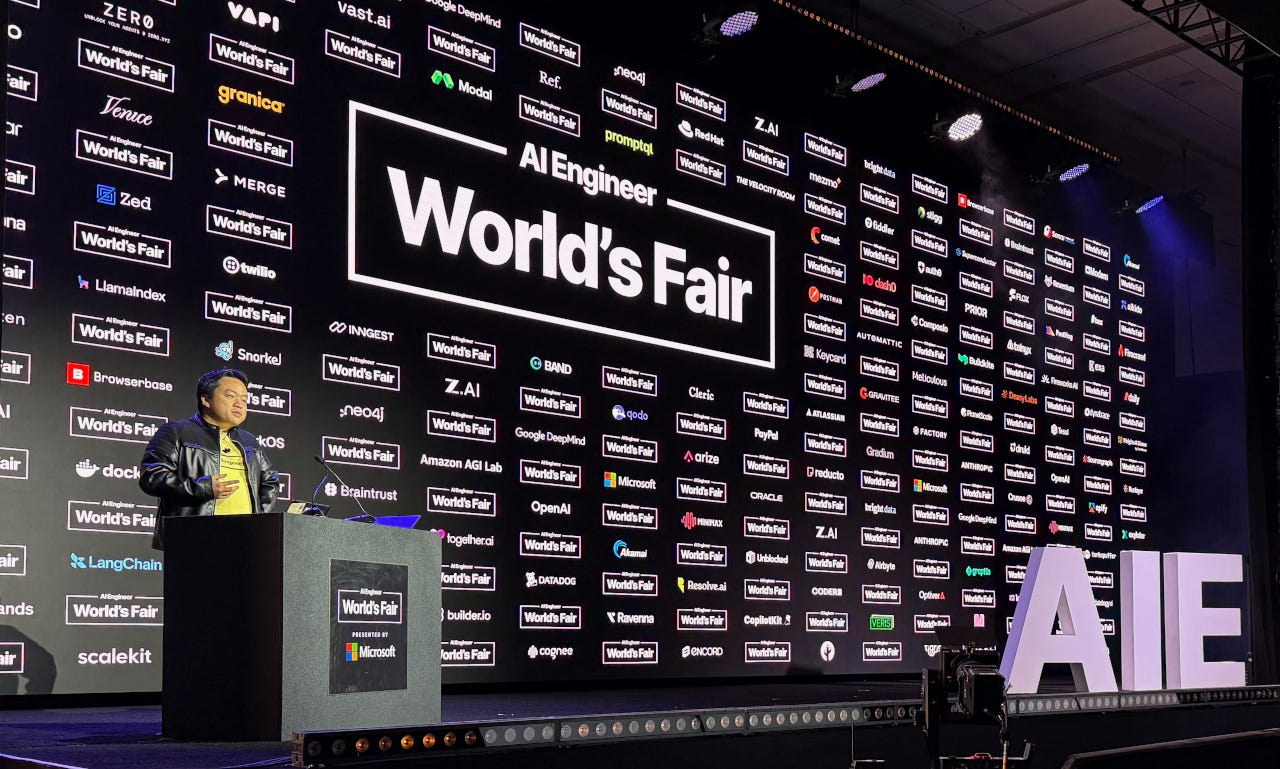
Allie Howe, a member of technical staff for Keycard, then introduced the main stage track for the day: Software Factories. She referenced Geoffrey Huntley’s influential article, “everything is a ralph loop,” a theory about turning an AI coding agent into a persistent worker by repeatedly restarting it against the same spec.

Pablo Castro from Microsoft then talked about Foundry, the company’s “AI app and agent factory.” He claimed that a “learning loop” occurs when people and agents work together.

OpenAI’s Alexander Embiricos and Romain Huet were next on, and they focused a lot on Codex, the company’s coding agent. One point they made was that using multiple agents via loops can result in enhanced productivity.
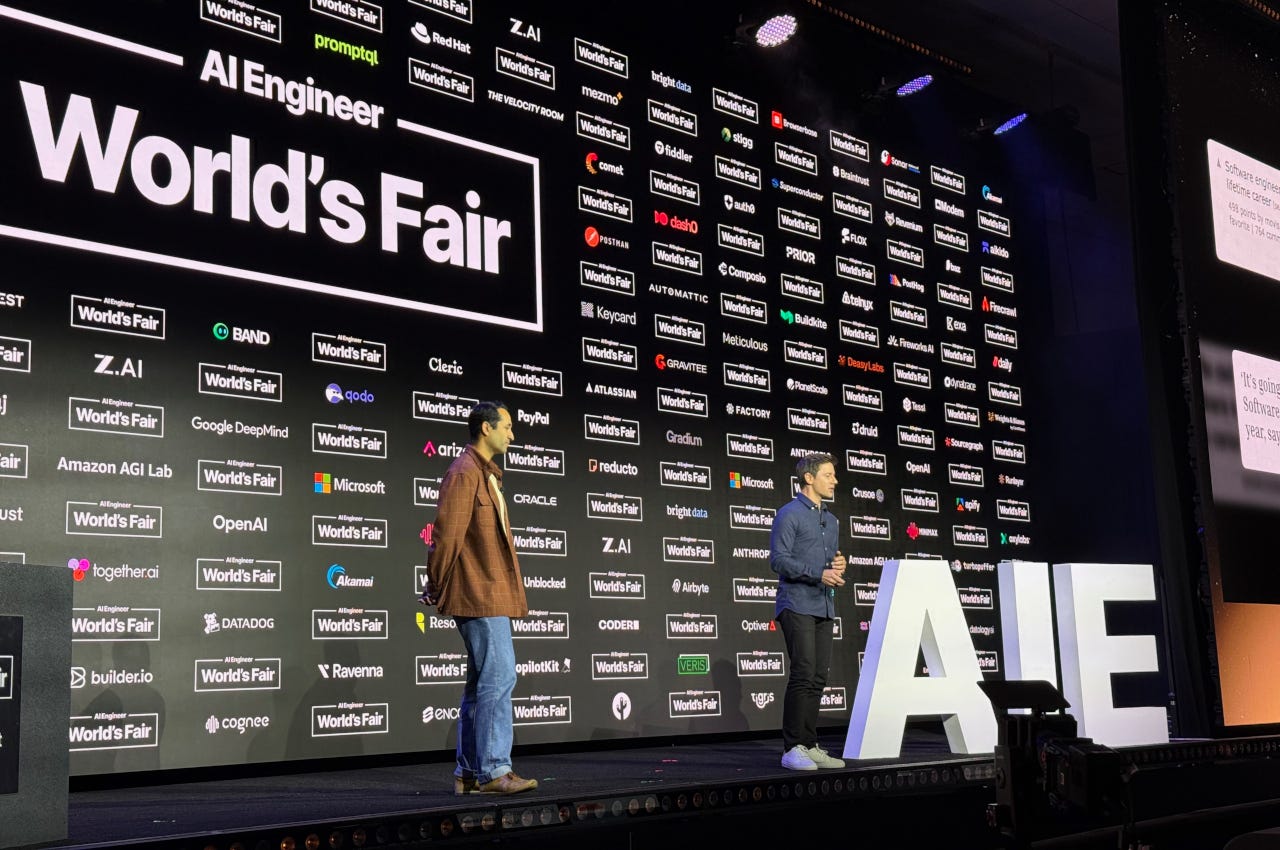
“There will be a lot of talk today about loops,” Embiricos said. “And if you can connect the agent to not only the work that you have to do, but why it has to be done, that’s how you can get the agent to start to begin much more work. And then if you can connect it to what you do afterwards, review and deploy, that’s how you help it land much more work.”

This segued to a presentation by Peter Steinberger, the “ClawFather” of OpenClaw, now working for OpenAI. He too was all-in on loops, noting that he designs loops to manage agents. He added that deciding what to pay attention to is his main challenge nowadays — and that the future is “better loops” to help solve this issue.
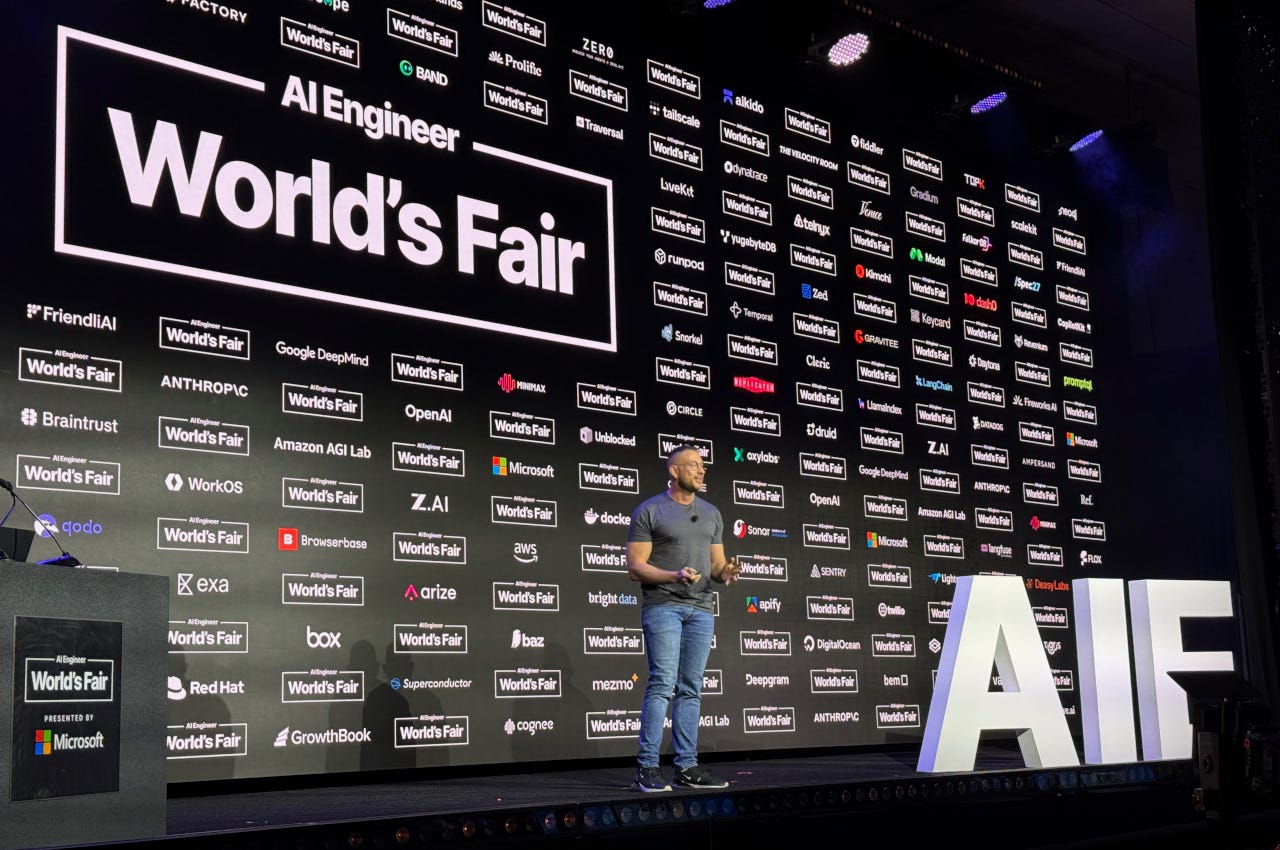
All this talk of looping led naturally to the concept of “software factories,” the subject of a presentation by Tereza Tížková from a company called Factory. She defined a software factory as “the whole loop, the whole lifecycle of developing software with autonomy.” She added that this doesn’t mean just coding, but also “collecting all the signals, reacting to user feedback [and] to logs, prioritizing what’s important, then orchestrating it all.”
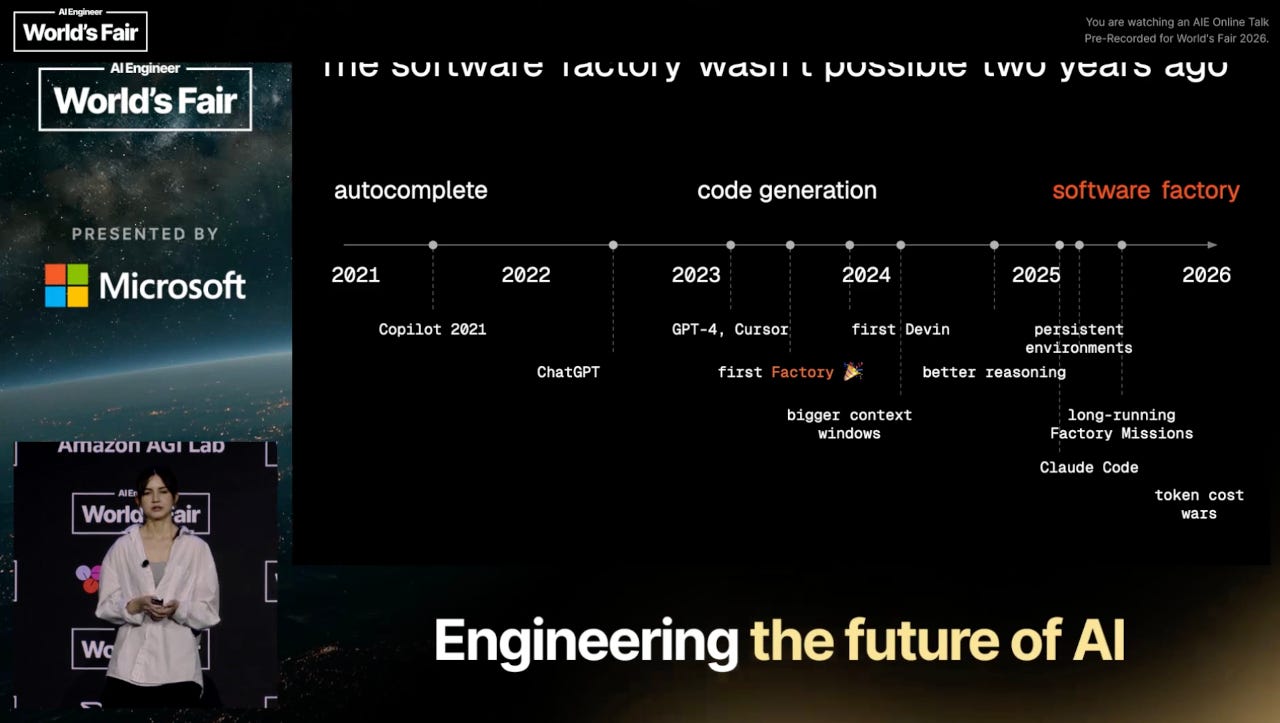
Zach Lloyd from Warp also spoke about software factories; in fact, his thesis was that “software engineering will become factory engineering.” Loops in Lloyd’s framing were about improving the system.

In both Tížková and Lloyd’s talks, the emphasis was on having the agents doing the building for you. “You’ll be building the thing that builds the product,” was how Lloyd put it.

Afterwards, I went down to Warp’s booth in the AIEWF expo hall and spoke to Lloyd about software factories. I particularly wanted to know why Warp, which began as a CLI tool for developers, has pivoted into a ‘software factory’ platform where developers aren’t supposed to do coding anymore.

“The way to think of the factory is, like, pick your repos, pick the parts of the lifecycle that you want to automate, pick the ways in which you want humans to be brought into the loop,” Lloyd told me. “And different organizations [and] code bases will have different preferences for, like, do you fully automate code review [or] do you have humans do hard coding, stuff like that.”
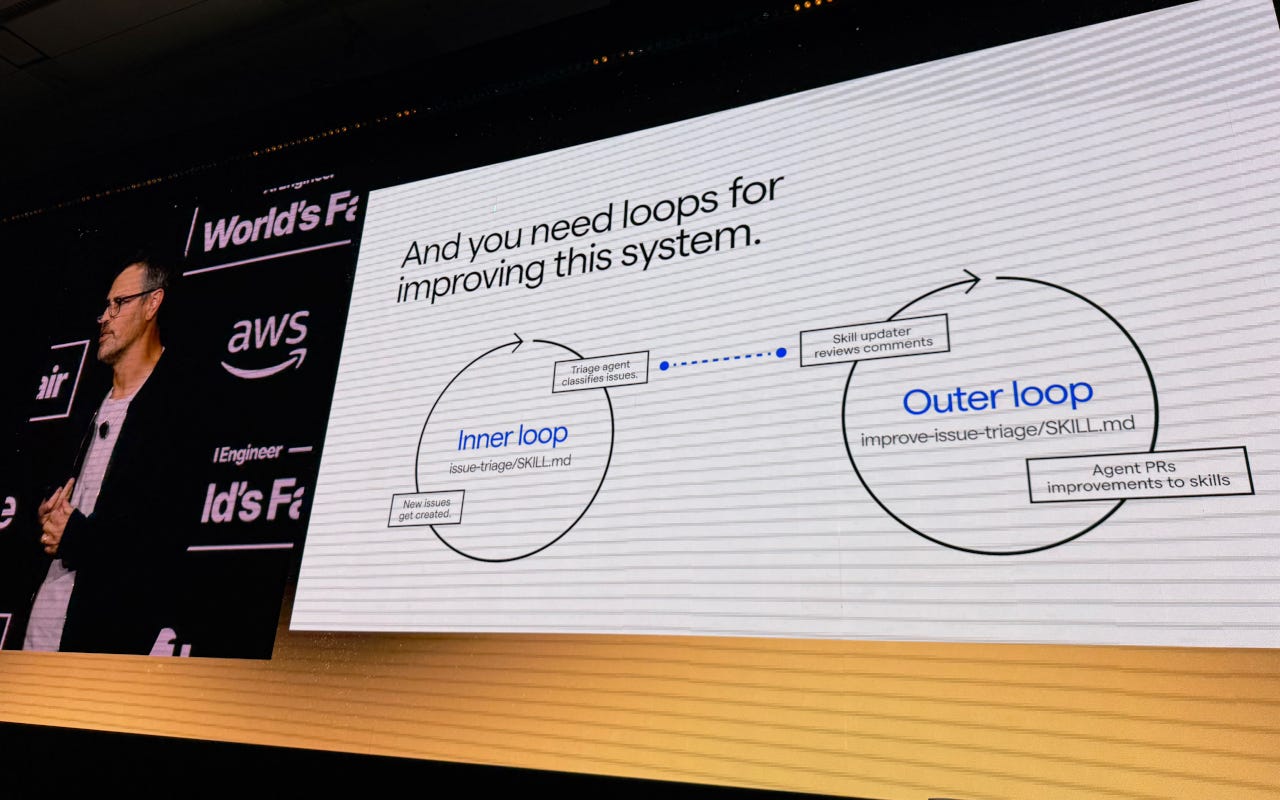
I noted that the term “factory” might be offputting to many developers, since it implies mechanized rote work — much different from the creative era of coding we’ve just come from. Lloyd recognizes this is a challenge, but he argues software factories will become a new discipline of engineering — and that it still requires problem solving.

“For better or worse, the power of these systems is so great and the ability to accelerate is so strong that just writing stuff by hand...I don’t think it’s going to make sense for very much longer,” he said.

(For more from Zach Lloyd on software factories, stay tuned for a Latent Space interview to publish shortly.)

Related to loops and software factories, another theme from AIEWF today was the trendy new role of Forward Deployed Engineers. In an interview with Natalie Meurer, Head of Agent Engineering at Sierra, I established that FDEs are also sometimes called “agent engineers.” The main point is to help organizations adapt to agents, from a development perspective.

Meurer pointed out that a lot of the work of integrating AI into companies these days is in orchestrating agents.

“In practice, most customer-specific work takes place at the orchestration layer rather than in the models themselves,” she told me.

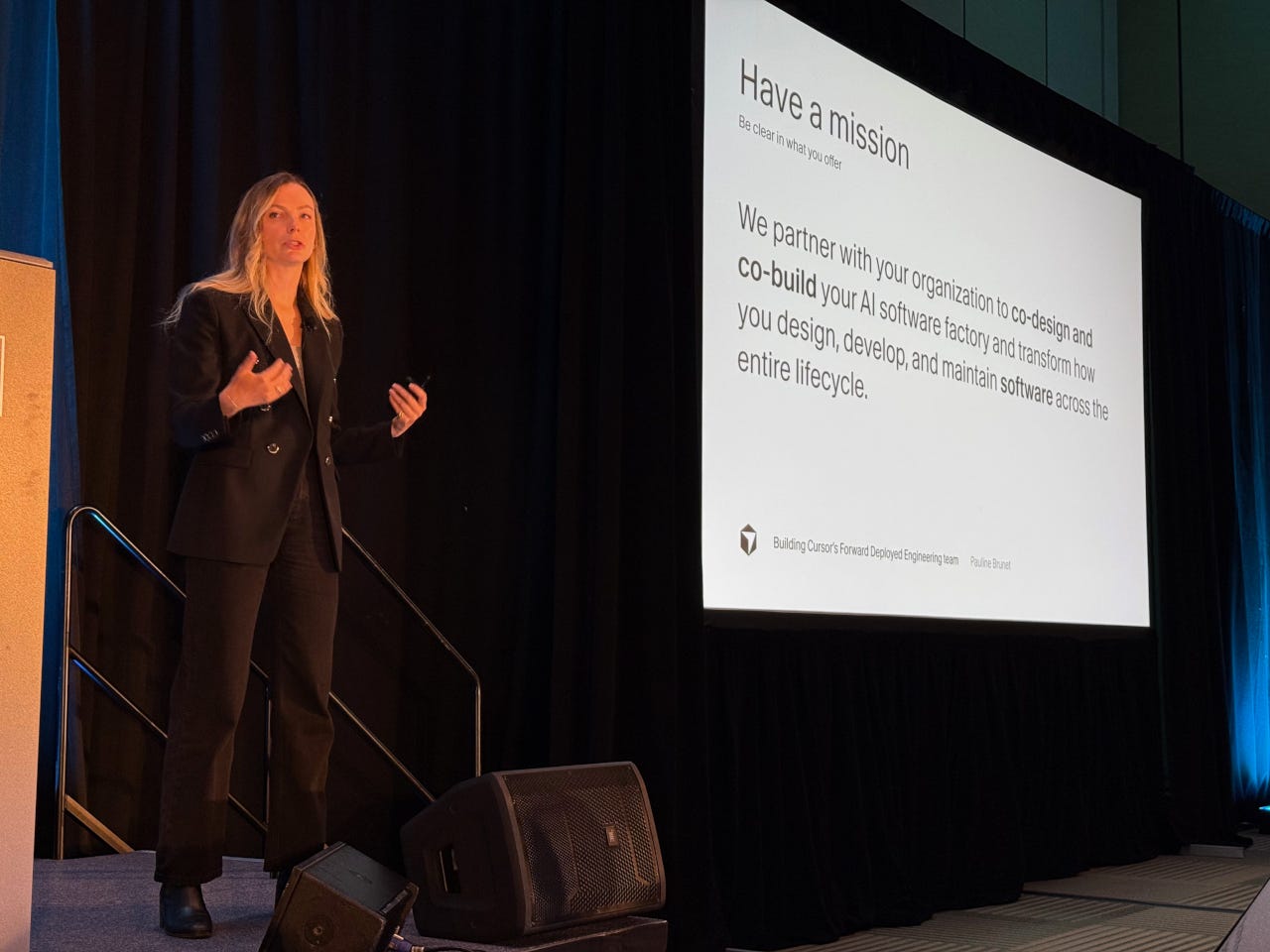
Cursor’s VP of Forward Deployed Engineering, Pauline Brunet, also ran a session today at AIEWF, in which she positioned FDE as part of the shift to software factories. “We partner with your organization to co-design and co-build your AI software factory,” she said. “We transform how you design, develop, and maintain software across your entire life cycle.”
(More insights from Brunet coming in an upcoming Q&A.)

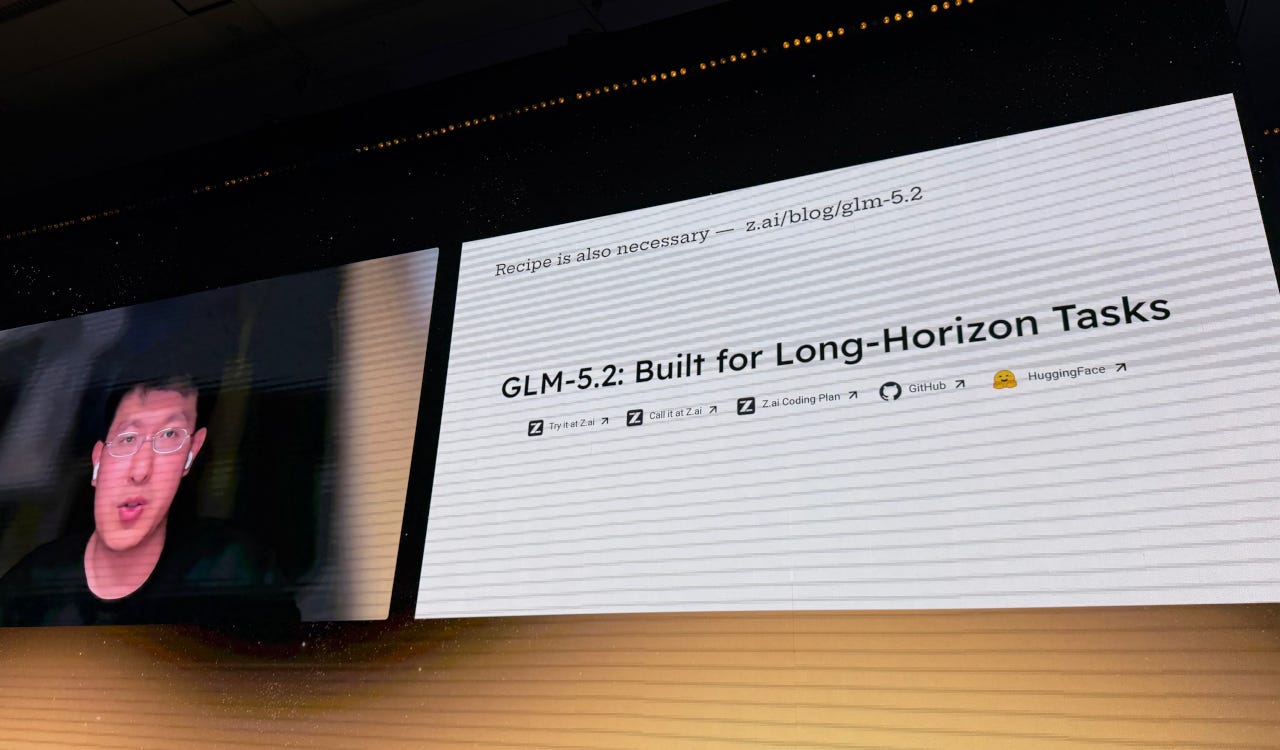
Another key theme from AIEWF today was the rise of open source AI. Zixuan Li, the head of intriguing new Chinese company Z.ai, was due to make an appearance at the conference. Because of travel issues, he couldn’t make it in person. He did make a virtual presentation, though, focusing on the company’s groundbreaking open LLM, GLM-5.2 — its “flagship model for long-horizon tasks.”

He also introduced ZCode, a harness that “supports all frontier models.” Li compared it specifically to OpenAI’s Codex.
HuggingFace’s Thomas Wolf then interviewed Olive Song from Chinese company MiniMax, which recently released its latest open-weight model, M3.

Open source AI is a big reason why local AI is becoming more popular. Ahmad Osman is the founder of Osmantic, a company building open source software for deploying and operating local AI systems. He spoke to us today and noted that open models have improved dramatically in recent times.

“Architectures are becoming more efficient, and many small improvements compound,” he said. “Once a frontier lab demonstrates that a capability is possible, the open source ecosystem can work backwards from that and find ways to reproduce it more efficiently.”

Those were the big trends from day 2 of the AI Engineer World’s Fair. I’ll be back tomorrow with all the action and analysis from day 3. Don’t forget to tune into the keynotes on YouTube if you’re following from work or home.