


I have been on the Norseman start ferry more times than I can count. The boat leaves the pier at Eidfjord around four in the morning. It is dark. It is cold. 250 athletes in wetsuits shuffle around the car deck, trying to stay calm. And at some point, before they jump four meters down into the fjord, we spray them with cold water.
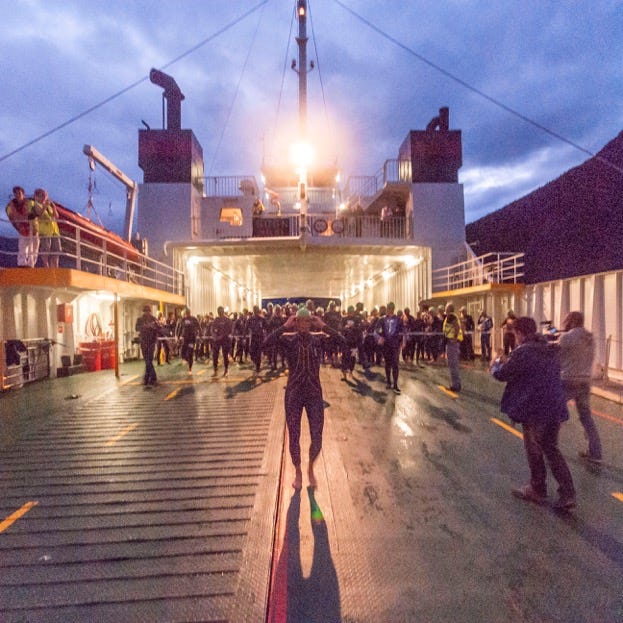
A lot of people think this is theatre. Some kind of wake-up ritual. It is not. We do it because the first sixty seconds in cold water is the most dangerous minute of the whole race. The spray is one of the best ways I know to make that minute less dangerous.
When people ask me what kills in cold water, they expect me to say hypothermia. But hypothermia is slow. The real killer is much faster, and it usually strikes before you have even started swimming. Let me try to explain why, and what you can do about it.
The moment cold water hits bare skin, your body panics. The nerves in your skin fire a huge alarm signal to the brain and the heart. You gasp. You hyperventilate. Your heart rate jumps. Your blood pressure climbs. All of this in a few seconds.
Michael Tipton described this sequence in 1989, and it has not really changed since. The first gasp alone is two to three liters of air, pulled in uncontrollably in the first second after you hit the water. If your face happens to be under water at that moment, you do not breathe in air. You breathe in water. This is how strong pool swimmers drown ten meters from a boat.
At the same time, the opposite reflex is triggered. Cold water on the face, together with holding your breath, sets off what is called the diving response. Your heart slows down. The blood vessels in your arms and legs squeeze shut. This is a very old reflex. Every mammal that dives under water has it, from seals to humans.
On its own, the diving response is harmless. On its own, the cold shock response is unpleasant but survivable. The problem is when they happen at the same time.
In 2012, Mike Shattock and Mike Tipton gave this problem a name: autonomic conflict. Here is what happens. The cold shock response is telling the heart to speed up, now. The diving response is telling the heart to slow down, now. Both signals are maximum. Both arrive at the same time.
The heart does not know what to do. In this confused moment, it can skip. It can flutter. In the worst case, it can drop into a dangerous rhythm called ventricular fibrillation. And this can happen in a heart that is perfectly healthy. That is the part that is hard to accept. The victim is not always the one with a weak heart.
The risk goes up if you have a known heart condition, if you are older, if you have had a drink, or if you jump in face-first while holding your breath. That last combination is the worst one I know of.
Most cold-water deaths happen in the first three minutes. Not in the middle of the fjord. Not halfway across the channel. The first three minutes. The body cools slowly. The nervous system does not. This is why harbours, piers, and ferry decks are over-represented in the fatality statistics, and not the open water.
The dangerous place is the edge.
The good news is that this whole cascade can be blunted, and the evidence on how is actually quite clear.
Do not jump. Walk in. Splash your face and the back of your neck first. Let your skin feel the cold for 30 to 60 seconds before you put your head under. The gasp will be much smaller.
Habituate. Five or six short cold-water dips over a couple of weeks will cut the cold shock response roughly in half, and the effect lasts for months. This is probably the single most underused safety intervention in open-water swimming.
Dress for the water, not the air. A wetsuit, a neoprene cap, and maybe booties are not only about staying warm during the swim. They cover the skin where the cold shock response begins. Less exposed skin means a smaller alarm signal.
Never swim alone, and keep safety boats in range. Most cold-water cardiac events are survivable if someone can reach you in the first minute.
Know your heart. If you have a known heart condition, think twice before starting. Think three times if you are over 40. I have written this in every Norseman race brief for years, and I will keep writing it.
Back to the ferry in Eidfjord.
The Norseman start is, on paper, nearly the worst possible cold-water entry. Dark. Cold. A four-meter jump. 250 people going at once. Adrenaline up to the ceiling. If I was trying to design a scenario to trigger autonomic conflict, I could not do much better.
So we spray the athletes on deck first.
Standing on the car deck in a wetsuit, the athlete feels the cold hit face and neck. The cold shock response starts. The gasp comes. The breathing gets quick. The heart rate jumps. And then, within twenty or forty seconds, it all settles. The nervous system has been told: cold is coming. The next exposure, about a minute later when they actually hit the fjord, is much smaller. The gasp is smaller. The breathing recovers faster. The collision between the two reflexes is less violent.
That is the physiology. But there is a psychological part as well, and I think it matters just as much.
The spray on deck tells the athlete: this feeling is expected. It is short. It is not an emergency. Panic is what turns a cold-water gasp into a drowning. Taking away the surprise takes away most of the panic.
We have been doing this for years now, and I still think it is one of the most important minutes in the whole race.
Cold water is not dangerous because it is cold. It is dangerous because of what your nervous system does in the first minute of contact. Respect that minute. Prepare for it. Do not treat it as the easy part of the swim.
If you do that, cold water stops being a killer. It becomes one of the best training tools we have.
Do not jump in. Walk in. And if you really have to jump, from a ferry, at five in the morning, into a Norwegian fjord — let somebody spray you first.
I have actually written a book about this - and Cold Water Swimming in general.
I wrote it because I think everyone deserves calm, trustworthy guidance before they get in cold water. The cold is worth experiencing. But it deserves your respect.
Get it here: Cold Water Swimming — A Mini Book
• Tipton MJ. The initial responses to cold-water immersion in man. Clinical Science 1989; 77: 581–588.
• Shattock MJ, Tipton MJ. ‘Autonomic conflict’: a different way to die during cold water immersion? Journal of Physiology 2012; 590(14): 3219–3230.
• Tipton MJ, Collier N, Massey H, Corbett J, Harper M. Cold water immersion: kill or cure? Experimental Physiology 2017; 102(11): 1335–1355.
• Work from our Norseman research group on cold-water swimming, body temperature regulation, and wetsuit use in triathletes.
This blog post represents my personal views and does not necessarily reflect the opinions of my employer or any organizations. I have no affiliations with any companies relevant to this.
I’d love for you to join my Substack blog!
If you find this interesting and want to support my work, consider selecting the monthly paid option.