








I've received the title riddle from furio and I found it interesting enough to pass it during the next few days to everyone that might be even remotely interested in C/C++ problems. The interesting thing here is the Undefined Behavior (UB), well... actually two UBs, thanks to which there are three possible correct answers: 11, 12 and 13.
Let's start with theoretical considerations on the possible answers and then get to empirical results (initially gathered by nism0, but later extended by readers from the Polish side of the mirror).
OK... so, which places are UB/unknown/compiler-dependent?
First UB
First, we don't know which a will get fetched first (by fetching I mean copying the value from memory to some internal register). There are two possibilities here:
Possibility 1. The first a will get fetched first, then the pre-increment will take place, and then the second a will be fetched (I'll skip the post-incrementation problem for now): Step 1. Fetch first a. Step 2. Pre-increment a. Step 3. Fetch second a. Step 4. Calculate the addition. Step 1. Pre-increment a. Step 2 i 3. Fetching both a. Step 4. Calculate the addition.a = a + ++a;
a = 5 + ++a; (a==5)
a = 5 + a; (a==6)
a = 5 + 6; (a==6)
a = 11;
Possibility 2. The pre-increment will take place first and the result will be stored in memory, and then the fetching of a will take place.a = a + ++a;
a = a + a; (a==6)
a = 6 + 6; (a==6)
a = 12;
So, even with skipping the post-incrementation we get two different possibilities (11 and 12).
Second UB
The second UB is related to the post-incrementation and the potentially trivial line a = a++. As it occurs, there are also two possibilities here (I'll demonstrate them using int a = 5; a = a++; as an example).
Terminology:
a_mem - a still in memory (e.g. as a local variable somewhere on the stack)
a_copy - a previously fetched copy of a in some internal register
Possibility 1. Post-increment goes Missing In Action: Step 1. Fetching a. Step 2. Post-increment on the variable (in memory). Step 3. "Set" gets executed - a_copy is moved to a_mem.Initial setup: (a_mem == 5, a_copy == n/a)
a = 5++; (a_mem == 5, a_copy == 5)
a = 5; (a_mem == 6, a_copy == 5)
(a_mem == 5, a_copy == n/a)
In the above case the result of post-incrementation went MIA - it got written to the memory but it was soon overwritten by another (not incremented) value. (Actually I've always thought that post-increment is always done after all operations finish so personally I would treat this behavior as a compiler bug.)
Possibility 2. Post-incrementation is deferred to the very end. Step 1. Fetching a. Step 2. "Set" gets executed - a_copy is moved to a_mem. Step 3. Post-increment on the variable (in memory).Initial setup: (a_mem == 5, a_copy == n/a)
a = 5++; (a_mem == 5, a_copy == 5)
(a_mem == 5, a_copy == n/a)
a++ (a_mem == 6, a_copy == n/a)
So, the post-increment is executed at the very end of the calculations and it does not get overwritten.
Summary of UBs
To sum up the two previously described UBs for the a = a++ + ++a equation we get:
Possibilities 1 i 1: 5+6 and the post-increment goes MIA, result: 11
Possibilities 2 i 1: 6+6 and the post-increment goes MIA, result: 12
Possibilities 1 i 2: 5+6 and the post-increment is deferred, result: 12
Possibilities 2 i 2: 6+6 and the post-increment is deferred, result: 13
Experimental results
Now for the empirical results (thx to nism0 for the initial tests and the initial table, and to nonek and qyon for spotting certain typos):
| Code 1 | Code 2 | Code 3 | Code 4 | Code 5 | Code 6 |
|---|---|---|---|---|---|
| int a = 5; a = a++ + a++; | int a = 5; a = a++ + ++a | int a = 5; a = ++a + a++; | int a = 5; a = ++a + ++a; | int a = 5; a = a++; | int a = 5; a = a + ++a; |
| Compiler/Lang | Ver. | Result 1 | Result 2 | Result 3 | Result 4 | Result 5 | Result 6 |
|---|---|---|---|---|---|---|---|
| gcc | 2.95 | 12 | 13 | 14 | 13 | 6 | 12 |
| gcc | 4.1 | 12 | 13 | 14 | 13 | 6 | 12 |
| gcc | 4.2 | 12 | 13 | 14 | 13 | 6 | 12 |
| gcc | 4.2.1 Apple | 12 | 13 | 14 | 13 | 6 | 12 |
| gcc | 4.3 | 12 | 13 | 14 | 13 | 6 | 12 |
| gcc | 4.3.3 | 12 | 13 | 13 | 14 | 6 | 12 |
| gcc | 4.4.4 | 12 | 13 | 13 | 14 | 6 | 12 |
| gcc | 4.6.0 (exp.) | 12 | 13 | 14 | 13 | 6 | 12 |
| gcc | 4.5.1 MinGW64 | 12 | 13 | 13 | 14 | 6 | 12 |
| tcc | 0.9.25 | ?? | ?? | ?? | ?? | 5 | 12 |
| bcc | 0.16.17 | ?? | ?? | ?? | ?? | 5 | 12 |
| Microsoft C/C++ | 16.00.30319.01 (80x86) | 12 | 13 | 13 | 14 | 6 | 12 |
| Embarcadero C++ | 6.31 for Win32 | 12 | 13 | 13 | 14 | 6 | 12 |
| Intel C++ | 12.0.1.127 | 12 | 13 | 13 | 13 | 6 | 12 |
| Keil C | 9.02 | 11 | 12 | 12 | 13 | 6 | 12 |
| SDCC | 3.0.1 #6092 | 11 | 12 | 13 | 14 | 5 | 12 |
| clang | 2.8 | 11 | 12 | 12 | 13 | 5 | 11 |
| clang | 1.6 Apple | 11 | 12 | 12 | 13 | 5 | 11 |
| PHP | 5.2.10 | 11 | 12 | 12 | 13 | 5 | 12 |
| java | 1.6.0_06 | 11 | 12 | 12 | 13 | 5 | 11 |
| javac | 1.4.2_12 | 11 | 12 | 12 | 13 | 5 | 11 |
| java | 1.6.0_21 | 11 | 12 | 12 | 13 | 5 | 11 |
| javac | 1.6.0_22 | 11 | 12 | 12 | 13 | 5 | 11 |
| C# | 2.0 | 11 | 12 | 12 | 13 | 5 | 11 |
| C# | 4.0 | 11 | 12 | 12 | 13 | 5 | 11 |
| C# | Mono 2.6.4 | 11 | 12 | 12 | 13 | 5 | 11 |
| Borland Turbo C++ for DOS | 2.01 | 12 | 13 | 13 | 14 | 6 | 12 |
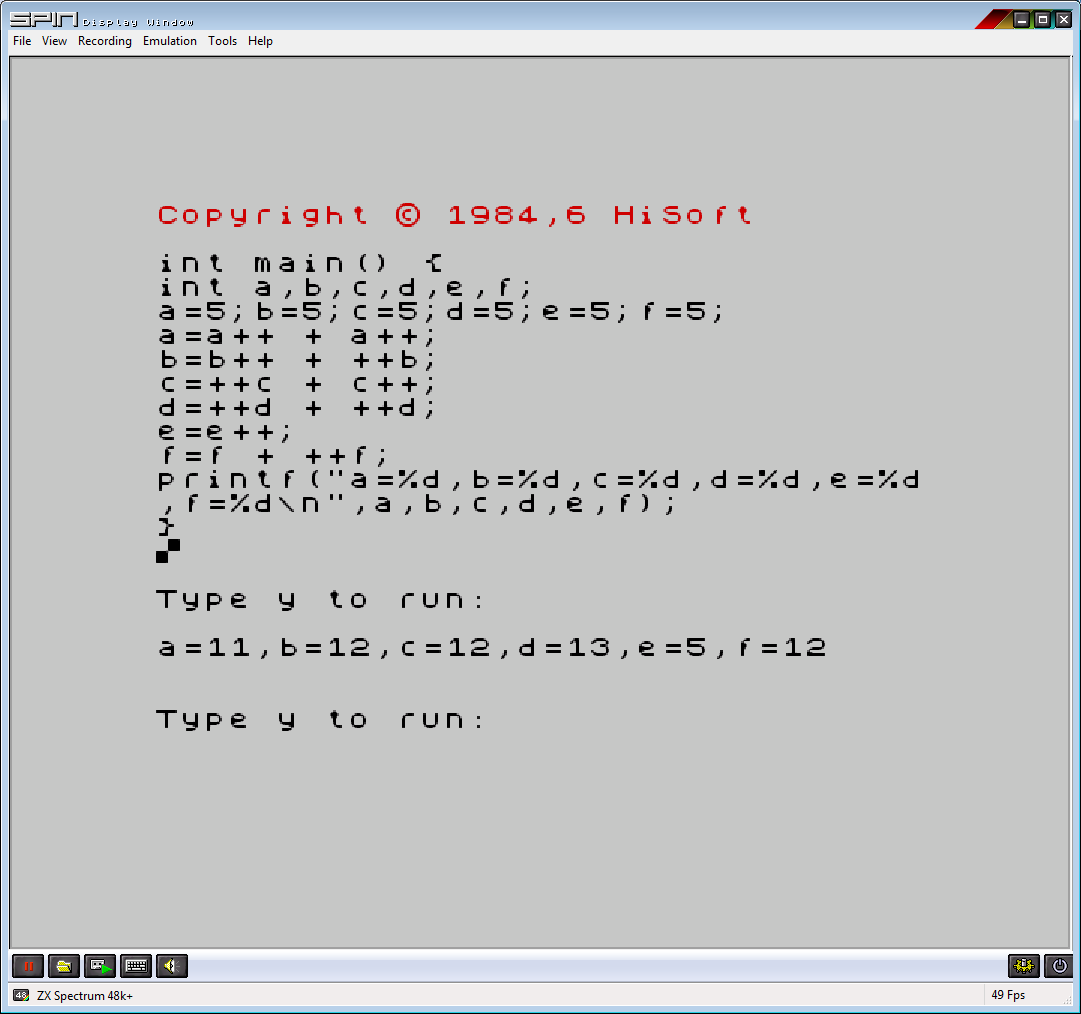
| HiSoft C for ZX Spectrum | 1.3 | 11 | 12 | 12 | 13 | 5 | 12 |
Thanks for additional results to: Icewall, Krzysztof Kotowicz (PHP 5.2.10), mlen (2x clang, 2x gcc), none'a (2x Java), Keraj (2x Java), MDobak (SDCC & Keil C), garbaty lamer (3x C#, Turbo C++, HiSoft C), Xgrzyb90 (gcc 4.4.4), no_name (gcc 4.3.3), dikamilo (mingw64 4.5.1)
Garbaty lamer has also posted (in the comments on the Polish side of the mirror) a really cool screenshot from the HiSoft C for ZX spectrum (click to zoom):
If you would like to test your compiler (posting back the results in the comments is really appreciated, especially from strange/uncommon compilers and other languages which support pre- / post- increments ;>) you can use the code (made by nism0) at the bottom of the post (see Appendix 3).
And that's that ;>
Appendix 1:
In the comments on the Polish side of the mirror Rolek has suggested to apply the same test to overloaded operators (see the comments on the Polish side for the code). Results (by Rolek from MSVC++ and me from g++):
| Code 1 | Code 2 | Code 3 | Code 4 | Code 5 | Code 6 |
|---|---|---|---|---|---|
| int a = 5; a = a++ + a++; | int a = 5; a = a++ + ++a | int a = 5; a = ++a + a++; | int a = 5; a = ++a + ++a; | int a = 5; a = a++; | int a = 5; a = a + ++a; |
| Compiler/Lang. | Ver. | Result 1 | Result 2 | Result 3 | Result 4 | Result 5 | Result 6 |
|---|---|---|---|---|---|---|---|
| Microsoft C/C/++ (w/o overloading) | 16.00.30319.01 | 12 | 13 | 13 | 14 | 6 | 12 |
| Microsoft C/C/++ (with overloading) | 16.00.30319.01 | 11 | 13 | 12 | 14 | 5 | 12 |
| g++ (w/o overloading) | 4.5.0 MinGW | 12 | 13 | 13 | 14 | 6 | 12 |
| g++ (with overloading) | 4.5.0 MinGW | 11 | 13 | 12 | 14 | 5 | 12 |
Also, krlm has posted a link to a good article about sequence points.
By the way...
If want to improve your binary file and protocol skills, check out the workshop I'll be running between April and June → Mastering Binary Files and Protocols: The Complete Journey
Appendix 2:
Garbaty lamer (again, on the Polish side of the mirror) has mentioned that in C# this riddle isn't actually a riddle - it's well defined behavior, see C# specification point §7.3:
Operands in an expression are evaluated from left to right. For example, in F(i) + G(i++) * H(i), method F is called using the old value of i, then method G is called with the old value of i, and, finally, method H is called with the new value of i. This is separate from and unrelated to operator precedence.
Appendix 3: int main(void) // test 1 // test 2 // test 3 // test 4 // test 5 // test 6 // done
Code for testing:#include <stdio.h>
{
int a = 5, b = 5, c = 5, d = 5, e = 5, f = 5;
a = a++ + a++;
printf("%i \n",a);
b = b++ + ++b;
printf("%i \n",b);
c = ++c + c++;
printf("%i \n",c);
d = ++d + ++d;
printf("%i \n",d);
e = e++;
printf("%i \n",e);
f = f + ++f;
printf("%i \n",f);
return 0;
}
Appendix 4:
A comment from Cem Paya:
--start--
Similar to C#, this is also not a riddle for Java because Java defines
evaluation to be strictly left-to-right.
See section 15.7 here for some examples with side-effects as in your case:
http://java.sun.com/docs/books/jls/second_edition/html/expressions.doc.html
In C++ where it is undefined, the result can also depend on the
optimization level used during compilation, which can change the
number of times a value is referenced. eg the compiler expects "a" to
not change its value during the evaluation and may optimize other
occurences to the same one it fetched.
==end==
此内容由惯性聚合(RSS阅读器)自动聚合整理,仅供阅读参考。 原文来自 — 版权归原作者所有。