


Spanish archaeologists exploring the bay that curves between the southern port of Algeciras and the Rock of Gibraltar have documented the wrecks of more than 30 ships that came to grief near the Pillars of Hercules between the fifth century BC and the second world war.
Over the millennia, the bay, which sits at the north end of the strait of Gibraltar that separates Europe from Africa, has swallowed everything from Phoenician and Roman vessels to British, Spanish, Venetian and Dutch ships – as well as the odd aeroplane.
A three-year project led by the University of Cádiz has now identified 151 archaeological sites in the bay, among them 134 shipwrecks. To date, the researchers and their colleagues from the University of Granada have worked to document 34 of those wrecks.
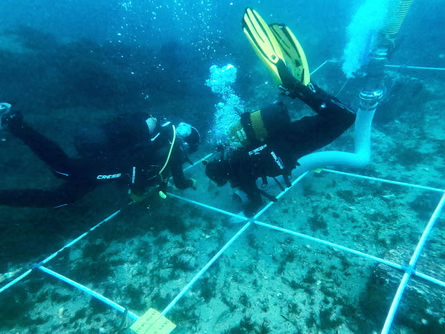
The oldest is that of a Punic era ship dating to the fifth century BC, while other finds include 23 Roman ships, two late Roman ships, four medieval ships and 24 vessels from the early modern period.
Between them, the sunken items – which include an agile and fearsome 18th-century Spanish gunboat and the engine and propeller of a plane from the 1930s – tell the story of war, trade, exploration and settlement in and around one of the most strategically important waterways in the world.
Felipe Cerezo Andreo, a professor of archaeology at the University of Cádiz who led the investigation, which is called Project Herakles, said that area has long been a watery crossroads.
“It’s one of those bottlenecks through which ships have always had to pass, whether on commercial shipping routes, voyages of discovery, or due to armed conflicts,” he said.
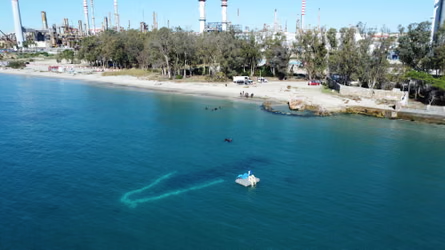
“There are really few places in the Mediterranean that have this kind of concentration and such a significant variety of archaeological remains, especially in terms of different cultures or different nations. We have Dutch, Venetian, Spanish, and of course English ships – ships of practically every nationality – because they all passed through the strait, whether heading out to the Atlantic for trade, or entering the Mediterranean from northern Europe or other regions.”
Cerezo said the researchers were particularly excited to have documented three medieval vessels that could shed light on seafaring during the late period of Islamic rule in southern Spain.
Although the team has come across large ships from the 16th and 17th centuries, one of the most exciting finds has been the wreck of the Puente Mayorga IV, a small, late 18th-century gunboat of a type used for rapid, stealthy attacks on British ships of the line around Gibraltar. The attack craft would often disguise themselves as fishing boats before flinging off their netting and firing their prow-mounted cannon at their enemies.
Despite being frequently mentioned in contemporary reports, such boats have been little studied by archaeologists.
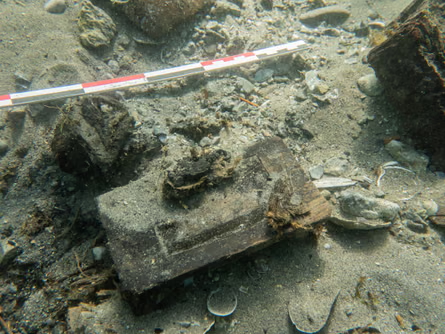
Cerezo himself was delighted to come across one of the Puente Mayorga IV’s less obvious treasures during an excavation. What he initially took to be a miraculously preserved book turned out to be a book-shaped wooden box with a hollow space inside.
“At first, we thought it could be used to hide documents, and we thought it might have something to do with espionage,” said the archeologist. “Was the officer who carried it mapping the position of an enemy vessel?” Sadly not. After careful examination, the box turned out to contain a pair of wooden combs, suggesting the officer may have been more preoccupied with grooming than spying.
Cerezo and his colleagues hope the Andalucían regional government and Spain’s culture ministry will act to preserve and protect the sites in the Bay of Algeciras – known to English-speakers as the Bay of Gibraltar – which are at risk from port development, dredging and dock construction. The climate emergency is already proving a threat, bringing both rising sea levels that are altering sediment layers and exposing archaeological sites, and an invasive algae that grows over rocks and wrecks alike.
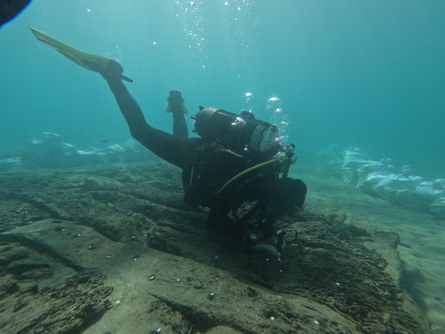
In order to share their finds and raise awareness of the importance of preserving them, the researchers have made virtual models and 360-degree videos of the sites, which they share with the public online and in local museums and town halls.
“We bring these goggles so that people who don’t dive can put them on and have a dryland diving experience,” said Cerezo. “Although people sometimes imagine they’re going to see a wrecked treasure ship like the Unicorn in Tintin, the sites tend not to be that well preserved. The state of them can sometimes be a bit disappointing, but it’s important that people know what’s going on. And showing this to people creates a demand for the protection of these sites.”
The waters of the bay offer an unparalleled microcosm of thousands of years of maritime and cultural development, said Cerezo.
“What we have here is a very small space that allows us to analyse the evolution of maritime history throughout practically the whole of the Iberian peninsula and north Africa.
“It tells us a story that we sometimes forget, which is that maritime societies, or peoples who have lived in coastal areas, have had a very intense relationship with the sea and have lived on the sea. And being able to study these kinds of archaeological remains – to document them, to learn about them in situ and not just through the objects that sometimes end up in a museum, but to understand them in their context – allows us to carry out that process of reconstruction and to tell the story of these people.”