


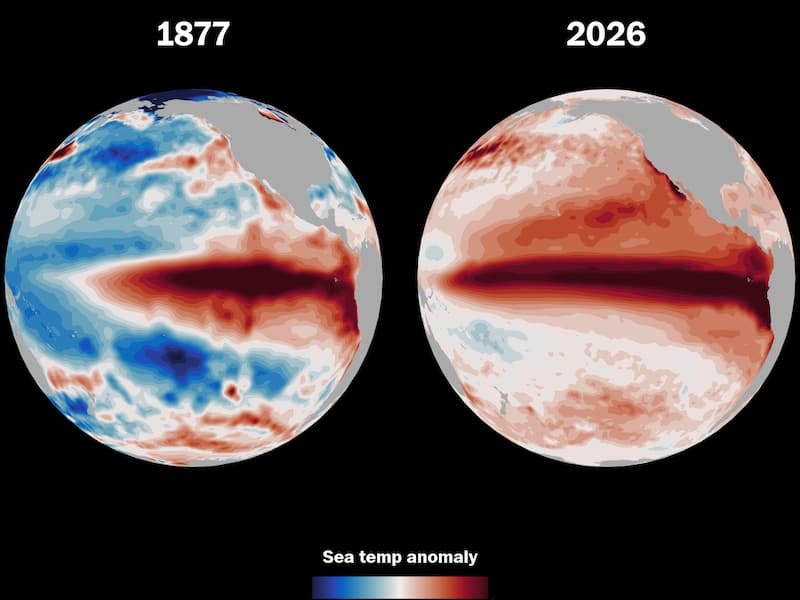
Look at the left image. That's 1877. The darkest red represents ocean temperatures so far above average that the resulting famine killed 3-4% of the entire global population.
The right image is May 2026.
This is not a drill.
NOAA has now placed the probability of a Super El Niño forming by winter at over 95%. Climate models show central Pacific temperatures potentially exceeding 3°C above average, a level not seen since that 1877 event. The ECMWF's May update has moved to 100% probability of a super El Niño forming by November.
What the last major events actually cost:
The 1982-83 El Niño: $4.1 trillion in global economic losses, measured over five years. Catastrophic floods across South America. Devastating droughts across Africa and Asia.
The 1997-98 El Niño: $5.7 trillion in global income losses. 16% of the world's coral reefs died. Air temperature spiked 1.5°C above normal. El Niño-fueled wildfires contributed to thousands of premature deaths from air pollution.
The 2015-16 El Niño: 100,000 deaths linked to fires and air pollution alone, according to Harvard researchers. $3.9 trillion in economic damage.
Now add climate change on top.
The planet is already at record temperatures. The last decade was the hottest on record. El Niño doesn't cause global warming, but it releases stored ocean heat into the atmosphere, sending global temperatures even higher. Scientists warn this event could push global average temperatures past 1.7°C above pre-industrial levels, potentially shattering the Paris Agreement targets in real time.
This isn't about weather. It's about food security, infrastructure, human lives, and an economic shock arriving at a moment when the world is already stretched thin.
We need to prepare. And not just locally.
A Super El Niño doesn't respect borders. The crop failures happen in one hemisphere, the food price spikes happen everywhere. The floods destroy infrastructure in Southeast Asia, the supply chain disruptions hit Europe and North America months later. The droughts in Africa drive migration that reshapes political systems worldwide.
Preparation means early warning systems, international food reserves, coordinated disaster response, and governments that actually take climate forecasts seriously before the disaster, not after. The 1877 event killed tens of millions partly because no one saw it coming and no one was coordinating a response. We have the science now. The question is whether we have the political will.
Sources:
NOAA CPC ENSO Forecast: https://www.cpc.ncep.noaa.gov/products/analysis_monitoring/enso_advisory/
NASA Earth Observatory: https://science.nasa.gov/earth/explore/el-nino/
Science Journal (Callahan/Mankin 2023): https://www.science.org/doi/10.1126/science.adf2983
Nature Climate Change (life expectancy losses): https://www.nature.com/articles/s41558-025-02534-4
Washington Post (1877 event): https://www.washingtonpost.com/weather/2026/05/12/super-el-nino-1877-population-impacts/
Live Science (Super El Niño 2026): https://www.livescience.com/planet-earth/weather/the-biggest-el-nino-event-since-the-1870s-super-el-nino-is-now-the-most-likely-scenario-by-the-end-of-this-year-and-the-humanitarian-cost-could-be-huge