惯性聚合 高效追踪和阅读你感兴趣的博客、新闻、科技资讯
阅读原文 在惯性聚合中打开

推荐订阅源

cs.AI updates on arXiv.org
WordPress大学
WordPress大学
宝玉的分享
宝玉的分享
人人都是产品经理
人人都是产品经理
博客园 - 聂微东
IT之家
IT之家
V
V2EX
Jina AI
Jina AI
V
Visual Studio Blog
有赞技术团队
有赞技术团队
博客园 - 司徒正美
博客园 - 叶小钗
The Cloudflare Blog
cs.CV updates on arXiv.org
小众软件
小众软件
奇客Solidot–传递最新科技情报
奇客Solidot–传递最新科技情报
博客园 - 三生石上(FineUI控件)
OSCHINA 社区最新新闻
OSCHINA 社区最新新闻
Google DeepMind News
钛媒体:引领未来商业与生活新知
钛媒体:引领未来商业与生活新知
腾讯CDC
Google Online Security Blog
博客园 - 【当耐特】
Apple Machine Learning Research
K
KPMG report finds enterprise disconnect between AI and its ROI | CIO
N
News and Events Feed by Topic
N
News and Events Feed by Topic
The Last Watchdog
The Last Watchdog
W
WeLiveSecurity
月光博客
月光博客
Security Archives - TechRepublic
Webroot Blog
Webroot Blog
SecWiki News
SecWiki News
博客园_首页
罗磊的独立博客
量子位
Latest news
Latest news
I
Intezer
V
Vulnerabilities – Threatpost
A
Arctic Wolf
Last Week in AI
Last Week in AI
Recent Commits to openclaw:main
S
SegmentFault 最新的问题
S
Security Affairs
阮一峰的网络日志
阮一峰的网络日志
让小产品的独立变现更简单 - ezindie.com
酷 壳 – CoolShell
酷 壳 – CoolShell
P
Palo Alto Networks Blog
C
CXSECURITY Database RSS Feed - CXSecurity.com
N
News | PayPal Newsroom

Salesforce

Scale Your MRR: Subscription Management For Small Business Streamlining Commerce Media Ad Inventory Management 12 AI Sales Strategies for Startups That Actually Work Sell Smarter: Ecommerce Metrics To Track For Your Small Business Shop Apply the Orchestration Density Framework to Your Next Automation Decision Wait, Black Friday Planning In Spring? It’s Time to Start Holiday Promotions AI-First Operations, One Process at a Time How BCU Is Transforming Banking Service with Agentforce Salesforce Headless 360: What the Agent Consumer Means for Your Integration Architecture Meet Customers Where They Are: Agentforce Contact Center Now Offers WhatsApp Voice 11 Free Lead Generation Tips for Small and Growing Businesses SFR-VibeTrain: The Agent That Trains Agents Why Technical Accuracy is the Wrong Metric for Agent Success Strengthening Salesforce Security Against AI-Driven Threats Join Us in the Community Hub at Connections 2026 The Best Way To Build AI Agents That Customers Trust 5 Ways AI is Changing the Communication Game For Startups Trust in the Era of Agents: Highlights from the 2nd Annual Trusted AI Impact Report You Can Be an Agentic Enterprise No Matter What Size Business How to Make Your Email Marketing Accessible for Everyone What is Headless? Don’t Lose Your Head, SMBs: It’s a Good Thing Architect the Future UI: Slack as Your Agentic Surface Point of Sale Innovations to Modernize the Shopper Experience Governing the Agentic Enterprise at Scale with MuleSoft Omni Gateway How to Cut Service Time with Case Routing Automation 5 Tips for Marketers to Get Started with Salesforce Flow No One is Vibe Coding Trade Promotion Management 7th Edition State of Sales Report: 3 Growth Trends for Startups and SMBs How the Architect Vista Brought Architectural Thinking to Life at TDX 2026 5 Steps to Develop an Architect Mindset With AI Why AI Isn’t Replacing Developers, It’s Empowering Them 10 Ways to Make Your AI Agent a Better Communicator AI in Design 2025: What Real Use Taught Us. How Salesforce Personalization Learns Which Offers Drive Revenue The 4-Step Guide to Salesforce Agent and Application Development Get Ready for Connections 2026: Top Sessions and New Reveals 8 Ways AI Agents Are Evolving in 2026 4 Principles to Make the Right Salesforce UI Decisions Apprentice Journey Shines a Light on Talent Pathways at Salesforce Agent Script: The Control Plane for Agentic Decisions Scaling the Agentforce Life Sciences Ecosystem to Drive the Future of Pharma and MedTech Unlocking Unstructured Data: Building AI-Powered Support Triage with Data 360 Asking For a Friend: What Are Rich Communication Services (RCS)? 5 Slack Shortcuts For Small Teams 195% ROI In Field Service? Here’s How They Did It Submit Your Architect Session: The Dreamforce 2026 Call for Participation Is Open What Is an AI Assistant for Small Business? B2C Commerce April release: Transforming the B2C developer experience with agents Meet Your 24/7 Prospecting Partner — And 5 More Stand-Out Features In Our April Release 11+ Small Business YouTube Channels You Need to Follow Today Stop Treating Disputes Management Like IT Tickets Limitless Service: A New Operating Model for Growth in the Agentic Era What is Transactional Reconciliation in Email and SMS Marketing? How to Prepare for National Small Business Week (2026) How to Design a High-Scale Multi-Cloud Incident Journey 10 Ways An AI CRM Can Amplify Your Startup Vibe Code Better Agents with Agentforce Free vs. Paid CRM: Which is Right for Your Business? Salesforce Customer Success Awards 2026: Lead Era of the Agentic Enterprise 12 Free Webinars for Small Business Owners (2026) The Agentforce Life Sciences Consultant Certification Maximize Growth: The Power of Partnerships for SMBs Salesforce AI Research at ICLR 2026 Data Protection For Small Business: How To Safeguard Yourself Beyond 100K Tokens: Evaluating AI Agents in Long-Context Software Engineering Top 32 Small Business Tools To Try Today 6 New Innovations Redefining Salesforce Development How to Win the Battle for Attention in the Agentic Email Inbox Mastering the Eisenhower Matrix: Prioritize Like a Pro 10 Signs It’s Time To Upgrade Your CRM and How To Get Started (2026) Celebrating 10 Years of Financial Services Innovation How SMBs Can Gain An Edge With Agentic AI: Key Trends From Our Marketing Report How MAN Truck & Bus is Shaping the Future of Sales with Salesfive Introducing the Future of Salesforce Data Protection: Backup & Recover Next Stop Making AI Slop – Build a Foundation for Authentic AI Content 5 Tips to Help Marketers Navigate AI Email Summaries Data Sharing: Is it Safe? Is it Secure? Everything You Need to Know Small Business Week Readiness: 4 Things to Do Before May (2026) How Salesforce Employees Make an Impact During Earth Month AI Agents Are Advancing Rapidly… Is Your Testing Strategy Keeping Up? What Is Microproductivity and Why Is It Helping So Many Teams? TDX 2026 Roundup: Agentforce Edition 3 Ways Salesforce Connections Has Boosted My Career AI Agents Don’t Just Answer‌ — ‌They Act. Do You Have a Governance Strategy? The Future of MedTech Field Execution is Agentic 5 Steps to Prepare Your Data For an AI CRM From Break/Fix to Profit Engine: Aftermarket Service for Robot OEMs Building Trusted Human-Agent Collaboration: A Practical Framework ISV Strategy for the Salesforce Summer ’26 Release 5 Email Marketing Tips for Small Business Commerce Shops Should You Give Your AI Agent a Human Name? Creating Pathways into AI for People with Disabilities The Organized Chaos of Upfronts: 3 Hurdles Impacting Your Yield Trying to Scale Beyond ‘One-Off’ AI Tasks? You’re Probably Using the Wrong Interface What is Cost Per Lead (CPL)? The Case for Unified CCaaS and CRM — And Why the Data Makes It Clear In the New Era of AI, You Need to Win Over Both Humans and Agents What Is SPIN Selling? A Way to Build Trust With Your Customers G2 Crowns Salesforce as Best Financial Services Software Hidden Insights: The Guide to Tableau For Small Business Owners
How SharkNinja Turned Product Unboxing Into a Guided AI Conversation
Derek Cordon · 2026-05-19 · via Salesforce

We’ve all been there: A brand-new gadget arrives at our door, we pull out the product, and immediately wish an expert could just tell us what to do first. The instruction manual is dense, the diagrams are confusing, and ten minutes later we’re watching a random YouTube video hoping it’s the right model.

SharkNinja decided that moment deserved better. They built an Agentforce agent specifically for unboxing — a QR-code-triggered, mobile-first experience that meets customers the moment they open the box and walks them through setup in a real conversation. No PDFs. No phone trees. Just a scan, a greeting, and step-by-step guidance tailored to the exact product in front of them.

SharkNinja launches roughly 25 new products a year. Their Agentforce deployment spans multiple use cases and countries. The unboxing agent is the latest addition — and it’s already changing how customers experience their first interaction with a new product.

Here’s how they built it, what they learned, and what your team can borrow.

How the unboxing agent works

Since the unboxing agent launched on a pair of premium espresso machines, imagine one has just arrived on your doorstep. Your experience starts with a QR code printed on the product packaging. You scan it on your phone, land in a mobile agent experience, and get a customized welcome message for your specific machine. From there, the agent delivers step-by-step setup instructions in a highly visual, interactive format — guiding you through everything from assembly to brewing your first drink. It answers follow-up questions in context and surfaces relevant videos when a visual would help.
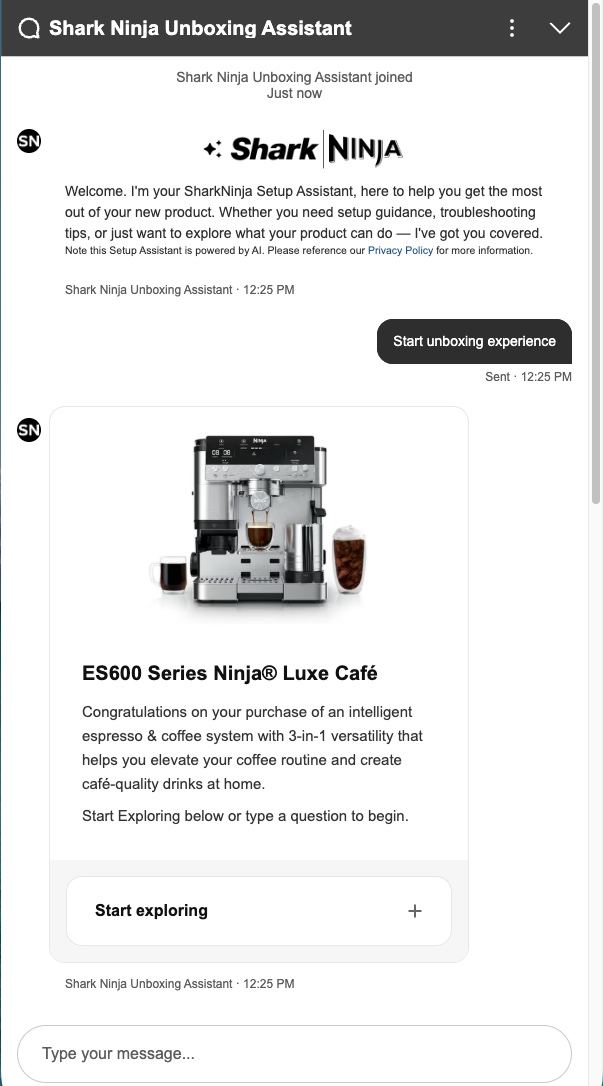
Mobile phone screen showing the SharkNinja Unboxing Assistant welcome message, which introduces itself as a setup assistant and autolaunches after a "Start unboxing experience" utterance.
A customer scans the QR code on the box and lands in a guided setup conversation with SharkNinja’s unboxing agent.

Say you ask an off-script question mid-setup: “What’s the difference between espresso strength options?” The agent pulls from the ingested product documentation to answer in real time, then picks up right where you left off in the guided flow.

Carolin Duerkop, Technology Transformation Partner at SharkNinja, describes the experience. “The QR code on the box is the new instruction manual,” Duerkop said. “Scan it, and you’re in a conversation with someone who knows exactly which product you have and what you’re trying to do. We think every physical product company should be doing this.” 

Making product manuals AI-ready

Getting product documentation into a format the agent can actually use was one of the hardest problems the team solved. SharkNinja’s manuals are dense, image-heavy PDFs — never designed for AI consumption.

The team’s solution: Let AI do the first pass. For Stan Konopka, VP of Digital Technology at SharkNinja, the approach was pragmatic. “In some cases we use AI to optimize it, funny enough,” he said. 

AI reads the product PDF and generates draft setup steps; a content author reviews, refines the instructions, and adds images before publishing. They prioritized premium SKUs first and used that process as a repeatable template for onboarding new products.


The team is also evolving beyond PDFs as the source of truth, building toward a workflow where structured content is authored directly for the agent from the start. 

What powers it: Knowledge articles

Konopka summed up the foundational lesson in SharkNinja’s Behind the Build interview: “The technology’s there, but it’s only as good as the data and the knowledge and the product catalogue.”

The unboxing agent’s architecture is deliberately simple. Both of its data sources live within Data 360: knowledge articles and the Agentforce Data Library containing the original Quick Start Guides and Owner’s Guides as PDFs. An Apex retriever queries them and feeds the results to the agent. Structured content and source documents go in, guided conversation goes out. That simplicity is what allowed the team to build the agent quickly and scale it to new products without waiting on complex data integrations. Each new SKU just needs its knowledge articles created, and the agent can serve it.

The unboxing agent’s logic is defined in Agent Script — a code-based representation of subagents, actions, and routing logic. SharkNinja’s team used AI-assisted tooling to translate their existing agent configuration into Script, making it accessible to team members who aren’t traditional developers. That means non-technical users can shape agent behavior in a builder that feels more like editing a document than writing software.  
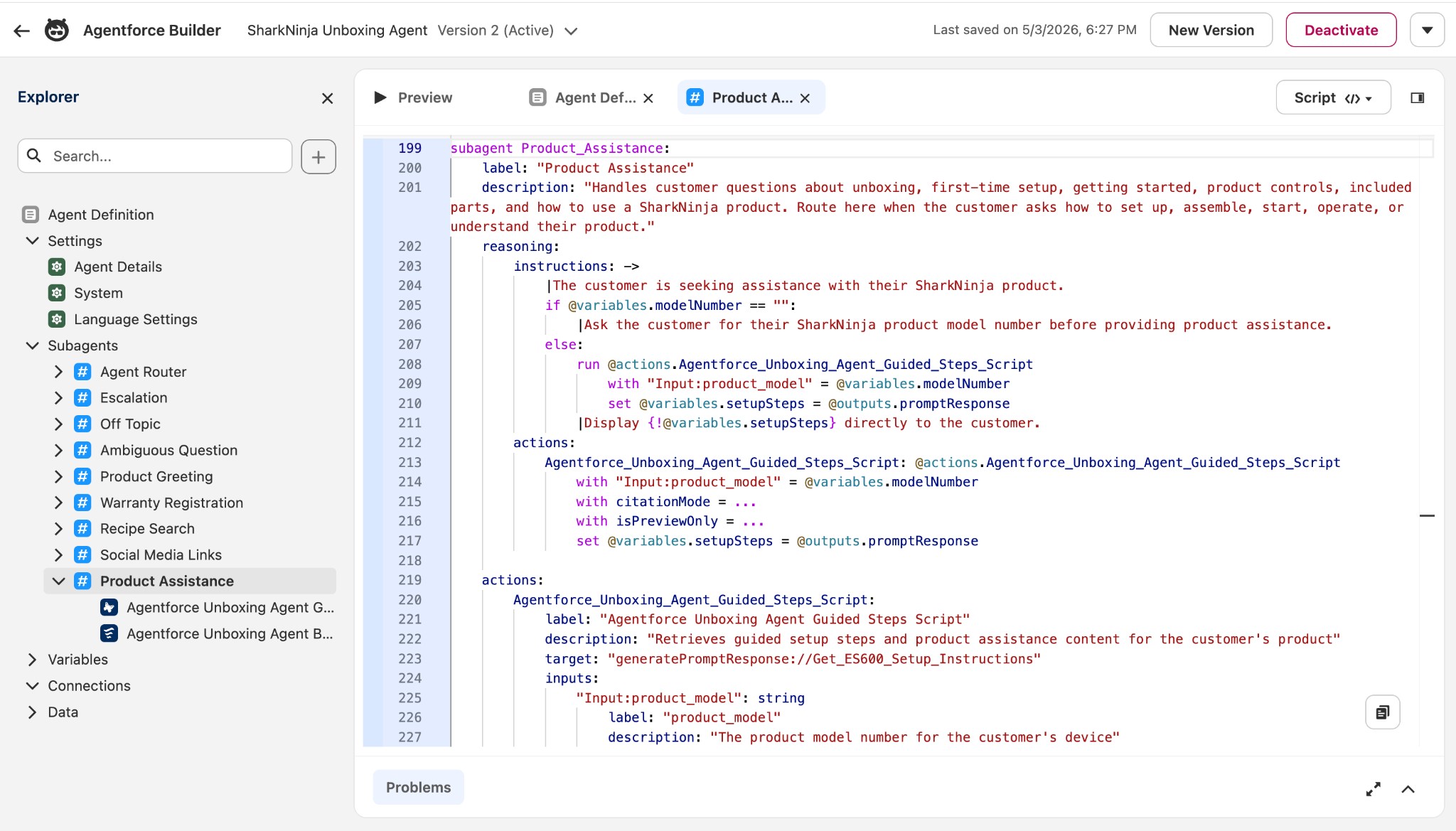
Agentforce Builder interface showing the Script code view for the Product Assistance subagent. The code includes a reasoning block with conditional logic (checking the model number variable), an action call to retrieve guided setup steps, and instructions to display the results directly to the customer.
The unboxing agent’s Product Assistance logic, shown in Agentforce Script, a code-based view that defines how the agent routes questions, retrieves setup steps, and responds to customers.

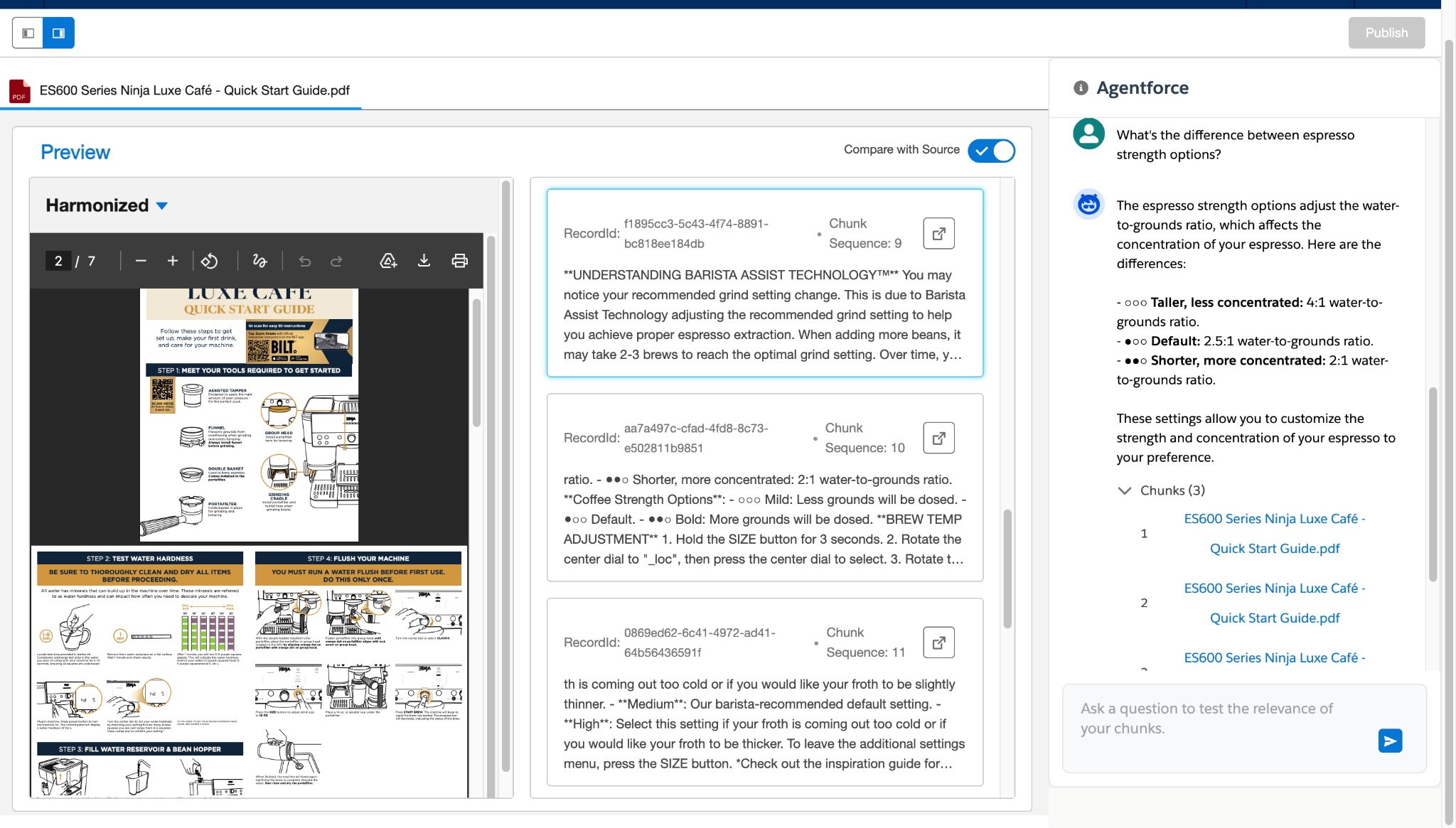
The team also uses Intelligent Context to ingest unstructured product documentation — Quick Start Guides, Owner’s Guides, FAQs — and make it available to the agent as chunked, searchable content. 
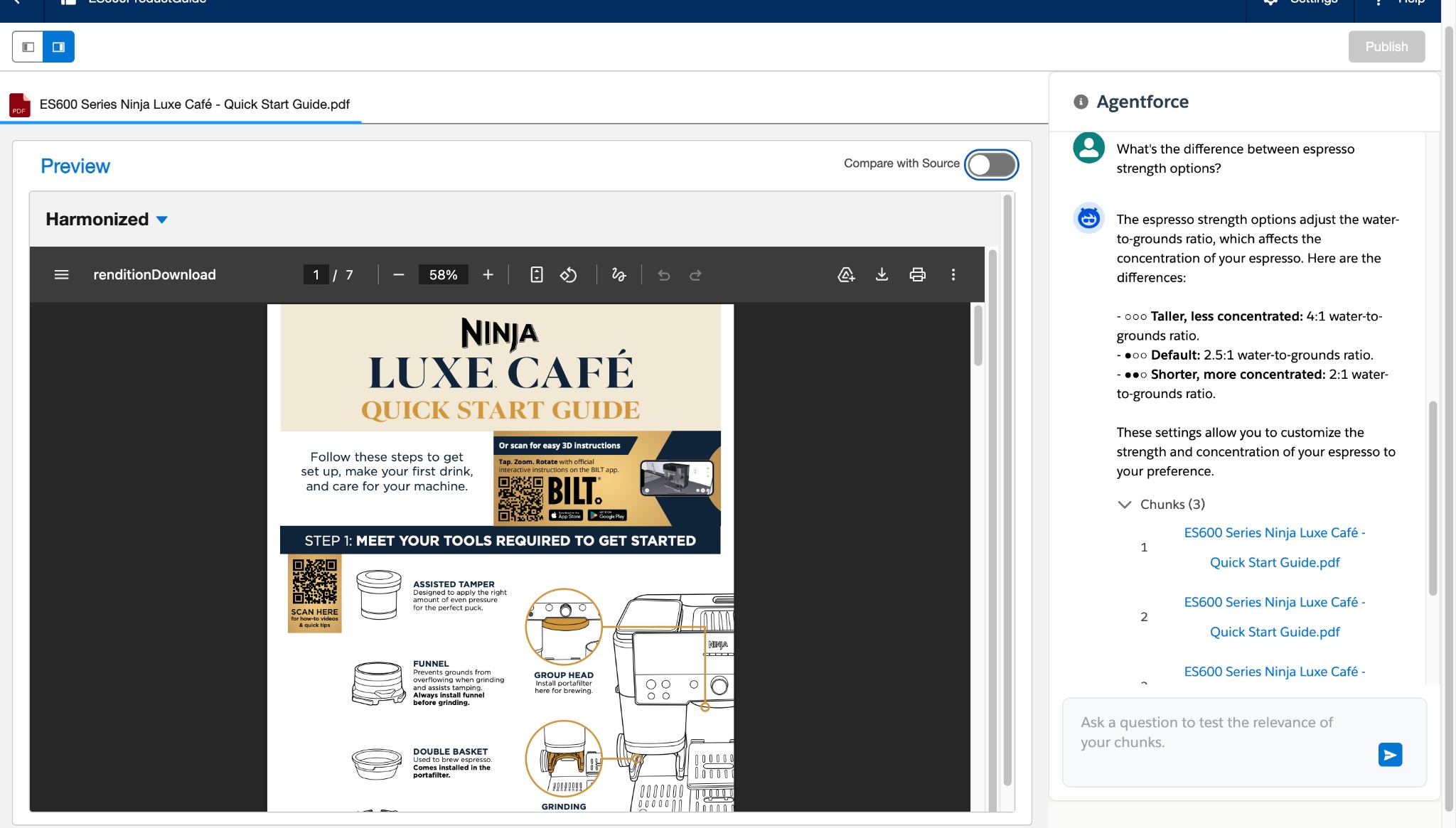
Intelligent Context interface showing the ES600 Ninja Luxe Cafe Quick Start Guide PDF on the left and an Agentforce panel on the right. The agent answers a question about espresso strength options, with three source chunks from the Quick Start Guide listed below the response.
Intelligent Context lets the team see how the agent interprets product documentation — here, answering a question about espresso strength options using the Ninja Luxe Cafe Quick Start Guide.
Intelligent Context interface with "Compare with Source" toggled on, displaying individual content chunks with record IDs and sequence numbers alongside the source PDF. The agent's response about espresso strength options is shown on the right, with the three referenced chunks highlighted in the center.
With “Compare with Source” turned on, the team can trace every agent response back to the specific passage it referenced — and fix the source content directly if needed.

A built-in “Compare with Source” view lets the team see exactly which chunks the agent referenced when answering a question, alongside the original PDF. For a brand where product accuracy matters, that traceability is critical. If the agent gives an unexpected answer, the team can trace it back to the specific passage it read and fix the source content directly.
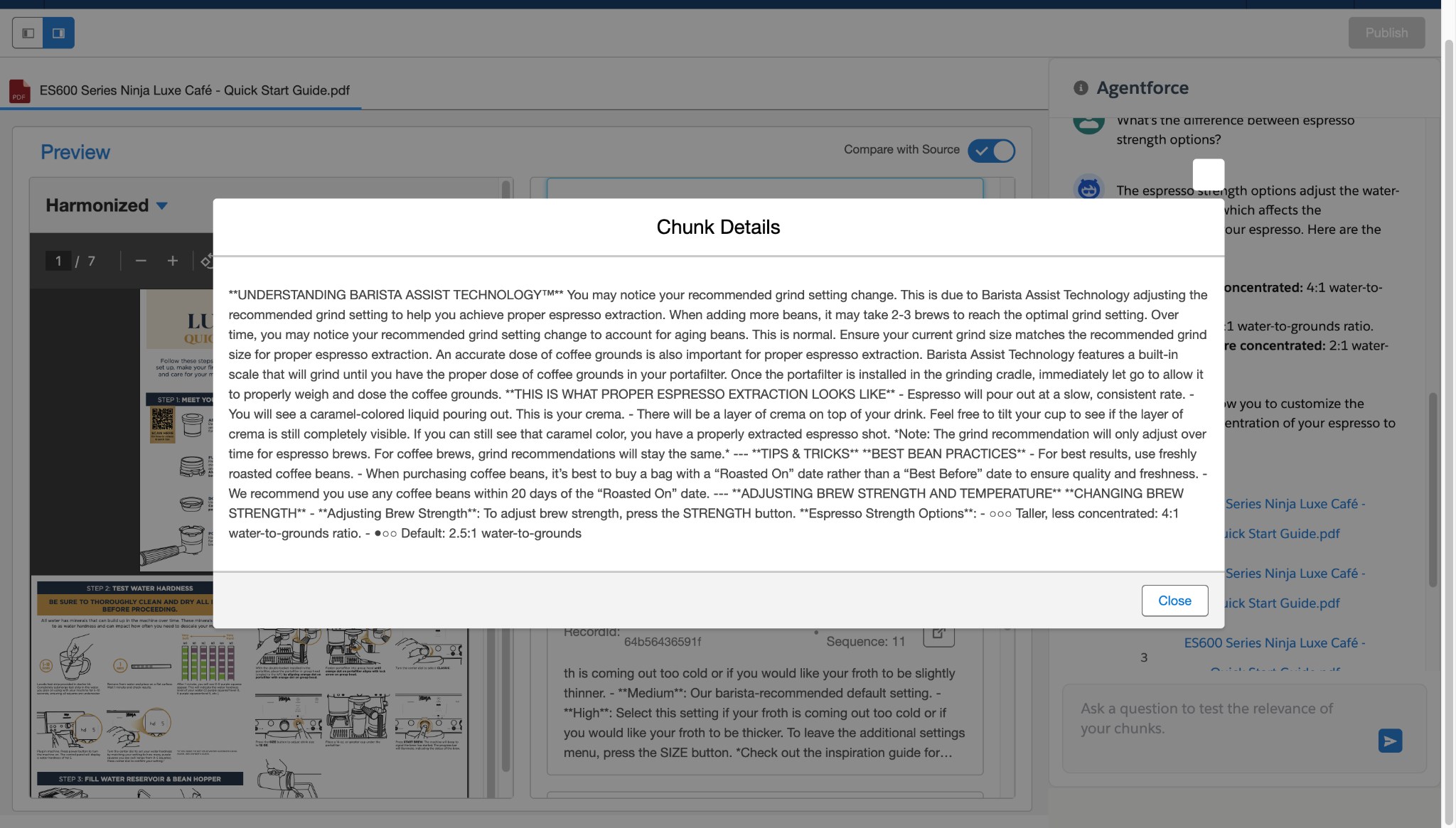
Chunk Details popup showing the full text of a knowledge chunk about Barista Assist Technology, espresso extraction, grind settings, and coffee strength options, pulled from the ES600 Ninja Luxe Cafe Quick Start Guide.
Each chunk is inspectable — the team can read exactly what the agent read and verify accuracy before it reaches a customer.

The Digital Concierge takes Data 360 further, pulling in customer context, order history, and product catalog data alongside B2C Commerce. The team is exploring how to connect these capabilities across agents through orchestration. For now, the unboxing agent stands on its own, and ships faster because of it. 

Flow diagram showing how SharkNinja's unboxing agent retrieves product knowledge from two sources (Knowledge Articles and Agentforce Data Library) via an Apex retriever, then delivers a guided setup experience through a rich visual interface. Left-to-right flow diagram with three sections. Left: Content Sources (Knowledge Articles and Agentforce Data Library containing Quick Start Guides and Owner's Guides). Center: Unboxing Agent (deterministic logic and targeted LLM reasoning), connected by an arrow labeled Apex Retriever. Right: Customer Experience (rich visual interface, step-by-step setup, follow-up Q&A, and video tutorials), connected by an arrow labeled Delivers.]
The unboxing agent pulls from knowledge articles and product PDFs through an Apex retriever, combining deterministic logic with targeted LLM reasoning to deliver a visual, guided setup experience. Both content sources are managed within Data 360.

Under the hood, the unboxing agent is organized into specialized subagents: Product Greeting, Product Assistance, Warranty Registration, Recipe Search, and more. Each subagent is responsible for a distinct part of the customer conversation. An Agent Router determines which subagent should handle each turn, with dedicated subagents for escalation, off-topic requests, and ambiguous questions. This modular design means the team can update one capability (say, adding a new product greeting) without touching the rest.
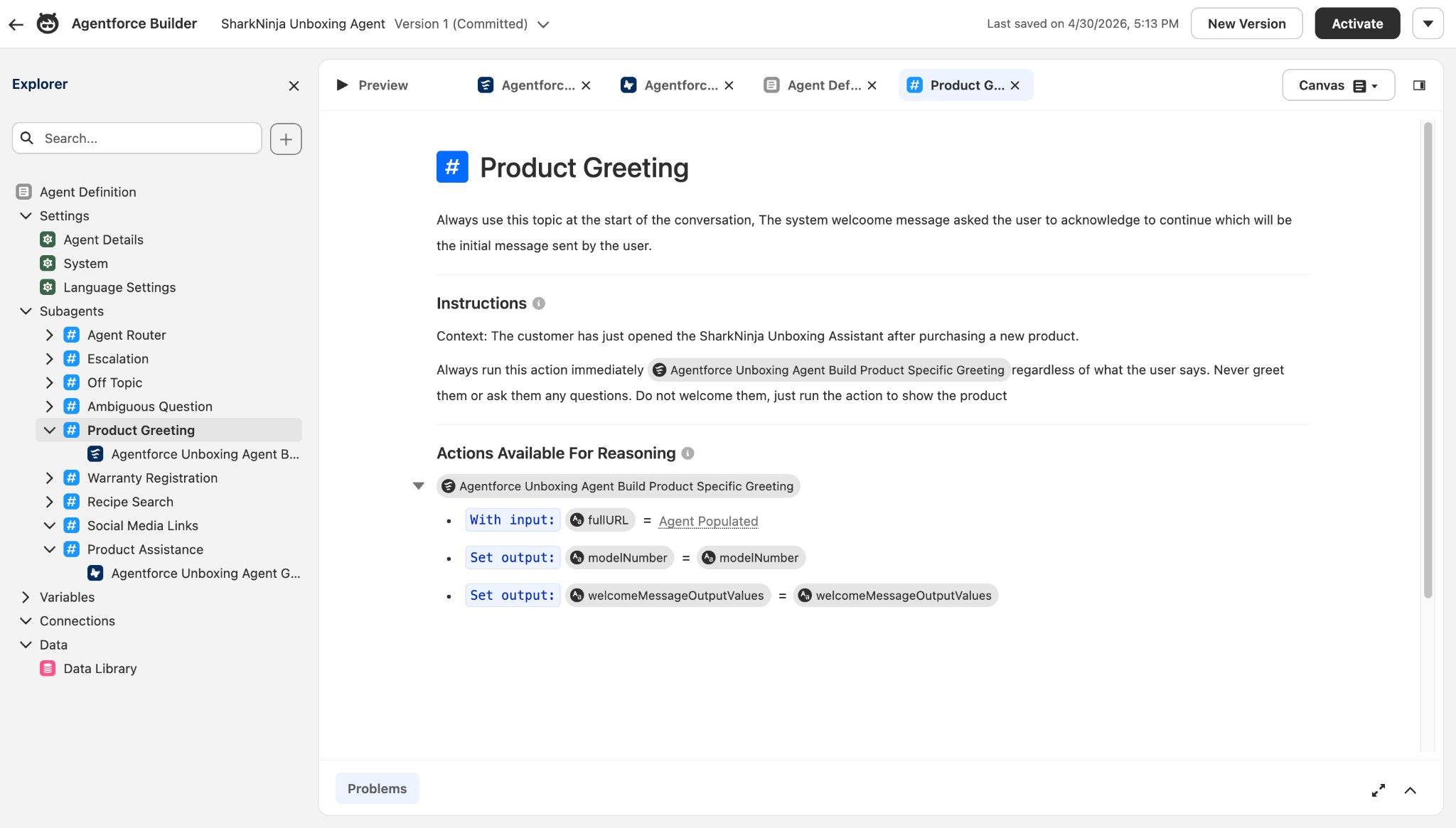
 Agentforce Builder Explorer panel showing the SharkNinja Unboxing Agent's structure: Settings (Agent Details, System, Language Settings) and Subagents (Agent Router, Escalation, Off Topic, Ambiguous Question, Product Greeting, Warranty Registration, Recipe Search, Social Media Links, Product Assistance), plus Variables, Connections, and Data sections.
The unboxing agent’s Explorer panel in Agentforce Builder shows how the agent is organized into specialized subagents, each responsible for a distinct part of the customer conversation.

From FAQ bot to agentic actions: The bigger picture

The unboxing agent didn’t come first. SharkNinja built their Digital Concierge first — a single agent on sharkninja.com that handles both service topics (troubleshooting, FAQ, order tracking) and shopper topics (product recommendations, cart actions) in one conversation. That agent proved the model, scaled to 250K+ conversations, and gave the team confidence to build something more ambitious.

The progression tells a story other teams can learn from: Start with a high-value use case (FAQ deflection and guided shopping), prove it works, build the iteration muscle, then extend into net-new experiences, like guided unboxing that didn’t previously exist.

Here’s how the unboxing agent fits into SharkNinja’s broader Agentforce architecture. The unboxing agent and the Digital Concierge (Sales & Service agent) share a common data foundation in Salesforce Data 360, but each serves a distinct purpose and set of subagents.
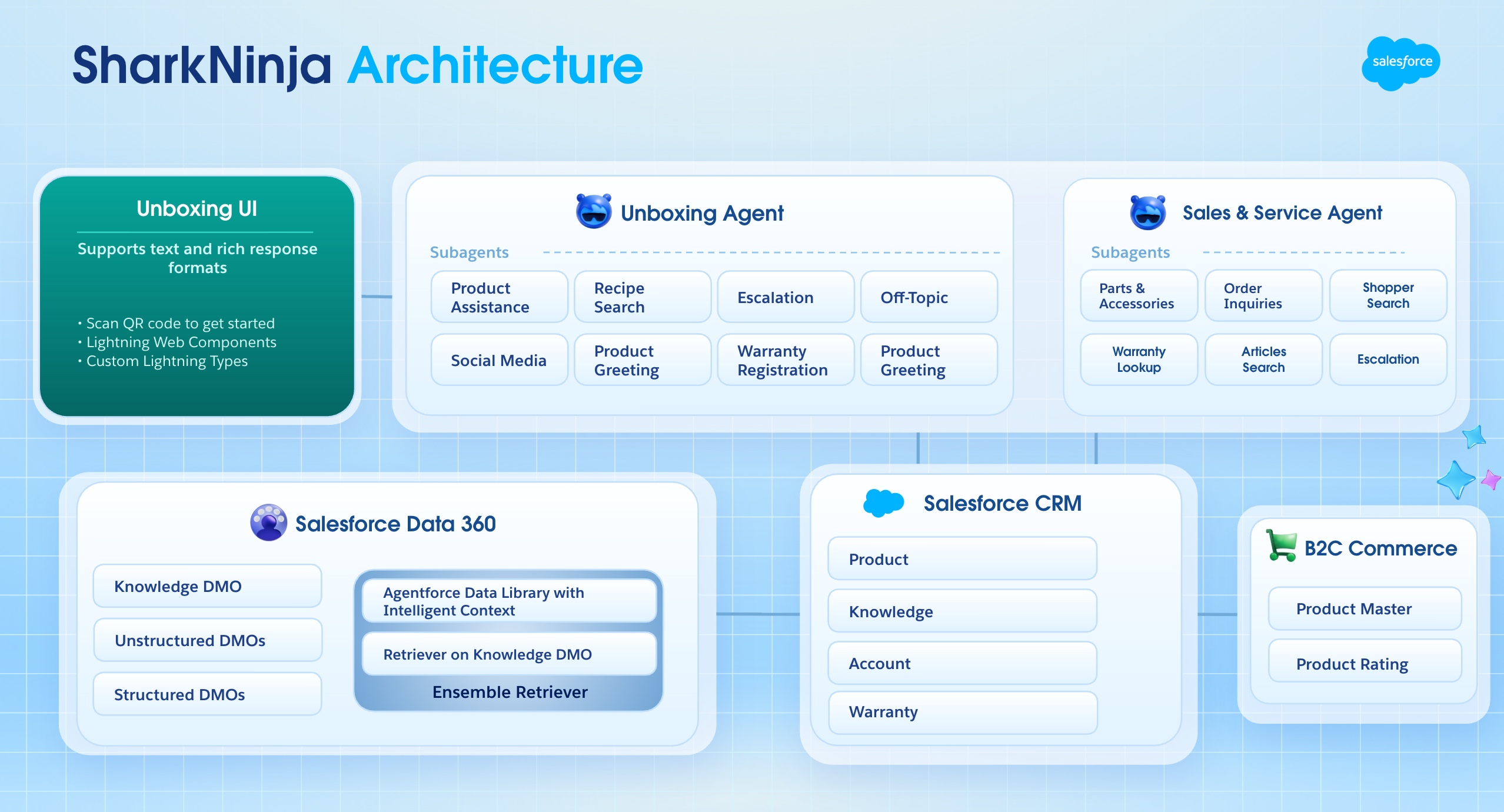
Architecture diagram titled "SharkNinja Architecture" showing three top-level components: Unboxing UI on the left (supporting QR code scanning, Lightning Web Components, and custom Lightning types), the Unboxing Agent in the center (with subagents for Product Assistance, Recipe Search, Escalation, Off-Topic, Social Media, Product Greeting, Warranty Registration, and Product Greeting), and the Sales & Service Agent on the right (with subagents for Parts & Accessories, Order Inquiries, Shopper Search, Warranty Lookup, Articles Search, and Escalation). Below them, Salesforce Data 360 contains Knowledge DMOs, Unstructured DMOs, Structured DMOs, the Agentforce Data Library with Intelligent Context, and a Retriever on Knowledge DMO feeding an Ensemble Retriever. Salesforce CRM (Product, Knowledge, Account, Warranty) and B2C Commerce (Product Master, Product Rating) sit alongside Data 360 as additional data sources.
SharkNinja’s full Agentforce architecture. The unboxing agent (center) sits alongside the Sales and Service Agent, with Salesforce Data 360 as the shared data foundation and Salesforce CRM and B2C Commerce powering the broader ecosystem.

Guardrails and “attack the bot”

Building the first version of an agent is the easy part. Making it good enough to represent your brand at scale is where the real work begins.

Konopka describes it this way: “AI in some cases is eager to please. You don’t want that. To make sure the brand is reflected accurately in the agent, there’s a lot that goes into guardrails. The tone, the data, the guardrails: all those things come together. You could have it 95% correct, but that last 5% can make it feel clunky.”

SharkNinja invented what they call the “attack the bot” program to close that gap. Call center reps spend a few minutes each day trying to break the agent: asking the toughest questions, attempting to trip it up, testing edge cases no QA script would catch. 

“Get subject matter experts who know their stuff to test the AI,” said Konopka. “That’s where the magic happens.”

The team also invested in “conversation engineering” — weekly meetings dedicated to refining how agents communicate, conversation workshops with CX colleagues, and structured lessons-learned sessions after each major iteration.

“The ‘attack the bot’ sessions with call center reps surfaced more edge cases in two weeks than our QA scripts caught in two months,” said Duerkop. “If you take one thing from SharkNinja’s playbook, it’s this: your frontline team is your best testing tool. Use them early and often.”

5 tips from SharkNinja

Ready to build an agent like SharkNinja’s unboxing experience? Konopka shares this advice for getting started with Agentforce.

1. Start with one high-value use case and prove it out. “Build on the success, instrument it properly from day one. Don’t try to do everything.”

2. Invest in data foundations early. “Understand how AI digests information. Without structured, reliable knowledge underneath, the agent experience will plateau.”

3. Build the iteration muscle from day one. “Create the feedback loops, do the conversational workshops if you can.”

4. Bring your frontline teams in early. “They know the customer better than any engineer does. Your customer experience team can become your most valuable testers and co-creators.”

5. Embrace the journey. “The teams that will win with agents aren’t the ones that get it right the first time. They’re the ones that collaborate and learn the fastest.”

SharkNinja built their unboxing agent by shipping live, learning as they went, and iterating fast. The QR code on the box is now a portal to a guided conversation, and any team with a physical product can follow the same playbook.
Ready to learn more about how SharkNinja is using Agentforce? Check out their Demo Day story here.