








Choosing the right integration pattern for a high-scale incident journey isn’t always straightforward. Imagine severe weather hitting your country or region so hard that it leads to outages across the power grid. Now imagine that as an architect, you are on the hook to design the architecture that helps deal with the fallout of such a crisis. You must identify affected parties across multiple systems and trigger automated, personalized notifications based on real-time data.
In this recap of episode three of Think Like an Architect, we reconstruct the architectural thinking process for this scenario, which was originally done in real time during the livestream. Rather than just looking at a finished architectural design, following along with this process will strengthen the mental muscles you need to evaluate requirements, weigh options, and justify a solution direction.
To design scalable solutions, we use a repeatable three-step method to move from raw business requirements to justified architectural decisions:
Watch Salesforce Architect experts apply the What/How/Why approach to unify data, route work to the right teams and create a proactive and personalized multi-channel service experience.



In the “What” step, let’s look at the specific challenge from episode three. Start with a raw business requirement and use highlighting to indicate the key parts, as shown below.
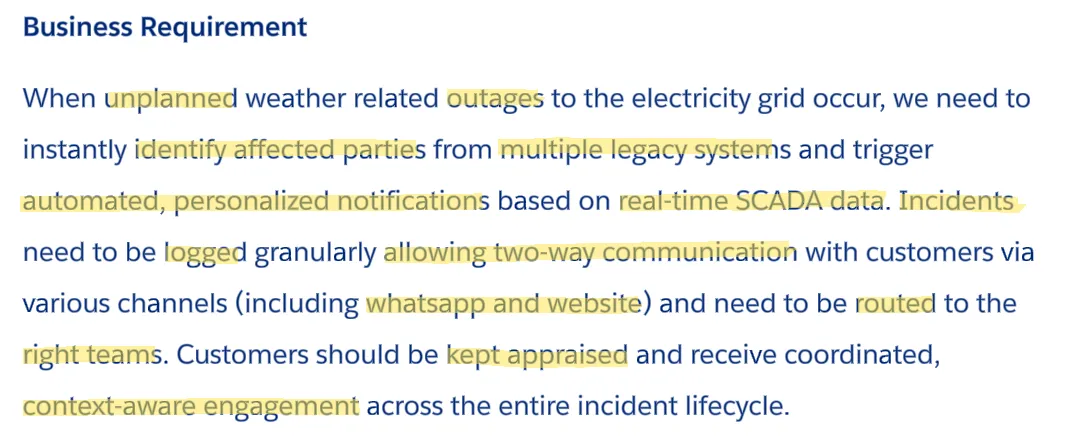
By highlighting key phrases, we strip away the business narrative to ensure we are solving the right problems from the start. Based on the electricity grid outage scenario, we arrive at five clear HLRs:
Note that the HLRs paraphrase rather than use the exact words from the business requirement. This is essential in validating with the business stakeholders that you understood the intention of their requirement.
To continue with evaluating solution options, let’s move into the “How” step by following the trail of questions, assumptions, and decisions captured during our live session.
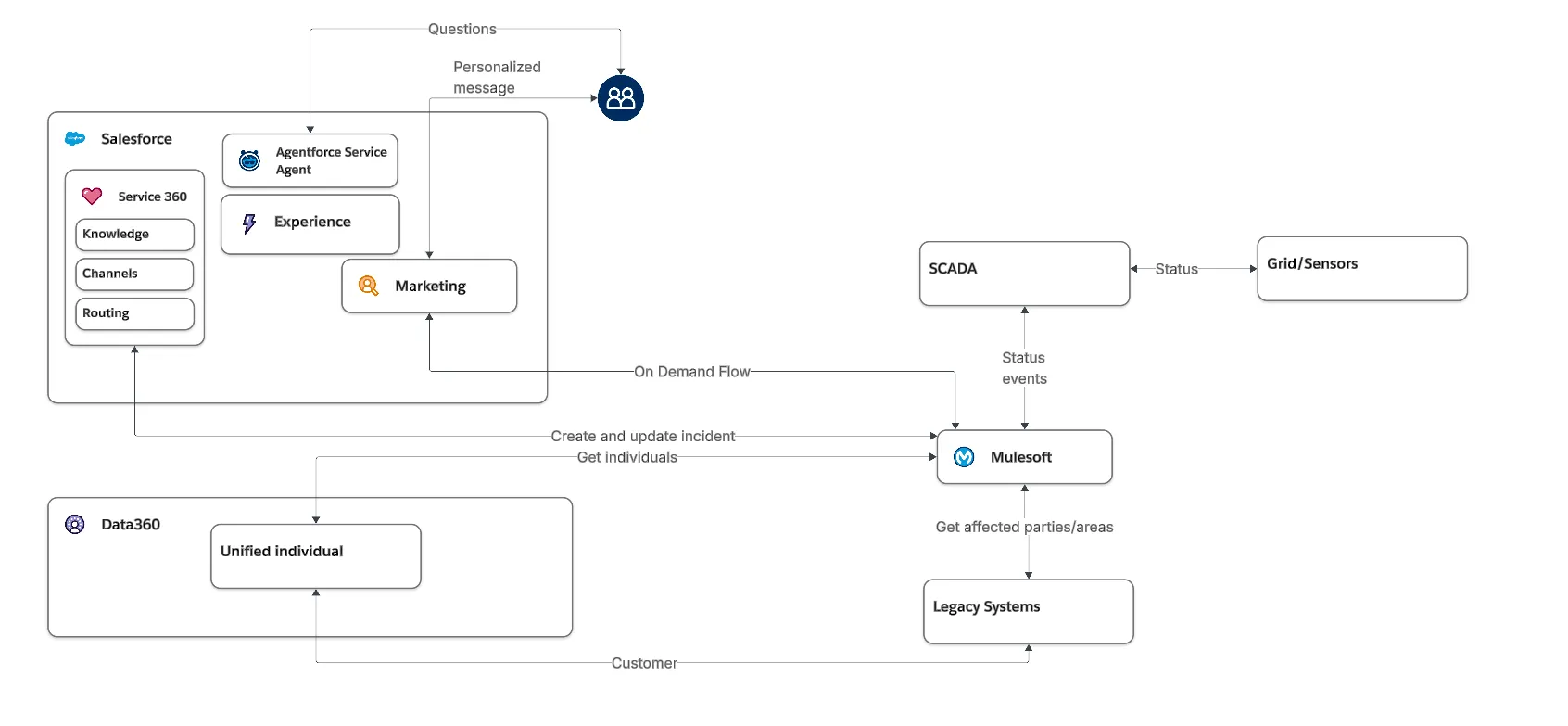
In the “How” step, we evaluate solution options against the extracted HLRs. To keep our thinking organized, we track questions, assumptions, and decisions alongside our technical diagram.
The first assumption is that the SCADA system that is part of the landscape is able to detect status events via connected sensors on the grid. The next assumption is that SCADA is able to publish status events in the case of an outage. Because the scenario requires low latency for high-volume events, we select MuleSoft as the middleware to consume these status events.
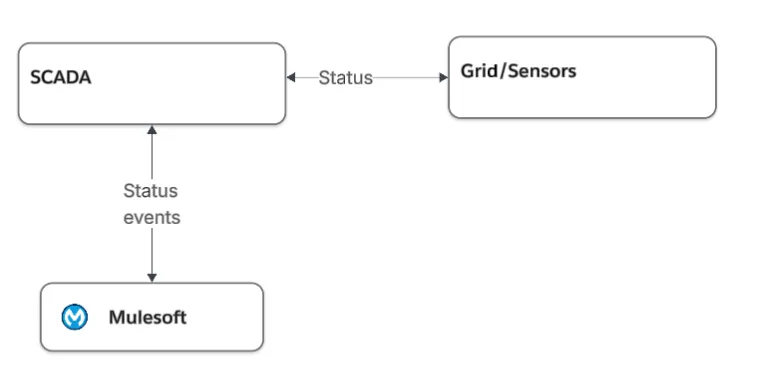
To notify Salesforce, we assume that MuleSoft connects to the Salesforce org. Let’s not draw that into the architecture until we tackle the result of that integration when we reach the requirement to log the incident(s) corresponding to the event.
We solution HLR 2 and 3 together as we need to identify the affected parties to be able to send them personalized notifications. To tackle the first requirement to identify who is affected, we ask the question how to identify the individuals and assume that work has already been done to resolve identities into Unified Individuals across the legacy systems in the landscape. We also note that identifying Unified Individuals is a strong prerequisite or recommendation if it has not been completed earlier. Without it, chaos will ensue when there is an outage. In terms of a Salesforce multi-cloud solution, we assume that the unification happens in Data 360.
To connect the grid areas impacted to the individuals affected, we assume that the legacy systems have the knowledge of that relationship and that leads to the decision to use MuleSoft to:
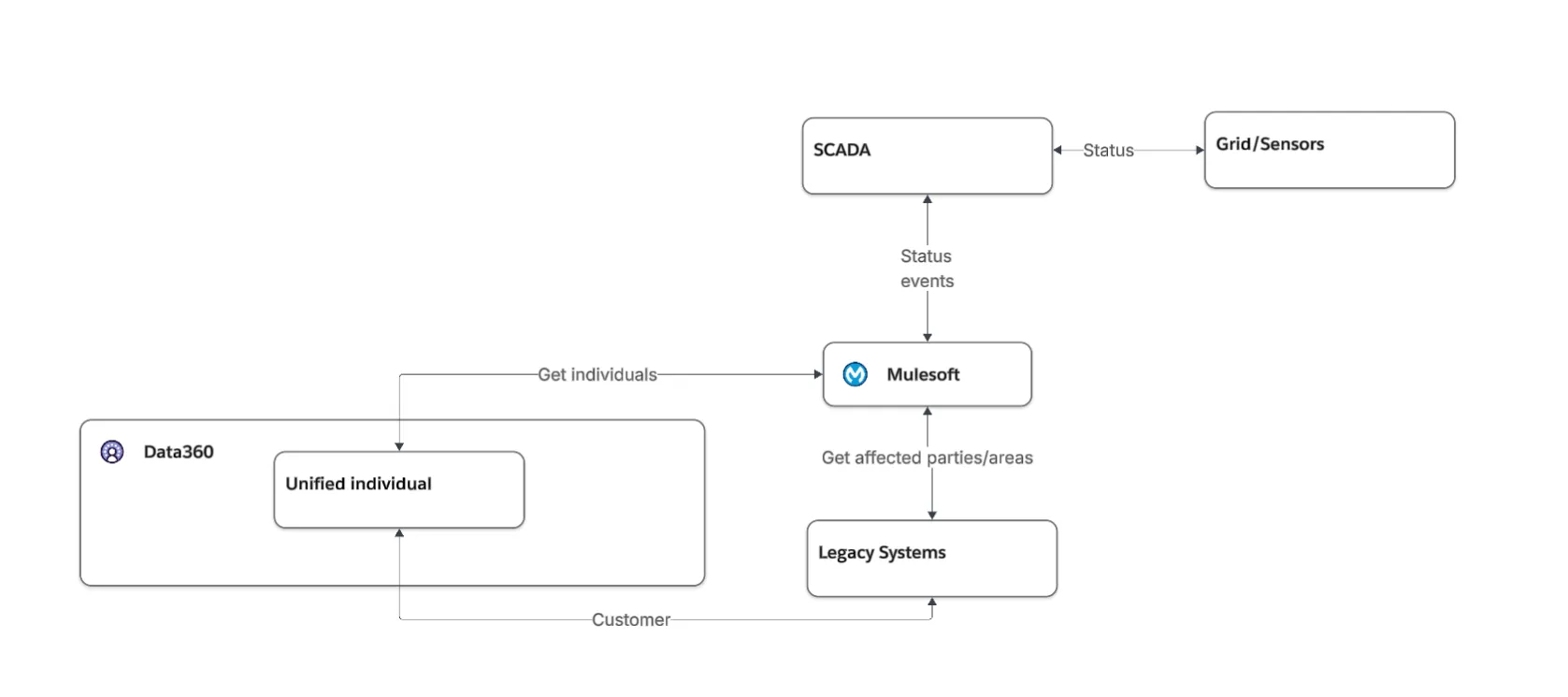
Now that we have the impacted parties, we are ready to send the personalized notifications as part of HLR 3.
To design the notification strategy, we prioritize scalability and future-proofness, leading to the decision to leverage Agentforce Marketing (formerly Marketing Cloud Advanced Edition) with on-demand flows. This feature provides a transactional API path to power high-volume, personalized flows with the low latency required during an emergency. To account for compliance considerations we make the assumption that consent is either not required or captured appropriately in Data 360 depending on local regulations.
While on-demand flow support for WhatsApp is a roadmap item where we personalize the message by passing the values in the API payload, we note that a Data 360 action could trigger these messages in the interim if we were going live today. As we are currently discussing the architecture though, the expectation is that this feature will be GA by the time we implement.
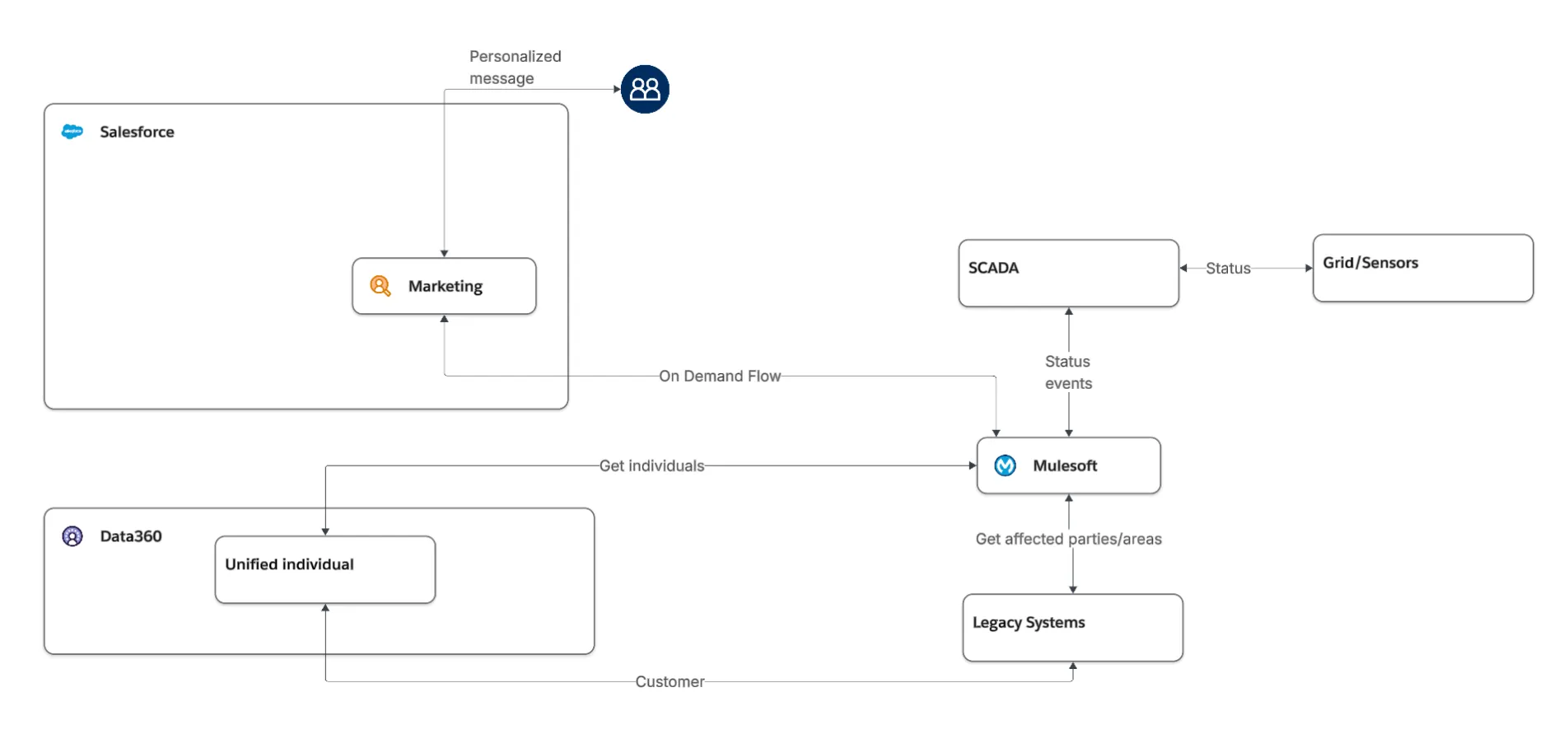
For the final pair of requirements, we start with a number of assumptions around using out-of-the-box Salesforce features. This helps us decide to leverage out-of-the-box Incident Management to track the outage, which leads to a decision to create cases for individual customers that reach out as child records to the overarching incident.
When customers reach out for updates, Agentforce handles inbound volumes on WhatsApp and the web. We assume that the Agentforce Service Agent has access to the latest incident status and decide that it can trigger actions to create child cases for personalized, two-way interaction.
This assumption surfaces “hidden” requirements that were not obvious earlier. First, the SCADA-to-MuleSoft integration, initially scoped to publish outage detection events, must be extended to also publish ongoing status change events as grid conditions evolve. Second, a new MuleSoft-to-Salesforce integration must be added to support both the creation of incidents and subsequent status updates to those records.
In the “Why” step, you justify your solution direction to stakeholders and your future self. During the live stream, we emphasized that an architect’s value is not in the solution, but in the rationale. With the questions, assumptions, limitations, and decisions we captured, we can apply the guidance in the Architectural Decisions: A Human-Led, AI-Powered Approach blog post on how to create an ADR with the help of LLMs. We use the notes we took in the How step to:
During the session, experts Scott Ratliff and Kunal Modi shared critical insights into the technical nuances of this multi-cloud journey:
An important takeaway for any architect is to attempt to solve the problem with the simplest, most standard tool or functionality first. If that won’t work, prove it before moving to more custom or made-to-measure solutions. In this episode, that meant starting with Incident Management and an Agentforce Service Agent before layering in MuleSoft and Marketing Cloud Advanced.
The other takeaway is one you can apply immediately: the thinking work is the deliverable. Whether you present a 40-page HLD or a sketch on a whiteboard, what matters is that your questions, assumptions, and decisions are documented and traceable. That’s what makes an architectural recommendation something your stakeholders can understand and get behind.
Get monthly curated content, technical resources, and event updates designed to support your Salesforce Architect journey.



此内容由惯性聚合(RSS阅读器)自动聚合整理,仅供阅读参考。 原文来自 — 版权归原作者所有。