










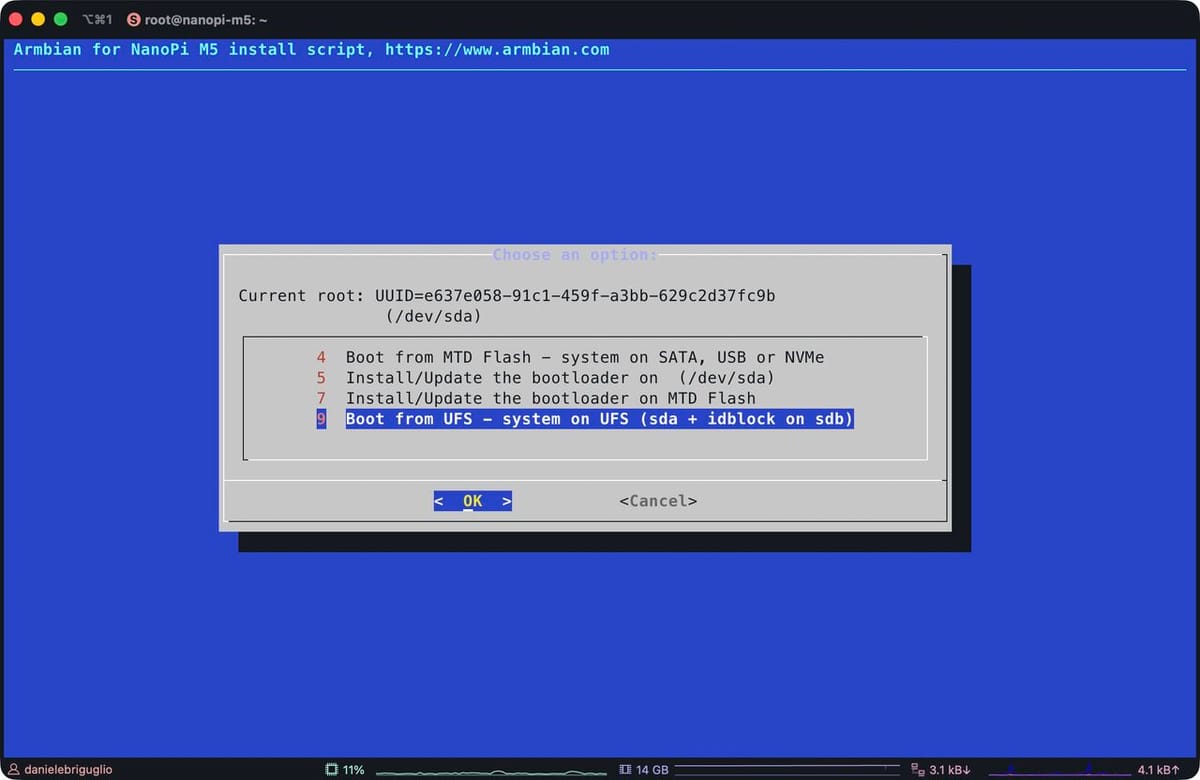
Armbian's next release boots the FriendlyElec NanoPi M5 end-to-end from UFS on a mainline U-Boot, with no proprietary recovery image in the loop. It is the first RK3576 board in the catalogue to reach this state, and the integration pattern paves the way for the others.
UFS, the storage class that replaced eMMC in phones, is packet-based and full-duplex with command queuing. The practical gain over an SD card shows up in random I/O, in latency under concurrent load, and in write endurance that holds up over years of deployment. FriendlyElec ships UFS on the M5 because the RK3576 has a native UFS controller, a sensible choice for any board destined for kiosks, robots, or industrial gateways.
What mainline was missing
The UFS controller IP itself had a partial driver in mainline U-Boot. Everything around it was not wired: PHY init sequencing, the regulator rails the device needs before it responds, the device-tree glue that tells U-Boot "yes, this board has UFS." For the M5, none of it existed. There is also a cosmetic detail that catches every newcomer, namely that Rockchip's loader tooling labels UFS as SATA in the RKDevTool storage dropdown. Flashing goes through upgrade_tool, not the more familiar rkdeveloptool, because rkdeveloptool has never had UFS support.
How it came together
Three workstreams had to converge. Jonas Karlman's kwiboo/rk3576 branch carried the upstream RK3576 U-Boot enablement, pinctrl, clocks, storage controller bindings, and has been merging into mainline through 2026. The rockchip-linux/rkbin tree had to ship a UFS-capable MiniLoader, which the RK3576MINIALL.ini recipe assembles from the DDR init, the UFS-aware loader, and the OP-TEE/ATF blobs. The Armbian side was the integration: a board config on U-Boot v2026.04, a U-Boot DT overlay that brings the UFS regulators and PHY up at the right moment, and a flashing path that upgrade_tool accepts. None of these were individually hard. Making them line up is what took the time.
On the device, the stack does its job cleanly. The BootROM reads the IDB off UFS and pulls in the TPL; the TPL initialises DDR and the UFS host controller, sequences the regulators, negotiates the link, and reads the next stage; ATF jumps to U-Boot; U-Boot enumerates ufs 0 and loads the kernel; the kernel re-probes the same controller it just booted through. The work, almost all of it, lived at the TPL stage. Controller fine, PHY fine, but the device sits silent if regulator sequencing is wrong by a handful of milliseconds. Once that is right, the upper layers see a clean SCSI-shaped block device and the rest is unsurprising.
What it leaves us with
For users with a UFS-equipped M5, the next release image flashes through the FriendlyElec Rockchip workflow with upgrade_tool, BOOT switch on UFS/SD, storage dropdown labelled "SATA". The board boots without an SD card or eMMC involvement, and armbian-install writes the same image to UFS in place once the system is running from another medium. Against microSD on the same hardware the difference is felt rather than benchmarked: small reads land faster, the system stays responsive under concurrent I/O, and the write endurance is in a different ballpark.
A few rough edges remain. The vendor tooling will keep calling UFS "SATA" until either Rockchip relabels the GUI or rkdeveloptool grows a cs ufs opcode, neither on the immediate horizon. The BOOT switch is a hardware gate with no software override. And upgrade_tool ships only as a Linux x86_64 ELF, so flashing from an Apple Silicon Mac means a Linux VM with USB passthrough or a Windows host running the GUI.
The same plumbing now unlocks every other UFS-equipped RK3576 board in the catalogue. The M5 reached the line first because the hardware was available and the upstream pieces were the most complete. The others should be substantially less work, now that the integration pattern exists and the loader path has been proven on real silicon.