
惯性聚合 高效追踪和阅读你感兴趣的博客、新闻、科技资讯
阅读原文 在惯性聚合中打开

推荐订阅源

aimingoo的专栏
aimingoo的专栏
I
InfoQ
B
Blog RSS Feed
D
Docker
GbyAI
GbyAI
N
Netflix TechBlog - Medium
Y
Y Combinator Blog
F
Fortinet All Blogs
P
Proofpoint News Feed
Microsoft Azure Blog
人人都是产品经理
人人都是产品经理
Martin Fowler
Martin Fowler
OSCHINA 社区最新新闻
OSCHINA 社区最新新闻
M
MIT News - Artificial intelligence
C
Check Point Blog
Vercel News
Vercel News
云风的 BLOG
云风的 BLOG
博客园 - Franky
Google DeepMind News
WordPress大学
WordPress大学
钛媒体:引领未来商业与生活新知
钛媒体:引领未来商业与生活新知
V
V2EX
Last Week in AI
Last Week in AI
L
LangChain Blog

Fortune | FORTUNE

One man can kill Bill Ackman’s $64 billion bid for Universal Music Group—and no one knows what he’ll do | Fortune Poppi’s cofounder pitched her startup on Shark Tank while 9 months pregnant and landed a $400,000 deal—now it's worth $2 billion | Fortune Teen boys are choosing AI girlfriends over real ones for 'maximum control, zero rejection'—experts say it could make them unemployable | Fortune A United American merger is by no means impossible given the president 'loves big deals' | Fortune Reed Hastings’s planned exit from $455 billion Netflix ‘had nothing to do with’ the failed deal for Warner Bros., says Ted Sarandos | Fortune Meet Joe McCann: The high-flying crypto trader held in Tanzania after sudden death of his influencer fiancée Ashly Robinson | Fortune Gen Z is carving a different path in the housing market by doing it alone | Fortune U.S. Catholic leaders criticize Trump for ‘disparaging words’ about the pope as Vatican clash risks alienating Catholic voters | Fortune China has ‘nearly erased’ America’s lead in AI—and the flow of tech experts moving to the U.S. is slowing to a trickle, Stanford report says | Fortune Self-made millionaire behind $5 billion Skims Emma Grede says it all began with a cold call to Kris Jenner: Emma Grede—the self-made millionaire behind the $5 billion Skims empire—says it all began with an audacious cold call to Kris Jenner: ‘The difference between me and someone else is, I made it happen’ | Fortune Americans have never been this gloomy about the economy. Wall Street has never cashed in harder | Fortune ‘The college grading system [is] almost meaningless’: People see the Ivy League as an easy A and with flawed admissions standards | Fortune The CEO of $8.5 billion Japanese car giant Nissan plays the drums in a band and hits the tennis courts to destress from the top job | Fortune New York governor's take on a millionaires tax: fancy pied-à-terre second apartments worth over $5 million | Fortune Pope Leo XIV: A ‘handful of tyrants’ are ravaging earth with war and exploitation | Fortune Trump has no plan to cut the $39 trillion national debt, but he does want to cut childcare. His budget director is scrambling to clarify | Fortune China's economy grows 5% in first quarter, surprising economists to the upside | Fortune Everyone was wondering what Trump wanted more: Warsh smoothly seated at the Fed, or for Powell to pay. We have our answer | Fortune Palantir exec: the biggest mistake retailers are making with AI? Trying to do it all with one agent | Fortune American YouTuber who calls himself a 'troll' sentenced to 6 months in Korean prison for literally dancing on wartime graves | Fortune BBC plans to cut up to 2,000 jobs to save 10% of annual budget | Fortune Canva debuts a new suite of agentic tools, as the design app quietly becomes one of the world’s most used AI services | Fortune Moody's CEO: AI has a trust problem – better models won’t fix it | Fortune Top New York surgeon: Americans have better data for choosing restaurants than surgeons. That has to change | Fortune The Iran war’s fertilizer shock is hammering American farmers, and 70% can’t afford what they need for this year’s growing season | Fortune Education experts to Mamdani: Why are you foisting AI on our kids? | Fortune This CEO pirated video games as a teen and became a hacker for the Air Force. Now he’s built a $3 billion cyber firm | Fortune Teacher, blame thyself: Yale report savages Ivy League schools for destroying American trust in higher education | Fortune Fed chair nominee Kevin Warsh is worth more than $100 million and has stakes in SpaceX and Polymarket | Fortune From wool sneakers to GPUs: Allbirds’ desperate AI pivot and 600% stock surge, explained | Fortune
The affordability crisis is so bad that, for the first ti...
Jacqueline Munis · 2026-06-18 · via Fortune | FORTUNE

Fifty years ago, four in 10 American families survived on a single income. Now, the days of the single-income household are long gone. 

For the first time in U.S. history, the majority of all heterosexual households have two full-time, working parents. Now, both parents in more than half (52%) of heterosexual couples with kids under 18 hold full-time jobs, according to a Pew Research analysis of 2025 U.S. Census Bureau data. 

As a result, the stay-at-home parent is also on the decline. About a fourth of families are made up of a dad who works full-time and a mom who is unemployed. Pew found that just 6% of moms work full-time while their male partner isn’t employed, or works part-time. That’s twice as many moms as 50 years ago.

Another 14% of working parents aren’t married or don’t live with a partner. 
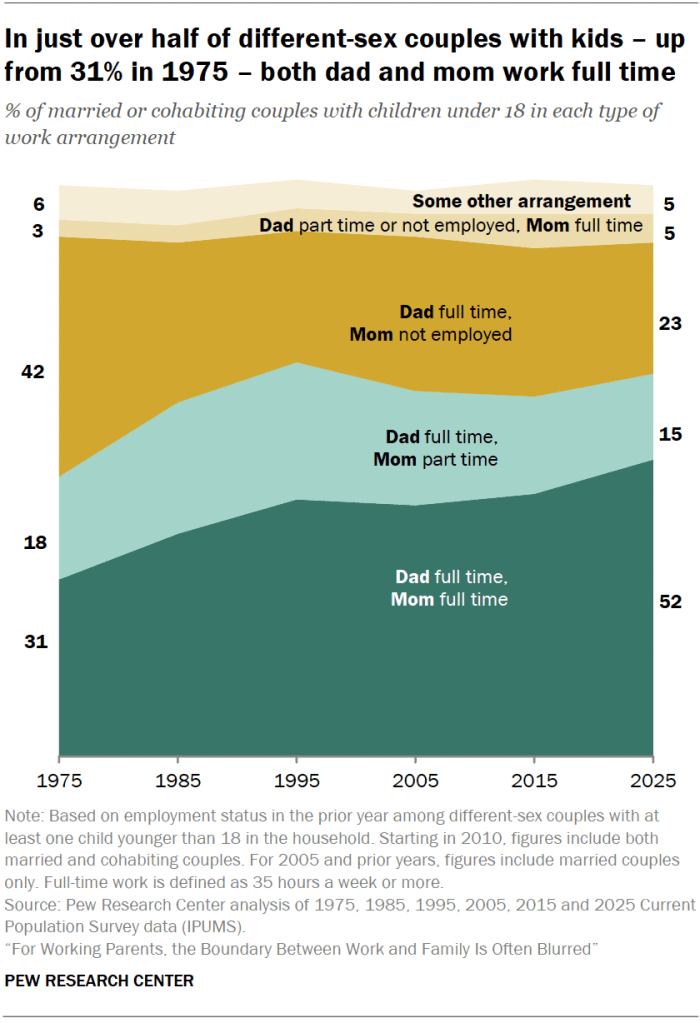
A graph explaining the results

Pew Research Center

The split between dads and moms working isn’t the same across all racial backgrounds. Six in 10 partnered Black mothers work full-time, down from 64% in 2000. Meanwhile, the share of working Asian and white moms has increased over time. Now, 54% of Asian moms and 52% of white moms work full-time. About 45% Asian and white moms worked full-time 25 years ago.

Hispanic families are an outlier: the percentage of full-time, double-income families has held steady over the last 25 years at about 44%. Another third of Hispanic mothers aren’t employed, the highest rate of unemployment across racial groups. 

Educational background also shapes how moms work. About seven in 10 partnered mothers with an advanced degree work full-time. Over half of moms with a bachelor’s degree work full-time, compared to 43% of moms with less education. 

Families where both parents work at least part-time see more financial benefits than families where just the father works, Pew found, even as all parents surveyed said their family’s work arrangement has not had a positive or negative effect on their career advancement. 

More employed, more involved

The increase of households depending on two full-time incomes comes as simply surviving life feels out of reach for more and more Americans. Homeownership, stable employment, or even just feeding your kids are becoming more unattainable as high inflation and even higher interest rates take up a larger percentage of people’s incomes. Concerns over the cost of living have skyrocketed since the pandemic. Now, nearly a third of Americans report high living costs as their main financial problem, compared to just 3% in 2020. 

It comes down to the higher costs of living. Raising a child costs more than $300,000 over the first 18 years of their life, LendingTree recently found, compared to $165,630 about 25 years ago. A two-child household must earn more than $400,000 a year for childcare to be considered affordable by federal guidelines. Half of Americans say they have just enough money to maintain their standard of living, and nearly a fifth say they’re falling behind.

On top of making ends meet, parents today are expected to spend more time with their children, adding pressure to strike the perfect work-life balance. More than half of parents who work full-time said they struggle to balance work and family responsibilities, Pew found.

“Working moms today are spending more time with their kids than stay-at-home moms when we were kids,” Wharton School economist Corinne Low previously told Fortune.  

The burden of child and household care still falls overwhelmingly on women. Even when a wife outearns her husband, she still does almost twice as much cooking and cleaning as her partner, according to Low, which Pew’s findings echoed. Nearly two-thirds of caregiving is done by women, and if American women were paid for all their unpaid labor, it would be worth $683 billion, according to the National Partnership for Women & Families.