
惯性聚合 高效追踪和阅读你感兴趣的博客、新闻、科技资讯
阅读原文 在惯性聚合中打开

推荐订阅源

Microsoft Azure Blog
GbyAI
GbyAI
P
Proofpoint News Feed
Engineering at Meta
Engineering at Meta
Recent Announcements
L
LangChain Blog
B
Blog
阮一峰的网络日志
阮一峰的网络日志
Microsoft Security Blog
博客园 - 【当耐特】
M
MIT News - Artificial intelligence
D
Docker
WordPress大学
WordPress大学
J
Java Code Geeks
奇客Solidot–传递最新科技情报
奇客Solidot–传递最新科技情报
The GitHub Blog
The GitHub Blog
博客园 - 叶小钗
Last Week in AI
Last Week in AI
Stack Overflow Blog
Stack Overflow Blog
有赞技术团队
有赞技术团队
MyScale Blog
MyScale Blog
H
Hackread – Cybersecurity News, Data Breaches, AI and More
MongoDB | Blog
MongoDB | Blog
博客园 - Franky

Fortune | FORTUNE

One man can kill Bill Ackman’s $64 billion bid for Universal Music Group—and no one knows what he’ll do | Fortune Poppi’s cofounder pitched her startup on Shark Tank while 9 months pregnant and landed a $400,000 deal—now it's worth $2 billion | Fortune Teen boys are choosing AI girlfriends over real ones for 'maximum control, zero rejection'—experts say it could make them unemployable | Fortune A United American merger is by no means impossible given the president 'loves big deals' | Fortune Reed Hastings’s planned exit from $455 billion Netflix ‘had nothing to do with’ the failed deal for Warner Bros., says Ted Sarandos | Fortune Meet Joe McCann: The high-flying crypto trader held in Tanzania after sudden death of his influencer fiancée Ashly Robinson | Fortune Gen Z is carving a different path in the housing market by doing it alone | Fortune U.S. Catholic leaders criticize Trump for ‘disparaging words’ about the pope as Vatican clash risks alienating Catholic voters | Fortune China has ‘nearly erased’ America’s lead in AI—and the flow of tech experts moving to the U.S. is slowing to a trickle, Stanford report says | Fortune Self-made millionaire behind $5 billion Skims Emma Grede says it all began with a cold call to Kris Jenner: Emma Grede—the self-made millionaire behind the $5 billion Skims empire—says it all began with an audacious cold call to Kris Jenner: ‘The difference between me and someone else is, I made it happen’ | Fortune Americans have never been this gloomy about the economy. Wall Street has never cashed in harder | Fortune ‘The college grading system [is] almost meaningless’: People see the Ivy League as an easy A and with flawed admissions standards | Fortune The CEO of $8.5 billion Japanese car giant Nissan plays the drums in a band and hits the tennis courts to destress from the top job | Fortune New York governor's take on a millionaires tax: fancy pied-à-terre second apartments worth over $5 million | Fortune Pope Leo XIV: A ‘handful of tyrants’ are ravaging earth with war and exploitation | Fortune Trump has no plan to cut the $39 trillion national debt, but he does want to cut childcare. His budget director is scrambling to clarify | Fortune China's economy grows 5% in first quarter, surprising economists to the upside | Fortune Everyone was wondering what Trump wanted more: Warsh smoothly seated at the Fed, or for Powell to pay. We have our answer | Fortune Palantir exec: the biggest mistake retailers are making with AI? Trying to do it all with one agent | Fortune American YouTuber who calls himself a 'troll' sentenced to 6 months in Korean prison for literally dancing on wartime graves | Fortune BBC plans to cut up to 2,000 jobs to save 10% of annual budget | Fortune Canva debuts a new suite of agentic tools, as the design app quietly becomes one of the world’s most used AI services | Fortune Moody's CEO: AI has a trust problem – better models won’t fix it | Fortune Top New York surgeon: Americans have better data for choosing restaurants than surgeons. That has to change | Fortune The Iran war’s fertilizer shock is hammering American farmers, and 70% can’t afford what they need for this year’s growing season | Fortune Education experts to Mamdani: Why are you foisting AI on our kids? | Fortune This CEO pirated video games as a teen and became a hacker for the Air Force. Now he’s built a $3 billion cyber firm | Fortune Teacher, blame thyself: Yale report savages Ivy League schools for destroying American trust in higher education | Fortune Fed chair nominee Kevin Warsh is worth more than $100 million and has stakes in SpaceX and Polymarket | Fortune From wool sneakers to GPUs: Allbirds’ desperate AI pivot and 600% stock surge, explained | Fortune
Communities are blocking billions in data centers. Big Te...
Nick Lichten · 2026-05-19 · via Fortune | FORTUNE

The town of Saline, Michigan, didn’t want a $16 billion data center in its backyard. Residents voted against it. Weeks later, as Fortune‘s Sharon Goldman reported, construction began anyway.

That dynamic — community opposition steamrolled by corporate momentum — is playing out across America at accelerating speed. At least 48 data center projects representing $156 billion in investment were blocked or stalled by local opposition in 2025 alone, according to Miquel Vila, a supply chain and political risk analyst at 10a Labs who maintains the Data Center Watch initiative.  

Project cancellations jumped from six in 2024 to 25 in 2025, and in the first quarter of 2026, more than 20 additional projects were killed — a record quarterly pace. There are now 188 local opposition groups operating across 40 states.

And yet Big Tech isn’t slowing down. It’s accelerating.

On May 11, Moody’s Ratings raised its capital spending projections for the top six U.S. hyperscalers — Microsoft, Amazon Web Services, Meta, Alphabet, Oracle, and CoreWeave — to $785 billion for 2026 and nearly $1 trillion for 2027. The revision came after a blowout first quarter in which Google Cloud revenue grew 63%, AWS posted its fastest growth in 15 quarters, and Microsoft’s AI revenue surpassed $37 billion at a 123% year-over-year clip.
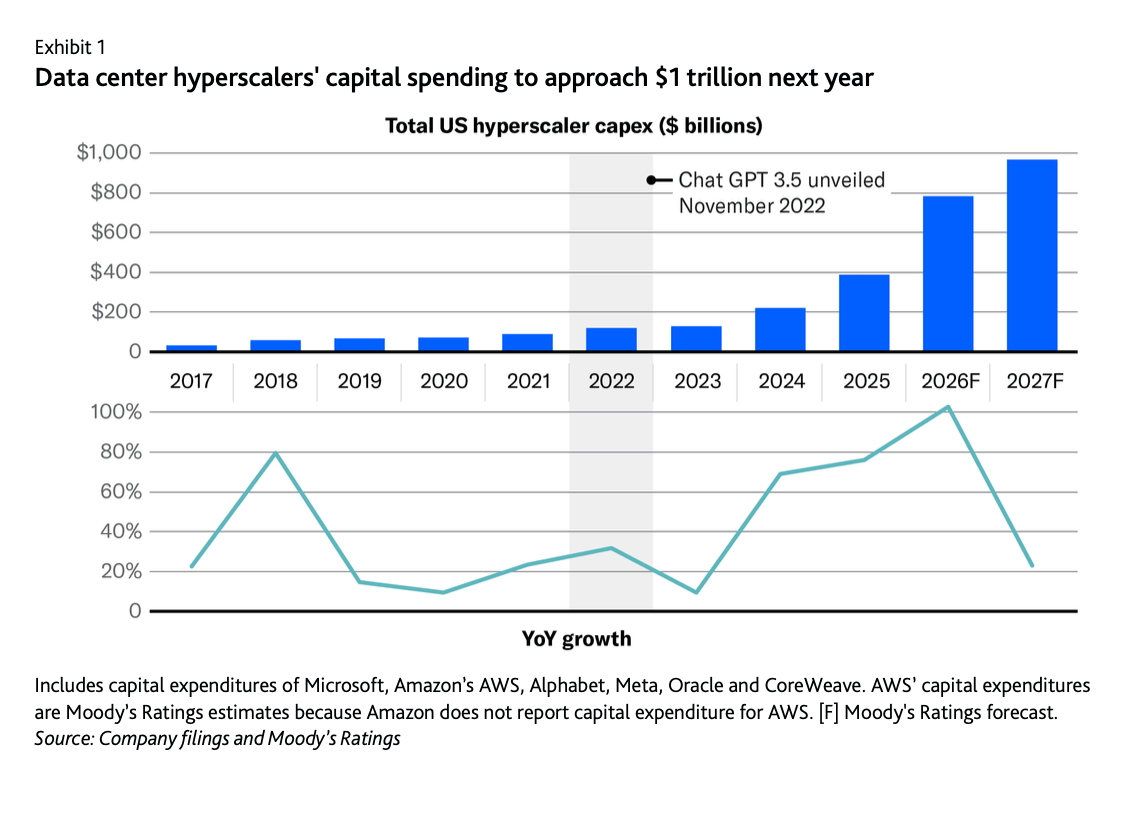
The companies funding this buildout aren’t doing it on faith. The three largest hyperscalers added roughly $700 billion in contracted revenue backlogs over just two quarters, with AI model companies like OpenAI and Anthropic so compute-starved they cannot meet existing demand. From the hyperscalers’ perspective, the economic logic is simple: the customers are there, the money is committed, and a blocked permit in rural Virginia is a routing problem, not a stop sign.

But the financial exposure underneath that confidence is substantial. Since September 2025, investment-grade hyperscalers have issued around $240 billion in debt to fund their buildout. Their three largest players carry $209 billion in operating and finance lease obligations, with an additional $379 billion in leases yet to commence — contracts that assume specific sites get built, on specific timelines.

The communities pushing back aren’t doing so on aesthetic grounds alone. Their grievances are concrete: surging local electricity demand, water consumption at industrial scale, noise, strained infrastructure, and generous tax breaks that shift the cost of all of the above onto residents. Opposition has proven to be strikingly bipartisan — a recent Gallup survey found 71% of Americans would oppose a data center in their community, a higher disapproval rate than for nuclear plants or gas facilities. Milwaukee-based comedian Charlie Berens shot a one-liner at a recent town hall: “the most bipartisan issue since beer.”

State legislators are beginning to respond. Construction moratoriums have been proposed in more than a dozen states. In Maine, a bill that would block new builds over 20 megawatts until late 2027 sits on the governor’s desk. Prince George’s County in Maryland has already enacted a full pause on data center development.

For now, hyperscalers can absorb the friction. Blocked projects represent somewhere between 8% and 20% of a single year’s capex — significant, but not structural. Moody’s identifies semiconductor shortages, not local opposition, as the more acute near-term constraint: DRAM and NAND prices are forecast to rise more than 50% in the first quarter of 2026, with data centers poised to consume nearly half of global memory supply.

But the trajectory of the opposition — doubling in organized groups, quadrupling in annual cancellations, wary state legislatures — suggests the math could shift. Big Tech has wagered $1 trillion on a buildout that depends on communities saying yes. Increasingly, they’re saying no.

For this story, Fortune journalists used generative AI as a research tool. An editor verified the accuracy of the information before publishing.