惯性聚合 高效追踪和阅读你感兴趣的博客、新闻、科技资讯
阅读原文 在惯性聚合中打开

推荐订阅源

有赞技术团队
有赞技术团队
H
Hackread – Cybersecurity News, Data Breaches, AI and More
I
InfoQ
J
Java Code Geeks
Microsoft Security Blog
G
Google Developers Blog
D
DataBreaches.Net
Recent Announcements
Microsoft Azure Blog
B
Blog RSS Feed
Y
Y Combinator Blog
博客园 - 【当耐特】
博客园 - 聂微东
奇客Solidot–传递最新科技情报
奇客Solidot–传递最新科技情报
大猫的无限游戏
大猫的无限游戏
P
Proofpoint News Feed
量子位
C
Check Point Blog
F
Fortinet All Blogs
罗磊的独立博客
Last Week in AI
Last Week in AI
GbyAI
GbyAI
L
LangChain Blog
博客园 - 司徒正美

Fortune | FORTUNE

One man can kill Bill Ackman’s $64 billion bid for Universal Music Group—and no one knows what he’ll do | Fortune Poppi’s cofounder pitched her startup on Shark Tank while 9 months pregnant and landed a $400,000 deal—now it's worth $2 billion | Fortune Teen boys are choosing AI girlfriends over real ones for 'maximum control, zero rejection'—experts say it could make them unemployable | Fortune A United American merger is by no means impossible given the president 'loves big deals' | Fortune Reed Hastings’s planned exit from $455 billion Netflix ‘had nothing to do with’ the failed deal for Warner Bros., says Ted Sarandos | Fortune Meet Joe McCann: The high-flying crypto trader held in Tanzania after sudden death of his influencer fiancée Ashly Robinson | Fortune Gen Z is carving a different path in the housing market by doing it alone | Fortune U.S. Catholic leaders criticize Trump for ‘disparaging words’ about the pope as Vatican clash risks alienating Catholic voters | Fortune China has ‘nearly erased’ America’s lead in AI—and the flow of tech experts moving to the U.S. is slowing to a trickle, Stanford report says | Fortune Self-made millionaire behind $5 billion Skims Emma Grede says it all began with a cold call to Kris Jenner: Emma Grede—the self-made millionaire behind the $5 billion Skims empire—says it all began with an audacious cold call to Kris Jenner: ‘The difference between me and someone else is, I made it happen’ | Fortune Americans have never been this gloomy about the economy. Wall Street has never cashed in harder | Fortune ‘The college grading system [is] almost meaningless’: People see the Ivy League as an easy A and with flawed admissions standards | Fortune The CEO of $8.5 billion Japanese car giant Nissan plays the drums in a band and hits the tennis courts to destress from the top job | Fortune New York governor's take on a millionaires tax: fancy pied-à-terre second apartments worth over $5 million | Fortune Pope Leo XIV: A ‘handful of tyrants’ are ravaging earth with war and exploitation | Fortune Trump has no plan to cut the $39 trillion national debt, but he does want to cut childcare. His budget director is scrambling to clarify | Fortune China's economy grows 5% in first quarter, surprising economists to the upside | Fortune Everyone was wondering what Trump wanted more: Warsh smoothly seated at the Fed, or for Powell to pay. We have our answer | Fortune Palantir exec: the biggest mistake retailers are making with AI? Trying to do it all with one agent | Fortune American YouTuber who calls himself a 'troll' sentenced to 6 months in Korean prison for literally dancing on wartime graves | Fortune BBC plans to cut up to 2,000 jobs to save 10% of annual budget | Fortune Canva debuts a new suite of agentic tools, as the design app quietly becomes one of the world’s most used AI services | Fortune Moody's CEO: AI has a trust problem – better models won’t fix it | Fortune Top New York surgeon: Americans have better data for choosing restaurants than surgeons. That has to change | Fortune The Iran war’s fertilizer shock is hammering American farmers, and 70% can’t afford what they need for this year’s growing season | Fortune Education experts to Mamdani: Why are you foisting AI on our kids? | Fortune This CEO pirated video games as a teen and became a hacker for the Air Force. Now he’s built a $3 billion cyber firm | Fortune Teacher, blame thyself: Yale report savages Ivy League schools for destroying American trust in higher education | Fortune Fed chair nominee Kevin Warsh is worth more than $100 million and has stakes in SpaceX and Polymarket | Fortune From wool sneakers to GPUs: Allbirds’ desperate AI pivot and 600% stock surge, explained | Fortune
Iran may have a higher tolerance for economic pain—but th...
Jason Ma · 2026-05-09 · via Fortune | FORTUNE

Iran’s regime has so far withstood U.S. and Israeli bombardment, but the economic forces that sparked the most serious conflict in decades have only gotten more severe.

Spiraling inflation and a collapsing currency set off mass protests in late December and early January, prompting a brutal crackdown that is estimated to have left tens of thousands dead.

Given the Iranian regime’s willingness to massacre its own people, analysts have said Tehran has a higher tolerance for economic pain than the U.S., which is trying to clinch a favorable peace deal with a naval blockade that’s choking off oil exports.

Still, the pain is excruciating, and now, even the regime is acknowledging it.

An official in Iran’s labor and social affairs ministry said the war has put a million people out of work, as top employers in the oil and manufacturing sectors have suffered damage.

Iran’s parliament speaker and top negotiator, Mohammad Bagher Ghalibaf, warned Wednesday that the U.S. blockade represented a “new phase” of war.

“The enemy has pinned great hope on economic pressure,” he said.

The government has urged Iranians to limit consumption of water, electricity and gas, while authorities in the capital called on residents use public transportation instead of their cars. Iran’s steel industry encouraged companies to ration their use of steel sheets.

First vice president Mohammad Reza Aref also admitted that prices for certain products soared by more than 100% in less than a week. The overall annual inflation rate hit 67% in mid-April from a year earlier, according to Iran’s central bank.

That tracks with assessments in mid-April, when residents of Tehran and other cities told Reuters that some prices have shot up around 40% in the six weeks after the war started.

Prior to that, food inflation had soared to an annual rate of 64% in October, then accelerated further to 105% by February, vaulting overall inflation to 47.5% on the eve of war.

A 56-year-old housewife in Tehran told the Financial Times a block of cheese jumped 29% in price in just the past week. And authorities are expected to approve a 40% price hike in cement, a critical raw material for rebuilding war damage.

Meanwhile, prosecutors in Tehran have vowed to sentence price-gougers and hoarders of staple goods to 20 years of prison and flogging, according to state-affiliated media.

The Iranian government has hiked wages, distributed cash to the poor, and issued coupons for staples like rice, chicken, and cooking oil.

But such support is further straining the government’s finances. Without an influx of funds, authorities will have trouble making payroll, eventually threatening the regime’s ability to govern Iran, an insider close to the Iranian establishment told Reuters last month.

Another Iranian official said the country “will face a disaster” if sanctions aren’t lifted as the biggest industrial plants that power the economy will take months or ​years to repair, according to Reuters.

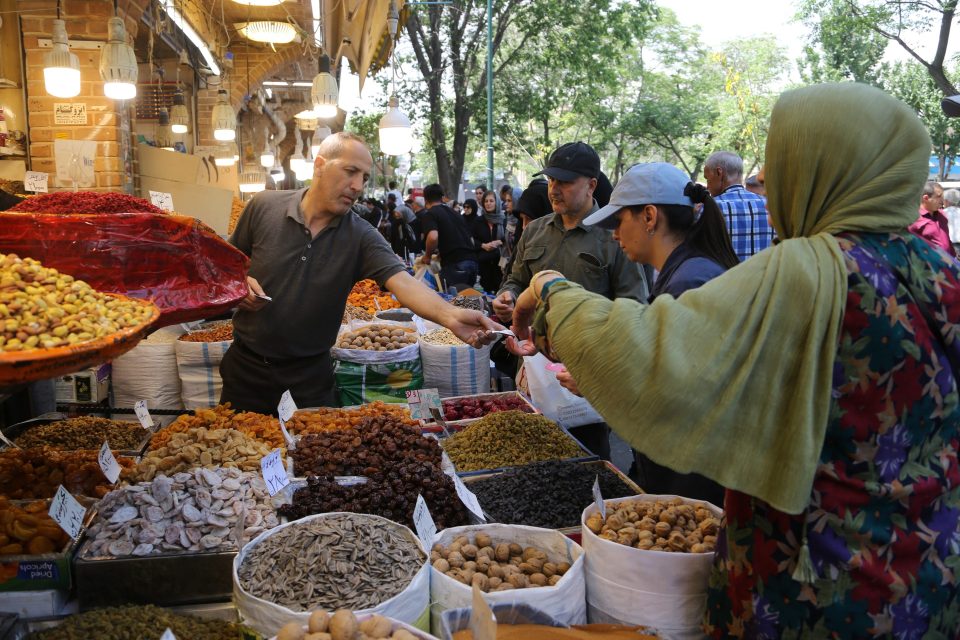
Crowds gather around the Grand Bazaar in southern Tehran on April 28, 2026..

Fatemeh Bahrami/Anadolu via Getty Images

At the same time, Iran’s currency sank to a fresh all-time low against the U.S. dollar of 1.8 million rial on Wednesday, stoking more panic over declining purchasing power.

That’s after the rial fell 8% during first month and a half of the war and lost 60% of its value in the months after the 12-day war against Israel last June.

While hopes are high that the U.S. and Iran are close to a lasting peace deal, the arduous task of rebuilding will take years.

State media estimated reconstruction could cost of around $270 billion, or nearly 80% of Iran’s entire GDP of $341 billion.

The regime also may not be able to rely on neighbors like the United Arab Emirates to facilitate oil trades and provide Iranians with capital after the war officially ends.

For now, some Iranians have taken to doom-spending with the economic outlook getting increasingly grim.

Melika, 28, who was visiting Turkey in late April, told the New York Times, that restaurants were packed despite the rest of the economy stagnating. She speculated people were enjoying the money they had, not bothering anymore to try saving it.

“Now those things are out of reach for a large portion of society,” Melika said. “So they say, ‘Why should we be hard on ourselves? Let’s at least have a nice meal.’”