
惯性聚合 高效追踪和阅读你感兴趣的博客、新闻、科技资讯
阅读原文 在惯性聚合中打开

推荐订阅源

人人都是产品经理
人人都是产品经理
MongoDB | Blog
MongoDB | Blog
Google DeepMind News
L
LangChain Blog
J
Java Code Geeks
MyScale Blog
MyScale Blog
Cyber Security Advisories - MS-ISAC
WordPress大学
WordPress大学
小众软件
小众软件
Microsoft Security Blog
OSCHINA 社区最新新闻
OSCHINA 社区最新新闻
月光博客
月光博客
aimingoo的专栏
aimingoo的专栏
F
Fortinet All Blogs
I
InfoQ
博客园 - 聂微东
量子位
A
About on SuperTechFans
S
SegmentFault 最新的问题
钛媒体:引领未来商业与生活新知
钛媒体:引领未来商业与生活新知
Apple Machine Learning Research
Hugging Face - Blog
Hugging Face - Blog
云风的 BLOG
云风的 BLOG
H
Help Net Security

Fortune | FORTUNE

One man can kill Bill Ackman’s $64 billion bid for Universal Music Group—and no one knows what he’ll do | Fortune Poppi’s cofounder pitched her startup on Shark Tank while 9 months pregnant and landed a $400,000 deal—now it's worth $2 billion | Fortune Teen boys are choosing AI girlfriends over real ones for 'maximum control, zero rejection'—experts say it could make them unemployable | Fortune A United American merger is by no means impossible given the president 'loves big deals' | Fortune Reed Hastings’s planned exit from $455 billion Netflix ‘had nothing to do with’ the failed deal for Warner Bros., says Ted Sarandos | Fortune Meet Joe McCann: The high-flying crypto trader held in Tanzania after sudden death of his influencer fiancée Ashly Robinson | Fortune Gen Z is carving a different path in the housing market by doing it alone | Fortune U.S. Catholic leaders criticize Trump for ‘disparaging words’ about the pope as Vatican clash risks alienating Catholic voters | Fortune China has ‘nearly erased’ America’s lead in AI—and the flow of tech experts moving to the U.S. is slowing to a trickle, Stanford report says | Fortune Self-made millionaire behind $5 billion Skims Emma Grede says it all began with a cold call to Kris Jenner: Emma Grede—the self-made millionaire behind the $5 billion Skims empire—says it all began with an audacious cold call to Kris Jenner: ‘The difference between me and someone else is, I made it happen’ | Fortune Americans have never been this gloomy about the economy. Wall Street has never cashed in harder | Fortune ‘The college grading system [is] almost meaningless’: People see the Ivy League as an easy A and with flawed admissions standards | Fortune The CEO of $8.5 billion Japanese car giant Nissan plays the drums in a band and hits the tennis courts to destress from the top job | Fortune New York governor's take on a millionaires tax: fancy pied-à-terre second apartments worth over $5 million | Fortune Pope Leo XIV: A ‘handful of tyrants’ are ravaging earth with war and exploitation | Fortune Trump has no plan to cut the $39 trillion national debt, but he does want to cut childcare. His budget director is scrambling to clarify | Fortune China's economy grows 5% in first quarter, surprising economists to the upside | Fortune Everyone was wondering what Trump wanted more: Warsh smoothly seated at the Fed, or for Powell to pay. We have our answer | Fortune Palantir exec: the biggest mistake retailers are making with AI? Trying to do it all with one agent | Fortune American YouTuber who calls himself a 'troll' sentenced to 6 months in Korean prison for literally dancing on wartime graves | Fortune BBC plans to cut up to 2,000 jobs to save 10% of annual budget | Fortune Canva debuts a new suite of agentic tools, as the design app quietly becomes one of the world’s most used AI services | Fortune Moody's CEO: AI has a trust problem – better models won’t fix it | Fortune Top New York surgeon: Americans have better data for choosing restaurants than surgeons. That has to change | Fortune The Iran war’s fertilizer shock is hammering American farmers, and 70% can’t afford what they need for this year’s growing season | Fortune Education experts to Mamdani: Why are you foisting AI on our kids? | Fortune This CEO pirated video games as a teen and became a hacker for the Air Force. Now he’s built a $3 billion cyber firm | Fortune Teacher, blame thyself: Yale report savages Ivy League schools for destroying American trust in higher education | Fortune Fed chair nominee Kevin Warsh is worth more than $100 million and has stakes in SpaceX and Polymarket | Fortune From wool sneakers to GPUs: Allbirds’ desperate AI pivot and 600% stock surge, explained | Fortune
The 'obscene economics' of modern warfare show how the ra...
Jason Ma · 2026-04-27 · via Fortune | FORTUNE

The Iran conflict has confirmed a transformation in the economics of warfare toward cheap, mass-produced weapons, forcing a wholesale rethinking of military procurement, according to a recent report.

While the U.S. and Israel have decimated Iran’s military, the Islamic republic still has enough combat power to inflict meaningful economic and physical damage, said Noah Ramos, chief innovation strategist at Alpine Macro, in a note earlier this month.

In particular, the regime has leveraged its Shahed drones, which cost only $20,000-50,000, forcing the U.S. and its allies to shoot them down with $4 million PAC-3 missiles or THAAD interceptors that cost $12 million-$15 million.

“Even with interception rates above 90%, the value of asset protection is diminished given the obscene economics,” Ramos wrote. “This imbalance has haunted Western military planners since the early days of Russia’s invasion of Ukraine.”

He explained that such lopsided attrition is the opposite of the West’s model of precision lethality and is a deliberate part of Iran’s strategy: mass losses are a feature not a flaw, because even the most advanced defenses can be overwhelmed with sufficient volume.

The cost asymmetry is worsened by severe production and supply-chain constraints. For example, no new THAAD interceptors have been delivered since August 2023, and the next batch is due in April 2027.

At the same time, the U.S. has rapidly drawn down stockpiles of its most expensive munitions during the Iran war. The Center for Strategic and International Studies put the tally at 45% of its Precision Strike Missiles, 50% of its THAAD interceptors, and almost half of its of PAC-3 missiles. CSIS estimated it would take one to four years to restock seven major munitions to prewar levels.

“The diminished munitions stockpiles have created a near-term risk,” the report said. “A war against a capable peer competitor like China will consume munitions at greater rates than in this war. Prewar inventories were already insufficient; the levels today will constrain U.S. operations should a future conflict arise.”

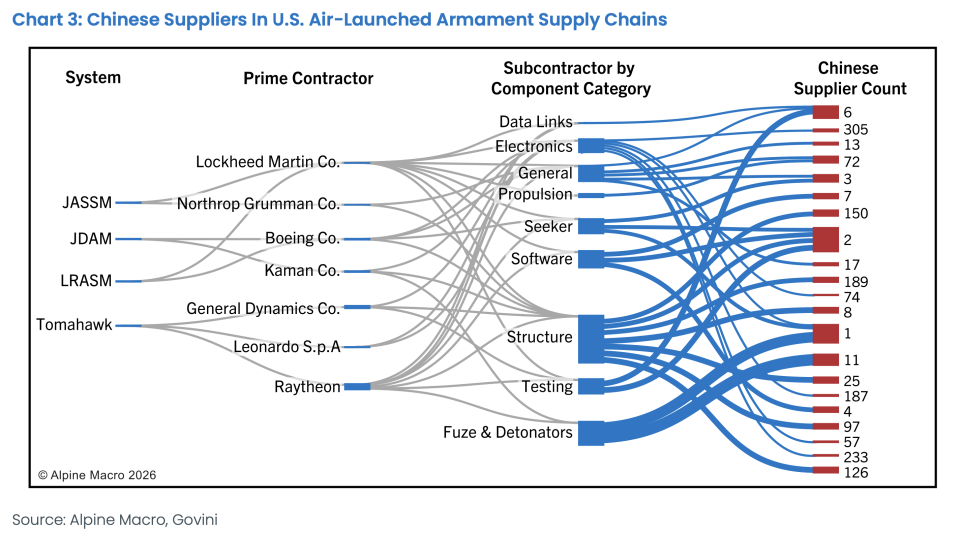
In fact, Alpine Macro’s Ramos pointed out that many critical components for a variety of U.S. munitions are deeply exposed to Chinese supply chains.

That includes the stealthy Joint Air-to-Surface Standoff Missile, the Tomahawk cruise missile, the Long-Range Anti-Ship Missile, and the Joint Direct Attack Munition guidance kit.

The U.S. military’s reliance on Chinese suppliers “poses a grave threat given geopolitical fragmentation or a conflict over Taiwan,” Ramos warned.
Despite the emergence of mass-produced munitions, Ramos still expects legacy platforms like fighter jets, strategic bombers, precision missiles, and warships to continue enabling force projection.

Rather than displacing so-called “exquisite” weapons, the more expendable systems will sit along side them and even amplify them, he predicted.

Cheaper weapons can exploit specific vulnerabilities, prevent expensive assets from being depleted, and carry out riskier missions unsuitable for traditional platforms, Ramos suggested.

“Going forward, supremacy will belong to the force that deploys the right tool for the right task at the right cost, not the one that defaults to multi-billion dollar platforms for every engagement,” he added. “The Iran conflict is proving this in real time.”

The Pentagon also understands the new economics of warfare that bring to mind a quote attributed to Joseph Stalin during World War II as he weighed the Red Army’s numerical advantage against Nazi Germany’s superior weapons: “quantity has a quality all its own.”

Efforts at cheaper, mass-produced platforms are underway while upstart defense contractors like Anduril are developing manufacturing innovations to enable hyperscale production.

The U.S. has even incorporated a copycat version of the Shahed drone, using the American version against Iran during the war. Emil Michael, the undersecretary of defense for research and engineering, said at an industry conference last month that the Pentagon plans to go big with the LUCAS drone.

“After only a few years, we continue to refine that and make that something that we can mass produce at scale,” he said. “They’ve worked very well so far and it’s proven out to be a useful tool in the arsenal.” 
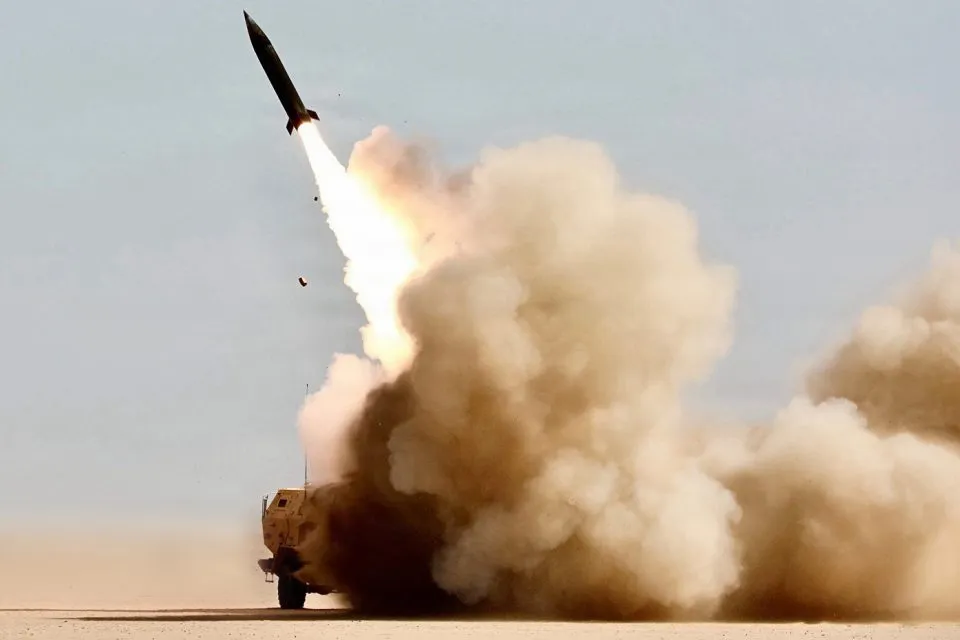
M142 High Mobility Artillery Rocket Systems (HIMARS) conduct live-fire missions during Operation Epic Fury in the U.S. Central Command area of responsibility.

U.S. Army