


惯性聚合 高效追踪和阅读你感兴趣的博客、新闻、科技资讯
阅读原文 在惯性聚合中打开

推荐订阅源

cs.AI updates on arXiv.org
WordPress大学
WordPress大学
宝玉的分享
宝玉的分享
人人都是产品经理
人人都是产品经理
博客园 - 聂微东
IT之家
IT之家
V
V2EX
Jina AI
Jina AI
V
Visual Studio Blog
有赞技术团队
有赞技术团队
博客园 - 司徒正美
博客园 - 叶小钗
The Cloudflare Blog
cs.CV updates on arXiv.org
小众软件
小众软件
奇客Solidot–传递最新科技情报
奇客Solidot–传递最新科技情报
博客园 - 三生石上(FineUI控件)
OSCHINA 社区最新新闻
OSCHINA 社区最新新闻
Google DeepMind News
钛媒体:引领未来商业与生活新知
钛媒体:引领未来商业与生活新知
腾讯CDC
Google Online Security Blog
博客园 - 【当耐特】
Apple Machine Learning Research
K
KPMG report finds enterprise disconnect between AI and its ROI | CIO
N
News and Events Feed by Topic
N
News and Events Feed by Topic
The Last Watchdog
The Last Watchdog
W
WeLiveSecurity
月光博客
月光博客
Security Archives - TechRepublic
Webroot Blog
Webroot Blog
SecWiki News
SecWiki News
博客园_首页
罗磊的独立博客
量子位
Latest news
Latest news
I
Intezer
V
Vulnerabilities – Threatpost
A
Arctic Wolf
Last Week in AI
Last Week in AI
Recent Commits to openclaw:main
S
SegmentFault 最新的问题
S
Security Affairs
阮一峰的网络日志
阮一峰的网络日志
让小产品的独立变现更简单 - ezindie.com
酷 壳 – CoolShell
酷 壳 – CoolShell
P
Palo Alto Networks Blog
C
CXSECURITY Database RSS Feed - CXSecurity.com
N
News | PayPal Newsroom

Fortune | FORTUNE

One man can kill Bill Ackman’s $64 billion bid for Universal Music Group—and no one knows what he’ll do | Fortune Poppi’s cofounder pitched her startup on Shark Tank while 9 months pregnant and landed a $400,000 deal—now it's worth $2 billion | Fortune Teen boys are choosing AI girlfriends over real ones for 'maximum control, zero rejection'—experts say it could make them unemployable | Fortune A United American merger is by no means impossible given the president 'loves big deals' | Fortune Reed Hastings’s planned exit from $455 billion Netflix ‘had nothing to do with’ the failed deal for Warner Bros., says Ted Sarandos | Fortune Meet Joe McCann: The high-flying crypto trader held in Tanzania after sudden death of his influencer fiancée Ashly Robinson | Fortune Gen Z is carving a different path in the housing market by doing it alone | Fortune U.S. Catholic leaders criticize Trump for ‘disparaging words’ about the pope as Vatican clash risks alienating Catholic voters | Fortune China has ‘nearly erased’ America’s lead in AI—and the flow of tech experts moving to the U.S. is slowing to a trickle, Stanford report says | Fortune Self-made millionaire behind $5 billion Skims Emma Grede says it all began with a cold call to Kris Jenner: Emma Grede—the self-made millionaire behind the $5 billion Skims empire—says it all began with an audacious cold call to Kris Jenner: ‘The difference between me and someone else is, I made it happen’ | Fortune Americans have never been this gloomy about the economy. Wall Street has never cashed in harder | Fortune ‘The college grading system [is] almost meaningless’: People see the Ivy League as an easy A and with flawed admissions standards | Fortune The CEO of $8.5 billion Japanese car giant Nissan plays the drums in a band and hits the tennis courts to destress from the top job | Fortune New York governor's take on a millionaires tax: fancy pied-à-terre second apartments worth over $5 million | Fortune Pope Leo XIV: A ‘handful of tyrants’ are ravaging earth with war and exploitation | Fortune Trump has no plan to cut the $39 trillion national debt, but he does want to cut childcare. His budget director is scrambling to clarify | Fortune China's economy grows 5% in first quarter, surprising economists to the upside | Fortune Everyone was wondering what Trump wanted more: Warsh smoothly seated at the Fed, or for Powell to pay. We have our answer | Fortune Palantir exec: the biggest mistake retailers are making with AI? Trying to do it all with one agent | Fortune American YouTuber who calls himself a 'troll' sentenced to 6 months in Korean prison for literally dancing on wartime graves | Fortune BBC plans to cut up to 2,000 jobs to save 10% of annual budget | Fortune Canva debuts a new suite of agentic tools, as the design app quietly becomes one of the world’s most used AI services | Fortune Moody's CEO: AI has a trust problem – better models won’t fix it | Fortune Top New York surgeon: Americans have better data for choosing restaurants than surgeons. That has to change | Fortune The Iran war’s fertilizer shock is hammering American farmers, and 70% can’t afford what they need for this year’s growing season | Fortune Education experts to Mamdani: Why are you foisting AI on our kids? | Fortune This CEO pirated video games as a teen and became a hacker for the Air Force. Now he’s built a $3 billion cyber firm | Fortune Teacher, blame thyself: Yale report savages Ivy League schools for destroying American trust in higher education | Fortune Fed chair nominee Kevin Warsh is worth more than $100 million and has stakes in SpaceX and Polymarket | Fortune From wool sneakers to GPUs: Allbirds’ desperate AI pivot and 600% stock surge, explained | Fortune The Sam Altman attack is putting two anti-AI groups under scrutiny—but the story is more complicated | Fortune Elizabeth Warren on her proposal to bring back IRS Direct File: ‘For just one day of bombing Iran, we could pay for 20 years’ | Fortune ‘I am certain’: Harvard policy expert warns the true cost of the Iran war to U.S. taxpayers will exceed $1 trillion | Fortune The CEO of a $24 billion Dutch lender has sandwiches once a week with the staff to hear their views and get them on side with cost cuts | Fortune Why insurance giant Travelers' CTO is placing fewer, bigger bets on AI | Fortune Current price of oil as of April 15, 2026 | Fortune The dirty secret behind Big Tech’s AI arms race: Massive hardware investments that are obsolete in 3 years | Fortune Dow’s CEO handoff elevates an insider and seasoned operator | Fortune Anthropic faces user backlash over reported performance issues with its Claude AI chatbot | Fortune Stock futures sink while oil spikes as the U.S. Navy looks to squeeze Iran's economy and break its grip on the Strait of Hormuz | Fortune A major U.S. gasoline production hub is in such a severe drought that its refineries may be hobbled. 'We are actively praying for a hurricane' | Fortune U.K. won’t take part in Trump’s planned blockade of Hormuz strait | Fortune Hungarian voters oust Viktor Orbán, a close ally of Trump and Putin, despite late campaign push from JD Vance | Fortune Blazing hot IPOs, an AI agent craze, and a new word for ‘token’: Here’s what’s happening in the world of Chinese AI | Fortune Iran’s crumbling economy is the regime’s greatest weakness with prices up 40% since the war began while authorities worry about making payroll | Fortune Here’s how a U.S. naval blockade of the Strait of Hormuz could work. ‘This is a big task, and it’s a big gamble’ | Fortune Intuit was an AI pioneer. Why its stock became a SaaSpocalypse casualty | Fortune Artemis III will practice docking Orion with lunar landers in Earth orbit next year while Musk’s Starship and Bezos’ Blue Moon compete for Artemis IV | Fortune Oil tankers U-turn in Hormuz as U.S.-Iran talks break down Saudi Arabia says East-West pipeline restored to full capacity In 2011, Barack Obama said it was time to ‘pivot’ to Asia. But 15 years later, the U.S. is still at war in the Middle East Trump says U.S. Navy to impose Hormuz blockade after Iran ceasefire talks end with no deal. ‘No one who pays an illegal toll will have safe passage’ This TikTok sensation sold her startup for $2 billion. Now Pepsi is letting ‘Poppi be Poppi’ ‘Almost unmanageable’: Raising a child in the U.S. now costs more than $300,000 As Iran peace talks fail, Trump and Joe Rogan watch a hobbled fighter triumph in a brutal cage match Haiti stares down starvation as Iran War drives 200,000 into acute food emergency status ‘I just keep seeing a lot of different aspects of life getting more expensive’: New car prices are up 30% over 6 years America is not ready for its own longevity crisis — and 2026 is the wake-up call | Fortune JD Vance leaves Pakistan after marathon talks with Iran end without a deal as Tehran refuses U.S. demand not to develop nuclear weapons | Fortune Average price of new cars nears $50,000 as automakers focus on big pickups and SUVs while cheaper sedans get phased out | Fortune Navy tests Hormuz blockade as expert says U.S. military prepares for round 2 and could degrade Iran’s hold over the strait to a ‘manageable level’ | Fortune Pakistan sends military force to Saudi Arabia as part of pact | Fortune Three oil supertankers sail through the Strait of Hormuz | Fortune Trump downplays talks for ceasefire deal with Iran, claiming military victory. 'It doesn’t matter. From the standpoint of America, we win' | Fortune Boeing’s moon rocket faces uncertain future under Trump’s NASA | Fortune Appeals court says national security implications of halting White House ballroom construction must be weighed | Fortune Some of cheapest fuel can be found on Native American reservations as tribes are exempt from state gas taxes | Fortune JD Vance begins talks with Iran in Pakistan while Trump claims U.S. has begun 'clearing out' the Strait of Hormuz | Fortune 'This is the last warning.' Iran threatens U.S. warships after they throw down the gauntlet for winner-take-all Strait of Hormuz | Fortune U.S. Navy ships transit Hormuz ahead of mine-clearing mission | Fortune Over a third of Ireland's fuel stations are empty and truck and tractor drivers are protesting nationwide | Fortune Some communities are enduring unprecedented long waits on federal disaster requests, and Democrat-led states say they're being denied | Fortune These niche AI startups are trying to protect the Pentagon’s secrets | Fortune Former Tesla president reveals the ‘single most important thing’ you can do for your career—it’s a habit Elon Musk and Warren Buffett share too | Fortune Ingersoll Rand CEO: here's how employee ownership helped drive more than 8x enterprise value growth | Fortune The petrodollar faces increased risk, but a petroyuan is ‘far-fetched’ as fears of U.S. losing superpower status are overhyped, strategist says | Fortune Palantir CEO says AI ‘will destroy’ humanities jobs, but there will be ‘more than enough jobs’ for people with vocational training | Fortune Warren Buffett says 'accumulating great amounts of money' doesn’t achieve greatness—He still lives in a $31,500 Nebraska home and clipped coupons | Fortune Starbucks' game plan to roll out AI chatbots at cafes could serve as a 'litmus test' for the industry, analyst says | Fortune Data centers and gas demand make boring pipelines great again | Fortune The 'Tuscan Mom' aesthetic is taking over TikTok as Gen Z glamorize McMansions and reject millennial gray | Fortune Man's best friend may soon live a little longer thanks to a new pill promising to extend your pup's lifespan | Fortune Danantara CIO: Indonesia can anchor the AI and energy economy—if governance keeps pace | Fortune OpenAI’s TBPN deal shows how talent, media, and influence are collapsing into one | Fortune AI promises to free workers from grunt work, but psychologists say those mindless tasks are exactly what our brains need to recover | Fortune The 'affordability economy' has created a housing market nobody predicted: Prices collapsing in the Sun Belt, soaring in the Rust Belt | Fortune 'It’s 13 minutes of things that have to go right': Artemis II splashes down despite faulty heat shield | Fortune Fed seeks details on U.S. banks' exposure to private credit firms | Fortune The Navy confirmed an ‘abundant amount’ of Uncrustables when the Artemis II crew lands. Smucker’s just offered them a lifetime supply | Fortune Meet ‘trendslop,’ the new, AI-fueled scourge of workplace consultants everywhere | Fortune Amazon is still paying Jeff Bezos an $80,000 yearly salary—but $1.6 million for travel and security | Fortune Trump-backed World Liberty Financial crypto tokens reach all-time low on reports of insider loans | Fortune Iran is demanding tankers in the Strait of Hormuz pay tolls in crypto: What we know so far | Fortune First they went after medtech, then Kash Patel. Iranian hackers’ next target is likely ‘low-hanging fruit’ in water, energy, and tourism, experts say | Fortune The AI that found 27-year-old vulnerabilities no human ever caught before just forced an emergency meeting with every major Wall Street CEO | Fortune Inflation goes up by a whopping monthly rate of nearly 1%—and it’s hitting you at the grocery store and gas station | Fortune H&R Block is betting it can be more than a tax company | Fortune The real engine of innovation is trust | Fortune Huntington is powering digital growth—by opening a branch almost every 2 weeks, says CFO | Fortune How the 173-year-old glass-maker behind Edison's light bulb and iPhone screens became a Silicon Valley darling | Fortune
From Hobbes to the 14th amendment: The ancient and modern cases against Trump's $1.8 billion fund | Fortune
Austin Sarat · 2026-05-24 · via Fortune | FORTUNE

Hobbes, one of the finest political theorists of his time, said this in his great political treatise, “Leviathan,” published in 1651 during a civil war in England and Scotland.

Hobbes would likely also take a dim view of a major development announced by the Trump administration on May 20, 2026.

The U.S. Department of Justice has established a $1.776 billion “Anti-Weaponization Fund,” to be used, the AP reports, to “allow people who believe they were targeted for prosecution for political purposes, including by the Biden administration Justice Department, to apply for payouts.”

The fund, Acting Attorney General Todd Blanche said, offers “a lawful process for victims of lawfare and weaponization to be heard and seek redress.”

The establishment of the fund is part of a settlement agreement, in response to which President Donald Trump dropped his $10 billion lawsuit against the Internal Revenue Service for damages stemming from the leak of his tax returns. Those leaks, the lawsuit alleged, “caused Plaintiffs reputational and financial harm, public embarrassment, unfairly tarnished their business reputations, portrayed them in a false light, and negatively affected President Trump.”

A DOJ press release indicates the fund will provide “formal apologies and monetary relief” to those who file claims and will cease processing claims “no later than” Dec. 1, 2028. It will be run by a five-person board appointed by the attorney general, and the president will also have the power to remove board members.

Whether or not Jan. 6 participants benefit, some believe that this situation creates an unavoidable appearance of self-dealing and favoritism. As a student of American law and political morality, I think there are important moral and constitutional issues implicated by the president’s suit against the IRS and the creation of the Anti-Weaponization Fund.

Some of them are straightforward; others are less so.
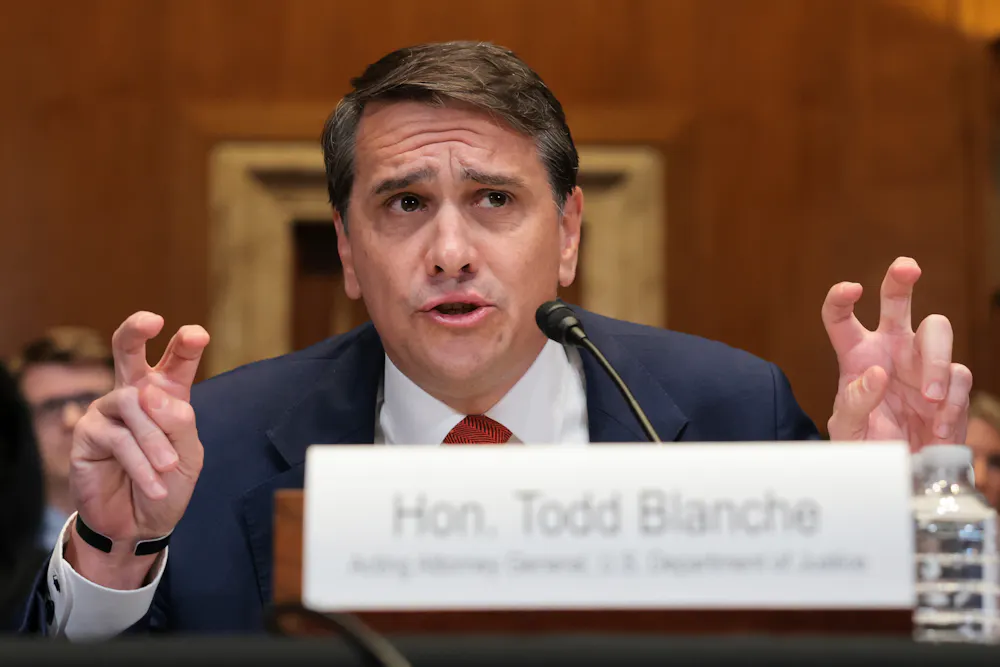
A man talking at a table behind a name plate, gesturing with his fingers.
Acting U.S. Attorney General Todd Blanche testified about the compensation fund during a Senate Committee on May 19, 2026, in Washington, D.C. Anna Moneymaker/Getty Images

A judge in their own cause

An obvious question is: Should taxpayer funds be given to Trump allies, in a settlement reached by the Trump-controlled DOJ as compensation for a Trump family lawsuit?

As far back as ancient Greece, philosophers like Aristotle have worried about what happens when people are called on to make judgments in cases where they are involved. Aristotle thought that the natural instinct for self-preservation meant that they would always favor themselves.

From that concern emerged what was then, and remains, an uncontroversial, bedrock moral principle.

In the Roman world, the Latin phrase “Nemo iudex in causa sua” meant “no one should be a judge in their own cause.” It recognized that anyone having a personal interest should not get to decide matters in which they are involved.

In the Englsh-speaking world, Hobbes himself reiterated that phrase as he explained some of the advantages of living in an organized society, which could supply impartial judges to resolve disputes. And in 1787, James Madison wrote, “No man is allowed to be a judge in his own cause, because his interest would certainly bias his judgment, and, not improbably, corrupt his integrity.”

Commentators reacting to the Justice Department’s decision to establish an Anti-Weaponization Fund to settle the president’s claims against the IRS have drawn on these longstanding principles to criticize it, including how the DOJ, which is part of the executive branch controlled by Trump, negotiated with him to reach this settlement.

The conservative lawyer and activist Ed Whelan said, “There is a glaring conflict of interest with Trump being on both sides of the claim.” Whelan added, “It is outrageous that he and those answering to him would be deciding how the government responds to these extravagant claims.”

In testimony on May 19, 2026, before the Senate Appropriations Committee, Blanche offered a different view. He said the settlement fund was not unprecedented and likened it to a different fund, established by the Obama administration, to settle discrimination claims brought by Native American and Black farmers.

“It’s not limited to Republicans. It’s not limited to Democrats,” Blanche added. “It’s not limited to January 6th defendants. It’s limited only by the term weaponization.” Blanche promised that payments from the fund will be publicly disclosed.

Negotiating with himself

In April, Kathleen Williams, the Florida federal judge who was presiding over Trump’s lawsuit, reframed the moral issue of self-dealing as a legal one. She questioned whether the case could go on, noting “President Trump’s own remarks about this matter acknowledge the unique dynamic of this litigation.”

The remarks she referenced occurred when the president talked about the lawsuit and the prospect of negotiating with himself. “And they do say that, you know, it’s never been a case like this. Donald Trump sues the United States of America. Donald Trump becomes president, and now Donald Trump has to settle the suit.”

Williams, the judge, wrote that “it is unclear to this Court whether the Parties are sufficiently adverse to each other so as to satisfy Article III’s case or controversy requirement.” That requirement means that a court can only rule when there is a real dispute before it.

That rule is designed to prevent so-called collusive lawsuits, in which “the parties are not actually in disagreement but are cooperating” to achieve a result. Judge Williams was scheduled to hear arguments on that question on May 20, 2026. But the settlement announcement was made two days before, and, in light of it, she dismissed the case.

Back to Hobbes

Beyond the case and controversy question, the Justice Department’s actions may implicate constitutional issues.

One is whether, under the constitutional separation of powers, the executive branch has the authority to create a victim compensation fund, or whether that authority rests with Congress.

Another is whether the fund violates the Constitution’s Emoluments Clause, which prohibits the president from receiving any “Emolument from the United States” other than his salary.

While the new fund may not make direct payments to Trump, he may benefit from payments to family members, business associates and others who will claim to have been victimized by the Biden administration, including people prosecuted and convicted of crimes committed on Jan. 6.

Democratic Congressman Jamie Raskin, a former professor of constitutional law, also contends that what the Justice Department has done violates Section 4 of the 14th Amendment, part of which states: “neither the United States nor any State shall assume or pay any debt or obligation incurred in aid of insurrection or rebellion against the United States.”

Referring to the president, Raskin argues hypothetically, “So, to the extent that he wants to give a million dollars to each of 1,600 pardoned rioters and insurrectionists, we think that that’s an unconstitutional use of money.”

That section of the 14th Amendment was designed to ensure that Confederate rebels would not receive compensation for the value of their emancipated slaves. However, in Perry v. United States, a 1935 case, the Supreme Court stated that Section 4’s “language indicates a broader connotation” beyond its Civil War context.

It seems clear that courts will soon be asked to decide whether Raskin and other legal critics are right in their assertions of a host of legal problems with the Anti-Weaponization Fund. How they will do so remains to be seen.

But, in a democracy, deciding whether the creation of the fund violates the moral maxim that no one can be a judge in his or her own cause ultimately will be up to the people.

Austin Sarat, William Nelson Cromwell Professor of Jurisprudence and Political Science, Amherst College

This article is republished from The Conversation under a Creative Commons license. Read the original article.

The Conversation