Spy satellite hardware has been repurposed to scan the Universe in the infrared.
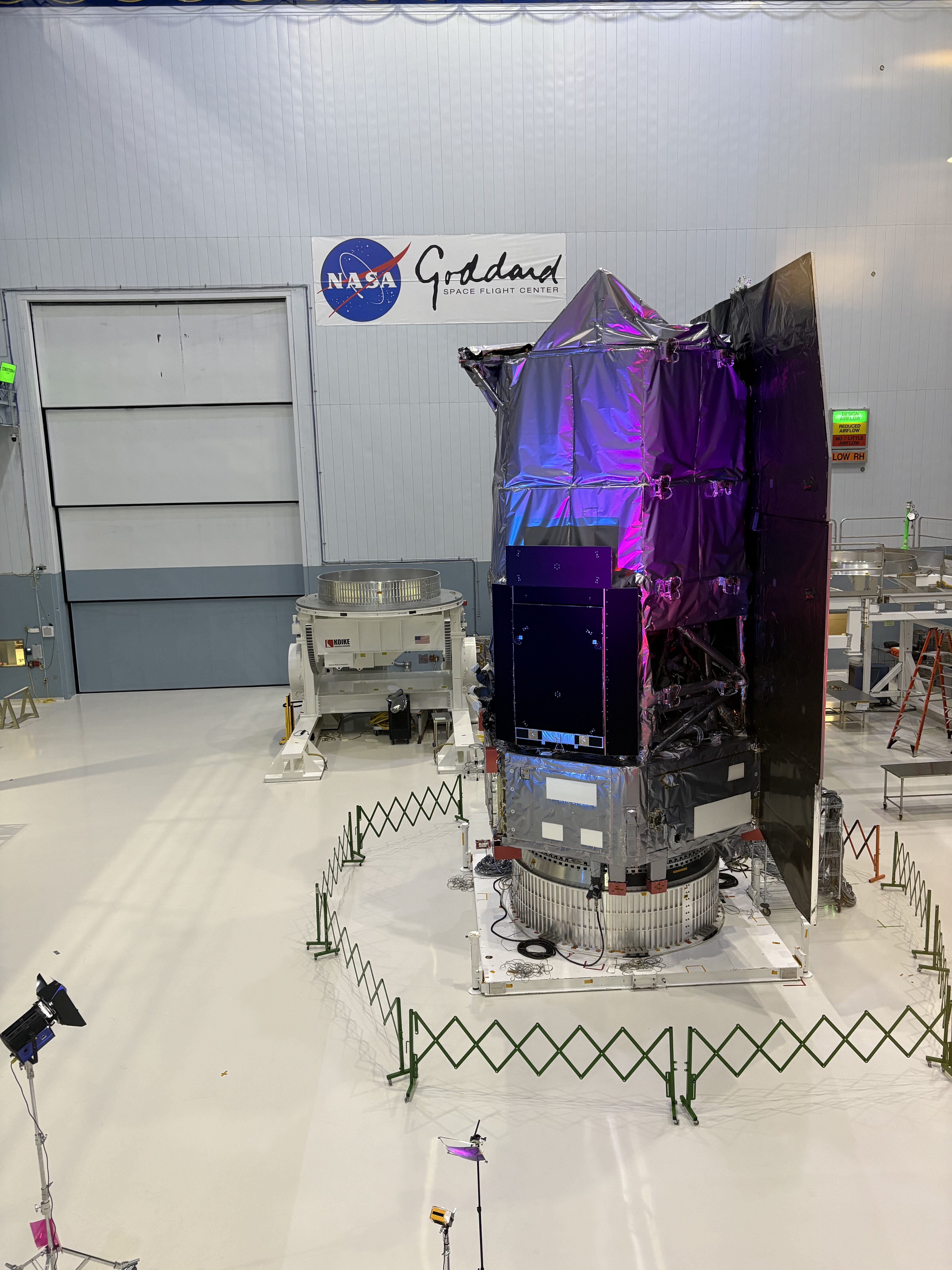
GREENBELT, Md.—On Tuesday, NASA invited the press to look at the fully assembled Nancy Grace Roman Space Telescope, which is now ready to join the ranks of the great observatories in orbit, ahead of its September launch. The Roman Space Telescope (NGRST), named after a key figure in the planning of the Hubble Space Telescope, is notably distinct from hardware like the Hubble and Webb, as it’s designed around a wide-field view and massive imaging system that will allow it to send back 1.4 terabytes of data to Earth every day.
It also has an unusual history that began when NASA’s planning intersected with surplus spy hardware.
In from the cold
Many of the gases in our atmosphere absorb infrared wavelengths, contributing to the greenhouse effect that has helped keep the planet habitable for us. But that effect also makes infrared astronomy from Earth extremely difficult. That’s unfortunate, as a number of important phenomena, from the earliest galaxies to the features of exoplanet atmospheres, are only detectable at infrared wavelengths. There have been a number of infrared-specific telescopes put into space, notably the Spitzer, one of the original suite of Great Observatories.
But those telescopes were largely designed to provide high-resolution imaging of a tiny slice of the sky. There was also a call for a survey telescope capable of imaging large swaths of the sky simultaneously. In the infrared, this could do everything from revealing the large-scale structure of the early Universe to cataloging far more of the asteroids orbiting in Earth’s vicinity. NASA eventually adopted the idea as a priority in the form of WFIRST, the Wide Field Infrared Survey Telescope.
Around the same time, the National Reconnaissance Office decided that two of its spy satellites were surplus to requirements and offered the hardware to NASA. By the time the news broke, NASA had already recognized that the hardware could work for WFIRST. NASA’s Mark Melton told Ars that WFIRST designs at the time used a 1.5-meter telescope; the NRO hardware was almost twice that size. This required scaling up a lot of the hardware—the present NGRST easily extended past the second story of the building it was housed in—but it also provided higher-resolution imaging and more space for some of the imaging hardware.
Since the rethink, things have gone incredibly smoothly. At the time of the hardware gift in 2012, estimates suggested that the earliest we could see a launch was earlier this decade. It’s only a bit beyond that highly optimistic estimate, and NASA Administrator Jared Isaacman told the press that the September launch would be “eight months ahead of schedule and under budget.” There was a lot of discussion about how the lessons learned here might inform future NASA projects.
What’s going to space?
The NGRST will carry just two instruments. The first is its Wide Field Instrument, meant to capture a huge portion of the sky at once. NASA compares the size of its field of view to that of a full Moon; it’s roughly 100 times wider than the largest images Hubble can capture. That will be paired with an array of 18 individual detectors, each capable of capturing 4096 x 4096 pixels.
The result is that a complete NGRST survey image will be enormous. NASA astronomer Julie McEnery said that using 4K displays to display it at single-pixel resolution would require enough TVs to cover the surface of El Capitan in Yosemite—hence the enormous bandwidth needed to get those images back to Earth.
Sitting between the mirrors and the imaging device will be a carousel of filters that limit which wavelengths get through. The carousel also includes both a prism and grism (a planar prism) that will allow the telescope to do spectroscopy, giving us a picture of what wavelengths of light are arriving from certain sources or how severely redshifted the light of distant objects has become.
The second instrument is a Coronagraph, which blocks out a star in the center of the field of view, allowing nearby orbits to be directly imaged, even if they are far dimmer than the star. The effectiveness of the coronagraph will determine just how close to the star an object can be imaged. The one flying on the NGRST will be the first time a coronagraph with active elements—components that can progressively adjust to decrease the light coming from the star—will be used on a space-based observatory.
Scientifically, it will be used to image exoplanets in distant orbits from their stars. But it also serves an engineering purpose: starting the development of a coronagraph for the planned Habitable Worlds Observatory that will need to be 100 times more effective at blocking out stars.
Compared to something like the Webb Telescope, Roman is also delightfully simple. It has relatively few moving parts that need to be deployed once in space, and those that exist, like the solar arrays and high-gain antenna, are simple spring-loaded devices. Once latches are released, they’ll simply open into place, a process that NASA’s Melton said will start as soon as 20 minutes after the NGRST separates from the launch vehicle. Commissioning is planned to take only 90 days, and Melton told Ars that it could be doing science before it completes the final burn to put it into orbit around the L2 Lagrange point.
He said the fuel needed to keep it in orbit will be the primary factor limiting the observatory’s life. Using very conservative estimates of its rate of use, NGRST will be sent to space with 10 years of fuel, so barring a major hardware failure, it’s likely to be operational for quite a bit longer.
What will we be looking for?
One of the key targets of the NGRST surveys is what are called baryon acoustic oscillations. In the extremely early Universe, matter was dense enough that sound waves could create interference patterns in the material, with areas forming that had higher or lower densities than average. As the Universe expanded, these patterns were frozen into place and ultimately formed regions with a higher or lower density of galaxies.
Identifying these patterns at large scales can tell us about the composition of the Universe, including the factors that shape most of its structure: dark matter and dark energy. Tracking how they evolve over time could also help us determine whether dark energy is changing with time rather than being in constant acceleration. There have been hints that some details of our understanding of these factors are wrong, and the NGRST will provide an independent measure of them.
In addition to directly imaging exoplanets, the NGRST will conduct a microlensing survey to detect them. This effort will focus on the galactic bulge, where star density is much higher, and will take advantage of the fact that a planet can act as a small gravitational lens, briefly brightening any background stars that pass between it and Earth.
These events are very brief, often only a few hours, and NGRST will repeatedly observe the same locations at a 15-minute cadence, providing the opportunity to capture much of the curve of the brightening and dimming. That will often be accompanied by the lensing event produced by the planet’s host star, but we’re also expecting to capture some “rogue planets” that have been ejected from extrasolar systems and are floating freely through space. In any case, the expectation is that we’ll identify tens of thousands of planets in this survey, most of them further from the host star than the ones spotted by Kepler.
Those are the planned targets for now. There will also be time set aside for individual research proposals that may find additional uses for the hardware. But there was a clear sense that we were likely to either find something entirely new with the RST or be able to use it to help tackle future problems. McEnery summed everything up by saying, “I very much hope and in fact expect that the most exciting science from Roman is going to be the things that we didn’t expect that we couldn’t predict, but that will set the new, deep questions [for] future missions to address.”

John is Ars Technica's science editor. He has a Bachelor of Arts in Biochemistry from Columbia University, and a Ph.D. in Molecular and Cell Biology from the University of California, Berkeley. When physically separated from his keyboard, he tends to seek out a bicycle, or a scenic location for communing with his hiking boots.