
惯性聚合 高效追踪和阅读你感兴趣的博客、新闻、科技资讯
阅读原文 在惯性聚合中打开

推荐订阅源

WordPress大学
WordPress大学
The Cloudflare Blog
大猫的无限游戏
大猫的无限游戏
小众软件
小众软件
V
Visual Studio Blog
钛媒体:引领未来商业与生活新知
钛媒体:引领未来商业与生活新知
博客园 - 司徒正美
OSCHINA 社区最新新闻
OSCHINA 社区最新新闻
酷 壳 – CoolShell
酷 壳 – CoolShell
奇客Solidot–传递最新科技情报
奇客Solidot–传递最新科技情报
月光博客
月光博客
The GitHub Blog
The GitHub Blog
L
LangChain Blog
D
DataBreaches.Net
T
The Blog of Author Tim Ferriss
F
Fortinet All Blogs
博客园 - Franky
阮一峰的网络日志
阮一峰的网络日志
GbyAI
GbyAI
Apple Machine Learning Research
宝玉的分享
宝玉的分享
Engineering at Meta
Engineering at Meta
V
V2EX
MyScale Blog
MyScale Blog

South China Morning Post

Singapore drama sparks Malaysian ire over scam hub depiction Time to act on stalled proposal toughening child abuse penalties, lawmakers say ‘Eager to explore’: Chinese migrants return to Venezuela after Maduro’s capture ‘We have no trust in the other side’: Iran blames US as talks end with no deal Opinion | Why securing Hong Kong’s economic future is a cultural question Hong Kong’s ministerial team spent HK$46.6 million on visits in past 3 years China family creates AI clone to comfort elderly mum after only son dies in crash Canada Olympic star Williams plans on ‘having a ‘blast’ at Hong Kong Sevens Singapore’s robotaxi drive revs up with help from Chinese AV leaders Editorial | Making Hong Kong desirable to overseas students must be a priority All 7 are dentists and hot. The Asian-American family blowing up social media Editorial | Ageing Hong Kong should welcome more open conversations around death My Take | Discovery Bay will never be the same if the restriction on taxi access is lifted Medical intern suspended after complaint over patient data in social media post Fish and vegetarianism major flashpoints in India’s West Bengal election Chinese crystal ‘paves way’ for GPS-free thorium clock navigation SCMP Best Bets: Endued can show his quality at Sha Tin Russia and Ukraine begin 32-hour ceasefire for Orthodox Easter Israeli spy firm Black Cube involved in Cyprus corruption probe ‘A big deal’: military drills show Tokyo’s growing focus on deterring China China targets middlemen in renewed crackdown on ‘hidden’ corruption Hong Kong-born gymnast leading quest to turn Singapore into elite hub Thais celebrate new year despite fuel price shocks delaying travel Harry Bentley tees up two good chances in Smart Golf and Elite Golf at Sha Tin Is this Kenyan rail project a model for Chinese and Western firms in Africa? Unearthing peace: ancient China gravesite reveals significance of broken weapons Meet Queen Elizabeth’s youngest grandchild, James, who was at Easter service Turtle found dead after apparent fall in Hong Kong’s Wong Tai Sin Landlords of 5,557 subdivided homes seek 3-year grace period to fix flats Trump critique pauses UK handover of Chagos Islands to Mauritius
Meet the professors advancing digital safety and molecula...
Morning Studio editors · 2026-05-29 · via South China Morning Post

Digital spaces and molecular bonds may not seem to have much in common. But for two leading academics at Hong Kong Baptist University, both fields reveal how research can lead to important discoveries that have a real-world impact.

Christy Cheung, chair professor in information systems and digital innovation management at the School of Business, is studying the human side of technology, from platform safety and online deviance to digital wellness. Professor Wang Jun, based at the university’s Department of Chemistry, is developing more efficient ways to build molecules, which can help to produce new medicines and sustainable technologies.

For Cheung, her work begins in the online spaces where people increasingly live, work and interact.
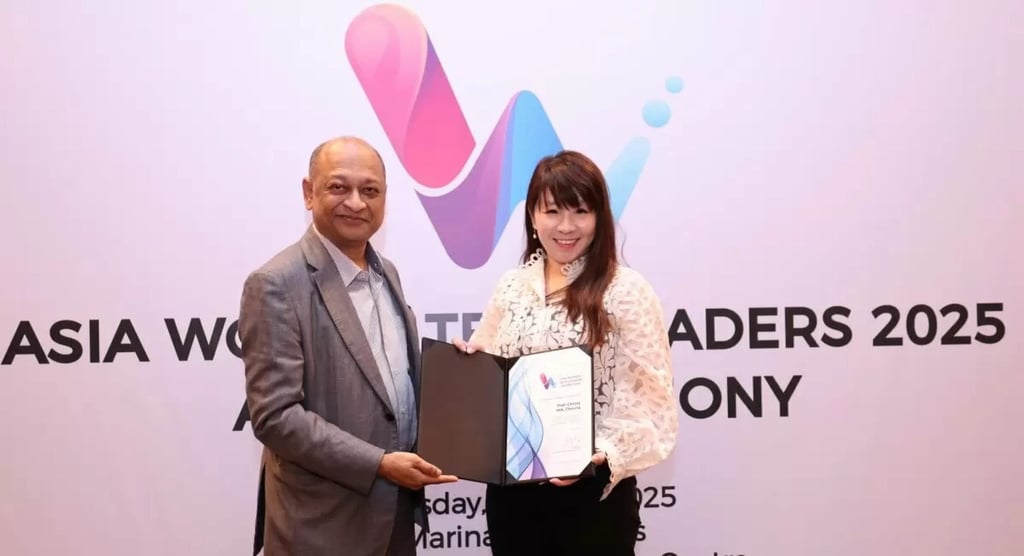
Sandeep Sakar (left), HCL Technologies’ senior vice-president, Asia-Pacific, presents Professor Christy Cheung with her award as one of the 50 most influential women in tech at the Asia Women Tech Leaders Award 2025 awards ceremony in Singapore. Photo: Hong Kong Baptist University

Sandeep Sakar (left), HCL Technologies’ senior vice-president, Asia-Pacific, presents Professor Christy Cheung with her award as one of the 50 most influential women in tech at the Asia Women Tech Leaders Award 2025 awards ceremony in Singapore. Photo: Hong Kong Baptist University

“The societal challenges I am tackling are the everyday, but deeply harmful behaviour that flourishes in digital spaces,” says Cheung, who was named in Stanford University’s 2025 “World’s Top 2% Scientists” list in information and communication technologies, which identifies highly cited scholars in their respective fields. “My research is not just about diagnosing the problem. It’s fundamentally about prevention and intervention.”

As an RGC Senior Research Fellow in 2020, Cheung investigated the dynamics of social media cybermobbing, an attack involving many people collectively intimidating or socially isolating a target online. She says her work contributes to the United Nations’ Sustainable Development Goals by raising awareness of responsible digital citizenship and shaping healthier, more inclusive global digital ecosystems. Cheung was also recognised as one of the 50 most influential women in tech at the Asia Women Tech Leaders Award in 2025.
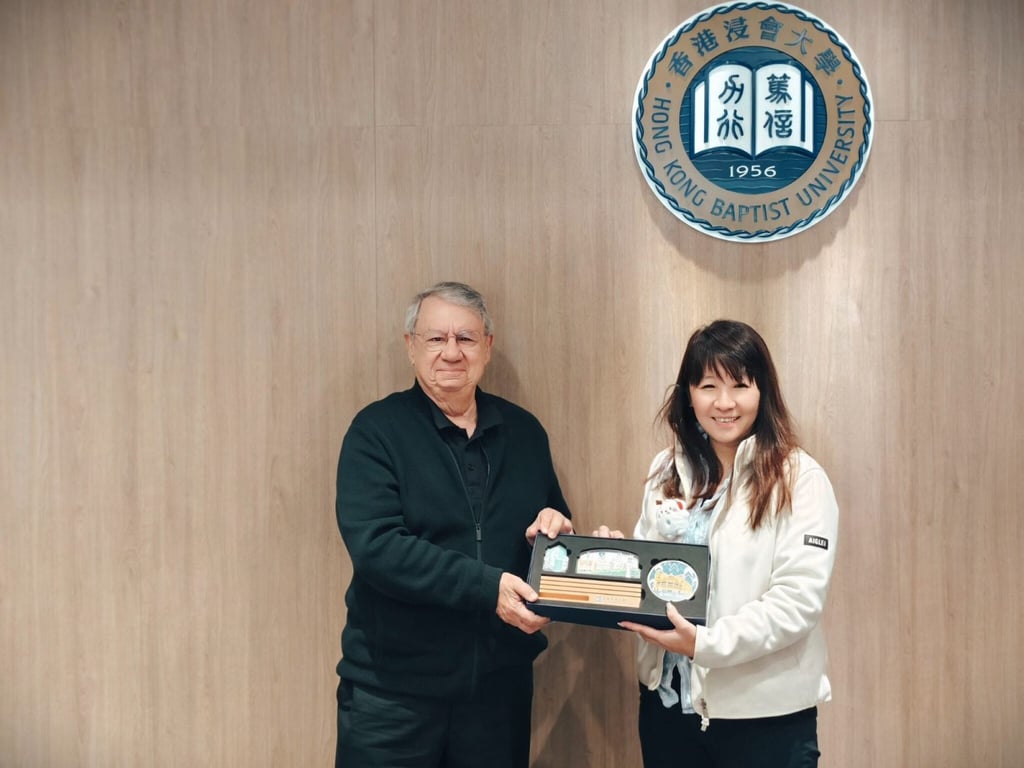
Professor Christy Cheung (right) with her mentor, Professor Emeritus Izak Benbasat, of the University of British Columbia’s Sauder School of Business, after his lecture at Hong Kong Baptist University last year. Photo: Hong Kong Baptist University

Professor Christy Cheung (right) with her mentor, Professor Emeritus Izak Benbasat, of the University of British Columbia’s Sauder School of Business, after his lecture at Hong Kong Baptist University last year. Photo: Hong Kong Baptist University

“Ultimately, my work is about reimagining the role of design, from merely attracting attention to actively cultivating empathy, consent and accountability,” she says. “By embedding protective norms into the very fabric of our digital environments, we can foster cultures where responsible use feels natural, and where safety is not an afterthought but a core experience.”

Wang’s work starts with one of chemistry’s most persistent problems: how to build better molecular structures to support advances in fields from medicine to manufacturing.

“A major challenge scientists continue to confront is the inefficiency of chemical processes, which are often slow, wasteful and resource-intensive,” she says. “Equally pressing is the issue of poor selectivity, where reactions fail to yield only the desired product, creating significant hurdles in drug development and beyond.”
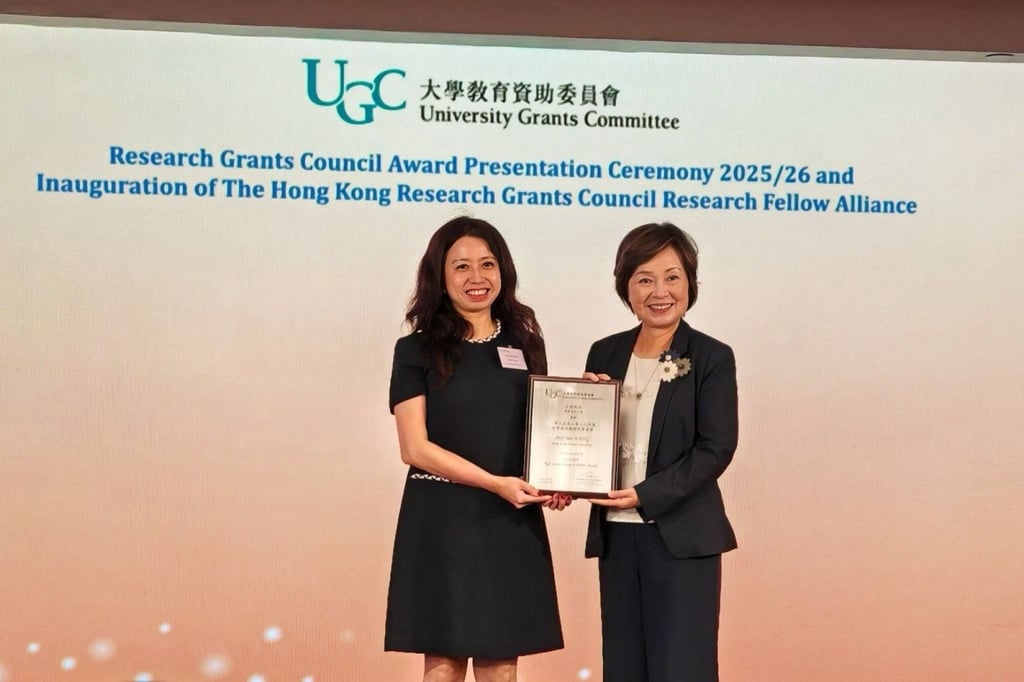
Professor Wang Jun (left) is presented with her RGC Senior Research Fellow certificate last year by Dr Choi Yuk-lin, Hong Kong’s Secretary for Education. Photo: Hong Kong Baptist University

Professor Wang Jun (left) is presented with her RGC Senior Research Fellow certificate last year by Dr Choi Yuk-lin, Hong Kong’s Secretary for Education. Photo: Hong Kong Baptist University

Last year, Wang, who was also named an RGC Senior Research Fellow and serves as a senior member of the Chinese Chemical Society, received funding for a project that applies computational and data-driven innovation to develop more precise molecular tools.

“In my lab at HKBU [Hong Kong Baptist University], we work on modular molecular editing,” she says. “Our research goes beyond fundamental chemical research, aiming to develop next-generation ligands [molecular bonding agents], high-precision medicines and high-performance materials. Beyond chemistry, its impact extends to pharmaceuticals, agrochemicals, materials science and environmental and sustainable technologies.”

Both scholars regard their work as locally grounded but globally relevant. Cheung says her research can strengthen Hong Kong’s digital resilience by cultivating responsible digital citizenship and show how home-grown scholars can lead in emerging digital fields.

Wang says advances in her field offer greener, more efficient solutions, which can support healthcare, food security and technology around the world, while also strengthening Hong Kong’s profile as a hub for sustainable science.

Looking ahead, they both believe Hong Kong can play a greater role in global research, from human-centred approaches to AI and robotics to foundational technologies across pharmaceuticals and environmental science.

Watch the video to learn more about how Hong Kong Baptist University academics are advancing interdisciplinary research that has real-world impact.