

惯性聚合 高效追踪和阅读你感兴趣的博客、新闻、科技资讯
阅读原文 在惯性聚合中打开

推荐订阅源

A
Arctic Wolf
T
The Blog of Author Tim Ferriss
月光博客
月光博客
Recent Announcements
V
V2EX
Microsoft Azure Blog
博客园 - 三生石上(FineUI控件)
P
Proofpoint News Feed
The Register - Security
博客园 - 叶小钗
博客园 - Franky
The Cloudflare Blog
雷峰网
雷峰网
罗磊的独立博客
M
MIT News - Artificial intelligence
I
InfoQ
钛媒体:引领未来商业与生活新知
钛媒体:引领未来商业与生活新知
博客园 - 【当耐特】
Engineering at Meta
Engineering at Meta
N
Netflix TechBlog - Medium
爱范儿
爱范儿
博客园 - 司徒正美
Recorded Future
Recorded Future
酷 壳 – CoolShell
酷 壳 – CoolShell
Google DeepMind News
Martin Fowler
Martin Fowler
Microsoft Security Blog
F
Full Disclosure
让小产品的独立变现更简单 - ezindie.com
B
Blog
大猫的无限游戏
大猫的无限游戏
奇客Solidot–传递最新科技情报
奇客Solidot–传递最新科技情报
腾讯CDC
WordPress大学
WordPress大学
小众软件
小众软件
K
Kaspersky official blog
Attack and Defense Labs
cs.AI updates on arXiv.org
Forbes - Security
Forbes - Security
aimingoo的专栏
aimingoo的专栏
IT之家
IT之家
The Last Watchdog
The Last Watchdog
N
News and Events Feed by Topic
B
Blog RSS Feed
S
Security @ Cisco Blogs
美团技术团队
量子位
Threat Intelligence Blog | Flashpoint
Cloudbric
Cloudbric
Hacker News - Newest:
Hacker News - Newest: "LLM"

South China Morning Post

Singapore drama sparks Malaysian ire over scam hub depiction Time to act on stalled proposal toughening child abuse penalties, lawmakers say ‘Eager to explore’: Chinese migrants return to Venezuela after Maduro’s capture ‘We have no trust in the other side’: Iran blames US as talks end with no deal Opinion | Why securing Hong Kong’s economic future is a cultural question Hong Kong’s ministerial team spent HK$46.6 million on visits in past 3 years China family creates AI clone to comfort elderly mum after only son dies in crash Canada Olympic star Williams plans on ‘having a ‘blast’ at Hong Kong Sevens Singapore’s robotaxi drive revs up with help from Chinese AV leaders Editorial | Making Hong Kong desirable to overseas students must be a priority All 7 are dentists and hot. The Asian-American family blowing up social media Editorial | Ageing Hong Kong should welcome more open conversations around death My Take | Discovery Bay will never be the same if the restriction on taxi access is lifted Medical intern suspended after complaint over patient data in social media post Fish and vegetarianism major flashpoints in India’s West Bengal election Chinese crystal ‘paves way’ for GPS-free thorium clock navigation SCMP Best Bets: Endued can show his quality at Sha Tin Russia and Ukraine begin 32-hour ceasefire for Orthodox Easter Israeli spy firm Black Cube involved in Cyprus corruption probe ‘A big deal’: military drills show Tokyo’s growing focus on deterring China China targets middlemen in renewed crackdown on ‘hidden’ corruption Hong Kong-born gymnast leading quest to turn Singapore into elite hub Thais celebrate new year despite fuel price shocks delaying travel Harry Bentley tees up two good chances in Smart Golf and Elite Golf at Sha Tin Is this Kenyan rail project a model for Chinese and Western firms in Africa? Unearthing peace: ancient China gravesite reveals significance of broken weapons Meet Queen Elizabeth’s youngest grandchild, James, who was at Easter service Turtle found dead after apparent fall in Hong Kong’s Wong Tai Sin Landlords of 5,557 subdivided homes seek 3-year grace period to fix flats Trump critique pauses UK handover of Chagos Islands to Mauritius Hong Kong’s Cathay Pacific and HK Express cut some flights as jet fuel prices rise Calls grow for HKMA to go further on stablecoins after conservative first batch Nepal’s school fee crackdown upends South Asian private education norms DeepSeek ramps up hiring ahead of V4 launch as chip strategy questions swirl Hins Cheung to lead arrested 2019 Hong Kong protesters on mainland exchange trips Macroscope | Can World Bank and IMF leaders rescue a global economy on the brink? Hong Kong proposes mandatory renovation briefings to combat bid-rigging The winners from China’s growing intercity football rivalries may surprise you China warns university students about lucrative job offers from foreign spies Profile | Who is Byeon Woo-seok, IU’s co-star in romance K-drama Perfect Crown? Richard Kingscote hopes lightweight ride will be a Force again: ‘I’m happy to squeeze the lemon a bit for a horse like him’ Tighter civil service disciplinary rules risk becoming excessive: union head How the Gulf conflict recast risks for Asian investors in Dubai What does China’s tightening grip on red-chip structures mean for IPOs? South Korea’s president hits back at Israel in row over ‘disturbing’ video China café sets ‘entry rules’, ban littering, discarding black stockings, turtle theft Samsung weighs China overhaul as local rivals pile on the pressure Beijing’s point man on Hong Kong affairs wraps up second bay area visit in 3 weeks Gucci shoes worth HK$11,000 stolen from shopping centre restroom in Hong Kong Vaccine coverage gaps spur Bangladesh’s deadly measles outbreak How to get an iPod and set it up as Apple’s music device makes a comeback Global wealth gap widens as aid to world’s poorest sees record drop Malaysia detains masseuses from China offering ‘extra services’ Asian Angle | Who is Vietnam’s new Prime Minister Le Minh Hung? ‘Cancelling orders’ in China: Hormuz oil crisis hits transport and manufacturing Discovery Bay developer submits proposal for full taxi access despite backlash Hong Kong hairstylist’s cancer battle takes him on a crowdfunding campaign UAE pulls US$3.5 billion from Pakistan after Iran war mediation Champions-elect Kitchee out to prove they are city’s best despite cup final flop US-Iran talks in Islamabad stretch on as Hormuz stand-off fuels duelling claims Letters | Policy outcomes of Hong Kong’s mega-events can be improved Asia’s ‘panicked farmers’ brace for a looming rice crisis post-Iran war Can Hong Kong’s listing reform 2.0 win over innovative firms? Was Penang ‘robbed’ from Kedah? Malaysian states face off in sovereignty row Why has China mapped out a third new county in Xinjiang on its western frontier? Rory McIlroy in total command at the Masters, takes 6-shot lead into the weekend As I see it | Helpful analysts predict China property recovery now, soon and much later 73 public schools join new scheme to hire native English-speaking teachers How gossip spread in ancient China before newspapers reported on scandals Molotov attack on OpenAI CEO Sam Altman’s home leads to arrest Reflections | Cremation was frowned upon in ancient China, so why was it so widespread? Japan’s Middle East oil habit gets an Iran war reality check Ex-Wales flanker Parks on ‘dark thoughts’ and going Pole to Pole with Will Smith In pictures: 50 years of mud, sweat and beers at the Hong Kong Rugby Sevens China’s Li Qiang hosts Moonshot AI chief, urges faster industrial AI roll-out Editorial | Cheng’s Beijing visit underscores hope for cross-strait engagement Hypertension’s link to dementia calls for stronger blood pressure control Artemis II astronauts return home from record-breaking moon mission Editorial | Hong Kong’s rare, speedy response to fuel price surge shows preparedness This new exhibition pays tribute to Queen Elizabeth’s style legacy Vocational schools a new front as China backs businesses’ global expansion Meet Gerran Howell, who plays Dr Whitaker in HBO Max’s The Pitt Trump’s tariff powers tested again as court questions ‘deficit’ justification Opinion | China’s next growth engine? An AI-powered intelligence dividend Trump tariff refund tool will go live on April 20, US Customs says China, Russia rally behind Cuba as US squeezes Havana in deepening crisis US presses Iran as talks gear up in Pakistan under fragile ceasefire Trump unveils plan for his giant triumphal arch: eagles, lions, lots of gold High fertiliser prices mean more soybeans for farmers – and greater reliance on China Prince Harry sued by African charity he set up to honour Princess Diana Ukrainians sceptical as Russia’s Putin orders Easter truce Girl, 9, in a critical condition with meningococcal infection after holiday in Japan China banks buffer against AI contagions as US sweats over Anthropic’s Mythos China telecoms face US exit risk as FCC deepens crackdown on data centres China police detain and fine man behind cyberbullying of Olympian Quan Hongchan Man jailed for killing ‘ruthlessly’ abused wife who jumped from Scottish bridge Tai Po blaze: no fire risk checks done for HK$336 million estate renovation Taxi passengers won’t benefit from Hong Kong’s 50% reduction in tunnel tolls Tencent moves to rein in AI content flood on WeChat with stricter rules China-North Korea thaw gathers pace as Kim says ties have reached a new level
How AI integration into real-world tasks enhances healthcare and education
Randy Mulyanto · 2026-06-23 · via South China Morning Post

The growing use of artificial intelligence (AI) in our daily lives has become a constant topic of worldwide conversation. Its most proclaimed everyday benefits of the technology include boosting efficiency, productivity and decision-making, but developing and deploying it is a much more complicated matter.

The next phase of its adoption will be defined not by access to the technology, but by the ability to translate AI capabilities into real-world outcomes. In education and healthcare, institutions are looking at ways to embed AI into their core academic, clinical and administrative functions.

Early on, many organisations typically focused on introducing AI through pilot projects or siloed applications – standalone software programs that operate independently. These initiatives showed what AI could do, but also exposed a broader industry issue: technical capability does not automatically become an institutional capability. Real transformation depends on it being embedded into everyday workflows, decision-making processes and broader operational systems.

For Huawei Technologies, a global provider of information and communication technology and smart devices, the next step in its development demands translating raw AI technologies into institutional capabilities that support long-term, sustainable transformation. Two of its recent initiatives – the AI Practice Lab (AIPL) in higher education and the Hospital AI Platform (HAIP) in healthcare – have shown how this systematic approach is being applied to help solve real-world challenges.

Moving from ‘learning AI’ to ‘Discipline + AI’

AI’s impact on higher education extends far beyond computer science and technology-related disciplines. As industries are increasingly embracing its use, universities are having to respond by preparing students who can understand and apply AI within their own professional fields – including engineering, business, law, education or manufacturing.

Traditionally, universities have provided valuable exposure to AI technologies through dedicated courses or standalone laboratory environments, but these initiatives are often disconnected from the needs of different disciplines. Now, some universities are looking to integrate AI into their core teaching, practical training, scientific research and innovation activities.

AIPL, which was developed to support this transition, reflects the company’s commitment to systematic innovation in the education industry. Its value lies not only in the construction of an AI laboratory, but in helping universities integrate the new technology’s capabilities into core teaching and learning processes through a “Discipline + AI” educational model.

It offers a framework that ensures students acquire foundational AI skills while learning to be applied within discipline-specific teaching, research and practical scenarios, so they are able to learn, use and innovate with AI in the context of their own professional fields.

Rather than simply introducing AI tools to campuses, AIPL enables universities to embed AI into their academic workflows by integrating technology, teaching scenarios and disciplinary needs to transform technical potential into practical educational capability, while supporting the transition from “learning AI” to a “Discipline + AI” educational model.

AIPL was implemented at China’s Beijing Institute of Technology last March, for example, when the university and Huawei jointly launched the world’s first AI Practice Lab showcase. It provides a framework that seamlessly integrates theory, practice and application innovation and has already begun supporting diverse disciplines, including chemistry and chemical engineering, law, economics and management, and education.

The project shows how AI can be integrated into teaching, practical training and research across multiple disciplines, so students can work on real-world problems using data and tools directly relevant to their fields of study.

Similarly, Hefei College of Economics and Applied Sciences, in China’s Anhui province, has also adopted the AIPL model, combining the platform with the university’s academic strengths and real, local-based industry needs, with focal points such as “audit + AI” and “manufacturing + AI” used to create practical, industry-oriented training courses.

Beijing Institute of Technology’s use of AIPL shows its implementation capability across multiple disciplines, while Hefei College of Economics and Applied Sciences highlights the model’s ability to be replicated and adapted to different universities, disciplines and regional industry needs.

Shift towards smart, hospital-wide integration

Healthcare organisations have been experiencing a different, but equally significant stage of AI transformation in recent years, with hospitals adopting AI into areas such as medical imaging, pathology, medical record quality control, scientific research and patient services. These applications have shown clear value in specific scenarios, but also created new challenges as AI expands across departments and workflows.

Many hospitals now face issues such as data fragmentation, independent computing power silos, repeated model development and difficulties in integrating AI processes into clinical and operational workflows. While individual AI applications can address specific problems, they often operate independently, making it difficult to manage and scale capabilities using the new technology across the entire organisation.

As a result, the focus of hospital AI development is shifting from individual applications to platform-based construction, with the challenge of building a unified foundation that supports the planning, management and operation of the technology across the hospital.

HAIP was developed as an innovative solution for hospital-wide AI. By integrating data, computing power, models and applications, the platform supports the transition from fragmented AI pilots to hospital-wide collaboration and continuous operation. More broadly, HAIP combines information and communication technology infrastructure, AI engineering capabilities and ecosystem collaboration to address real-world implementation challenges.

This approach aims to support four areas: centralised computing resources; reusable data assets; shared model capabilities; and applications integrated into diagnosis, treatment, research, teaching and patient services.

HAIP’s implementation at Nanfang Hospital of Southern Medical University, in Guangdong province, shows how this approach can be applied in practice.

Working with Huawei and its ecosystem partners, the hospital has explored or deployed AI-enabled applications across scenarios, including chronic kidney disease management, perioperative anaesthesia management, pathology-assisted diagnosis, medical record quality control and electronic medical record support. It has also established a smart AI centre to support intelligent agent development.

These initiatives, which span clinical diagnosis and treatment, patient services, scientific research and hospital management, show how a unified AI foundation can support multiple operational functions.

The West China Hospital of Sichuan University is also working with Huawei to adopt the platform, highlighting its potential for replication across leading healthcare institutions.

Through AIPL and HAIP, Huawei is showing a consistent vision: AI creates greater value when it is embedded into institutional systems, professional workflows and real-world decision-making processes. By combining ICT infrastructure, AI engineering capabilities, ecosystem collaboration and real-world industry scenarios, the company is helping institutions transform technical potential into practical educational and healthcare capacities.

In doing so, the company is supporting a vital transition by moving organisations away from isolated AI experiments towards the implementation of the technology involving a systematic, organisation-wide capability, where it is integrated across core institutional functions.
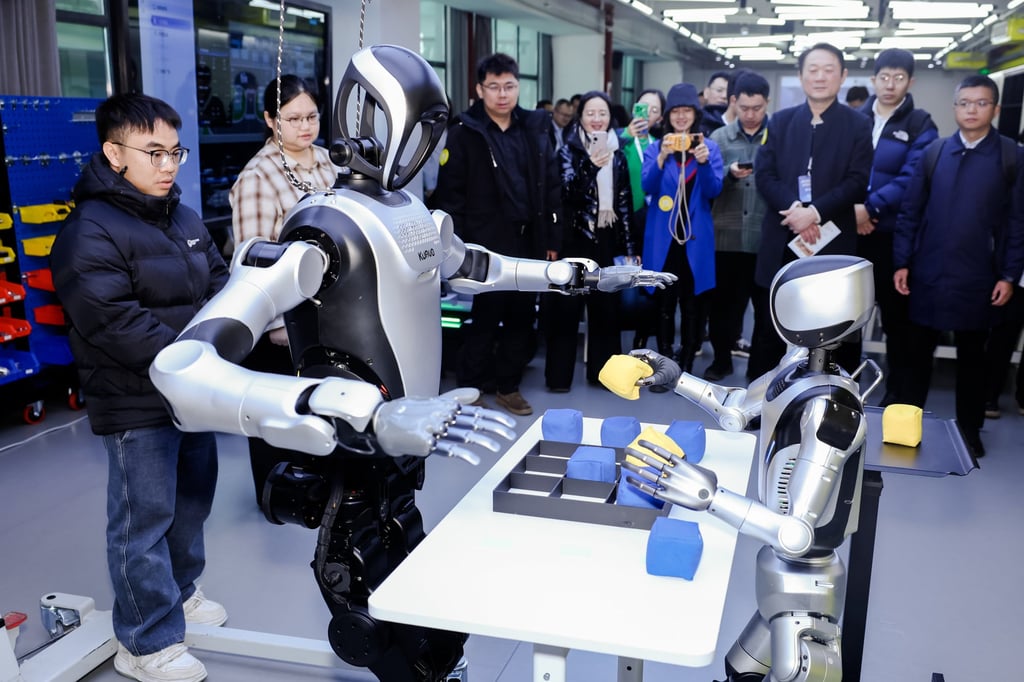
Visitors explore AI and robotics applications at last March’s launch event for Huawei’s AIPL at Beijing Institute of Technology, reflecting broader efforts to integrate AI into higher education and practical training.

Visitors explore AI and robotics applications at last March’s launch event for Huawei’s AIPL at Beijing Institute of Technology, reflecting broader efforts to integrate AI into higher education and practical training.