


Traces of illicit drugs in wastewater in England show spikes in usage during bank holiday weekends, heatwaves and sports events, while the Eurovision song contest ranks as one of the most drug-fuelled nights of the year.
Tests at water treatment plants across the country found clear patterns in drug taking through the week and changing seasons, and revealed particularly high levels of cocaine and ketamine use compared with other European countries.
Ketamine is a powerful anaesthetic that can be fatal and is especially dangerous when taken with other drugs. It can damage memory and cause serious bladder problems that can require surgical repair or even lead to removal of the organ.
The project, led by Imperial College London for the Home Office, is one of the most detailed investigations to date into drug use in a single country. Researchers analysed more than 1,700 water samples from 15 treatment sites across England in 2022 to establish a baseline that future measurements can be compared against.
The findings highlight when emergency services should prepare for more overdoses and drug-related incidents and show how public health messaging can be bolstered to reduce harm.
“This really tells you what to focus on,” said Prof Leon Barron, who leads a team at Imperial’s Environmental Research Group. “People overdose from all sorts of illicit drugs and if there’s a particular event and that’s a repeatable event in the year, you can let the emergency services know that this is a night where we could see more drug overdoses or more drug-fuelled behaviour,” he said.
Scientists looked for 20 different compounds excreted into wastewater. Most were drugs such as cocaine, MDMA, ketamine, heroin and amphetamine, while others were breakdown products and cutting agents. The tests also looked for a compound that forms in the body when a person takes cocaine and alcohol at the same time.
The findings, reported in the journal Addiction, show that cocaine was detected at the highest average daily levels, followed by heroin, ketamine, amphetamine, MDMA and methamphetamine. Cocaine and MDMA use peaked at the weekend, though cocaine use remained high throughout the week. In total, the 15 sites detected the equivalent of about 12 tonnes of cocaine over the year.
For other drugs such as ketamine, usage was more stable over the week. “People are using it every single day and to the same degree, no matter whether it’s a weekend or a weekday,” Barron said. “It’s becoming very routinely used and it’s really quite a worrying situation.”
According to the tests, ketamine use was higher at seven sites in England than at any other European site monitored over the same period.
Drug use spiked in line with England’s World Cup football matches, summer heatwaves and bank holidays, including the queen’s platinum jubilee celebrations. The Eurovision song contest was an outlier linked to rises in cocaine, ketamine, MDMA and methamphetamine.
The work can help with emergency services planning, but also feeds into public health messaging, Barron said. While more people take cocaine and other drugs during heatwaves, the health risks are greater in hot weather. Likewise, mixing alcohol and cocaine comes with extra risks.
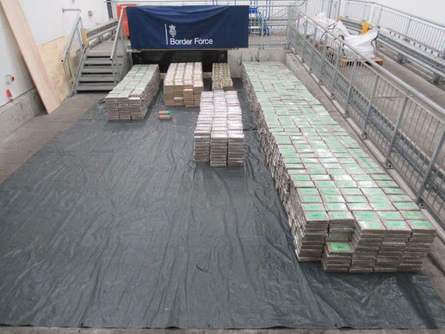
The tests also revealed the substantial impact drug seizures can have. In March 2022, authorities impounded 3.7 tonnes of cocaine at Southampton docks. The seizure severely dented consumption in three cities for a month, the study shows. “You can knock out or massively impact cocaine consumption in major urban areas, and these sites were hundreds of miles away from each other,” Barron said.
A spokesperson for the National Crime Agency, which supported the work, said ketamine use, dependence and related harms had all increased significantly in recent years with children and young people, particularly 16 to 24-year-olds, most likely to be affected.
“The drug can be seen as a safe party drug by young people, including students, who are unaware of the significant harm it can cause, with misuse of the drug having the potential to lead to a host of physical and psychological issues,” they said.
A government spokesperson said: “Our crackdown on drugs is having a real impact. We’ve strengthened our border security to tackle the criminal gangs putting lives at risk. Around 5 tonnes of cocaine have been seized by Border Force at just one port in less than a month – depriving criminal gangs of more than £400m worth of drugs.
“We will continue to work across health, policing and wider public services to drive down drug use and stop those who profit from its supply.”