


“Mandarin hotel! Out of Puerto Rico!” was the refrain of dozens of demonstrators on 21 April 2025 as they took over the lobby of the tony Manhattan hotel. One protester walked around holding a Puerto Rican pro-independence flag, a sign of the anti-colonialist movement advocating for sovereignty from the United States. In the atrium of the nearby luxury mall, the Shops at Columbus Circle, organizers unfurled a long banner that read in Spanish “No to Esencia”. They scattered informational flyers on the mall’s floor about their opposition to the Mandarin Oriental Hotel Group project slated to open in 2028.
The hotel group plans to partially operate the $2bn Esencia, luxury hotel rooms and a residential settlement, in Cabo Rojo, Puerto Rico, and activists held the demonstration to spotlight the multinational hospitality group’s expansion into a fragile coastal area. Puerto Rican demonstrators and their allies from the group Juventud Unida por la Independencia (JUPI) say that the project would reap environmental disaster by destroying more than 1,500 acres (600 hectares) of protected land with archaeological sites.
The youth-driven JUPI has drawn attention to Puerto Rico’s independence movement by drawing connections to displacement in the mainland US and within the US territory. Puerto Rico, which came under US control toward the end of the Spanish-American war in 1898, became an autonomous US commonwealth in 1952. Under commonwealth status, residents have US citizenship, but they can’t vote in presidential elections and don’t have representation in the US Senate. The independence movement, a cultural and political campaign, advocates for Puerto Rico’s full sovereignty. Supporters believe that independence will allow the archipelago to be economically self-sufficient and to have control over trade and foreign affairs. While most Puerto Ricans have historically favored statehood, support for sovereignty has grown in recent years.
JUPI’s founding in 2024 signals an increased interest in the pro-independence movement among Puerto Rican youth over the past decade. Activists and researchers attribute the US government’s failure to provide adequate disaster relief to Puerto Ricans after Hurricane Maria in 2017 as a major tipping point. Residents were left without power and 2,975 people died, according to the official death toll, though other estimates account for 4,600 deaths. In the two years following Hurricane Maria, up to 255,000 Puerto Rican residents moved to the mainland US, depleting the island’s workforce and leaving behind an ageing population.
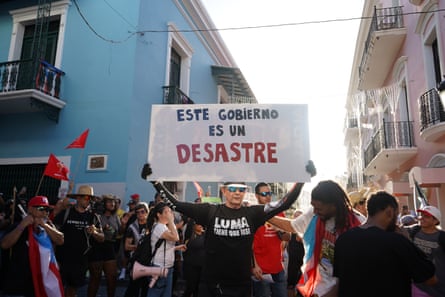
Independence supporters also credit Puerto Rican musician Bad Bunny for helping popularize the cause by including pro-independence lyrics in his music. As 128 million viewers tuned in to the Super Bowl halftime show in February, Bad Bunny waved the light blue flag associated with the independence movement, instead of the territory’s official dark blue one. Gripping the flag, he stood underneath dancers who twirled on power line poles that sparked and smoked. The performance symbolized Puerto Rico’s beleaguered power grid, which pro-independence activists say could be fixed if residents were free to build local, renewable energy sources.
The independence movement has a long history in Puerto Rico, beginning with grito de lares, the rebellion of 1868, in which hundreds of Puerto Rican rebels formed a short-lived insurrection against the Spaniards. But the fallout from Hurricane Maria “woke up a sleeping giant from the diaspora”, said Dr Jenaro Abraham, a political science assistant professor at Gonzaga University. “It brought people to look towards Puerto Rico again, to begin mutual aid societies … It began what I call a cultural renaissance of Puerto Ricans also trying to rediscover who they are, where they come from.” A 2024 poll by the Puerto Rican newspaper El Nuevo Día showed for the first time that voter support for sovereignty tied with support for statehood at 44%.
Gentrification and the failing power grid have also fueled the pro-independence movement among youth, said JUPI member Diego Nieves Berrios, located in Caguas, Puerto Rico. Electricity is so unreliable where Nieves Berrios lives that he loses power once a week, he said. “A lot of people are dissatisfied with the current government,” said Nieves Berrios, 23. “There’s no houses to buy. There’s literally expensive houses, and there’s no jobs for people who studied, and for professionals, they’re paid minimum wage.” It angers him that US companies displace Puerto Ricans by building hotels and residences. “That’s why I believe in independence, because we’re constantly being used by the United States,” he said.
Abraham points to the 2024 gubernatorial race as a clear sign of the growing interest in the independence movement. That year, the independence party secured second place by garnering 30.7% of the vote, more than double what it received during the 2020 gubernatorial election at 13.5%.
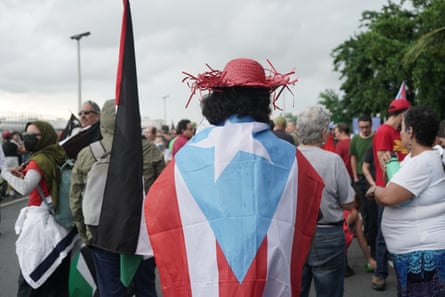
Opposition to the Trump administration among diasporic youth has also inspired them to look outside the United States’ Republican and Democratic parties for solutions, said Abraham: “Puerto Ricans in the diaspora now feel that they can no longer rely on the two-party system in the United States. They’re searching for political answers to their political questions in places where they feel they have a greater connection to. The diaspora has been looking more and more towards Puerto Rico, and it coincided with this proliferation of youth diaspora groups.”
‘Once Puerto Rico is free’
JUPI formed after splitting from the pro-independence movement group New York Boricua Resistance. The new group aimed to focus on Puerto Rican youth throughout the mainland after seeing the trend of people under the age of 35 increasingly leaving the archipelago since the 2010s.
Lorin Bruno, JUPI’s national education coordinator, joined the political organization in 2021 after seeing the aftermath of Hurricane Maria. The group currently has two main chapters, in the Bronx and Brooklyn, as well as organizing committees across the United States and in Puerto Rico, where members are working to build a full-fledged chapter. The local chapters host campaigns on displacement in their communities by holding town hall meetings and distributing flyers. In the Bronx, members canvass the area’s public housing to ask residents about their experiences of being evicted.
Bruno’s own family arrived in the US through displacement during Operation Bootstrap in the 1960s: in a campaign orchestrated by the US and Puerto Rican governments, the territory was transformed from an agrarian to an industrial economy following the second world war. Since there weren’t enough jobs for former farm workers in the new factories, the governments encouraged hundreds of thousands of Puerto Ricans to move to the mainland to fill US job shortages. Bruno, 25, sees the independence movement as a path toward a better future for Puerto Ricans, where they have a say over the environment and how they take care of their communities.
“Once Puerto Rico is free, we can really fix up our education system,” said Bruno. “Because of the fiscal control board, there have been a lot of cuts to funding our university system. We can fund the things that are important to us like fixing up our electrical grid, because that is a hot mess.” Luma Energy, a private Canadian-American consortium, began distributing electricity to the island in 2021 and has drawn criticism for the frequent blackouts. From 2021 to 2024, residents experienced an average of 27 hours without power per year, according to the US Energy Information Administration.
At JUPI’s Bronx chapter, the 10 members use the inadequate infrastructure in Puerto Rico as a launching point to discuss overdue repairs that Puerto Ricans face in their south Bronx rentals. Larimar Lora, the co-chair of local work for the Bronx chapter, attends community board meetings to hear about tenants’ housing concerns. In the future, they hope to help the tenants present their demands to policymakers. The group also hosts public educational sessions on Puerto Rico’s history, and hand out printed material about the pro-independence movement by going door to door and tabling.
Lora, a 29-year-old social services worker, grew up attending pro-independence protests with their grandmother in New York. Their interest in the movement increased when they learned about the impacts of colonialism on the island, such as the fact that eugenic ideology led to a third of Puerto Rican women of childbearing age being sterilized from the 1930s to the 1970s.
“Once I really started to learn and understand the depth of the injustice that people have been subject to, it was really easy for me to become sympathetic to the cause of independence,” Lora said. If Puerto Rico became independent, Lora sees greater trading opportunities for the archipelago. The 1920 Jones Act requires that American ships and crews transport goods between Puerto Rico and the mainland US. Since US vessels have more expensive operating and managing costs than foreign vessels, the act has resulted in increased prices of food and fuel imported to Puerto Rico.
In early March, JUPI’s national arm hosted a pro-independence summit to counter the Puerto Rico governor Jenniffer González-Colón’s Equality and Statehood Summit, where advocates lobbied Congress for statehood. Held at Washington DC’s St Stephen and the Incarnation Episcopal church, JUPI’s event featured a panel about issues in Puerto Rico and why they believe that statehood will not help the archipelago.
While Puerto Rican youth on the mainland are advocating for people in their homeland, the JUPI presence on the territory is steadily growing. Nieves Berrios believes that if Puerto Rico were to become a sovereign nation, it would solve problems including youth leaving the territory in droves.
“If we gain independence, we could get to connect to the world, because we are very limited by the United States in every aspect, like in architecture and planning,” Nieves Berrios said. “In independence, it will be very community-based, but also we will open our doors to negotiate and make business with the world and have more opportunities in Latin America.”
Nieves Berrios also envisions political sovereignty offering a sense of freedom in his own life. In the future, he wants to be a media leader who prioritizes sustainability. He dreams of owning a home with solar energy where the lights never go out.