


Where does the time go? It’s a year since Gary Oldman performed Krapp’s Last Tape in York, returning him to the Theatre Royal where at the age of 21 he played a sleepy panto cat. Now, Samuel Beckett’s play has a homecoming of its own. Oldman has brought the production – directed and designed by himself – to London’s Royal Court, where Krapp had its premiere in 1958, starring Patrick Magee. The Court is also where Oldman cut his teeth in the 80s. “I find it difficult to fully grasp, but four decades have passed,” he writes in the programme.
The sentiment is fitting: Krapp’s Last Tape is indeed an old man’s play. Beckett was 52 when it was first staged and Krapp is 69. He “heaves great sighs” as he shuffles around his den, reeling in the years through diary recordings made 30 years earlier, in which he reflects on his behaviour further back, in his late 20s. But for this Royal Court run, Krapp is accompanied by a teenage voice. The evening begins with a short new work by 19-year-old Leo Simpe-Asante, a winner of the theatre’s inaugural Young Playwrights award. It’s an audacious and generous bit of programming that signals huge confidence in the newcomer, should serve to inspire other first-time playwrights and retains the theatre’s mission to produce new writing while reviving a classic. It’s also a reminder that Krapp itself was originally a curtain-raiser – the main event in 1958 was Beckett’s Endgame.
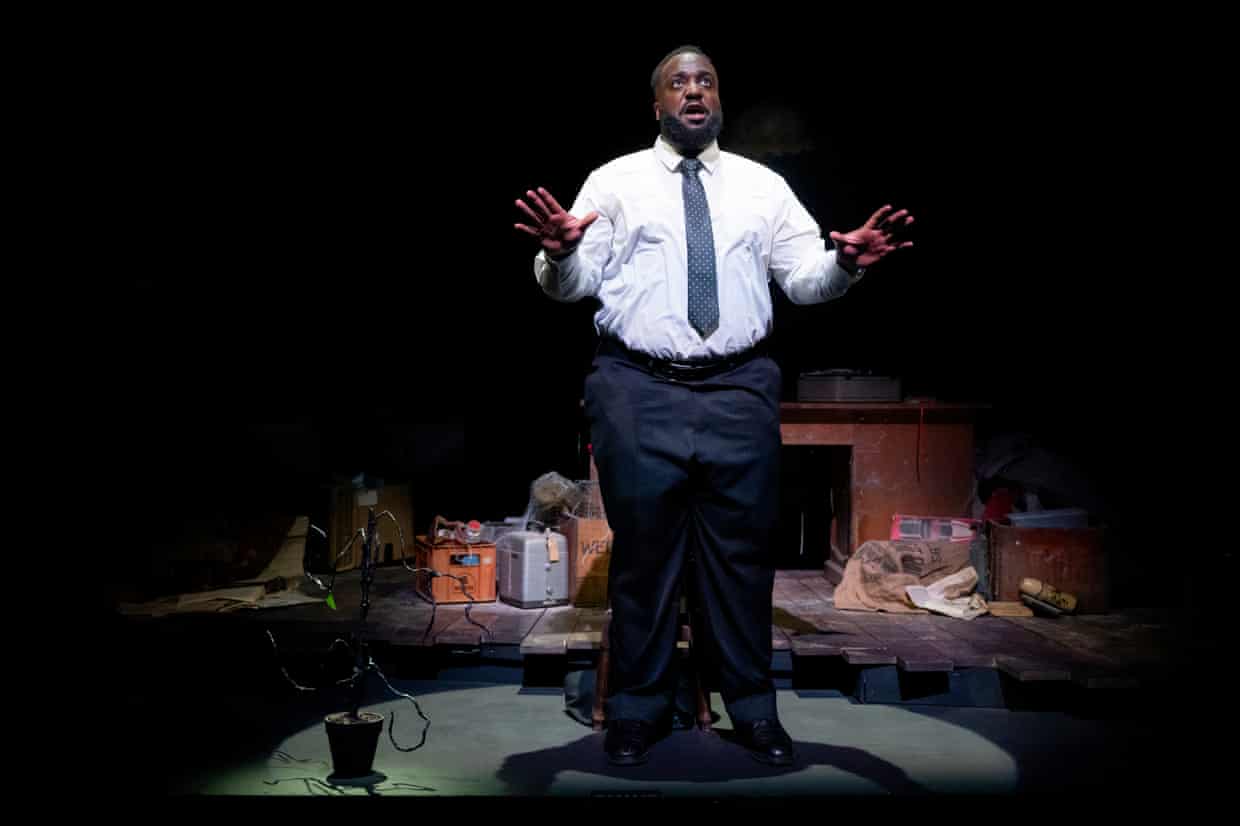
Simpe-Asante spoofs an earlier Beckett with his play, wittily entitled Godot’s To-Do List, performed against the detritus of Krapp’s den. Waiting for Godot’s backdrop is a country road and a tree; Simpe-Asante’s script specifies a stool and a potted plant, which here resembles a child’s fiendish buzz wire game. The play, punctuated by similar metallic pings, introduces us – at long last! – to Godot, a young man trying to make the best of things, who completes (some of) a series of tasks that range from “do the splits” to “piss yourself” to “work through your relationship with your father”.
It endlessly riffs on Beckett’s play – even the title inverts Estragon’s famous opening cry of defeat: “Nothing to be done.” This young Godot’s comical activities are akin to Vladimir’s – both conceal carrots, write rhymes and shake their hats in a similar manner – and like Estragon, he has unfinished business (shades of Beckett’s brothel joke without a punchline) and ends up with his trousers round his ankles.
In the title role of Aneesha Srinivasan’s lively production, Shakeel Haakim is dressed as if for a job interview – you sense the top button done too tightly, in a deft physical performance that stresses the nervous discomfort of trying to fit in. The tasks come as commands from an omnipotent To-Do List (spoken by the unseen Flora Ashton), creating a Krapp-like interplay between Godot and the voice. Is it Godot’s own, heard in his head? Certainly, Simpe-Asante evokes the inner critic through the play’s series of micro-decisions stemming from social anxiety and encroaching existential dread.
At times the voice seems to imply an authoritarian state but it remains pleasingly difficult to pin down – adopting the dulcet tones of a mindfulness app or even cheekily giving young Godot the horn (that bowler hat is bashfully moved to cover his groin). The two performers’ voices overlap in scenes of spiralling despair, and the play reaches for a similar effect to Rebecca Watson’s masterful Little Scratch in addressing the minutiae of the current moment alongside long-term, unresolved turmoil. Unresolved being the key word: Simpe-Asante laughingly considers, yet crucially does so with compassion, the sense that any of us could ever wield any kind of control in this world. It shows, at one point quite literally, a futile search to be in sync with your surroundings.
The writer is studying musical theatre at Royal Central School of Speech and Drama (one of his projects is a sort of classical jukebox musical about children at an orchestra camp modelled after famous composers). He mimics Beckett’s impish humour and musicality when Godot attempts a limerick and riffs on the playwright’s name to create a character: “Beckett? Nah. Beck? Bick? Bock? Boq? Quock? Sam Quock? Sam Cock – no, no, that’s definitely not it.”
Like Beckett, Simpe-Asante considers a sense of emptiness and overload at once, so it makes sense artistically – not just practically – to bring Godot’s solitary stool and pot plant briefly into Krapp’s cluttered abode. That scene looks even more, now, like the dank habitat of Oldman’s Slough House HQ in Slow Horses. The actor wearily climbs his way into this attic space, peering at a pocket watch, wincing and chomping down the first of Krapp’s beloved bananas. In his programme note, Oldman reflects on recently celebrating his 68th birthday and how he can’t believe he’s one year shy of Krapp’s age. Theatregoers may have a similar reaction. In my teens, Oldman was one of my favourite actors – revelling in Quentin Tarantino’s dialogue in True Romance, cackling through a satanic cameo in a Guns N’ Roses video and pulling off that hairdo in Dracula. His Premiere magazine cover (with love note to Tim Roth on his arm) was on my bedroom wall.
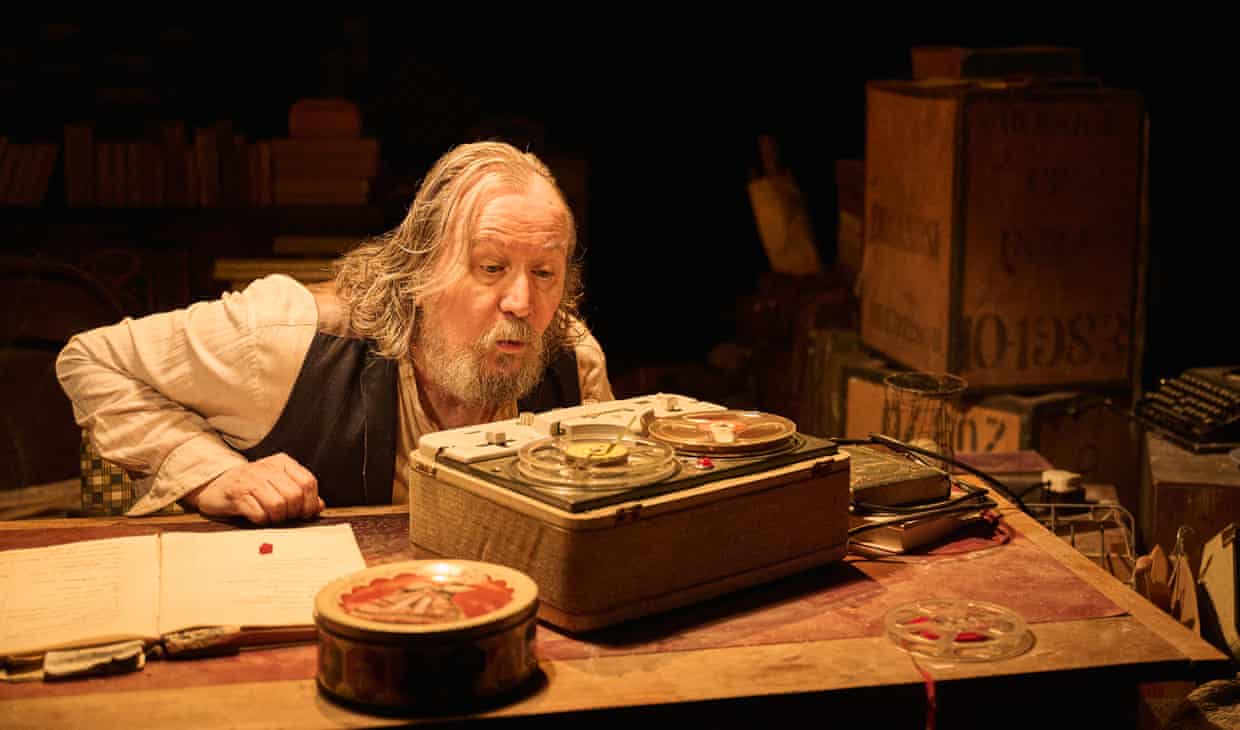
And here he is, back on stage with greying whiskers, and in much closer quarters than York Theatre Royal. It’s a play that always benefits from a smaller theatre but Oldman’s performance has deepened, too, since I saw it last year. The right lightness is there, from the slight smile that greets the unpeeling of the second banana to his dumbfounded chuckle greeting the word “spool”, but there is fury, too, when he throws the contents of his desk to the floor, a flash of anger at (and from?) his past.
Krapp’s Last Tape is such a peculiar challenge for an actor. There is something about seeing it again, in the home of new writing, that reveals its experimentalism. This is a play set in the future that sifts desperately through the past; a performance where the star has delivered the bulk of the dialogue (for the audio recording) before even getting on stage; a conversation of sorts between one character at different ages.
Krapp chastises himself, as does Simpe-Asante’s Godot. But Oldman nails how he also eternally kids himself, even while boastfully detecting a “false ring” in his own voice: “With all this darkness round me I feel less alone,” he says, wavering as he adds: “In a way.” Oldman’s countenance is of a man poleaxed by images rearing up from his past and Beckett’s descriptions make time stand still: the funereal sight of the “big black hooded perambulator”, the feel of the dog’s “small, old, black, hard, solid rubber ball”, the woman with transfixing eyes like “chrysolite!” – the same sort of spellbinding gaze that the great Krapps have cast on audiences.
The young Godot is run ragged by his never-ending to-do list; Krapp fills the empty days with the tapes listed in his old ledger. Godot assures us he has places to go; Krapp’s land could be as uninhabited – almost apocalyptically – as it seemed to him 30 years earlier.
Oldman’s direction delicately captures a sense of nightfall, with the dying moments of Malcolm Rippeth’s lighting design creating a terrible pathos. Krapp’s defining memory – this evening, at least – is of lying with a young woman on a punt, their romance wrecked: “We lay there without moving. But under us all moved, and moved us.” A stillness concealing tumult is exactly what Oldman’s expression captures as the machine whirs almost like lapping water, and he picks over what is left behind in life when the tide goes out.
I’m not sure if I could have dealt with watching a whole Endgame after Oldman’s painstaking performance. This new pairing works wonderfully but its three-week run swiftly sold out. Might I suggest a task for the top of the Court’s to-do list? Film it now so Oldman can join the ranks of the great Krapps on camera.
-
Krapp’s Last Tape / Godot’s To-Do List is at the Royal Court theatre, London, until 30 May