


Shane O’Brien first skated at London’s Southbank Centre in the summer of 1975, at the age of 10. But before he could call himself a “Southbanker”, a regular of the famous spot, he had to face a certain ritual. In 1983 he was launched into the Thames by senior skaters and could finally consider himself one of the crew. Now in his 60s, O’Brien calls the South Bank his second home.
The skate spot at the Southbank Centre was created by accident. When the centre’s Queen Elizabeth Hall was built in the 1960s, the architects left a space, or undercroft, beneath the building open to the public. The space featured concrete ledges and ramps, features that were utilised by local skateboarders in the mid-1970s – the spot has been skated ever since. If you’re in the area on the south-east side of the Thames in central London, you may not see the skaters right away. You will, however, always hear them.
Neil Ellis, skater and spokesperson for Skateboard GB, says that skate spots often develop organically in this way. “Most people would see a set of stairs or a bench, but skateboarders see these places differently; they are things we can grind, slide or jump down.” As a kid, Ellis would see photos of the space in skateboarding magazines. Eventually, he travelled to visit for the first time. “It was such a buzz to skate somewhere I had seen my idols performing tricks.”
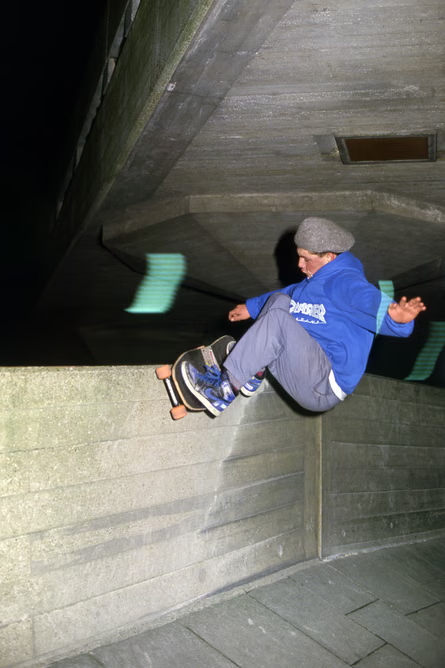
To mark 50 years of the city’s most famous skatepark, the Southbank Centre is putting on an exhibition called Skate 50. Developed with members of the local skateboarding community, it will feature archival footage and photography as well as films. The exhibition originated from a series of workshops led by film-maker Winstan Whitter, who brought together different generations to identify how the space has been used over the years and to pinpoint key moments in its history. Featured artists include film-makers Dan Magee and Jack Brooks, Palace Skateboards founder Lev Tanju, animator Sofia Negriand and sound artist Beatrice Dillon.
Cedar Lewisohn, curator of site design at the Southbank Centre, says that this show was his first priority when he got the job. With previous experience at the London Museum, Tate Britain and Tate Modern, Lewisohn wanted to blend his skill for curation with his love of skateboarding. He refers to his childhood visits to the space as “pilgrimages”. “Skating opened up a whole world of visuals, clothing and music for me when I was younger, and the South Bank was at the heart of that,” he says. “Working on this project has reminded me about all the different creative possibilities of skating.”
Skateboarding as we understand it today was born in the mid-20th century in California. Sick of the waves dictating when they could get out on the water, surfers wanted an alternative. “Sidewalk surfing” became skateboarding, and soon began to dominate culture in the state. The first skate magazine, The Quarterly Skateboarder, was born in 1964, leading the way for Thrasher, Big Brother and more. Skate fashion, such as Dickies workwear, Vans shoes and T-shirts over long-sleeved tops, worked its way into the mainstream. Even skate videos, often shoddily filmed on handheld camcorders, became an art form. The director Spike Jonze began his career shooting street skate films. Jonze was also a driving force behind the prank franchise Jackass, which emerged from skateboard magazine culture to spawn a hit TV show and several movies.
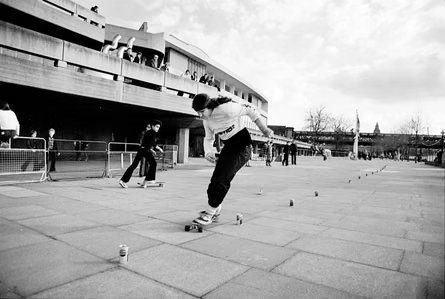
Skateboarding soon made its way across the world. The first skateboards were brought to this country from the US in the 1960s, but, unlike in California, the rain largely dictates when we can skate. Many consider the Southbank Centre to be the birthplace of British skateboarding. People talk about the space in almost religious terms. Lewisohn says that the brutalist architecture of the Southbank Centre is a draw, but that there’s something “spiritual” about the undercroft, in part because it’s next to the Thames. “It’s hard to pinpoint why a space that was designed with no real purpose is such a powerful creative hub,” he says. “But it is.”
But the undercroft hasn’t survived for five decades by accident. As with many skate spaces, its long life is the result of relentless campaigning by skaters, who are increasingly being pushed out of public life. In 2013, the nonprofit organisation Long Live Southbank was launched in response to the proposed redevelopment of the site. The campaigners fought hard – and won. But the legitimisation of skateboarding is an ongoing battle, and one that is often lost, no matter how passionate its fighters. “Skate spots are incredibly important to skateboarders. They are places we meet, create communities and make friends,” says Ellis.
Many of the city’s skateparks, including famous ones such Palace’s Mwadlands site in Peckham, and House of Vans in Waterloo, both in south-east London, have closed down over the years. However, thanks to the efforts of skateboarders, there is still a booming scene. Skateboard GB recently conducted the first ever audit of skateable spaces in the UK to assess what makes a good park and discover underrepresented areas. The study found that the country has almost 2,000 of these spaces, but many of them are under threat.
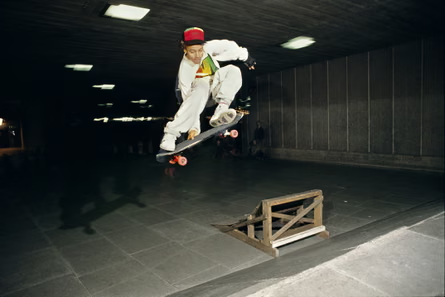
Skateboarding is good for you. It not only gets you outside learning a new skill, but it also puts you in community with others. “I am fortunate to have an expansive skate family all over the world,” says O’Brien. “I have known and loved my adopted skate brothers and sisters for five decades now.” That kind of community is becoming available to more people all the time. In recent years, there’s been a surge of interest in the sport, in part because of its addition to the Olympics in 2020. “Skateboarding is growing in popularity, particularly with youngsters who are turned off by competitive sports,” says Ellis. “It provides people with the opportunity to be creative.” There has been a huge effort to make it easier for previously overlooked groups to get into the sport: women, older people, beginners, people of colour, LGBTQ+ people; collectives made up of underrepresented groups often meet at skateparks to make it less intimidating, while some skateparks will put on girls’ nights or 40+ nights.
One such group is London Skate Mums, which started as a WhatsApp group for women to organise meet-ups. Today, they provide low-cost access to skateboarding for mums of all abilities. Their monthly outdoor sessions focus on getting comfortable in places such as the South Bank. “South Bank is iconic worldwide, so it feels special to skate there, but it can also feel daunting,” says member Jardena. When they first showed up, the group felt self-conscious. That was, says another member, Aiwa, until a guy waved at them and said: “Mums are always welcome here!”Jardena says: “Representation matters, and if you don’t see people like you doing it then you don’t realise this sport has room for you, too.”
Lewisohn hopes that visitors to Skate 50 will be immersed in the richness of skate culture while learning about how important communities such as the South Bank one are. “Skaters set an example of alternative ways to interact with urban space, and that mindset is linked to a way of thinking that is always questioning systems. With Skate 50, we have really tried to let the skaters tell their own story,” he says. The exhibition shows that there is a shift in perception, at least when it comes to the South Bank. What was once an overpoliced and politicised space is now immortalised in art. It’s a part of the city’s history, and whatever challenges are on the horizon for skateboarding, it’s clear that it’s never going anywhere without a fight.
Skate 50 is at the Queen Elizabeth Hall undercroft, London, 30 April to 21 June.