


If oppressive regimes inadvertently give rise to striking artistic works of resistance, then Hen might just be a parting gift from Viktor Orbán’s far-right regime. This compelling, original film, told from the perspective of a hen, was only made because Hungarian film-maker György Pálfi could no longer create anything in his home country. Orbán’s 16 years of cronyism banished any chance of funding a film in Budapest, so Pálfi – who has directed eight wildly original films, from his near-wordless 2002 debut Hukkle to 2006’s visually striking and grotesque Taxidermia – was driven into exile. Searching for a universal story he could tell even when filming in a culture or country he didn’t fully understand, he and co-writer and partner Zsófia Ruttkay settled on a biopic of a factory-farmed chicken.
The hen escapes her gruesome, industrial birthplace in Greece and, through her naturally comic beady eyes, we witness the unfolding of a modern-day Greek tragedy, whereby a down-at-heel restaurateur is drawn into the brutal world of people-smuggling.
I video-call Pálfi the day after Orbán is voted out and, like many Hungarians, he’s full of smiles and relief. “Orbán wasn’t a real prime minister,” he says. “He just supported those who voted for him, not all Hungarians. That was for 16 years – and it got worse and worse, every year, every hour. The new prime minister gave a beautiful speech but, you know, he has 70% of the parliament, which means total power again. We just hope he will control himself and give the power back. He’s promising real democratic stuff, so let’s see.”
With no financial support available for independent film-making in Hungary, Pálfi headed first to Mexico, gradually developing the idea of making his star a powerless chicken, through whose adventures would be woven a human story. After his producer identified an opportunity to film – and find funding – in Greece, the people-smuggling theme emerged. “When we find this very small chicken meets with a huge social problem, then it can be a good movie,” says Pálfi, who moved his family to Greece for a year “to learn about the people”.
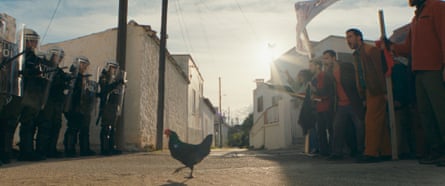
The film begins very deliberately, by simply following our heroine hen’s birth and escape from factory-farming shackles. “If you can go with the chicken after the first 15 or 20 minutes,” says Pálfi, “then somehow you become the chicken, and people become a higher level, like the gods of ancient Greek mythology. It’s very interesting. That was the most important thing – to change the perspective.”
When the hen is rescued from the jaws of his dog by Giorgos, an ageing restaurateur whose shabby seaside business is shuttered for more than just a season, a human tragedy begins to unfold. Giorgos lives with his small granddaughter and his frustrated daughter whose ne’er-do-well boyfriend brings a modest smuggling operation – booze and fags – to his door. While Hen enjoys a comic romantic encounter with the household cockerel, Giorgos is drawn into a more ambitious smuggling scheme: bringing people into Europe.
To tell this story, Pálfi had to mobilise eight identical leading ladies. Eszti, Szandi, Feri, Enci, Eti, Enikő, Nóra and Anett play the part of the plucky black hen. Each was trained for two months before the shoot, to become “human friendly”. An animal trainer handled them during filming, and although Pálfi struggled to tell them apart, they soon realised that each chicken possessed a special power. One was good at running, another at pecking and a third kept beautifully still when required. So they chose whichever star would shine, given the requirements of the scene.
Because a merciless shoestring shooting schedule required them to shoot 50 days of script in 35 days, the Greek cast had to accept a novel hierarchy: lining up the chickens for the cameras came first. “It was hard for the actors to realise they were last in line,” says Pálfi. And if he hit problems, he would call for his favourite leading lady: Feri. “She wasn’t so professional at jumping, she wasn’t so professional at running, but she knew everything. She was a jolly joke. And if one hen couldn’t do a scene because maybe she was tired or her stomach was full, we would say, ‘Bring Feri’ – and Feri would do it.”
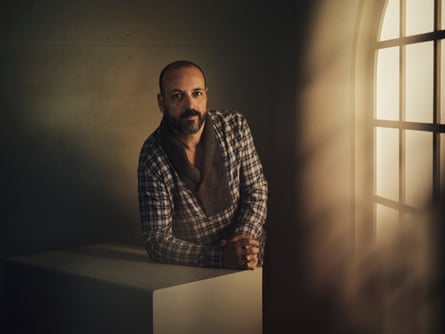
Pálfi is renowned for his inventive, experimental films but being led by hens compelled him to become rather more orthodox. He couldn’t dabble with eight-minute-long shots or other fancy arthouse techniques, so instead “chose classical Hollywood storytelling and shot-by-shot movie language. And that was a good decision because the chicken could do it.” So the chickens made him conventional? He grins. “It’s also a good experiment to make a normal movie.”
Normal-ish. Hollywood movies depict their stars “somewhere at neck level” says Pálfi, so he shot Hen at a chicken’s eye level, using a low position. Keen to make his heroine as natural as possible, he used no CGI on the chickens at all. But CGI was deployed to make the animal trainer disappear from the frame. In an early scene, Hen finds herself on the roof of a service station, pursued by a fox. Here, the terrifying scene was made possible because the fox was actually on a leash that was later removed using special effects.
Hen serves as an innocent eyewitness, through which we see the foibles of human behaviour with new clarity. At times, it almost feels as if her beady gaze is casting moral judgment. “But this is just happening in the audience’s mind,” says Pálfi. “The chicken needs to be a chicken. Sometimes we play with what a chicken can think, but we try very carefully to use a chicken as a chicken.”
There are comic, romantic scenes but the brutality of life for powerless chickens – and powerless people – is laid bare. The film’s revealing scenes of factory farming – and the quiet desperation we imagine Hen feels when her eggs are repeatedly snatched – may turn audiences vegetarian, or at least away from factory-farmed chicken. But that was not the intention. “Chickens are chickens. And they bite each other, and so they are not a perfect society,” he says. “But humans should be able to change their way of living to be a bit better.”
Hoping that life in Hungary will become a bit better under the new government, Pálfi and his family are living in Budapest again. He wants to write a trilogy of animal films. Next will come a monkey, living in an Indian city. He has a Hungarian outlaw story, too. “Not a western, but an eastern,” he says. I’m surprised when this career-long movie maverick says he would love to make a mainstream film, although he still has an eye on that elusive balance between “the mainstream and the outer movie, which is the best kind of movie ever, you know – Kubrick movies, good Ridley Scott movies like Blade Runner. Artistic and mainstream.”
He hopes he’ll get the chance to make films in Hungary again. For now, though, Hen stands as a testament to the triumph of creativity over oppression. The film’s heroine offers a powerful commentary on our times, too. “When we considered the difference between animals and humans, we concluded that humans have the possibility to make moral decisions. But when someone makes this moral decision, according to the Greek tragedies, it’s too late. Although Giorgos gave his life to a mafia, he can take it back – but he will get his punishment.”
This one fictional Greek restaurateur stands for all people who embrace brutal populist regimes – Americans, perhaps, as well as Hungarians. “We gave away our rights to a mafia,” says Pálfi. “Now the big question is, ‘Can we get them back?’”